
UNITED STATES
SECURITIES AND EXCHANGE COMMISSION
Washington, D.C. 20549
FORM 10-K
(Mark One):
| Annual report pursuant to Section 13 or 15(d) of the Securities Exchange Act of 1934. | |||||
For the fiscal year ended December 31 , 2025
| Transition report pursuant to Section 13 or 15(d) of the Securities Exchange Act of 1934. | |||||
For the transition period from to
Commission File Number: 001-14195
(Exact name of registrant as specified in its charter)
| (State or other jurisdiction of Incorporation or Organization) | (I.R.S. Employer Identification No.) | |||||||
(Address of principal executive offices)
Telephone Number (617 ) 375-7500
(Registrant’s telephone number, including area code)
Securities registered pursuant to Section 12(b) of the Act:
| Title of each Class | Trading Symbol(s) | Name of exchange on which registered | ||||||
| | ||||||||
Securities registered pursuant to Section 12(g) of the Act:
None
Indicate by check mark if the registrant is a well known seasoned issuer, as defined in Rule 405 of the Securities Act: Yes ☒ No ☐
Indicate by check mark if the registrant is not required to file reports pursuant to Section 13 or Section 15(d) of the Act: Yes ☐ No ☒
Indicate by check mark whether the registrant (1) has filed all reports required to be filed by Section 13 or 15(d) of the Securities Exchange Act of 1934 during the preceding 12 months (or for such shorter period that the registrant was required to file such reports), and (2) has been subject to such filing requirements for the past 90 days: Yes ☒ No ☐
Indicate by check mark whether the registrant has submitted electronically every Interactive Data File required to be submitted pursuant to Rule 405 of Regulation S-T during the preceding 12 months (or for such shorter period that the registrant was required to submit such files). Yes ☒ No ☐
Indicate by check mark whether the registrant is a large accelerated filer, an accelerated filer, a non-accelerated filer, smaller reporting company, or an emerging growth company. See the definitions of “large accelerated filer,” “accelerated filer,” “smaller reporting company,” and “emerging growth company” in Rule 12b-2 of the Exchange Act. (Check One):
| ☒ | Accelerated filer | ☐ | ||||||||||||||||||
| Non-accelerated filer | ☐ | Smaller reporting company | ||||||||||||||||||
| Emerging growth company | ||||||||||||||||||||
If an emerging growth company, indicate by check mark if the registrant has elected not to use the extended transition period for complying with any new or revised financial accounting standards provided pursuant to Section 13(a) of the Exchange Act. ☐
Indicate by check mark whether the registrant has filed a report on and attestation to its management’s assessment of the effectiveness of its internal control over financial reporting under Section 404(b) of the Sarbanes-Oxley Act (§15 U.S.C. 7262(b)) by the registered public accounting firm that prepared or issued its audit report. ☒
Indicate by check mark whether the registrant is a shell company (as defined in Rule 12b-2 of the Act): Yes ☐ No ☒
If securities are registered pursuant to Section 12(b) of the Exchange Act, indicate by check mark whether the financial statements of the registrant included in the filing reflect the correction of an error to previously issued financial statements. ☐
Indicate by check mark whether any of those error corrections are restatements that required a recovery analysis of incentive-based compensation received by any of the registrant’s executive officers during the relevant recovery period pursuant to §240.10D-1(b). ☐
The aggregate market value of the voting and non-voting common stock held by non-affiliates of the registrant as of June 30, 2025 was $103.4 billion, based on the closing price of the registrant’s common stock as reported on the New York Stock Exchange as of the last business day of the registrant’s most recently completed second quarter.
As of February 17, 2026, there were 466,084,820 shares of common stock outstanding.
DOCUMENTS INCORPORATED BY REFERENCE
Portions of the definitive proxy statement (the “Definitive Proxy Statement”) to be filed with the Securities and Exchange Commission relative to the registrant’s 2026 Annual Meeting of Stockholders are incorporated by reference into Part III of this Report.
AMERICAN TOWER CORPORATION
TABLE OF CONTENTS
FORM 10-K ANNUAL REPORT
FISCAL YEAR ENDED DECEMBER 31, 2025
| Page | ||||||||
| PART I | ||||||||
| ITEM 1. | ||||||||
| ITEM 1A. | ||||||||
| ITEM 1B. | ||||||||
| ITEM 1C. | ||||||||
| ITEM 2. | ||||||||
| ITEM 3. | ||||||||
| ITEM 4. | ||||||||
| PART II | ||||||||
| ITEM 5. | ||||||||
| ITEM 6. | ||||||||
| ITEM 7. | ||||||||
| ITEM 7A. | ||||||||
| ITEM 8. | ||||||||
| ITEM 9. | ||||||||
i
AMERICAN TOWER CORPORATION
TABLE OF CONTENTS—(Continued)
FORM 10-K ANNUAL REPORT
FISCAL YEAR ENDED DECEMBER 31, 2025
| Page | ||||||||
| ITEM 9A. | ||||||||
| ITEM 9B. | ||||||||
| ITEM 9C. | ||||||||
| PART III | ||||||||
| ITEM 10. | ||||||||
| ITEM 11. | ||||||||
| ITEM 12. | ||||||||
| ITEM 13. | ||||||||
| ITEM 14. | ||||||||
| PART IV | ||||||||
| ITEM 15. | ||||||||
| ITEM 16. | ||||||||
F-1 | ||||||||
ii
SPECIAL NOTE REGARDING FORWARD-LOOKING STATEMENTS
This Annual Report on Form 10-K (this “Annual Report”) contains statements about future events and expectations, or forward-looking statements, all of which are inherently uncertain. We have based those forward-looking statements on our current expectations and projections about future results. When we use words such as “anticipates,” “intends,” “plans,” “believes,” “estimates,” “expects” or similar expressions, we are making forward-looking statements. Examples of forward-looking statements include, but are not limited to, future prospects of growth in the communications infrastructure leasing industry, our relationships with our customers, the creditworthiness and financial strength of our customers, our ability to maintain or increase our market share, the effects of consolidation among companies in our industry and among our customers and other competitive and financial pressures, our plans to fund our future liquidity needs, our expectations for the closing of signed agreements, including divestitures, and the expected impacts of such agreements on our business, the expected impacts of strategic partnerships on our business, our substantial leverage and debt service obligations, our future financing transactions, our future operating results, the level of future expenditures by companies in this industry and other trends in this industry, the impacts of technology failures, including cybersecurity, data governance and data privacy incidents, on our business, our ability to operate our distinct data centers business, our ability to protect our rights to the land under our towers and buildings in which our data centers are located, changes in zoning, tax and other laws and regulations and administrative and judicial decisions, economic, political and other events, particularly those relating to our international operations, our future capital expenditure levels, the impact of technology changes on our industry and our business, our ability to remain qualified for taxation as a real estate investment trust (“REIT”), the amount and timing of any future distributions including those we are required to make as a REIT, the expected impact of our transformation initiatives on our business and natural disasters and similar events. These statements are based on our management’s beliefs and assumptions, which in turn are based on currently available information. These assumptions could prove inaccurate. These forward-looking statements may be found under the captions “Business” and “Management’s Discussion and Analysis of Financial Condition and Results of Operations,” as well as in this Annual Report generally.
You should keep in mind that any forward-looking statement we make in this Annual Report or elsewhere speaks only as of the date on which we make it. New risks and uncertainties arise from time to time, and it is impossible for us to predict these events or how they may affect us. In any event, these and other important factors, including those set forth in Item 1A of this Annual Report under the caption “Risk Factors,” may cause actual results to differ materially from those indicated by our forward-looking statements. We have no duty, and do not intend, to update or revise the forward-looking statements we make in this Annual Report, except as may be required by law. In light of these risks and uncertainties, you should keep in mind that the future events or circumstances described in any forward-looking statement we make in this Annual Report or elsewhere might not occur. References in this Annual Report to “we,” “our” and the “Company” refer to American Tower Corporation and its predecessor, as applicable, individually and collectively with its subsidiaries as the context requires.
iii
PART I
| ITEM 1. | BUSINESS | ||||
Overview
We are one of the largest global real estate investment trusts and a leading independent owner, operator and developer of multitenant communications real estate. Our primary business is the leasing of space on communications sites to wireless service providers, radio and television broadcast companies, wireless data providers, government agencies and municipalities and tenants in a number of other industries. We refer to this business, inclusive of our data center business discussed below, as our property operations, which accounted for 97% of our total revenues for the year ended December 31, 2025. We also offer tower-related services in the United States, which we refer to as our services operations. These services include site application, zoning and permitting, structural and mount analyses, and construction management services, together with program management offerings that support customer deployment needs from project scoping through construction. Our services operations primarily support our site leasing business, including the addition of new tenants and equipment on our sites. Our customers include our tenants, licensees and other payers.
Since inception, we have grown our communications real estate portfolio through acquisitions, long-term lease arrangements and site development. Our portfolio primarily consists of towers that we own and towers that we operate pursuant to long-term lease arrangements, as well as distributed antenna system (“DAS”) networks, which provide seamless coverage solutions in certain in-building and outdoor wireless environments. In addition to the communications sites in our portfolio, we manage rooftop and tower sites for property owners under various contractual arrangements. We also hold other telecommunications infrastructure, fiber and property interests that we lease primarily to communications service providers and third-party tower operators, and, as discussed further below, we hold a portfolio of highly interconnected data center facilities and related assets in the United States that we provide for the leasing of space primarily to enterprises, network operators, cloud providers and supporting service providers.
As of December 31, 2025, our communications real estate portfolio of 149,686 communications sites included 42,224 communications sites in the U.S. & Canada, 27,857 communications sites in Africa & APAC (as defined below), 32,524 communications sites in Europe and 47,081 communications sites in Latin America, as well as (i) urban telecommunications assets in Argentina, Brazil, Colombia and Spain, (ii) other property interests in Canada and the United States and (iii) 30 operating data center facilities across eleven markets in the United States.
We operate as a real estate investment trust for U.S. federal income tax purposes (“REIT”). Accordingly, we generally are not required to pay U.S. federal income taxes on income generated by our REIT operations, including the income derived from leasing space on our towers and in our data centers, as we receive a dividends paid deduction for distributions to stockholders that offsets our REIT taxable income and gains. However, we remain obligated to pay U.S. federal income taxes on earnings from our domestic taxable REIT subsidiaries (“TRSs”). In addition, our international assets and operations, regardless of their classification for U.S. tax purposes, continue to be subject to taxation in the jurisdictions where those assets are held or those operations are conducted.
The use of TRSs enables us to continue to engage in certain businesses and jurisdictions while complying with REIT qualification requirements. We may, from time to time, change the election of previously designated TRSs to be included as part of the REIT. As of December 31, 2025, our REIT-qualified businesses included our U.S. tower leasing business, a majority of our U.S. DAS networks business, our Services and Data Centers segments, as well as most of our operations in Canada, Costa Rica, France, Germany, Ghana, Kenya, Mexico, Nigeria, South Africa, Spain and Uganda.
We report our results in six segments: U.S. & Canada property (which includes all assets in the United States and Canada, other than our data center facilities and related assets), Africa & Asia-Pacific (“APAC”) property, Europe property, Latin America property, Data Centers and Services.
1
Products and Services
Property Operations
Our property operations accounted for 97%, 98% and 99% of our total revenues for the years ended December 31, 2025, 2024 and 2023, respectively. Our revenue is primarily generated from tenant leases. Within our tower leasing operations, our tenants lease space on our communications real estate, where they install and maintain their equipment. Rental payments vary considerably depending upon numerous factors, including, but not limited to, amount, type and position of tenant equipment on the tower, remaining tower capacity and tower location. Our costs typically include ground rent (which is primarily fixed under long-term lease agreements with annual cost escalations) and power and fuel costs, some or all of which may be passed through to our tenants, as well as property taxes and repair and maintenance expenses. Our property operations have generated consistent growth in revenue and typically have low cash flow volatility due to the following characteristics:
•Long-term tenant leases with contractual rent escalations. In general, our tenant leases for our communications sites with wireless carriers have initial non-cancellable terms of five to ten years with multiple renewal terms, with provisions that periodically increase the rent due under the lease, typically annually, based on a fixed escalation percentage (averaging approximately 3% in the United States) or an inflationary index in most of our international markets, or a combination of both. Based upon foreign currency exchange rates and the tenant leases in place as of December 31, 2025, we expect to generate over $54 billion of non-cancellable tenant lease revenue over future periods, before the impact of straight-line lease accounting.
•Consistent demand for our sites. As a result of rapidly growing usage of mobile data and other wireless services and the corresponding wireless industry capital spending trends in the markets we serve, we anticipate consistent demand for our communications sites. We believe that our global asset base positions us well to benefit from the increasing proliferation of advanced wireless devices and the increasing usage of high bandwidth applications on those devices. We have the ability to add new tenants and new equipment for existing tenants on our sites, which typically results in incremental revenue and modest incremental costs. Our site portfolio and our established tenant base provide us with a solid platform for new business opportunities, which has historically resulted in consistent and predictable organic revenue growth.
•High lease renewal rates. Our tenants tend to renew leases because suitable alternative sites may not exist or be available and repositioning a site in their network may be expensive and may adversely affect network quality. We define churn as tenant billings lost when a tenant cancels or does not renew its lease or, in limited circumstances, when the lease rates on existing leases are reduced. We derive our churn rate for a given year by dividing our tenant billings lost on this basis by our prior-year tenant billings. During the year ended December 31, 2025, churn was approximately 2% of our tenant billings, primarily driven by churn in our U.S. & Canada property segment.
•High operating margins. Incremental operating costs associated with adding new tenants or equipment to an existing communications site are typically relatively minimal. Therefore, as tenants or equipment are added, the substantial majority of incremental revenue flows through to gross margin and operating profit. In addition, in many of our international markets, certain expenses, such as ground rent or power and fuel costs, are reimbursed or shared by our tenant base.
•Low maintenance capital expenditures. On average, we require relatively low amounts of annual capital expenditures to maintain our communications sites.
Our property business includes the operation of communications sites and managed networks, the leasing of property interests and, in select markets, the operation of fiber, the operation of data centers and the provision of backup power through shared generators and power solutions. Our presence in a number of markets at different relative stages of wireless development provides us with significant diversification and long-term growth potential. Our property segments accounted for the following percentage of consolidated total revenue for the years ended December 31,:
_______________
| 2025 | 2024 | 2023 | |||||||||||||||
| U.S. & Canada | 49 | % | 52 | % | 53 | % | |||||||||||
Africa & APAC (1) | 13 | % | 12 | % | 12 | % | |||||||||||
| Europe | 9 | % | 8 | % | 8 | % | |||||||||||
| Latin America | 15 | % | 17 | % | 18 | % | |||||||||||
| Data Centers | 10 | % | 9 | % | 8 | % | |||||||||||
(1) For the years ended December 31, 2024 and 2023, excludes the operating results of our subsidiaries, ATC Asia Pacific Pte. Ltd. and ATC Telecom Infrastructure Private Limited (“ATC TIPL”), which are reported as discontinued operations. See note 21 to our consolidated financial statements included in this Annual Report (“Note 21”) for further discussion.
2
Communications Sites. Approximately 82%, 87% and 88% of revenue in our property segments was attributable to our communications sites, excluding data center facilities and related assets, DAS networks and fiber, for the years ended December 31, 2025, 2024 and 2023, respectively.
We lease space on our communications sites to tenants providing a diverse range of communications services, including cellular voice and data, broadcasting, mobile video and a number of other applications. In addition, in many of our international markets, we receive pass-through revenue from our tenants to cover certain costs, including power and fuel costs and ground rent. Our top tenants by revenue for each property segment are as follows for the year ended December 31, 2025:
•U.S. & Canada: AT&T Inc. (“AT&T”); T-Mobile US, Inc. (“T-Mobile”); and Verizon Communications Inc. (“Verizon Wireless”) accounted for an aggregate of 85% of U.S. & Canada property segment revenue.
•Africa & APAC: Bharti Airtel Limited (“Airtel”); and MTN Group Limited (“MTN”) accounted for an aggregate of 81% of Africa & APAC property segment revenue.
•Europe: Telefónica S.A. (“Telefónica”) accounted for an aggregate of 70% of Europe property segment revenue.
•Latin America: América Móvil; AT&T; Telefónica; and TIM S.p.A. accounted for an aggregate of 71% of Latin America property segment revenue.
Accordingly, we are subject to certain risks, as set forth in Item 1A of this Annual Report under the caption “Risk Factors—A substantial portion of our current and projected future revenue is derived from a small number of customers, and we are sensitive to adverse changes in the creditworthiness and financial strength of our customers.” In addition, we are subject to risks related to our international operations, as set forth under the caption “Risk Factors—Our foreign operations are subject to economic, political and other risks that could materially and adversely affect our revenues or financial position, including risks associated with fluctuations in foreign currency exchange rates.”
Data Centers and Related Assets, Managed Networks, Other Telecommunications Assets, Property Interests and Shared Generators and Power Solutions. In addition to our communications sites, we also own and operate several types of managed network solutions, provide communications site management services to third parties, manage and lease property interests under carrier or other third-party communications sites, operate data center facilities and related assets, operate other telecommunications assets and provide back-up power sources and power solutions to tenants at our sites. The balance of our property segment revenue not attributable to our communications sites was attributable to these items.
•Data Centers and Related Assets. We own and operate data center facilities and related assets in the United States, which consist of specialized and secure buildings that house networking, storage and communications technology infrastructure, including servers, storage devices, switches, routers and fiber optic transmission equipment. These buildings are designed to provide the power, cooling and network connectivity necessary to efficiently operate this equipment. Data centers located at points where many communications networks converge can also function as interconnection hubs where customers are able to connect to multiple networks, cloud companies and other service providers to exchange traffic and interoperate with each other.
•Managed Networks. We own and operate DAS networks in the United States and certain international markets. We obtain rights from property owners to install and operate in-building DAS networks, and we grant rights to wireless service providers to attach their equipment to our installations. We also offer a small portfolio of outdoor DAS networks as a complementary shared infrastructure solution for our tenants in the United States and in certain international markets. Typically, we have designed, built and operated our outdoor DAS networks in areas in which zoning restrictions or other barriers may prevent or delay deployment of more traditional wireless communications sites, such as macro tower sites. We also hold lease rights and easement interests on rooftops capable of hosting communications equipment in locations where towers are generally not a viable solution based on area characteristics. In addition, we provide management services to property owners in the United States who elect to retain full rights to their property while simultaneously marketing the rooftop for wireless communications equipment installation. As the demand for advanced wireless services in urban markets evolves, we continue to evaluate a variety of infrastructure solutions, including small cells and other network architectures that may support our tenants’ networks in these areas.
•Other Telecommunications Assets. We own and operate other telecommunications assets, including fiber and related assets, in certain international markets. We currently provide the right to use such fiber and related assets to communications and internet service providers and third-party operators to support their telecommunications infrastructure.
•Property Interests. We own portfolios of property interests in Canada and the United States, including land under carrier or other third-party communications sites, which provide recurring cash flow under complementary leasing arrangements.
•Shared Generators and Power Solutions. We have contracts with certain of our tower tenants pursuant to which we provide access to shared backup power generators in the United States. In Africa, we also have contracts to power our
3
tower tenants’ equipment through the use of shared infrastructure assets, primarily consisting of generators, solar panels and electricity storage solutions.
Services Operations
We offer tower-related services in the United States, including site application, zoning and permitting, structural and mount analyses, and construction management services, together with program management offerings that support customer deployment needs from project scoping through construction. Our services operations primarily support our site leasing business, including through the addition of new tenants and equipment on our sites. This segment accounted for 3%, 2% and 1% of our total revenue for the years ended December 31, 2025, 2024 and 2023, respectively.
Site Application, Zoning and Permitting. We engage in site application services on our own behalf in connection with our tower development projects, as well as on behalf of our tenants. We typically work with our tenants’ engineers to determine the geographic areas where new communications sites will best address the tenants’ needs and meet their coverage objectives. Once a new site is identified, we acquire the rights to the land or structure on which the site will be constructed, and we manage the permitting process to ensure all necessary approvals are obtained to construct and operate the communications site.
Structural and Mount Analyses. We offer structural and mount analyses services to wireless carriers in connection with the installation of their communications equipment on our towers. Our team of engineers can evaluate whether a tower structure can support the additional burden of the new equipment or if an upgrade is needed, and whether the proposed mount configurations will be capable of supporting the required loads in accordance with applicable standards. This enables our tenants to better assess potential sites before making an installation decision. Our structural and mount analyses capabilities enable us to provide higher quality service to our existing tenants by, among other things, reducing the time required to achieve on-air readiness, while also providing opportunities to offer structural and mount analyses services to third parties.
Construction Management. We offer construction management services to wireless carriers in connection with the deployment of their networks on our tower sites. Our construction management team oversees construction activities such as contractor sourcing, contractor selection and management, materials management, on-site quality control and closeout documentation for new installations or modifications. Our construction management capabilities enable us to provide efficient deployment to the carriers while ensuring that the construction work meets our quality control standards.
Strategy
Operational Strategy
As wireless communications technologies advance and the use of wireless services on handsets, tablets and other advanced mobile devices grows, there is a corresponding increase in demand for the communications infrastructure required to facilitate ever growing network demand. To capture this demand, our primary operational focus is to (i) increase the occupancy of our existing communications real estate portfolio to support global connectivity, (ii) invest in, and selectively grow, our communications real estate portfolio and service offerings, including through platform expansion initiatives, (iii) further improve our operational performance and efficiency and (iv) maintain a strong balance sheet. We believe these efforts to meet our customers’ needs will support and enhance our ability to capitalize on the growth in demand for wireless infrastructure. In addition, we expect to explore new opportunities to enhance or extend our shared communications infrastructure businesses, including those that may make our assets incrementally more attractive to new customers, or to existing customers for new uses, and those that increase our operational efficiency.
•Increase the occupancy of our existing communications real estate portfolio to support global connectivity. We believe that our highest incremental returns will be achieved by leasing additional space on our existing communications sites. Increasing demand for wireless services in our served markets has resulted in significant capital spending by major wireless carriers and other connectivity providers. As a result, we anticipate growing demand for our communications sites because they are attractively located and typically have capacity available for additional tenants and equipment. In the United States, incremental carrier network activity is being driven by ongoing 5G network deployments. In our international markets, carriers are increasingly deploying more advanced network technologies such as 4G and, in the case of our international markets with more mature network technology, 5G, while continuing to selectively augment legacy networks. We believe that the majority of our towers have capacity for additional tenants and that substantially all of our towers that are currently at or near full structural capacity can be upgraded or augmented to meet future tenant demand with relatively modest capital investment. Therefore, we will continue to target our sales and marketing activities to increase the utilization and return on investment of our existing communications sites.
•Invest in and selectively grow our communications real estate portfolio to meet our customers’ needs. We seek opportunities to invest in and grow our operations through our capital expenditure program, acquisitions and platform expansion initiatives. A significant portion of our inorganic growth has been focused on properties with lower initial
4
tenancy because we believe that over time we can significantly increase tenancy levels, and therefore, drive strong returns on those assets. More recently, we have invested in strategic data center assets, including through our acquisition of CoreSite Realty Corporation (“CoreSite”) in late 2021 (the “CoreSite Acquisition”), which we believe can drive strong, recurring growth and also meaningfully enhance the value of our existing communications tower real estate through emerging edge compute opportunities in the future. We also expect to explore additional ways to use our platform expansion initiatives to enhance the efficiency of our operations over time.
•Further improve our operational performance and efficiency. We continue to seek opportunities to improve our operational performance throughout the organization. This includes investing in our systems and people as we strive to improve efficiency and provide superior service to our customers. To achieve this, we intend to continue to focus on customer service initiatives, such as reducing cycle times for key functions, including lease processing and tower structural analysis. We are also focused on developing and implementing power solutions across our footprint to help improve the overall efficiency of the communications infrastructure and wireless industries through our power as a service (PaaS) initiatives.
•Maintain a strong balance sheet. We remain committed to disciplined financial policies, which we believe result in our ability to maintain a strong balance sheet and will support our overall strategy and focus on asset growth and operational excellence. As a result of these policies, we currently have investment grade credit ratings. We continue to focus on maintaining a robust liquidity position and, as of December 31, 2025, had $11.1 billion of available liquidity. We believe that our investment grade credit ratings provide us consistent access to the capital markets and our liquidity provides us the ability to continue to invest in growing and augmenting our business.
Capital Allocation Strategy
The objective of our capital allocation strategy is to simultaneously increase adjusted funds from operations per share and our return on invested capital over the long term. To maintain our qualification for taxation as a REIT, we are required annually to distribute an amount equal to at least 90% of our REIT taxable income (determined before the deduction for distributed earnings and excluding any net capital gain) to our stockholders. After complying with our REIT distribution requirements, we plan to continue to allocate our available capital among investment alternatives that meet or exceed our return on investment criteria, while taking into account the repayment of debt consistent with our financial policies. On an ongoing basis, we also perform a comprehensive assessment of our global operations to ensure our portfolio is positioned to drive sustained growth and achieve our risk-adjusted return objectives. This assessment can influence our decisions on future capital allocation priorities between certain countries and assets, and may result in our decision to prioritize investments into developed markets, including the U.S. & Canada, Europe and the data centers markets. Conversely, this assessment can influence our decision to divest a portion, or all, of certain assets, including our Mexico fiber and Poland businesses in 2023, our Australia, India and New Zealand businesses in 2024 and our South Africa fiber business in 2025, and repurpose proceeds, and potential future capital, to other capital priorities, including investments into developed markets.
•Capital expenditure program. We expect to continue to invest in and expand our existing communications real estate portfolio through our capital expenditure program. This includes capital expenditures associated with site maintenance, increasing the capacity of our existing sites and projects such as new site and data center facility construction, land interest acquisitions and power solutions.
•Acquisitions. We intend to continue to pursue acquisitions of communications sites and other telecommunications infrastructure in our existing or new markets where we can meet or exceed our risk-adjusted return on investment criteria. The risk-adjusted hurdle rates used to evaluate acquisition opportunities consider additional factors such as the country and counterparties involved, investment and economic climate, legal and regulatory conditions and industry risk, among others.
•Return excess capital to stockholders. If we have excess capital available after funding (i) our required distributions, (ii) capital expenditures, (iii) the repayment of debt consistent with our financial policies and (iv) anticipated future investments, including acquisition and select platform expansion opportunities, we will seek to return such excess capital to stockholders, including through our stock repurchase programs.
International Strategy
Our international strategy incorporates portfolio analysis, capital prioritization and the disciplined management of overseas cash, including repatriation where feasible.
We believe that, in certain international markets, we can create value by expanding our existing, communications real estate leasing business, and leveraging our shared global experience, capabilities and services, to deliver a best-in-class offering for our customers and attractive risk-adjusted return for our shareholders. We strive to maintain a diversified approach to our
5
international strategy by operating in a geographically diverse array of markets in a variety of stages of wireless network development.
Specifically as part of our ongoing portfolio analysis, we conduct an extensive review of a particular country’s historical and projected macroeconomic fundamentals, including inflation and foreign currency exchange rate trends, demographics, capital markets, tax regime and investment alternatives, and the general business, political and legal environments, including property rights and regulatory regime. We also analyze (i) the competitiveness of the country’s wireless market and (ii) how a particular market fits within our long-term strategic objectives.
Regulatory Matters
Towers, Antennas and Fiber. Our U.S. and international tower leasing businesses are subject to national, state and local regulatory requirements with respect to the registration, siting, construction, lighting, marking and maintenance of our towers. In the United States, the construction of new towers or modifications to existing towers may require pre-approval by the Federal Communications Commission (“FCC”) and the Federal Aviation Administration (“FAA”), depending on factors such as tower height and proximity to public airfields. Towers requiring pre-approval must be registered with the FCC and maintained in accordance with FAA standards. Similar requirements regarding pre-approval of the construction and modification of towers are imposed by regulators in other countries. Non-compliance with applicable tower-related requirements may lead to monetary penalties or site deconstruction orders.
Certain of our international operations are subject to regulatory requirements with respect to licensing, registration and permitting.
In Africa & APAC, our subsidiaries in Burkina Faso, Ghana, Kenya, Niger, Nigeria and Uganda are required to hold a license in order to establish and maintain passive telecommunications infrastructure services and DAS networks for communications service providers. Our subsidiaries in the Philippines and Bangladesh are required to hold a registration or license in order to establish, manage and operate passive telecommunications infrastructure services.
In Latin America, our subsidiary in Chile holds a concession of intermediate telecommunications services and our subsidiary in Argentina holds an information and communications technology service license. In Peru, our subsidiaries are registered as infrastructure providers. The subsidiary that holds our fiber business in Brazil is also licensed and regulated as an authorization holder to provide telecommunications services. In certain of the markets in which we operate, we are required to provide tower space to service providers on a non-discriminatory basis, subject to the negotiation of mutually agreeable terms. Additionally, one of our Brazilian subsidiaries, American Tower do Brasil – Cessao de Infraestruturas S.A. (“ATC Brazil”) issued non-convertible debentures in 2023 and in 2025, which are listed on the Brazilian stock exchange. Although the non-convertible debentures are held by another subsidiary of ours and are eliminated in consolidation, ATC Brazil is still subject to the listing requirements of such exchange.
Our international business operations may be subject to increased licensing fees or ownership restrictions. For example, in South Africa, the Broad-Based Black Economic Empowerment Act, 2003 (the “BBBEE Act”) has established a legislative framework for the promotion of economic empowerment of South African citizens disadvantaged by Apartheid. Accordingly, the BBBEE Act and related codes measure BBBEE Act compliance and good corporate practice by the inclusion of certain ownership, management control, employment equity and other metrics for companies that do business there. Our foreign operations may be affected if a country’s regulatory authority restricts, revokes or modifies spectrum licenses of certain wireless service providers or implements modifications or limitations on foreign ownership.
In all countries where we operate, we are subject to zoning restrictions and restrictive covenants imposed by local authorities or community organizations. While these regulations vary, they typically require tower owners or tenants to obtain approval from local authorities, environmental bodies or community standards organizations prior to tower construction or the addition of a new antenna to an existing tower. Local zoning authorities and community residents periodically oppose construction in their communities, which can delay or prevent new tower construction, new antenna installation or site upgrade projects, thereby limiting our ability to respond to tenant demand. This opposition and existing or new zoning, environmental or aviation regulations can increase costs associated with new tower construction, tower modifications or additions of new antennas to a site or site upgrades, as well as adversely affect the associated timing or cost of such projects. Further, additional regulations may be adopted that cause delays or result in additional costs to us or changes in the competitive landscape that may negatively affect our business. In addition, certain municipalities have sought to impose permit fees based upon structural or operational requirements of towers and certain regional and other governmental bodies have sought to impose levies or other forms of fees. These factors could materially and adversely affect our operations. In the United States, the Telecommunications Act of 1996 prohibits any action by state and local authorities that would discriminate between different providers of wireless services or ban altogether the construction, modification or placement of communications sites. It also prohibits state or local restrictions
6
based on the environmental effects of radio frequency emissions to the extent the facilities comply with FCC regulations. Further, in February 2012, the United States government adopted regulations requiring that local and state governments approve modifications or colocations that qualify as eligible facilities under the regulations.
Portions of our business are subject to additional regulations, for example, in a number of states throughout the United States, certain of our subsidiaries hold Competitive Local Exchange Carrier (CLEC) or other status, in connection with the operation of our outdoor DAS networks business. In addition, we, or our customers, may be subject to new regulatory policies in certain jurisdictions from time to time that may materially and adversely affect our business or the demand for our communications sites.
Data Centers. Our U.S. data center facilities and related assets are subject to various federal, state and local regulations, such as state and local fire and life safety regulations and Americans with Disabilities Act (“ADA”) federal requirements. If one of our properties is not in compliance with these regulations, we may be required to make significant unanticipated expenditures in order to comply with such regulations and/or pay fines or civil damage awards. Existing regulations may subsequently change or future regulations may be enacted, either of which could have a similar impact as described above, and could materially and adversely affect our operations.
In some markets, our data centers are subject to zoning restrictions imposed by local authorities. While these regulations vary, they may require data center operators to obtain approval from local authorities or environmental bodies prior to data center construction or modification of an existing facility. Local authorities and community residents periodically oppose construction in their communities, which can delay or prevent new data center construction, thereby limiting our ability to respond to tenant demand. This opposition and existing or new zoning or environmental regulations can increase costs associated with new data center construction or modifications to existing facilities, as well as adversely affect the associated timing or cost of such projects.
Environmental Matters. Our U.S. and international operations are subject to various national, state and local environmental laws and regulations, including those relating to the management, use, storage, disposal, emission and remediation of, and exposure to, hazardous and non-hazardous substances, materials and wastes, the siting of our towers and the maintenance of our data center facilities. We may be required to obtain permits, pay additional property taxes, comply with regulatory requirements and make certain informational filings related to hazardous substances or devices used to provide power such as batteries, generators and fuel at our tower sites and/or data center facilities. When a site is decommissioned, we are required to follow applicable regulatory requirements, including by following decommissioning procedures and environmental management plans. With respect to our data center facilities, the presence of contamination, asbestos, lead or lead-based paint, mold or other air quality issues or the failure to remediate contamination, asbestos, lead or lead-based paint, mold or other air quality issues at our facilities may expose us to third-party liability or materially and adversely affect our ability to sell, lease or develop the real estate or to borrow using the real estate as collateral. Violations of these types of regulations could subject us to fines or criminal sanctions.
Additionally, in the United States and in other countries where we operate, before constructing a new tower or adding an antenna to an existing site, we must review and evaluate the impact of the action to determine whether it may significantly affect the environment and whether we must disclose any significant impacts in an environmental assessment. If a tower or new antenna might have a material adverse impact on the environment, FCC or other governmental approval of the tower or antenna could be significantly delayed or modifications to the site construction plans may be necessary.
The U.S. Environmental Protection Agency, or EPA, some of the states and localities in which we operate and the governments of other countries in which we operate have also enacted or proposed certain climate-related disclosures and may adopt new regulations related to the use of fossil fuels or requiring the use of alternative fuel or renewable energy sources to power energy resources that serve our data centers. Efforts to support and enhance renewable electricity generation may increase our costs of electricity above those that would be incurred through procurement of conventionally generated electricity. Our data centers require and consume significant amounts of power, including electricity generated by the burning of fossil fuels. These laws, regulations and stakeholder requests could limit our ability to develop new facilities or result in substantial compliance, maintenance, repair, retrofit and construction costs, including capital expenditures for environmental control facilities and other new equipment. Changes in regulations that affect electric power providers, such as regulations related to the control of greenhouse gas emissions or other climate change-related matters, could adversely affect the costs of electric power and increase our operating costs, which could adversely affect our business, financial condition and results of operations or those of our customers. See “Risk Factors” in Item 1A of this Annual Report for more information on our data center-related risks.
Health and Safety. In the United States and in other countries where we operate, we are subject to various national, state and local laws regarding employee health and safety, including protection from radio frequency exposure and air quality issues.
7
Competition
Our industry is highly competitive. There are frequently new market participants that create additional competition. We compete, both for new business and for the acquisition of assets, with other public tower companies, such as Crown Castle International Corp., SBA Communications Corporation, Vertical Bridge, Telesites S.A.B. de C.V. and Cellnex Telecom, S.A., wireless carrier tower consortia and private tower companies, private equity sponsored firms, carrier-affiliated tower companies, independent wireless carriers, tower owners, broadcasters and owners of non-communications sites, including rooftops, utility towers, water towers and other alternative structures. Our data center business also competes with a variety of companies offering similar data center solutions and services, including space, power, interconnection and development services. We believe that location and capacity, grid distribution constraints, network and/or interconnection density, price, quality and speed of service have been, and will continue to be, significant competitive factors affecting owners, operators and managers of communications sites and data center facilities.
Our services business competes with a variety of companies offering individual, or combinations of, competing services. The field of competitors includes site application consultants, zoning consultants, real estate firms, right-of-way consultants, structural engineering firms, construction management firms, tower owners/managers, telecommunications equipment vendors who can provide turnkey site development services through multiple subcontractors and our tenants’ personnel. We believe that our tenants base their decisions for services on various criteria, including a company’s experience, local reputation, price and time for completion of a project.
For more information on demand trends in our industry, see Item 7 of this Annual Report under the caption “Management’s Discussion and Analysis of Financial Condition and Results of Operations—Executive Overview.”
Human Capital Resources
As of December 31, 2025, we employed 4,866 full-time individuals, including 2,388 employees based in the United States and 2,478 employees based internationally. Our teams in our more than 20 countries around the world are our most important assets and fundamental to our success. Aligned with our business strategy, our human capital management strategy focuses on developing and delivering solutions to attract, develop, engage and retain top talent in each of the countries where we operate. Our Chief Human Resources Officer regularly reports to the Compensation and Human Capital Committee of our Board of Directors (our “Board”) on our initiatives related to human capital management.
A critical factor in our success is ensuring that an inclusive and collaborative workplace remains at the core of our business culture, infusing fresh ideas, helping us remain connected to our customers in a dynamic global market and ensuring mutual respect guides us in our interactions both internally and externally. Additionally, we have implemented several initiatives designed to support our inclusion efforts, including pledges from the American Tower Foundation. We also enable global employee resource groups to promote better employee engagement, which are open to all employees with the goal of enhancing professional development, connection and collaboration for everyone.
As a critical investment in our capacity to provide our customers with outstanding support and customer service, we offer a variety of development opportunities unique to each market to cultivate our talent throughout our global organization. For individual contributors, we provide resources in up to five languages that focus on job-specific training and general topics, such as productivity, collaboration and project management. We create and customize courses to meet regional needs and update these courses regularly to address changing marketplace dynamics and employee interests.
Developing our managers is critical to our success, and several resources and tools are provided to all levels of management. For example, our Management Essentials program provides continuous learning opportunities through training led by American Tower leaders globally. Managers learn tools and best practices that enable both management and team success, and that build and strengthen competencies to better respond to the needs of a growing and increasingly complex organization. Furthermore, our Gateway to Leadership program builds further on the skills and competencies we deliver through Management Essentials by providing additional leadership training for managers in Europe, Africa and Latin America. Our annual Accelerated Leadership Development program, in collaboration with the INSEAD executive education program, provides our next generation leaders in Latin America, Europe, the U.S. and Africa, with a seven-week intensive workshop to enhance management and leadership skills. For our employees with high potential, we offer several professional development opportunities designed to support these employees through a career path journey to become inclusive leaders. These are all supported by a comprehensive talent-management review process to develop future leaders and ensure effective succession planning. Additionally, our virtual corporate university, ATC YOU, provides our employees with a range of global learning resources for professional development and career growth.
Our recruiting efforts consistently include strategies to build qualified candidate pipelines with varied skills and backgrounds and promote a culture that supports a diverse team of global employees. We have developed education initiatives and increased access to professional development opportunities for employees, including an enhanced focus on mentoring opportunities.
8
Our Compensation and Human Capital Committee also approved a shared human capital management goal for the entire executive team for 2025, which focuses on developing talent.
We are committed to the safety of our employees and surrounding communities. Depending on the role, team members are required to pass and complete regular safety training courses and follow specific tower and site safety protocols with the support of operational manuals. A key component of our culture is a strong commitment to incident reporting and corrective actions, as well as a comprehensive program for ensuring vendor compliance with safety standards and certifications. Our strict adherence to the rigorous standards set forth by the relevant government agencies and other authorities, such as the Telecommunications Infrastructure Registered Apprenticeship Program and Telecommunications Industry Association, is critical to ensuring our towers are structurally safe for field personnel, vendors, customers and communities. We have several employee security protocols and standards in place to better protect our people and assets worldwide. These include global standards for the security of international travelers and personnel ground movements. We also operate a traveler assistance program that allows us to better monitor international travel and provide employees with relevant trip advice and 24/7 assistance services. A related journey risk management program provides support for trips in complex threat environments, and includes hostile environment awareness training, real-time tracking of personnel and 24/7 support. Furthermore, as part of our efforts to globalize our operations, we created a new global Health & Safety (“H&S”) function tasked with strengthening our H&S policies and culture, ensuring compliance with global and local regulations and fostering a proactive safety-first mindset across all organizational levels.
We offer medical and parental leave benefits to full-time employees across all markets, with some local variation. We conduct wellness check-ins and offer resources to support our employees’ mental health and well-being, including access to a free Employee Assistance Program, which offers confidential assistance on a wide range of issues. We also offer market competitive benefits in all locations and, in 2025, continued our behavioral health benefit in the United States to support employees’ mental well-being.
Executive Officers
For information about our Executive Officers, see Item 10 of this Annual Report under the caption “Directors, Executive Officers and Corporate Governance.”
Available Information
Our internet website address is www.americantower.com. Information contained on our website is not incorporated by reference into this Annual Report, and you should not consider information contained on our website as part of this Annual Report. You may access, free of charge, our Annual Reports on Form 10-K, Quarterly Reports on Form 10-Q and Current Reports on Form 8-K, plus amendments to such reports as filed or furnished pursuant to Sections 13(a) or 15(d) of the Securities Exchange Act of 1934, as amended (“Exchange Act”), through the “Investor Relations” portion of our website as soon as reasonably practicable after we electronically file such material with, or furnish it to, the Securities and Exchange Commission (the “SEC”).
We have adopted a written Code of Ethics and Business Conduct Policy (the “Code of Conduct”) that applies to all of our employees and directors, including, but not limited to, our principal executive officer, principal financial officer and principal accounting officer or controller or persons performing similar functions. The Code of Conduct, our Corporate Governance Guidelines and the charters of the audit, compensation and nominating and corporate governance committees of our Board are available on the “Investor Relations” portion of our website, under the “Corporate Governance” tab. In the event we amend the Code of Conduct, or provide any waivers of the Code of Conduct to our directors or executive officers, we will disclose these events on our website as required by the regulations of the New York Stock Exchange (the “NYSE”) and applicable law.
In addition, paper copies of these documents may be obtained free of charge by writing us at the following address: 222 Berkeley Street, Boston, Massachusetts 02116, Attention: Investor Relations; or by calling us at (617) 375-7500.
9
| ITEM 1A. | RISK FACTORS | ||||
Risks Related to Our Business Strategy
A significant decrease in leasing demand for our communications infrastructure would materially and adversely affect our business and operating results, and we cannot control that demand.
A significant reduction in leasing demand for our communications infrastructure would materially and adversely affect our business, results of operations or financial condition. Factors that may affect such demand include:
•the ability and willingness of wireless and cloud service providers to maintain or increase capital expenditures on network infrastructure;
•the financial condition of communications service providers;
•increased mergers, consolidations or exits that reduce the number of communications service providers or increased use of network sharing among governments or communications service providers;
•a decrease in demand for wireless or colocation services, including due to general economic conditions, changes in global tariff or trade policies or regulations, disruption in the financial and credit markets or global social, political or health crises, inflation, slowing growth, high interest rates or recession;
•delays or changes in the deployment of next generation wireless technologies;
•technological changes, including artificial intelligence (“AI”), wireless equipment changes, satellite technology and an increase in the use of radio access network (“RAN”) sharing among wireless service providers;
•zoning, environmental, health, tax or other government regulations or changes in the application and enforcement thereof; and
•governmental licensing of spectrum or restriction or revocation of our customers’ spectrum licenses.
Our business, results of operations and financial condition could be negatively impacted by disputes with our customers.
In the ordinary course of our business, we occasionally experience disputes with our customers, generally regarding the interpretation of terms in our leases. Historically, we have resolved these disputes in a manner that did not have a material adverse effect on us or our relationships with our customers. However, it is possible that such disputes could lead to a termination of leases with those customers, a material adverse modification of the terms of those leases or a deterioration in our relationships with those customers that leads to a failure to obtain new business or maintain existing business with them, any of which could have a material adverse effect on our business, results of operations or financial condition. If we are forced to resolve any of these disputes through litigation or arbitration, our relationship with the applicable customer could be terminated or damaged, which could lead to decreased revenue or increased costs, resulting in a corresponding adverse effect on our business, results of operations or financial condition.
For example, we are currently engaged in a legal dispute (the “Arbitration”) with one of our customers in Mexico, AT&T Comunicaciones Digitales, S. de R.L. de C.V. and related entities (collectively, “AT&T Mexico”). AT&T Mexico, which represented approximately $300 million of tenant revenue in 2025, is challenging the calculation of the monthly lease amount established under our Master Lease Agreement with AT&T Mexico (the “MLA”), as well as certain other provisions of the MLA, seeking rent abatement both retroactively and prospectively, and withheld certain tower rents during 2025. As previously discussed, on September 23, 2025, we and AT&T Mexico reached an agreement pursuant to which AT&T Mexico has remitted payment of the majority of the withheld tower rents and has resumed monthly payments of the majority of its owed tower rents. The remainder of the outstanding receivables and the future monthly unpaid tower rent amounts are being deposited into an irrevocable escrow account, overseen by an independent trustee, to be released in accordance with a final ruling in the Arbitration or by mutual consent of us and AT&T Mexico. We incurred approximately $30 million of reserves during the year ended December 31, 2025 related to this customer. We expect to record future reserves until the Arbitration is settled.
Additionally, on September 24, 2025, one of our U.S. customers, DISH Wireless L.L.C., a subsidiary of DISH Network Corporation (“DISH”), delivered a notice purporting to be excused from its contractual obligations under our Strategic Collocation Agreement entered into in March 2021 (the “SCA”). DISH has failed to meet its payment obligations, and as of January 2026 is in default under the SCA. We filed a complaint seeking a declaratory judgment that DISH has not been excused from its obligations under the SCA, that the SCA remains in full force and effect, and that DISH remains required to perform all of its obligations under the SCA. This matter is still pending.
The outcomes of these matters are uncertain, and there can be no assurance that our positions will be upheld. Adverse rulings in one or both of these disputes could have a material negative impact on our results of operations and financial condition.
10
A substantial portion of our current and projected future revenue is derived from a small number of customers, and we are sensitive to adverse changes in the creditworthiness and financial strength of our customers.
A substantial portion of our total operating revenues is derived from a small number of customers. If any of these customers are unwilling or unable to perform their obligations under their agreements with us, our revenues, results of operations, financial condition and liquidity could be materially and adversely affected. In addition, our growth projections are based on future revenue from a small number of customers, and such projections could be adversely impacted by adverse changes in the creditworthiness and financial strength of our customers.
The following is a list of significant customers (representing at least 10% of revenue in any of the last three years) and the percentage of our total revenues for the specified time periods received from these customers:
| For the year ended December 31, | |||||||||||||||||
| 2025 | 2024 | 2023 | |||||||||||||||
T-Mobile | 18 | % | 19 | % | 19 | % | |||||||||||
AT&T | 17 | % | 18 | % | 18 | % | |||||||||||
Verizon Wireless | 14 | % | 13 | % | 14 | % | |||||||||||
Telefónica | 10 | % | 10 | % | 10 | % | |||||||||||
One or more of our customers, or their parent companies, may experience financial difficulties, file for bankruptcy, reduce or terminate their operations or exit certain markets as a result of a prolonged economic downturn, economic difficulties (such as those from the imposition of taxes, fees (including the cost of, and access to, spectrum), regulations or judicial interpretations of regulations, and any associated penalties or interest, which may be substantial) or otherwise. Impacts on the economic environment, such as inflation or rising interest rates, could materially and adversely affect our customers through disruptions of, among other things, their ability to procure their equipment through their supply chains, their ability to procure power and fuel and their ability to maintain liquidity and deploy network capital, with potential decreases in consumer spending contributing to liquidity risks. Such financial difficulties could result in uncollectible accounts receivable and an impairment of our deferred rent asset, tower asset, network location intangible asset, tenant-related intangible asset or goodwill. The loss of significant customers, or the loss of all or a portion of our anticipated lease revenues from certain customers, could have a material adverse effect on our business, results of operations or financial condition.
Due to the long-term nature of our customer leases, we depend on the continued financial strength of our customers. Many communications service providers operate with substantial levels of debt. In our international operations, many of our customers are subsidiaries of global telecommunications companies. These subsidiaries may not have the explicit or implied financial support of their parent entities.
In addition, many of our customers and potential customers rely on capital raising activities to fund their operations and capital expenditures, which may be more difficult or expensive in the event of downturns in the economy or disruptions in the financial and credit markets, including those caused by factors such as inflation, currency devaluations and other foreign currency exchange rate volatility, higher interest rates and supply chain disruptions. If our customers or potential customers are unable to raise adequate capital to fund their business plans or face capital constraints, they may reduce their spending, file for bankruptcy, reduce or terminate their operations or exit certain markets, which could materially and adversely affect demand for our communications infrastructure and our services business. For example, during the second half of 2025, Echostar Corporation, parent company to DISH, announced agreements to sell a material amount of spectrum licenses, and subsequently began to abandon and decommission deployment of portions of its 5G VoNR and broadband network. DISH represented approximately 2% and 4% of our total annual property revenue and total annual U.S. & Canada property revenue, respectively, for 2025.
Increasing competition within our industries may materially and adversely affect our revenue.
Our industries are highly competitive and our customers have numerous alternatives in leasing communications infrastructure assets. Competition due to pricing or alternative contractual arrangements from peers could materially and adversely affect our lease rates. We may not be able to renew existing customer leases or enter into new customer leases, or if we are able to renew or enter into new leases, they may be at rates lower than our current rates or on less favorable terms than our current terms, resulting in an adverse impact on our results of operations and growth rate. During the year ended December 31, 2025, churn was approximately 2% of our tenant billings. An increase in our future churn rate resulting from non-renewal, or renegotiations at less favorable terms than our current rates, from one or more of our larger customers could materially and adversely impact our growth rate and revenue.
11
In addition, some of our data center competitors may have significant advantages over us, including greater name recognition, longer operating histories, lower operating costs, lower levels of leverage, pre-existing relationships with current or potential customers, greater financial, marketing and other resources, access to better networks and access to less expensive power. These advantages could allow our data center competitors to respond more quickly or effectively to strategic opportunities and, as a result, we may lose existing or potential data center customers, incur costs to improve our data centers or be forced to reduce our rental rates. These risks are compounded by the fact that a significant percentage of our data center customer leases expire every year.
If our customers consolidate their operations, exit their businesses or share site infrastructure to a significant degree, our growth and revenue could be materially and adversely affected.
Significant consolidation among our customers could reduce demand for our communications infrastructure and may materially and adversely affect our growth and revenues. Certain combined companies have rationalized duplicative parts of their networks or modernized their networks, and these and other customers could determine not to renew, or attempt to cancel, avoid or limit leases or related payments with us. Additionally, some of our international customers may use consolidation and/or restructuring to address financial or other competitive pressures, which could in turn result in the sale of wireless assets. In the event a customer terminates, consolidates or restructures its business, or separately sells its spectrum or wireless assets, we may experience increased churn as a result. Our ongoing contractual revenues and our future results may be negatively impacted if a significant number of these leases are terminated or not renewed.
In addition, extensive sharing of site infrastructure through RAN sharing, roaming or resale arrangements among wireless service providers, including due to increases in advanced network technology such as 5G, as an alternative to leasing our communications sites, without compensation to us, may cause new lease activity to slow if carriers utilize shared equipment rather than deploy new equipment, or may result in the decommissioning of equipment on certain existing sites because portions of the customers’ networks may become redundant.
Competition to build or purchase assets could adversely affect our ability to achieve our return on investment criteria.
We may experience increased competition for contracts to build or acquire communications infrastructure assets, which could cause us to lose such contracts or make them significantly more costly. Some of our competitors are larger and may have greater financial resources than we do, while other competitors may apply less stringent investment criteria or less stringent contractual terms than we have. In addition, we may not anticipate or be able to address increased competition entering a particular market or competing for the build or acquisition of the same assets. Higher prices or less favorable terms for the construction or acquisition of assets or the failure to build or otherwise add new assets to our portfolio could make it more difficult to achieve our anticipated returns on investment or future growth, which could materially and adversely affect our business, results of operations or financial condition.
New technologies or changes, or lack thereof, in our or a customer’s business model could make our communications infrastructure leasing business less desirable and result in decreasing revenues and operating results.
The development and implementation of new technologies designed to enhance the efficiency of wireless networks or changes in a customer’s business model could reduce the need for tower-based wireless services, decrease demand for tower space or reduce previously obtainable lease rates. In addition, if the industry trends toward deploying increased capital to the development and implementation of new technologies, then customers may allocate less of their budgets to leasing space on our towers. Examples of these technologies include more spectrally efficient technologies, which could relieve a portion of our customers’ network capacity needs and, as a result, could reduce the demand for tower-based antenna space. Additionally, certain small cell complementary network technologies or satellite services could shift a portion of our customers’ network investments away from traditional tower-based networks, which may reduce the need for carriers to add more equipment at certain communications sites.
Moreover, the emergence of alternative technologies could reduce the need for tower-based broadcast services transmission and reception. Further, a customer may decide to cease outsourcing tower infrastructure or otherwise change its business model, which would result in a decrease in our revenue and operating results. Similarly, our data center site infrastructure may become antiquated or obsolete due to the development of new systems that deliver power to, or eliminate heat from, the servers and other customer equipment that we house or due to the development of new technology, such as AI, which is potentially more power-intensive, that requires levels of power and cooling density that our facilities may not be designed to provide. Our failure to innovate in response to the development and implementation of these or other new technologies or changes in a customer’s business model could have a material adverse effect on the growth of our business, results of operations or financial condition. Conversely, we may invest significant capital in technologies, platform expansion initiatives or new additions to our core
12
business that may not provide expected returns or profitability, which could divert management attention and have a material adverse effect on our operating results.
Additionally, our customers may overestimate or overvalue the benefits and use of 5G networks and other new technology that are deployed onto our communications sites that, in turn, could adversely affect our customers' growth, thereby adversely affecting our growth.
Divestitures may materially and adversely affect our financial condition, results of operations or cash flows.
We continually evaluate the performance, capital needs and strategic fit of all of our businesses and, as a result of such evaluation, may sell some or all of the equity interests in a particular business or components of a business. In recent years, we have divested our Mexico fiber and Poland businesses in 2023, our Australia, India and New Zealand businesses in 2024 and our South Africa fiber business in 2025. Divestitures involve risks, including difficulties in the separation of operations, services, products and personnel, requirements to obtain consents from third parties or potential legal claims or regulatory requirements. We cannot assure you that we will be successful in managing these or any other significant risks that we may encounter related to the divestiture of a business. Any divestiture we undertake could materially and adversely affect our business, reputation, financial condition, results of operations and cash flows, and may also result in a diversion of management’s attention, operational difficulties and losses. Divestitures and our evaluation of assets or businesses in connection with potential divestitures may result in asset impairment charges, including those related to goodwill and other intangible assets, or losses realized in connection with a transaction, which could have an impact on our financial condition and results of operations.
Our use of joint ventures and strategic partnerships may expose us to risks associated with jointly owned investments.
We currently operate parts of our business through joint ventures with third party partners that we believe will complement or augment our existing business. For example, we have joint ventures in our Europe property segment, Data Center property segment and Africa & APAC property segment. As we continue to engage in and sustain partnership opportunities, our partners may have business or economic goals that are inconsistent or conflict with ours, be in positions to take action contrary to our interests, policies or objectives, have competing interests in our, or other, markets that could create conflict of interest issues, withhold consents contrary to our requests or become unable or unwilling to fulfill their commitments, any of which could present challenges with multiple partners or expose us to additional liabilities or costs, including requiring us to assume and fulfill the obligations of that partnership or to execute buyouts of our partners’ interests. Additionally, we may not realize any of the anticipated benefits of our joint ventures. Such investments and any future strategic partnerships and/or joint ventures subject us and the companies we manage to risks and uncertainties not otherwise present with other methods of investment.
Risks Related to Our Financial Performance or General Economic Conditions
Our leverage, debt service obligations and repurchase activity may materially and adversely affect our ability to raise additional financing to fund capital expenditures, future growth and expansion initiatives and may reduce funds available to satisfy our distribution requirements.
We have a substantial amount of indebtedness. As of December 31, 2025, we had approximately $37.2 billion of consolidated debt and the ability to borrow additional aggregate amounts of approximately $9.6 billion under our $6.0 billion senior unsecured multicurrency revolving credit facility, as amended and restated in December 2021, as further amended (the “2021 Multicurrency Credit Facility”) and our $4.0 billion senior unsecured revolving credit facility, as amended and restated in December 2021, as further amended (the “2021 Credit Facility”), net of approximately $36.8 million of outstanding undrawn letters of credit.
Our leverage and debt service obligations could have significant negative consequences to our business, results of operations or financial condition, including:
•requiring the dedication of a substantial portion of our cash flow from operations to service our debt, thereby reducing the amount of our cash flow available for other purposes, including capital expenditures and REIT distributions;
•impairing our ability to meet one or more of the financial ratio covenants contained in our debt agreements or to generate cash sufficient to pay interest or principal due under those agreements, which could result in an acceleration of some or all of our outstanding debt and the loss of the towers securing such debt, as applicable, if a default remains uncured;
•limiting our ability to obtain additional debt or equity financing, thereby placing us at a possible competitive disadvantage to less leveraged competitors and competitors that may have better access to capital resources, including with respect to acquiring or building assets; and
•limiting our flexibility in planning for, or reacting to, changes in our business and the markets in which we compete.
13
We may need to raise additional capital through debt financing activities, asset sales or equity issuances, even if the then-prevailing market conditions are not favorable, to fund capital expenditures, future growth and expansion initiatives, required purchases of our partners’ interests and to satisfy our distribution requirements and debt service obligations and leverage requirements, including financial ratio covenants. An increase in our total leverage could lead to a downgrade of our credit rating below investment grade, which could negatively impact our ability to access credit markets or preclude us from obtaining funds on investment grade terms, rates and conditions or subject us to additional loan covenants, which could accelerate our debt repayment obligations. Further, certain of our current debt instruments limit the amount of indebtedness we and our subsidiaries may incur. Additional financing, therefore, may be unavailable, more expensive or restricted by the terms of our outstanding indebtedness.
Additionally, our Board has approved a share repurchase program allowing us to repurchase common stock through various methods, including open market purchases. The program does not require any specific amount or number of shares to be repurchased, and management will determine timing and volume based on market conditions and other factors. Repurchases could impact stock price, liquidity and cash reserves, potentially affecting future growth opportunities. While intended to enhance long-term shareholder value, there is no guarantee of success, and short-term price fluctuations could reduce the program’s effectiveness. Additionally, our share repurchase program could diminish our available cash, which may impact our ability to finance future growth and pursue possible future strategic opportunities and acquisitions.
Increased inflation and interest rates may adversely affect us by increasing costs beyond what we can recover through price increases.
The United States and other large global economies experienced historically high inflation in recent years. Future inflationary effects may be driven by, among other things, supply chain disruptions, changes in trade or tariff policies, governmental stimulus or fiscal policies, as well as ongoing global military conflicts. Inflation can materially and adversely affect us by increasing the costs of land, materials, labor and other costs required to manage and grow our business. In addition, should inflation rates exceed our fixed escalator percentages in markets where our leases include fixed escalators, our returns could be adversely affected. In an inflationary environment, depending on the terms of our contracts and other economic conditions, we may be unable to raise prices enough to keep up with the rate of inflation or our customers may be unwilling to pay contractual increases or demand discounts upon renewal, which would reduce our profit margins and returns. If we are unable to increase our prices to offset the effects of inflation, our business, results of operations and financial condition could be materially and adversely affected. Inflation has also contributed to foreign currency exchange rate volatility, including in several of the markets where we operate. Inflation impacts could also create foreign exchange rate instability in our international markets, including in markets such as Africa and Latin America, that could, in turn, depress the value of that market’s currency, thereby adversely impacting our business, results of operations, financial condition or the underlying value of foreign subsidiaries.
In addition, inflation is often accompanied by higher interest rates. The combination of higher interest rates and high inflation could lead to an extended economic downturn, which could reduce our ability to incur debt or access capital and impact our results of operations and financial condition even after these conditions improve. Additionally, higher inflation or higher costs of capital could also impact the risk premiums or market returns on our assets. Changes in costs of capital could adversely impact the underlying value of our assets, which could in turn result in impairment charges.
Further, market volatility and disruption caused by factors such as inflation and fluctuating interest rates may impact our ability to raise additional capital through debt and equity financing activities or our ability to repay or refinance maturing liabilities, or impact the terms of any new obligations, which in turn may have an adverse impact on our credit ratings. Federal fund rates have been elevated for several years and, although there were several rate cuts in recent years, rates could remain at current levels for an extended period of time. An increase in rates can have a corresponding impact to our costs of borrowing and may have an adverse impact on our ability to raise funds through the offering of our securities or through the issuance of debt due to higher debt capital costs, diminished credit availability or less favorable equity markets. The extent to which these factors will impact our business and financial results will depend on future developments, which are highly uncertain and cannot be predicted at this time.
Restrictive covenants in the agreements related to our securitization transaction, our credit facilities and our debt securities could materially and adversely affect our business by limiting flexibility, and we may be prohibited from paying dividends on our common stock, which may jeopardize our qualification for taxation as a REIT.
The agreements related to our Trust Securitization (as defined below) include operating covenants and other restrictions customary for loans subject to rated securitizations. Among other things, the borrowers under the agreements are prohibited from incurring other indebtedness for borrowed money or further encumbering their assets. A failure to comply with the covenants in the agreements could prevent the borrowers from taking certain actions with respect to the secured assets and could prevent the borrowers from distributing any excess cash from the operation of such assets to us. If the borrowers were to
14
default on any of the loans, the servicer on such loan could seek to foreclose upon or otherwise convert the ownership of the secured assets, in which case we could lose such assets and the cash flow associated with such assets.
The agreements for our credit facilities also contain restrictive covenants and leverage and other financial maintenance tests that could limit our ability to take various actions, including incurring additional debt, guaranteeing indebtedness or making distributions to stockholders, including our required REIT distributions, and engaging in various types of transactions, including mergers, acquisitions and sales of assets. Additionally, our credit facilities restrict our and our subsidiaries’ ability to incur liens securing our or their indebtedness. These covenants could have an adverse effect on our business by limiting our ability to take advantage of financing new tower or other communications infrastructure development, mergers and acquisitions or other opportunities. Our credit agreements also contain cross-default and/or cross-acceleration provisions, which may be triggered if we default on certain indebtedness in excess of certain thresholds. In the event of such a default, the resulting cross-defaults or cross-accelerations could have an adverse effect on our business and financial condition. Further, reporting and information covenants in our credit agreements and indentures require that we provide financial and operating information within certain time periods. If we are unable to provide the required information on a timely basis, we would be in breach of these covenants. For more information regarding the covenants and requirements discussed above, please see Item 7 of this Annual Report under the caption “Management’s Discussion and Analysis of Financial Condition and Results of Operations—Liquidity and Capital Resources—Factors Affecting Sources of Liquidity” and note 8 to our consolidated financial statements included in this Annual Report.
We also may enter into hedges for certain debt instruments, which may have an adverse impact on our results to the extent that the counterparties do not perform as expected at the inception of each hedge.
Risks Related to Laws and Regulations
Our foreign operations are subject to economic, political and other risks that could materially and adversely affect our revenues or financial position, including risks associated with fluctuations in foreign currency exchange rates.
Our international business operations and our potential expansion into additional new markets in the future expose us to potential adverse financial and operational problems not typically experienced in the United States. Our business is subject to risks associated with doing business internationally, including:
•uncertain, inconsistent or changing laws, regulations, rulings or methodologies impacting our existing and anticipated international operations, fees or other requirements directed specifically at the ownership and operation of communications infrastructure or our international acquisitions, any of which laws, fees or requirements may be applied retroactively or with significant delay;
•failure or inability to retain our tax status or to obtain an expected tax status for which we have applied;
•changes to applicable tax laws or successful challenges to how or where our profits are currently recognized, which could increase our overall taxes;
•expropriation resulting in government takeover of our or our customers’ operations;
•governmental regulation restricting foreign ownership or requiring reversion or divestiture;
•laws or regulations that tax or otherwise restrict repatriation of earnings or other funds or otherwise limit distributions of capital;
•changes in a specific country’s or region’s political or economic conditions, including inflation, currency devaluation, coup d’états and other violent and/or unplanned transitions of power;
•changes to zoning regulations or construction laws, which could be applied retroactively to our existing communications infrastructure;
•actions restricting or revoking our customers’ spectrum licenses, or alterations or interpretations thereof, or suspending or terminating business under prior licenses;
•failure to comply with anti-bribery laws such as the FCPA or similar local anti-bribery laws, or the Office of Foreign Assets Control requirements;
•failure to comply with data privacy laws or other protections of employee health and personal information;
•material site issues related to security, fuel availability and reliability of electrical grids;
•significant increases in, or implementation of new, license surcharges and similar fees or taxes on our revenue;
•anti-American sentiment or adverse impacts from United States trade or foreign policy, including the impacts of tariffs and retaliatory measures;
•loss of key personnel, including expatriates, in markets where talent is difficult or expensive to acquire; and
•price-setting or other similar laws or regulations for the sharing of passive infrastructure.
We also face risks associated with changes in foreign currency exchange rates, including those arising from the impacts of an inflationary and high interest rate environment on the global or regional economy and markets and on our operations, investments and financing transactions related to our international business. Volatility in foreign currency exchange rates can
15
also affect our ability to plan, forecast and budget for our international operations and expansion efforts. Our revenues earned from our international operations are primarily denominated in their respective local currencies. We have not historically engaged in significant currency hedging activities relating to our non-U.S. Dollar operations, and a weakening of these foreign currencies against the U.S. Dollar would negatively impact our reported revenues, operating profits and income.
Our business, and that of our customers, is subject to laws, regulations and administrative and judicial decisions, and changes thereto, that could restrict our ability to operate our business as we currently do or impact our competitive landscape.
Our business, and that of our customers, is subject to federal, state, local and foreign laws, treaties and regulations and administrative and judicial decisions. In certain jurisdictions, these regulations, laws and treaties could be applied or be enforced retroactively. Zoning authorities and community organizations are sometimes opposed to the construction of communications sites in their communities, which can delay, prevent or increase the cost of new tower or data center construction, modifications, additions of new antennas to a site or site upgrades, thereby limiting our ability to respond to customer demands. Existing or new regulatory policies, regulations or laws may materially and adversely affect the timing, cost or completion of our communications sites or result in changes in the competitive landscape that may negatively affect our business. Noncompliance could result in the imposition of fines or an award of damages to litigants or result in decreased revenue or the potential loss of our sites. In addition, in certain jurisdictions, we and certain of our customers are required to pay annual licenses, fees or taxes, which may be subject to substantial increases by the government, or new fees may be enacted and applied retroactively. In some instances, government regulation restricting foreign ownership of our customers could result in loss of revenue or penalties. Governmental licenses may also be subject to periodic renewal and additional conditions to receive or maintain such license. Additionally, we have government customers for several of our communications sites and data centers, which subjects us to risks including early termination, audits, investigations, sanctions and penalties.
Our data centers segment is also subject to various federal, state and local environmental and health and safety laws and regulations in the United States, as set forth in Item 1A of this Annual Report under the caption “Risk Factors— Our data center segment contains certain operational differences from our tower leasing operations resulting in different operational risks. If we do not successfully operate our data center segment or identify or manage the related operational risks, such operations may produce results that are lower than anticipated.”
Furthermore, the tax laws, regulations, applicable license terms and conditions, and interpretations governing our business, and that of our customers, in jurisdictions where we operate, may change at any time, potentially with retroactive effect. The evolving nature of global tax laws and regulations and compliance approaches could have an impact on our financial results. This includes changes in tax laws, transfer pricing regulations, spectrum use terms, administrative compliance guidance or judicial interpretations thereof. In recent years, there have been some legislative proposals regarding tax laws applicable to REITs. Any increases in tax liability could reduce the amount of cash available for other purposes.
In addition, as of January 1, 2024, we and our subsidiaries, in principle, became subject to the Organization for Economic Cooperation and Development (the “OECD”) Global Anti-Base Erosion Rules (the “Pillar 2 Rules”) as promulgated by jurisdictions. The Pillar 2 Rules can potentially lead to additional taxes (“Top-Up Tax”) when the effective tax rate (as defined by the Pillar 2 Rules) in a jurisdiction is below 15%. The Pillar 2 Rules, however, do not apply to “Excluded Entities” and certain subsidiaries of Excluded Entities. We believe we qualify as an Excluded Entity as a “Real Estate Investment Vehicle.” In the event certain subsidiaries do not qualify as Excluded Entities, available “Safe Harbor” rules could apply that would exempt the entities from any Top-Up Tax. For 2025, the Under-Taxed Payments Rule (UTPR) Safe Harbor excludes all US income from the Pillar 2 Rules. In addition, substantially all of our non-excluded, non-U.S. jurisdictions qualify for other Safe Harbors. The remaining jurisdictions that may not qualify would have immaterial Top-Up Taxes. Beginning in fiscal year 2026, the U.S. income of non-excluded entities may result in material Top-Up Taxes; however, on January 5, 2026, the OECD announced a comprehensive Side-by-Side Safe Harbor that, if enacted, would exempt U.S.-parented multinational companies from certain Top-Up Taxes under the Pillar 2 Rules beginning January 1, 2026. The Side-by-Side Safe Harbor is not an exemption from any qualified domestic minimum Top-Up Tax. The Side-by-Side Safe Harbor has yet to be enacted in any jurisdiction where we operate that has already implemented the Pillar 2 Rules. Additionally, the Pillar 2 Rules are still yet to be enacted in many of the jurisdictions in which we operate.
If we fail to remain qualified for taxation as a REIT, we will be subject to tax at corporate income tax rates, which may substantially reduce funds otherwise available, and even if we qualify for taxation as a REIT, we may face tax liabilities that impact earnings and available cash flow.
Commencing with the taxable year beginning January 1, 2012, we have operated as a REIT for federal income tax purposes. Qualification for taxation as a REIT requires the application of certain highly technical and complex provisions of the Internal Revenue Code of 1986, as amended (the “Code”), which provisions may change from time to time, to our operations as well as
16
various factual determinations concerning matters and circumstances not entirely within our control. Further, tax legislation may adversely affect our ability to remain qualified for taxation as a REIT or the benefits or desirability of remaining so qualified. There are few judicial or administrative interpretations of the relevant provisions of the Code.
If, in any taxable year, we fail to qualify for taxation as a REIT and are not entitled to relief under the Code:
•we will not be allowed a deduction for distributions to stockholders and would be subject to federal and state income tax on our taxable income at regular corporate income tax rates, which could be substantial in amount, and may require us to borrow additional funds or liquidate some investments to pay any additional tax liability and, accordingly, may reduce funds available for other purposes; and
•we will be disqualified from REIT tax treatment for the four taxable years immediately following the year during which we were so disqualified.
We are subject to certain federal, state, local and foreign taxes on our income and assets, including taxes on any undistributed income and state, local or foreign income, franchise, property and transfer taxes. While state and local income tax regimes often parallel the U.S. federal income tax regime for REITs, many of these jurisdictions differ in their treatment of REITs. For example, some state and local jurisdictions currently or in the future may limit or eliminate a REIT’s deduction for dividends paid, which could increase our income tax expense. We are also subject to the continual examination of our income tax returns by the U.S. Internal Revenue Service and state, local and foreign tax authorities. The results of an audit and examination of previously filed tax returns and continuing assessments of our tax exposures may have an adverse effect on our provision for income taxes and cash tax liability.
Furthermore, we have owned and may from time to time own direct and indirect ownership interests in subsidiary REITs, which must also comply with the same REIT requirements that we must satisfy, together with all other rules applicable to REITs. If the subsidiary REIT is determined to have failed to qualify for taxation as a REIT and certain relief provisions do not apply, then the subsidiary REIT would be subject to federal income tax, which tax we would economically bear along with applicable penalties and interest. In addition, our ownership of shares in such subsidiary REIT would fail to be a qualifying asset for purposes of the asset tests applicable to REITs and any dividend income or gains derived by us from such subsidiary REIT may cease to be treated as income that qualifies for purposes of the 75% gross income test. These consequences could have a material adverse effect on our ability to comply with the REIT income and asset tests, and thus our ability to qualify for taxation as a REIT.
Complying with REIT requirements may limit our flexibility or cause us to forego otherwise attractive opportunities.
Our use of TRSs enables us to engage in non-REIT qualifying business activities. Under the Code, no more than 20% (25% beginning in 2026) of the value of the assets of a REIT may be represented by securities of one or more TRSs and no more than 25% of the value of the assets of the REIT may be represented by non-qualifying assets (including securities of one or more TRSs). This limitation may hinder our ability to make certain attractive investments or take advantage of acquisition opportunities, including the purchase of non-qualifying assets, the expansion of non-real estate activities and investments in the businesses to be conducted by our TRSs, and to that extent limit our opportunities and our flexibility to change our business strategy. Further, as a REIT, we must distribute to our stockholders an amount equal to at least 90% of our REIT taxable income (determined before the deduction for distributed earnings and excluding any net capital gain). To meet our annual distribution requirements, we may be required to distribute amounts that may otherwise be used for our operations, including amounts that may otherwise be invested in future acquisitions, capital expenditures or repayment of debt. As no more than 25% of our gross income may consist of dividend income from our TRSs and other non-qualifying types of income, our ability to receive distributions from our TRSs may be limited, which may impact our ability to fund distributions to our stockholders or to use income of our TRSs to fund other investments.
In addition, the majority of our income and cash flows from our TRSs are generated from our international operations. In many cases, there are local withholding taxes and currency controls that may impact our ability or willingness to repatriate funds to the United States to help satisfy REIT distribution requirements. Additionally, to the extent we have excess cash in foreign locations that could be used in, or is needed by, our U.S. or foreign operations, we may incur significant foreign taxes to repatriate these funds, which would reduce the net amount ultimately available for such purposes.
We could have liability under environmental and occupational safety and health laws.
Our operations are subject to various federal, state, local and foreign environmental and occupational safety and health laws and regulations, including those relating to the management, use, storage, disposal, emission and remediation of, and exposure to, hazardous and non-hazardous substances, materials and wastes. As the owner, lessee or operator of real property and facilities, including generators, we may be liable for substantial costs of investigation, removal or remediation of soil and groundwater contaminated by hazardous materials, and for damages and costs relating to off-site migration of hazardous materials, without regard to whether we, as the owner, lessee or operator, knew of, or were responsible for, the contamination. We may also be
17
liable for certain costs of remediating contamination at third-party sites to which we sent waste for disposal, even if the original disposal may have complied with all legal requirements at the time. Many of these laws and regulations contain information reporting and record keeping requirements. We may not be at all times in compliance with all environmental requirements. Further, our data center properties are subject to various federal, state and local regulations, such as state and local fire and life safety regulations and ADA federal requirements. We may be subject to potentially significant fines or penalties if we fail to comply with any of these requirements.
The requirements of the environmental and occupational safety and health laws and regulations are complex, change frequently and could become more stringent in the future. In certain jurisdictions, these laws and regulations could be applied retroactively or be broadened to cover situations or persons not currently considered. It is possible that these requirements will change or that liabilities will arise in the future in a manner that could have a material adverse effect on our business, results of operations or financial condition. While we maintain environmental and workers’ compensation insurance, we may not have adequate insurance to cover all costs, fines or penalties.
We may be adversely affected by regulations related to climate change.
Efforts to regulate greenhouse gas emissions, the use of fossil fuels or requirements to use alternative fuel to power energy resources that serve our data centers or the generators we use in our emerging markets to deliver primary power to our customers may have direct or indirect effects on our business by increasing the cost of compliance. Although in the United States, the current administration has taken steps to reconsider many greenhouse gas initiatives (including reporting and disclosure requirements), there is an increased focus by many foreign (including the European Union), state (including California and New York) and local governments, regulators, investors, employees, customers and other stakeholders regarding environmental and energy policies relating to climate change, greenhouse gas emissions and other climate-related matters, including policies related to disclosure requirements. Accordingly, we will need to be prepared to contend with overlapping, yet distinct, climate-related disclosure requirements in multiple jurisdictions. Although a reduction in greenhouse gas emissions standards and reporting obligations in the U.S. may be possible at the federal level in the short-term, foreign and state governmental initiatives are becoming more stringent and may require us and our customers to make capital expenditures, such as investing in internal compliance systems and investments in personnel, which would result in increased costs for us and our customers. Failure to comply with applicable laws and regulations or other requirements imposed on us could also lead to fines and/or lost revenue.
Risks Related to the Operation of Our Business
If we, or third parties on which we rely, experience technology failures, including cybersecurity incidents or the loss of personally identifiable information, we may incur substantial costs and suffer other negative consequences, which may include reputational damage.
As part of our normal business activities, including in our data centers, we rely on energy systems, cooling systems, communication networks, information technology and other computing resources, and collect, store, manage and otherwise process third-party data, including our customers’ data, our vendors’ data and our own data. We are vulnerable to physical or cybersecurity breaches, attacks, computer viruses, ransomware, malware, fraud, worms, adverse impacts of artificial intelligence, social engineering, denial-of-service attacks, malicious software programs, insider threats, unauthorized access and other cybersecurity incidents that could disrupt our, our customers’ or our vendors’ operations, expose us to liability and have a material adverse effect on our financial performance and operating results. These threats may result from human error, equipment failure, fraud or malice on the part of employees or third parties. A party who is able to compromise the security measures on our or our vendors’ networks or the security of our communications infrastructure could misappropriate our proprietary information or the personal information of our customers, our vendors, our employees or management, or cause interruptions or malfunctions in our operations or our customers’ operations. As we provide assurances to our customers that we provide a high level of security, such a compromise could be particularly harmful to our brand and reputation. We may be required to expend significant capital and resources to address any breaches, protect against such threats or to alleviate problems caused by security breaches.
Globally, the frequency, severity and sophistication of cybersecurity incidents have increased, and these trends will likely continue, especially during times of geopolitical tension or instability among countries from which a number of recent cybersecurity events have been alleged to have originated. Such cyber-attacks could be in the form of espionage, phishing campaigns and otherwise. Additionally, the use of AI technologies has led to increased exposure to cybersecurity threats globally. AI systems may be used by threat actors to exploit vulnerabilities more efficiently or to facilitate increasingly
sophisticated cyberattacks, any of which could result in data breaches, operational disruptions or liability. We are continuously evaluating and enhancing our cybersecurity and information security systems and creating new systems and processes. However, there can be no assurance that these measures are or will be effective in preventing or limiting the impact of future
18
cybersecurity incidents. As techniques used to breach security grow in frequency and sophistication, and are generally not recognized until launched against a target, we, or our vendors, may not be able to promptly detect that a cyber breach has occurred or implement security measures in a timely manner. If and when implemented, we, or our vendors, may not be able to determine the extent to which these measures could be circumvented. Any breaches that may occur could expose us to increased risk of lawsuits, regulatory penalties, loss of existing or potential customers, damage relating to loss of proprietary information, harm to our reputation and increases in our security costs or related insurance, which could have a material adverse effect on our financial performance and operating results. We offer managed services in certain of our data centers where we provide “remote hands” services for our customers. The access to our customers’ networks and data, which is gained from these services, creates some risk that our customers’ networks or data will be improperly accessed. If we were held responsible for any such breach, it could result in a significant loss to us, including damage to our customer relationships, harm to our brand and reputation and legal liability. Additionally, while we maintain insurance coverage for cybersecurity incidents, we may not have adequate insurance to cover the associated costs in the event of a breach resulting in loss of data, such as personally identifiable information or other such data protected by data privacy or other laws, and we may be liable for damages, fines and penalties for such losses under applicable regulatory frameworks.
Although we and our vendors have disaster recovery programs and security measures in place, if our computer systems and our backup systems are compromised, degraded, damaged, breached or otherwise cease to function properly, we could suffer interruptions in our operations, including our ability to correctly record, process and report financial information, our customers’ network availability may be impacted or we could unintentionally allow misappropriation of proprietary or confidential information (including information about our customers or landlords, or customer information on our fiber, data center or managed networks businesses), which could result in a loss of revenue, damage to our reputation, damage to our customer and vendor relationships, litigation, regulatory investigations and penalties under existing or future data privacy laws and require us to incur significant costs to remediate or otherwise resolve these issues.
Our data center segment contains certain operational differences from our tower leasing operations, resulting in different operational risks. If we do not successfully operate our data center segment or identify or manage the related operational risks, such operations may produce results that are lower than anticipated.
Over the last five years, we have significantly expanded our data centers business, which is a much less mature business for us than our tower leasing operations. Our data centers segment represented 10% of our total revenues for the year ended December 31, 2025. The business model for our data center business contains certain differences from our business model for our tower leasing operations, including those relating to customer base, competition, contract terms (including requirements for service level agreements regarding data center uptime and network performance), upfront capital requirements, ongoing capital improvements, expenditures required for maintenance of data center power, cooling and network equipment, landlord demographics, deployment and ownership of certain network assets, operational oversight requirements and government regulations. As we continue to invest in our data center segment, we may be required to commit significant operational and financial resources to data center developments, generally 12 to 18 months before securing customer contracts. Additionally, investments in data centers developments require a longer time to achieve stabilization and underwritten development yields than the development of new towers. If customer demand in our markets is insufficient once the data centers are built, we may have difficulty realizing expected or reasonable returns on these investments.
Moreover, we rely on third parties, governmental entities and suppliers to provide sufficient power for our data centers and to support future expansion, which is different than our tower leasing operations. Difficulties in securing contracted energy or obtaining adequate capacity for future data center developments may adversely affect our operations, financial performance and customer relationships. Power constraints, delays, unfavorable contractual terms and increased costs from utility providers could limit our ability to identify suitable sites and expand, particularly as evolving technologies, such as AI, increase power requirements. Our ability to scale remains dependent on reliable energy access amid rising electrification trends and associated infrastructure challenges.
Additionally, we are currently engaging in, or contemplating, data center expansions and new ground-up data center builds in new and existing markets. The construction projects associated with such expansion initiatives expose us to many risks that differ from those for our tower leasing operations, such as delays in site readiness, utility power and power grid constraints, the potential requirement for on-site power generation solutions where utility power is unavailable, lack of availability and delays for data center equipment, unexpected budget changes and unanticipated customer requirements that would necessitate alternative data center design, making our sites less desirable or leading to increased costs in order to make necessary modifications or retrofits. Construction projects are dependent on permitting from public agencies and utility companies. Any delay in permitting could affect our growth. While we do not currently anticipate any material long-term negative impact on our business due to construction delays, these types of delays and stoppages related to permitting from public agencies and utility companies could have an adverse effect on our revenue or growth.
19
Furthermore, we also may face pressure from certain stakeholders, such as the communities in which we operate, who are increasingly focused on climate change and shortages of power, land and water resources, which are different pressures than those faced by our tower leasing operations. Such pressure could lead to federal, state or municipal governments imposing more stringent regulations and requirements to control the growth and development of data centers in their communities. New builds and further expansion of data center operations in such markets are increasingly being evaluated and approvals, if required, may only be granted where we are not only able to demonstrate that our operations are efficient in their use of energy and water but also that they have and/or will bring positive and significant environmental, economic and social impact to their local community.
We have service level commitments to substantially all of our data center customers, and interruptions, equipment damage or staffing challenges could impair our ability to meet these obligations and lead to potential claims. Because our data centers are critical to many customers’ operations, such failures could result in lost profits or other consequential damages and diminish customer confidence, impacting our ability to retain and attract business. Additionally, we rely on third-party providers for internet, telecommunications and utilities, and any failure by these providers could adversely affect our business, financial condition and results of operations.
If we are unable to protect our rights to the land under our towers and buildings in which our data centers are located, it could adversely affect our business and operating results.
Our real property interests relating to our towers consist primarily of leasehold and sub-leasehold interests, fee interests, easements, licenses and rights-of-way. A loss of these interests at a particular tower site may interfere with our ability to operate that tower site and generate revenues. For various reasons, we may not always have the ability to access, analyze and verify all information regarding titles and other issues prior to completing an acquisition of communications sites, which can affect our rights to access and operate a site. From time to time, we also experience disputes with landowners regarding the terms of easements or ground agreements for land under towers, which can affect our ability to access and operate tower sites. Further, for various reasons, landowners may not want to renew their ground agreements with us, they may lose their rights to the land, or they may transfer their land interests to third parties, including ground lease aggregators, which could affect our ability to renew ground agreements on commercially viable terms. A significant number of the communications sites in our portfolio are located on land we lease pursuant to long-term operating leases. Further, for various reasons, title to property interests in some of the foreign jurisdictions in which we operate may not be as certain as title to our property interests in the United States. Our inability to protect our rights to the land under our towers may have a material adverse effect on our business, results of operations or financial condition.
We do not own the buildings for all of our data centers and our business could be harmed if we are unable to renew the leases for these data centers at favorable terms or at all, though we generally have the right to extend the terms of our leases when the primary terms of the leases expire. Failure to increase operating revenues to sufficiently offset any potential increase in lease costs, including as a result of the current inflationary environment, would adversely impact our operating income. We could also lose customers due to the disruptions in their operations caused by our inability to renew our data center leases.
Additionally, we rely on our landlords for basic maintenance of our leased data centers. If such landlords have not maintained our leased properties sufficiently, we may be forced into an early exit from one or more of these data centers, which could be disruptive to our business or cause us to incur additional costs.
Our business depends on effective data governance, and failures in our data governance frameworks could adversely affect our operations.
Our business depends on our ability to appropriately collect, manage, integrate and use data across our operations. We maintain data governance policies, steering committees and standards and controls designed to promote data quality and appropriate use. However, these frameworks may not operate as intended or keep pace with changes in our business, technology or regulatory environment. Insufficient controls over data access and usage (such as role-based entitlements, segregation of duties and monitoring) increase the likelihood of the perpetration of fraud, unauthorized changes to site inventories or records, data leakage involving sensitive customer, landlord or vendor information and operational disruptions to provisioning, energy management and service-level performance. Any material failure in these areas could negatively impact customers, drive delays and increase operating costs. Additionally, we utilize AI technologies that rely on access to and use of significant amounts of data, which in some cases include sensitive information. Inadequate safeguards over AI training data and model inputs or outputs could result in misuse of such data, algorithmic bias or violations of applicable privacy and data protection requirements. Moreover, errors or limitations in AI systems may unintentionally expose sensitive information, which could subject us to regulatory action, contractual claims or reputational harm. Failures or deficiencies in our data governance practices could result in inaccurate or inconsistent data, impaired decision‑making, operational disruptions, regulatory noncompliance or reputational harm, which could adversely affect our business.
20
The transformation initiatives we undertake may not deliver the results we expect.
We continue to seek to drive organizational improvement through a variety of actions, including operational and digital transformation, integration activities, strategic initiatives and business and operating model assessments. These initiatives can be time-consuming, disruptive to operations, and costly in the short-term. Successfully implementing these and other initiatives throughout our operations is critical to our future competitiveness and our ability to achieve long-term profitability. However, we cannot be certain that these initiatives will be successful in creating profit margins sufficient to sustain our current operating structure and business. Additionally, our future success depends upon our ability to recruit and retain the services of, among others, personnel with IT, data centers and telecommunications-related skills. There may be competition in attracting qualified personnel, and we may experience difficulty retaining and motivating existing employees and attracting qualified personnel to fill key positions.
Our expansion initiatives involve a number of risks and uncertainties that could adversely affect our operating results, disrupt our operations or expose us to additional risk.
During the course of acquiring or building communications sites and other communications infrastructure assets, including data center facilities and related assets, in our existing markets and expansion into new markets, we are subject to a number of risks and uncertainties, including not meeting our return on investment criteria and financial objectives, increased costs, assumed liabilities and the diversion of managerial attention. Achieving the benefits of acquisition and platform expansion initiatives depends in part on timely and efficient integration of operations, data centers and telecommunications infrastructure assets and personnel. Integration may be difficult and unpredictable for many reasons, including, among other things, increased construction costs or supply chain disruptions, portfolios without requisite permits, differing systems, cultural differences, conflicting policies, procedures and operations or with incomplete information.
Significant acquisition-related integration costs, including certain nonrecurring charges such as costs associated with onboarding employees, integrating information technology systems, acquiring permits and visiting, inspecting, engineering and upgrading tower sites or other communications infrastructure assets, could materially and adversely affect our results of operations in the period in which such charges are recorded or our cash flow in the period in which any related costs are actually paid. Some of our acquired portfolios have included sites that do not meet our structural specifications, including sites that may be overburdened. In these cases, beyond additional capital expenditures, general liability risks associated with such portfolios will exist until such time as those portfolios are upgraded or otherwise remedied. In addition, integration may significantly burden management and internal resources, including through the potential loss or unavailability of key personnel.
Moreover, we may fail to successfully integrate the assets we acquire or fail to utilize such assets to their full capacity. If we are not able to meet these integration challenges, we may not realize the benefits we expect from our acquired portfolios and businesses, and our business, financial condition and results of operations will be adversely affected. Post-integration, certain operational complexities may remain into the mid- or long-term arising from the acquisition of assets from different sellers until they can be renegotiated, such as the requirement to manage multiple master lease agreements with differing terms with a single client.
As a result of our acquisitions, we have a substantial amount of intangible assets and goodwill. In accordance with accounting principles generally accepted in the United States (“GAAP”), we are required to assess our goodwill and other intangible assets annually or more frequently in the event of circumstances indicating potential impairment to determine if they are impaired. If, as a result of the factors noted above, the testing performed indicates that an asset may not be recoverable or the carrying value exceeds the fair value, we would be required to record a non-cash impairment charge in the period the determination is made.
Our towers, data centers, other telecommunications assets or computer systems may be affected by natural disasters (including as a result of climate change), public perception of health risks and other unforeseen events for which our insurance may not provide adequate coverage or result in increased insurance premiums.
Our towers, data centers, other telecommunications assets and computer systems are subject to risks associated with natural disasters, such as hurricanes, ice and windstorms, tornadoes, floods, earthquakes and wildfires, as well as other unforeseen events, such as the potential adverse effects of pandemics and acts of terrorism. During the past several years, we have seen an increase in severe weather events and expect this trend to continue due to climate change. Additionally, certain natural disasters or unforeseen events could lead to supply chain delays or shortages, which could impact our operational and financial performance. Moreover, rising incidents of theft, vandalism and fiber cuts targeting our assets could disrupt service and increase costs that we may not be able to fully insure or pass on to customers, which could lead to reputational harm and impact our financial performance. Further, environmental liabilities, such as contamination, asbestos-containing building materials, lead or lead-based paint and mold or other air quality issues at some of our data centers, could arise and have a material adverse effect on our financial condition and performance.
21
While we maintain insurance coverage for certain natural disasters, we may not have adequate insurance to cover the associated costs of repair or reconstruction of sites or other telecommunications assets for a major future event, lost revenue, including from new customers that could have been added to our towers, data centers or other telecommunications assets but for the event, or other costs to remediate the impact of a significant event, such as wildfire damage caused by our towers. Further, we may be liable for damage caused by towers that collapse for any number of reasons including structural deficiencies, which could harm our reputation and require us to incur costs for which we may not have adequate insurance coverage.
Any damage or destruction to, or inability to access, our towers, data centers, other telecommunications assets or computer systems may cause supply chain delays or impact our ability to operate our business or provide services to our customers and lead to customer loss, which could have a material adverse effect on our business, results of operations or financial condition. Additionally, our communications sites could be subject to attacks instigated by claims that the deployment of 5G or similar networks is linked to adverse health effects.
Additionally, we must safeguard our customers’ infrastructure and equipment located in our data centers and ensure our data centers remain operational at all times. Problems at one or more of our data centers, whether or not within our control, could result in service interruptions or significant infrastructure or equipment damage. These could result from numerous factors, including limited power availability and grid distribution constraints due to high demand, human error, equipment failure, physical, electronic and cybersecurity breaches, fire, earthquake, hurricane, flood, tornado and other natural disasters, extreme temperatures, water damage, fiber cuts, power loss, terrorist acts, sabotage and vandalism, global pandemics or health emergencies and failure of business partners.
Negative public perception or regulations regarding perceived health risks from wireless technologies, including 5G, could slow wireless industry growth and adversely affect our business. Any finding or campaign suggesting radio frequency emissions pose health risks could harm customer relationships, reduce market acceptance and materially impact our operations and financial condition.
If we are unable or choose not to exercise our rights to purchase towers that are subject to lease and sublease agreements at the end of the applicable period, our cash flows derived from those towers will be eliminated.
Our communications real estate portfolio includes towers that we operate pursuant to lease and sublease agreements that include a purchase option at the end of the lease period. We may not have the required available capital to exercise our right to purchase the towers at the end of the applicable period, or we may choose, for business or other reasons, not to do so. If we do not exercise these purchase rights, and are unable to extend the lease or sublease or otherwise acquire an interest that would allow us to continue to operate these towers after the applicable period, we will lose the cash flows derived from the towers.
| ITEM 1B. | UNRESOLVED STAFF COMMENTS | ||||
None.
| ITEM 1C. | CYBERSECURITY | ||||
Governance
Board of Directors
22
Management
We, along with CoreSite, our data centers operations subsidiary, each maintain a management information security steering committee. We maintain two steering committees because of the distinct nature of CoreSite’s business. Each committee works in collaboration with the other, including through the overlap of certain key steering committee members. Each committee meets quarterly. These committees provide direction and support for our and CoreSite’s security initiatives and review operational metrics.
CoreSite’s steering committee includes CoreSite’s Chief Executive Officer, its Chief Accounting Officer, its Chief Revenue Officer, its Senior Vice President of IT & Digitization, its Vice President of Legal, its Senior Vice President of Development & Product Engineering, its Senior Vice President of Data Center Operations, its Senior Vice President of Human Resources, its Senior Vice President of Finance & Corporate Development, its Vice President of Information Security and IT Infrastructure, its Director of Compliance & Internal Controls, and American Tower’s CISO. Each of CoreSite’s steering committee members has been chosen based on their understanding of, and participation in, maintaining the rigorous control environment necessary to achieve the list of certifications detailed below.
Risk Management and Strategy
As part of our risk management strategy, we maintain an insurance policy to cover cybersecurity incidents.
CoreSite maintains several certifications related to cybersecurity processes for nearly all of its data center facilities, including: (i) System and Organization Controls (SOC) 1 Type 2 examination; (ii) SOC 2 Type 2 examination; (iii) International Organization for Standardization (ISO/IEC 27001); (iv) National Institute of Standards and Technology Publication Series 800-53 (NIST 800-53) attestation based on the high-impact baseline controls and additional Federal Risk and Authorization Management Program (FedRAMP) requirements for a subset of control families applicable to colocation services; (v) Payment Card Industry Data Security Standard (PCI DSS) validation; and (vi) Health Insurance Portability and Accountability Act (HIPAA) attestation for the HIPAA Security Rule and the Health Information Technology for Economic and Clinical Health Act (HITECH) Breach Notification requirements.
Our cybersecurity awareness program provides training for all global employees at onboarding and subsequently three times every year. In 2025, across our organization, employees completed over 16,000 training classes related to cybersecurity and responsible AI use. Additionally, in 2025, to elevate cybersecurity awareness, we also conducted live trainings as part of our Employee Development program, sent monthly phishing tips to all employees and provided weekly communications during October, which is cybersecurity awareness month.
Operationally, we, along with CoreSite, each perform periodic penetration testing to identify weaknesses in systems and networks so that they can be addressed appropriately. At least once every other year, we also engage an outside cybersecurity firm to perform independent testing or a risk assessment. Our vulnerability management program is in place to adequately identify, classify, prioritize and remediate vulnerabilities affecting assets. Our security operations program monitors our
23
systems and networks, and is responsible for investigating, responding to, and reporting any potential security incidents in a timely manner. Our Incident Response Plan includes steps to determine materiality of any such incident and escalate matters to the Board and our employees are regularly trained on the plan. We conduct an incident response exercise at least annually to ensure a timely, consistent and compliant response. In 2025, we performed a cybersecurity-focused tabletop exercise which simulated multiple types of cybersecurity incidents, including (a) compromised credentials, (b) brute force attack, (c) uncleaned malware and (d) ransomware to validate and update our internal processes. This tabletop exercise was facilitated by a third-party.
At the core of our AI governance program is our Global Artificial Intelligence Use and Development Policy, launched in 2025, which establishes the benefits, restrictions and preconditions for AI use and empowers a permanent, cross‑functional AI steering committee to review and approve AI use cases, implement mandatory employee training and ensure that AI is used responsibly and with a balanced assessment of risks and benefits.
| ITEM 2. | PROPERTIES | ||||
As of December 31, 2025, we owned and operated a portfolio of 149,686 communications sites, including 862 DAS networks. See the table in Item 7 of this Annual Report, under the caption “Management’s Discussion and Analysis of Financial Condition and Results of Operations—Executive Overview” for more detailed information on the geographic locations of our communications sites. In addition, we own property interests that we lease to communications service providers and third-party tower operators in Canada and the United States, which are included in our U.S. & Canada property segment, and also own and operate data center facilities and related assets in the United States, which are included in our Data Centers segment.
Our interests in our communications sites consist of a variety of ownership interests, including leases created by long-term ground lease agreements, easements, licenses or rights-of-way granted by government entities.
A typical tower site consists of a compound enclosing the tower site, a tower structure and, in some cases, one or more equipment shelters that house a variety of transmitting, receiving and switching equipment. In addition, many of our international sites typically include power generators and batteries, which are often used for primary power in lieu of an electric grid connection in select markets. The principal types of our towers are guyed, self-supporting lattice and monopole, and rooftop towers in our international markets.
•A guyed tower includes a series of cables attaching separate levels of the tower to anchor foundations in the ground and can reach heights of up to 2,000 feet. A typical guyed broadcast tower can be located on a tract of land of up to 20 acres.
•A self-supporting lattice tower typically tapers from the bottom up and usually has three or four legs. A lattice tower can reach heights of up to 1,000 feet, although most lattice structures are between 200 and 400 feet. Depending on the height of the tower, a lattice tower site can be located on a tract of land of 10,000 square feet for a rural site or fewer than 2,500 square feet for a metropolitan site.
•A monopole tower is a tubular structure that is used primarily to address space constraints or aesthetic concerns. Monopoles typically have heights ranging from 50 to 200 feet. A monopole tower site used in metropolitan areas for a typical wireless communications tower can be located on a tract of land of fewer than 2,500 square feet.
•Rooftop towers are primarily used in metropolitan areas in our Africa & APAC, Europe and Latin America markets, where locations for traditional tower structures are unavailable. Rooftop towers typically have heights ranging from 10 to 100 feet.
U.S. & Canada Property Segment Encumbered Sites. As of December 31, 2025, the loan underlying the securitization transactions completed in March 2018 and March 2023 (the “2018 Securitization” and the “2023 Securitization”, respectively, and together, the “Trust Securitization”) is secured by mortgages, deeds of trust and deeds to secure the loan on substantially all of the 5,023 broadcast and wireless communications towers and related assets owned by the borrowers (the “Trust Sites”).
There are no encumbered sites in our Africa & APAC, Europe or Latin America property segments or in our Data Centers segment.
24
Ground Leases. Of the 148,824 towers in our portfolio as of December 31, 2025, approximately 80% were located on land we lease. Typically, we seek to enter long-term ground leases, which have initial terms of approximately five to ten years with one or more automatic or exercisable renewal periods. As a result, 56% of the ground leases for our sites have a final expiration date of 2035 and beyond.
Customers. Our customers are primarily wireless service providers, broadcasters and other companies in a variety of industries. For the year ended December 31, 2025, our top four customers by total revenue were T-Mobile (18%), AT&T (17%), Verizon Wireless (14%) and Telefónica (10%).
Across most of our markets, our tenant leases for our communications sites with wireless carriers have initial non-cancellable terms of five to ten years with multiple renewal terms. As a result, approximately 48% of our current tenant leases have a renewal date of 2031 or beyond.
Data Centers. We own and operate data center facilities and related assets, and as of December 31, 2025, our data center portfolio consisted of 30 operating data center facilities across eleven United States markets, across 3.7 million net rentable square feet (“NRSF”).
Offices. Our principal corporate headquarters is leased and located in Boston, Massachusetts, where we currently lease approximately 61,000 square feet of office space. We also own or have entered into long-term leases for the majority of our facilities in international and regional locations for the management and operation of our property and services businesses, including offices in each of our U.S. & Canada, Africa & APAC, Europe, Latin America and Data Centers segments. Our international headquarters is leased and located in Amsterdam, Netherlands. We believe that our owned and leased facilities are suitable and adequate to meet our anticipated needs.
| ITEM 3. | LEGAL PROCEEDINGS | ||||
We periodically become involved in various claims and lawsuits that are incidental to our business. While our management, after consultation with counsel, currently believes the ultimate outcome of these legal proceedings, individually and in the aggregate, will not have a material adverse impact on our consolidated financial position, results of operations or liquidity, litigation is subject to inherent uncertainties. Were an unfavorable ruling to occur, there exists the possibility of a material adverse impact on our financial condition and results of operations.
AT&T Mexico Dispute
We are currently engaged in an Arbitration with AT&T Mexico. AT&T Mexico, which represented approximately $300 million of tenant revenue in 2025, is challenging the calculation of the monthly lease amount established under the MLA, as well as certain other provisions of the MLA, seeking rent abatement both retroactively and prospectively, and had been withholding tower rents since the start of 2025. We incurred approximately $30 million of reserves during the year ended December 31, 2025 related to this customer. We expect to record future reserves until the Arbitration is settled. We believe we have meritorious defenses to the claims raised in this Arbitration, are vigorously defending the full enforceability of the MLA and remain confident in the terms and conditions of the MLA. The Arbitration is scheduled for a hearing in August 2026.
On September 23, 2025, we and AT&T Mexico reached an agreement pursuant to which AT&T Mexico will remit payment of the majority of the withheld tower rents and will resume monthly payments of the majority of its owed tower rents. The remainder of the outstanding receivables and the future monthly tower rent amounts not remitted directly to us will be deposited into an irrevocable escrow account, overseen by an independent trustee, to be released in accordance with a final ruling in the Arbitration or by mutual consent of us and AT&T Mexico.
DISH Dispute
On September 24, 2025, DISH delivered a notice purporting to be excused from its contractual obligations under the SCA. DISH has failed to meet its payment obligations, and as of January 2026 is in default under the SCA. We remain confident that DISH has not been excused from its obligations under the SCA, and that the SCA remains in full force and effect. On October 20, 2025, we filed a complaint in the U.S. District Court for the District of Colorado seeking a declaratory judgment that DISH has not been excused from its obligations under the SCA, that the SCA remains in full force and effect, and that DISH remains required to perform all of its obligations under the SCA. DISH represented approximately 2% and 4% of our total annual property revenue and total annual U.S. & Canada property revenue, respectively, for 2025.
25
| ITEM 4. | MINE SAFETY DISCLOSURES | ||||
N/A.
26
PART II
| ITEM 5. | MARKET FOR REGISTRANT’S COMMON EQUITY, RELATED STOCKHOLDER MATTERS AND ISSUER PURCHASES OF EQUITY SECURITIES | ||||
Our common stock is listed on the NYSE under the ticker symbol AMT. As of February 17, 2026, we had 466,084,820 outstanding shares of common stock and 121 holders of record.
Dividends
As a REIT, we must annually distribute to our stockholders an amount equal to at least 90% of our REIT taxable income (determined before the deduction for distributed earnings and excluding any net capital gain). Generally, we have distributed and expect to continue to distribute all or substantially all of our REIT taxable income after taking into consideration our utilization of net operating losses (“NOLs”).
The amount, timing and frequency of future distributions will be at the sole discretion of our Board and will depend upon various factors, a number of which may be beyond our control, including our financial condition and operating cash flows, the amount required to maintain our qualification for taxation as a REIT and reduce any income and excise taxes that we otherwise would be required to pay, limitations on distributions in our existing and future debt and preferred equity instruments, our ability to utilize NOLs to offset our distribution requirements, limitations on our ability to fund distributions using cash generated through our TRSs and other factors that our Board may deem relevant.
Performance Graph
This performance graph is furnished and shall not be deemed ‘‘filed’’ with the SEC or subject to Section 18 of the Exchange Act, nor shall it be deemed incorporated by reference in any of our filings under the Securities Act of 1933, as amended.
The following graph compares the cumulative total stockholder return on our common stock with the cumulative total return of the S&P 500 Index, the Dow Jones U.S. Telecommunications Equipment Index and the FTSE Nareit All Equity REITs Index. The performance graph assumes that on December 31, 2020, $100 was invested in each of our common stock, the S&P 500 Index, the Dow Jones U.S. Telecommunications Equipment Index and the FTSE Nareit All Equity REITs Index. The cumulative return shown in the graph assumes reinvestment of all dividends. The performance of our common stock reflected below is not necessarily indicative of future performance.
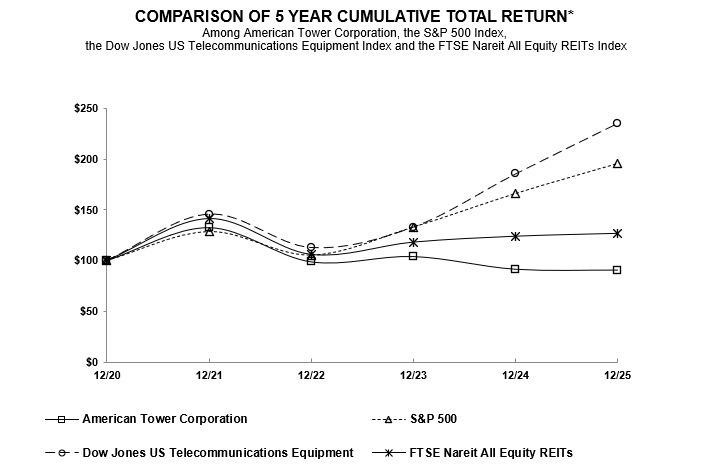
27
| Cumulative Total Returns | ||||||||||||||||||||||||||||||||||||||
| 12/20 | 12/21 | 12/22 | 12/23 | 12/24 | 12/25 | |||||||||||||||||||||||||||||||||
| American Tower Corporation | $ | 100.00 | $ | 132.89 | $ | 98.83 | $ | 104.12 | $ | 91.47 | $ | 90.61 | ||||||||||||||||||||||||||
| S&P 500 Index | 100.00 | 128.71 | 105.40 | 133.10 | 166.40 | 196.16 | ||||||||||||||||||||||||||||||||
| Dow Jones U.S. Telecommunications Equipment Index | 100.00 | 145.86 | 112.85 | 132.91 | 185.36 | 235.24 | ||||||||||||||||||||||||||||||||
| FTSE Nareit All Equity REITs Index | 100.00 | 141.30 | 106.05 | 118.09 | 123.90 | 126.71 | ||||||||||||||||||||||||||||||||
Issuer Purchases of Equity Securities
In March 2011, our Board approved a stock repurchase program, pursuant to which we are authorized to repurchase up to $1.5 billion of our common stock (the “2011 Buyback”). In December 2017, our Board approved an additional stock repurchase program, pursuant to which we are authorized to repurchase up to $2.0 billion of our common stock (the “2017 Buyback,” and together with the 2011 Buyback the “Buyback Programs”).
During the three months ended December 31, 2025, we repurchased a total of 2,036,100 shares of our common stock for an aggregate of $364.6 million, including commissions and fees, pursuant to the 2011 Buyback and the 2017 Buyback. As of December 31, 2025, we have no amounts remaining under the 2011 Buyback. The table below sets forth details of our repurchases under the Buyback Programs during the three months ended December 31, 2025.
| Period | Total Number of Shares Purchased (1) | Average Price Paid per Share (2) | Total Number of Shares Purchased as Part of Publicly Announced Plans or Programs | Approximate Dollar Value of Shares that May Yet be Purchased Under the Plans or Programs (3) | ||||||||||||||||||||||
| (in millions) | ||||||||||||||||||||||||||
| October 1, 2025 - October 31, 2025 | 240,568 | $ | 183.85 | 240,568 | $ | 1,973.4 | ||||||||||||||||||||
| November 1, 2025 - November 30, 2025 | 705,989 | $ | 180.50 | 705,989 | $ | 1,845.9 | ||||||||||||||||||||
| December 1, 2025 - December 31, 2025 | 1,089,543 | $ | 177.08 | 1,089,543 | $ | 1,653.0 | ||||||||||||||||||||
| Total Fourth Quarter | 2,036,100 | $ | 179.07 | 2,036,100 | $ | 1,653.0 | ||||||||||||||||||||
_______________
(1) Repurchases made pursuant to the Buyback Programs.
(2) Average price paid per share is a weighted average calculation using the aggregate price, excluding commissions and fees.
(3) Remaining under the 2017 Buyback.
Subsequent to December 31, 2025, through February 17, 2026, we repurchased 312,352 shares of our common stock for an aggregate of approximately $53.0 million, including commissions and fees, under the 2017 Buyback.
Through February 17, 2026, we have repurchased a total of 2,253,664 shares of our common stock under the 2017 Buyback for an aggregate of $400.0 million, including commissions and fees. We expect to continue to manage the pacing of the remaining $1.6 billion under the 2017 Buyback in response to general market conditions and other relevant factors. We expect to fund any further repurchases of our common stock through a combination of cash on hand, cash generated by operations and borrowings under our credit facilities. Purchases under the 2017 Buyback are subject to our having available cash to fund repurchases.
Under the 2017 Buyback, our management is authorized to purchase shares from time to time through open market purchases or in privately negotiated transactions not to exceed market prices and subject to market conditions and other factors. With respect to open market purchases, we may use plans adopted in accordance with Rule 10b5-1 under the Exchange Act in accordance with securities laws and other legal requirements, which allows us to repurchase shares during periods when we otherwise might be prevented from doing so under insider trading laws or because of self-imposed trading blackout periods. These programs may be discontinued at any time.
| ITEM 6. | [RESERVED] | ||||
N/A.
28
| ITEM 7. | MANAGEMENT’S DISCUSSION AND ANALYSIS OF FINANCIAL CONDITION AND RESULTS OF OPERATIONS | ||||
The discussion and analysis of our financial condition and results of operations that follow are based upon our consolidated financial statements, which have been prepared in accordance with GAAP. The preparation of our financial statements requires us to make estimates and assumptions that affect the reported amounts of assets and liabilities, revenues and expenses, and the related disclosure of contingent assets and liabilities at the date of our financial statements. Actual results may differ from these estimates and such differences could be material to the financial statements. This discussion should be read in conjunction with our consolidated financial statements included in this Annual Report and the accompanying notes, and the information set forth under the caption “Critical Accounting Policies and Estimates” below.
During the year ended December 31, 2025, we completed the sale of our fiber assets in South Africa (“South Africa Fiber”). Prior to the divestiture, the operating results of South Africa Fiber were included within the Africa & APAC property segment.
During the year ended December 31, 2024, we completed the sale of ATC TIPL (as defined below). The divestiture qualified for presentation as discontinued operations. See Note 21 for further discussion. Prior to the divestiture and classification as discontinued operations, ATC TIPL’s operating results were included within the Africa & APAC property segment. Historical financial information included in Management’s Discussion and Analysis of Financial Condition and Results of Operations has been adjusted to reflect the operating results of ATC TIPL as discontinued operations for all periods presented.
We report our results in six segments: U.S. & Canada property (which includes all assets in the United States and Canada, other than our data center facilities and related assets), Africa & APAC property, Europe property, Latin America property, Data Centers and Services. In evaluating financial performance in each business segment, management uses, among other factors, segment gross margin and segment operating profit (see note 19 to our consolidated financial statements included in this Annual Report).
Executive Overview
We are one of the largest global REITs and a leading independent owner, operator and developer of multitenant communications real estate. Our primary business is the leasing of space on communications sites to wireless service providers, radio and television broadcast companies, wireless data providers, government agencies and municipalities and tenants in a number of other industries. In addition to the communications sites in our portfolio, we manage rooftop and tower sites for property owners under various contractual arrangements. We also hold other telecommunications infrastructure and property interests that we lease primarily to communications service providers and third-party tower operators, and, as discussed further below, we hold a portfolio of highly interconnected data center facilities and related assets in the United States. Our customers include our tenants, licensees and other payers. We refer to the business encompassing the above as our property operations, which accounted for 97% of our total revenues for the year ended December 31, 2025 and includes our U.S. & Canada property, Africa & APAC property, Europe property and Latin America property segments and Data Centers segment.
We also offer tower-related services in the United States, including site application, zoning and permitting, structural and mount analyses, and construction management, together with program management offerings that support customer deployment needs from project scoping through construction. Our services operations primarily support our site leasing business, including the addition of new tenants and equipment on our sites.
29
The following table details the number of communications sites, excluding managed sites, that we owned or operated as of December 31, 2025:
_______________
| Number of Owned Towers | Number of Operated Towers (1) | Number of Owned DAS Sites | ||||||||||||||||||
| U.S. & Canada: | ||||||||||||||||||||
| Canada | 226 | — | — | |||||||||||||||||
| United States | 26,714 | 14,855 | 429 | |||||||||||||||||
| U.S. & Canada total | 26,940 | 14,855 | 429 | |||||||||||||||||
Africa & APAC: | ||||||||||||||||||||
| Bangladesh | 1,040 | — | — | |||||||||||||||||
| Burkina Faso | 733 | — | — | |||||||||||||||||
| Ghana | 3,438 | — | 37 | |||||||||||||||||
| Kenya | 4,500 | — | 11 | |||||||||||||||||
| Niger | 931 | — | — | |||||||||||||||||
| Nigeria | 9,706 | — | — | |||||||||||||||||
| Philippines | 384 | — | — | |||||||||||||||||
| South Africa | 2,483 | — | — | |||||||||||||||||
| Uganda | 4,547 | — | 47 | |||||||||||||||||
Africa & APAC total | 27,762 | — | 95 | |||||||||||||||||
| Europe: | ||||||||||||||||||||
| France | 4,279 | 303 | 9 | |||||||||||||||||
| Germany | 15,501 | — | — | |||||||||||||||||
| Spain | 12,431 | — | 1 | |||||||||||||||||
| Europe total | 32,211 | 303 | 10 | |||||||||||||||||
| Latin America: | ||||||||||||||||||||
| Argentina | 497 | — | 11 | |||||||||||||||||
| Brazil | 20,829 | 1,434 | 126 | |||||||||||||||||
| Chile | 3,681 | — | 107 | |||||||||||||||||
| Colombia | 4,858 | — | 6 | |||||||||||||||||
| Costa Rica | 712 | — | 2 | |||||||||||||||||
| Mexico | 8,689 | 185 | 75 | |||||||||||||||||
| Paraguay | 1,450 | — | — | |||||||||||||||||
| Peru | 3,968 | 450 | 1 | |||||||||||||||||
| Latin America total | 44,684 | 2,069 | 328 | |||||||||||||||||
| Total | 131,597 | 17,227 | 862 | |||||||||||||||||
(1)Approximately 98% of the operated towers are held pursuant to long-term finance leases, including those subject to purchase options.
As of December 31, 2025, our property portfolio included 30 operating data center facilities across eleven markets in the United States that collectively comprise approximately 3.7 million NRSF of data center space, as detailed below:
_______________
| Number of Data Centers | Total NRSF (1) | |||||||||||||
| (in thousands) | ||||||||||||||
| San Francisco Bay, CA | 9 | 1,051 | ||||||||||||
| Los Angeles, CA | 3 | 724 | ||||||||||||
| Northern Virginia, VA | 3 | 627 | ||||||||||||
| New York, NY | 3 | 376 | ||||||||||||
| Chicago, IL | 2 | 272 | ||||||||||||
| Denver, CO | 2 | 151 | ||||||||||||
| Boston, MA | 1 | 124 | ||||||||||||
| Orlando, FL | 1 | 104 | ||||||||||||
| Atlanta, GA | 2 | 95 | ||||||||||||
| Miami, FL | 2 | 90 | ||||||||||||
| Washington, D.C. | 2 | 47 | ||||||||||||
| Total | 30 | 3,661 | ||||||||||||
(1)Excludes approximately 0.4 million of office and light-industrial NRSF.
30
In most of our markets, our tenant leases for our communications sites with wireless carriers generally have initial non-cancellable terms of five to ten years with multiple renewal terms. Accordingly, the vast majority of the revenue generated by our property operations during the year ended December 31, 2025 was recurring revenue that we should continue to receive in future periods. Most of our tenant leases for our communications sites have provisions that periodically increase or “escalate” the rent due under the lease, typically based on (a) an annual fixed escalation (averaging approximately 3% in the United States), (b) an inflationary index in most of our international markets, or (c) a combination of both. In addition, certain of our tenant leases provide for additional revenue primarily to cover costs, such as ground rent or power and fuel costs.
Based upon existing customer leases and foreign currency exchange rates as of December 31, 2025, we expect to generate over $54 billion of non-cancellable customer lease revenue over future periods, before the impact of straight-line lease accounting.
The revenues generated by our property operations may be affected by cancellations of existing tenant leases. As discussed above, most of our tenant leases with wireless carriers and broadcasters are multiyear contracts, which typically are non-cancellable; however, in some instances, a lease may be cancelled upon the payment of a termination fee.
Revenue lost from either tenant lease cancellations or the non-renewal of leases or rent renegotiations, which we refer to as churn, has historically not had a material adverse effect on the revenues generated by our consolidated property operations. During the year ended December 31, 2025, churn was approximately 2% of our tenant billings, primarily driven by churn in our U.S. & Canada property segment, as discussed below.
AT&T Mexico Dispute. We are currently engaged in an Arbitration with AT&T Mexico. AT&T Mexico, which represented approximately $300 million of tenant revenue in 2025, is challenging the calculation of the monthly lease amount established under the MLA, as well as certain other provisions of the MLA, seeking rent abatement both retroactively and prospectively, and had been withholding tower rents since the start of 2025. We incurred approximately $30 million of reserves during the year ended December 31, 2025 related to this customer. We expect to record future reserves until the Arbitration is settled. We believe we have meritorious defenses to the claims raised in this Arbitration, are vigorously defending the full enforceability of the MLA and remain confident in the terms and conditions of the MLA. The Arbitration is scheduled for a hearing in August 2026.
On September 23, 2025, we and AT&T Mexico reached an agreement pursuant to which AT&T Mexico will remit payment of the majority of the withheld tower rents and will resume monthly payments of the majority of its owed tower rents. The remainder of the outstanding receivables and the future monthly tower rent amounts not remitted directly to us will be deposited into an irrevocable escrow account, overseen by an independent trustee, to be released in accordance with a final ruling in the Arbitration or by mutual consent of us and AT&T Mexico.
DISH Dispute. On September 24, 2025, DISH delivered a notice purporting to be excused from its contractual obligations under the SCA. DISH has failed to meet its payment obligations, and as of January 2026 is in default under the SCA. We remain confident that DISH has not been excused from its obligations under the SCA, and that the SCA remains in full force and effect. On October 20, 2025, we filed a complaint in the U.S. District Court for the District of Colorado seeking a declaratory judgment that DISH has not been excused from its obligations under the SCA, that the SCA remains in full force and effect, and that DISH remains required to perform all of its obligations under the SCA. DISH represented approximately 2% and 4% of our total annual property revenue and total annual U.S. & Canada property revenue, respectively, for 2025.
Property Operations Revenue Growth. Due to our diversified communications site portfolio, our tenant lease rates vary considerably depending upon numerous factors, including, but not limited to, amount, type and position of tenant equipment on the tower, remaining tower capacity and tower location. We measure the remaining tower capacity by assessing several factors, including tower height, tower type, environmental conditions, existing equipment on the tower and zoning and permitting regulations in effect in the jurisdiction where the tower is located. In many instances, tower capacity can be increased with relatively modest tower augmentation capital expenditures, which are often reimbursed to us.
The primary factors affecting the revenue growth of our property segments are:
•Growth in tenant billings, including:
•New revenue attributable to leasing additional space on our sites (“colocations”) and lease amendments;
•Contractual rent escalations on existing tenant leases, net of churn; and
•New revenue attributable to leases in place on day one on sites acquired or constructed since the beginning of the prior-year period.
•Revenue growth from our Data Centers segment in the United States, including rental and power revenue from new lease commencements and expansions, contractual rent and power escalations on existing leases, mark-to-market increases on renewing leases and increased interconnection services and solutions.
31
•Revenue growth from other items, including additional tenant payments primarily to cover costs, such as ground rent or power and fuel costs included in certain tenant leases (“pass-through”), straight-line revenue and decommissioning, partially offset, in certain cases, by revenue reserve provisions.
We continue to believe that our site leasing revenue, which makes up the vast majority of our property segment revenue, is likely to increase due to the growing use of wireless services globally and our ability to meet the corresponding incremental demand for our communications real estate. By adding new tenants and new equipment for existing tenants on our sites, we are able to increase these sites’ utilization and profitability. We believe the majority of our site leasing activity will continue to come from wireless service providers, with tenants in a number of other industries contributing incremental leasing demand. Our site portfolio and our established tenant base provide us with new business opportunities, which have historically resulted in consistent and predictable organic revenue growth as wireless carriers seek to increase the coverage and capacity of their existing networks, while also deploying next generation wireless technologies. In addition, we intend to continue to supplement our organic growth by selectively developing or acquiring new sites in our existing and new markets where we can achieve our risk-adjusted return on investment objectives.
Property Operations Organic Revenue Growth. Consistent with our strategy to increase the utilization and return on investment from our sites, our objective is to add new tenants and new equipment for existing tenants through colocation and lease amendments. Our ability to lease additional space on our sites is primarily a function of the rate at which wireless carriers and other tenants deploy capital to improve and expand their wireless networks. This rate of wireless network investment is influenced by the growth of wireless services, the penetration of advanced wireless devices, the level of emphasis on network quality and capacity in carrier competition, the financial performance of our tenants and their access to capital and general economic conditions. According to industry data, recent aggregate annual wireless capital spending in the United States has averaged at least $30 billion, resulting in consistent demand for our sites.
Based on industry research and projections, we expect that a number of key industry trends will result in incremental revenue opportunities for us:
•Rapid growth in mobile data consumption continues to be driven by increasing smartphone and other advanced device penetration, the proliferation of bandwidth-intensive applications on these devices and the continuing evolution of the mobile ecosystem. We believe carriers will be compelled to deploy additional equipment on existing networks while also rolling out more advanced wireless networks to address coverage and capacity needs resulting from this increasing mobile data usage.
•The deployment of advanced mobile technology, such as 4G and 5G, will provide higher speed data services and further enable fixed broadband substitution. As a result, we expect that our tenants will continue deploying additional equipment across their existing networks.
•Wireless service providers compete based on the quality of their networks, which is driven by capacity and coverage. To maintain or improve their network performance as overall network usage increases, our tenants continue to deploy additional equipment across their existing sites while also adding new cell sites. We anticipate increasing network densification over the next several years, as existing network density is anticipated to be insufficient to account for rapidly increasing levels of wireless data usage.
•Continued spectrum acquisition and deployment by wireless service providers, which is expected to result in additional sites and equipment on existing sites as operators optimize network configuration and utilize the additional spectrum. We expect this to be particularly relevant in the context of higher-band spectrum such as 2.5 gigahertz (GHz) and C-Band being deployed for 5G, as these spectrum assets tend to have more limited propagation characteristics compared to the lower-band spectrum that has historically been deployed on our towers.
•Emerging next generation technologies, such as edge computing functionality, autonomous vehicle networks and a number of other internet-of-things, or IoT, applications and other potential use cases for wireless services requiring wireless connectivity. These technologies may create new and complementary use cases for our communications real estate over time, although these use cases are currently in nascent stages.
•Continued data growth, including through increased use of AI, and emerging high-performance, latency-sensitive applications, will drive an increased need for reliable, secure and interconnected data center solutions. We believe these trends will result in incremental utilization and interconnection demand at our data center facilities.
As part of our international expansion initiatives, we have targeted markets in various stages of network development to diversify our international exposure and position us to benefit from a number of different wireless technology deployments over the long term, while benefitting from our shared global experience, capabilities and services. In addition, we have focused on building relationships with large multinational carriers to increase the opportunities for growth or mutually beneficial transactional opportunities across common markets. We believe that consistent carrier network investments across our international markets will, over the long term, position us to generate meaningful organic revenue growth going forward.
32
We believe that the network technology migration we have seen in the United States, which has led to significantly denser networks and meaningful new business commencements for us over a number of years, will be replicated in our international markets over time. As a result, we expect to be able to leverage our extensive international portfolio of approximately 108,000 communications sites and the relationships we have built with our carrier tenants to drive sustainable, long-term growth.
We have master lease agreements with many of our tenants for our communications sites that provide for consistent, long-term revenue and reduce the likelihood of non-contractual churn. Certain of those master lease agreements are comprehensive in nature and further build and augment strong strategic partnerships with our tenants while significantly reducing colocation cycle times, thereby providing our tenants with the ability to rapidly and efficiently deploy equipment on our sites.
Strong industry tailwinds also underpin our data center business. Our portfolio of highly interconnected data center facilities and related assets in the United States is well positioned to monetize elevated demand for hybrid-cloud and multi-cloud deployments, as well as demand from early-stage AI-related workloads like inferencing, machine learning models and GPU-as-a-Service from neo clouds. We believe it is important for AI workloads to be collocated with hybrid installations. Our data center facilities are well-suited for this, as they have a rich ecosystem of network and cloud interconnections coupled with purpose-built capacity designed to support AI and other higher-density deployments. These positive trends reinforce our expectation for our data centers to deliver long-term growth with attractive returns.
Demand for our communications infrastructure assets could be negatively impacted by a number of factors, including increased competition within our industries, an increase in network sharing or consolidation among our customers and financial difficulties for our customers, as set forth in Item 1A of this Annual Report under the captions “Risk Factors—If our customers consolidate their operations, exit their businesses or share site infrastructure to a significant degree, our growth and revenue could be materially and adversely affected,” “Risk Factors—Increasing competition within our industries may materially and adversely affect our revenue” and “Risk Factors—A substantial portion of our current and projected future revenue is derived from a small number of customers, and we are sensitive to adverse changes in the creditworthiness and financial strength of our customers.” In addition, the emergence and growth of new technologies could reduce demand for our sites, as set forth under the caption “Risk Factors—New technologies or changes, or lack thereof, in our or a customer’s business model could make our communications infrastructure leasing business less desirable and result in decreasing revenues and operating results.” Further, our customers may be subject to new regulatory policies from time to time that materially and adversely affect the demand for our communications infrastructure assets.
Property Operations New Site Revenue Growth. During the year ended December 31, 2025, we grew our portfolio of communications real estate through the acquisition and construction of approximately 2,230 communications sites globally. In a majority of our Africa & APAC, Europe and Latin America markets, the revenue generated from newly acquired or constructed sites resulted in increases in both tenant and pass-through revenues (such as ground rent or power and fuel costs) and expenses. We continue to evaluate opportunities to acquire communications real estate portfolios, both domestically and internationally, to determine whether they meet our risk-adjusted hurdle rates and whether we believe we can effectively integrate them into our existing portfolio.
| New Sites (Acquired or Constructed) | 2025 | 2024 | 2023 | ||||||||||||||
| U.S. & Canada | 155 | 15 | 20 | ||||||||||||||
Africa & APAC (1) | 1,265 | 1,660 | 1,700 | ||||||||||||||
| Europe | 745 | 590 | 555 | ||||||||||||||
| Latin America | 65 | 185 | 215 | ||||||||||||||
(1)For the years ended December 31, 2024 and 2023, excludes approximately 90 and 865 new sites in India, respectively.
Property Operations Expenses. Direct operating expenses incurred by our property segments include direct site or facility level expenses and consist primarily of ground rent and power and fuel costs, some or all of which may be passed through to our customers, as well as property taxes and repairs and maintenance expenses. These segment direct operating expenses exclude all segment and corporate selling, general, administrative and development expenses, which are aggregated into one line item entitled Selling, general, administrative and development expense in our consolidated statements of operations. In general, our property segments’ selling, general, administrative and development expenses do not significantly increase as a result of adding incremental customers to our sites or facilities and typically increase only modestly year-over-year. As a result, leasing additional space to new customers on our sites or within our facilities provides significant incremental gross margin and cash flow. We may, however, incur additional segment selling, general, administrative and development expenses as we increase our presence in our existing markets or expand into new markets. Our profit margin growth is therefore positively impacted by the addition of new customers to our sites or facilities but can be temporarily diluted by our development or expansion activities.
33
Services Segment Revenue Growth. As we continue to focus on growing our property operations, we anticipate that our services revenue will continue to represent a small percentage of our total revenues.
34
Non-GAAP Financial Measures
Included in our analysis of our results of operations are discussions regarding earnings before interest, taxes, depreciation, amortization and accretion, as adjusted (“Adjusted EBITDA”), Funds From Operations, as defined by the National Association of Real Estate Investment Trusts (“Nareit FFO”) attributable to American Tower Corporation common stockholders, Adjusted Funds From Operations (“AFFO”) attributable to American Tower Corporation common stockholders (“AFFO attributable to American Tower Corporation common stockholders”) and Segment gross margin.
We define Adjusted EBITDA as Net income before Income (loss) from equity method investments; Income (loss) from discontinued operations, net of taxes; Income tax benefit (provision); Other income (expense); Gain (loss) on retirement of long-term obligations; Interest expense; Interest income; Other operating income (expense), including Goodwill impairment; Depreciation, amortization and accretion; and stock-based compensation expense.
Nareit FFO attributable to American Tower Corporation common stockholders is defined as net income before gains or losses from the sale or disposal of real estate, real estate related impairment charges, real estate related depreciation, amortization and accretion, and including adjustments and distributions for unconsolidated affiliates and noncontrolling interests and adjustments for discontinued operations. In this section, we refer to Nareit FFO attributable to American Tower Corporation common stockholders as “Nareit FFO (common stockholders).”
We define AFFO attributable to American Tower Corporation common stockholders as Nareit FFO (common stockholders) before (i) straight-line revenue and expense; (ii) stock-based compensation expense; (iii) the deferred portion of income tax and other income tax adjustments; (iv) non-real estate related depreciation, amortization and accretion; (v) amortization of deferred financing costs, debt discounts and premiums and long-term deferred interest charges; (vi) other income (expense); (vii) gain (loss) on retirement of long-term obligations; and (viii) other operating income (expense); less cash payments related to capital improvements and cash payments related to corporate capital expenditures and including adjustments and distributions for unconsolidated affiliates and noncontrolling interests and adjustments for discontinued operations, which includes the impact of noncontrolling interests and discontinued operations on both Nareit FFO and the corresponding adjustments included in AFFO. In this section, we refer to AFFO attributable to American Tower Corporation common stockholders as “AFFO (common stockholders).”
We define Segment gross margin as segment revenue less segment operating expenses, excluding depreciation, amortization and accretion; selling, general, administrative and development expense; and other operating expenses.
Adjusted EBITDA, Nareit FFO (common stockholders), AFFO (common stockholders) and Segment gross margin are not intended to replace net income or any other performance measures determined in accordance with GAAP. None of Adjusted EBITDA, Nareit FFO (common stockholders), AFFO (common stockholders) or Segment gross margin represents cash flows from operating activities in accordance with GAAP and, therefore, these measures should not be considered indicative of cash flows from operating activities, as a measure of liquidity or a measure of funds available to fund our cash needs, including our ability to make cash distributions. Rather, Adjusted EBITDA, Nareit FFO (common stockholders), AFFO (common stockholders) and Segment gross margin are presented as we believe each is a useful indicator of our current operating performance. We believe that these metrics are useful to an investor in evaluating our operating performance because (1) each is a key measure used by our management team for decision making purposes and for evaluating our operating segments’ performance; (2) Adjusted EBITDA is a component underlying our credit ratings; (3) Adjusted EBITDA is widely used in the telecommunications real estate sector to measure operating performance as depreciation, amortization and accretion may vary significantly among companies depending upon accounting methods and useful lives, particularly where acquisitions and non-operating factors are involved; (4) AFFO (common stockholders) is widely used in the telecommunications real estate sector to adjust Nareit FFO (common stockholders) for items that may otherwise cause material fluctuations in Nareit FFO (common stockholders) growth from period to period that would not be representative of the underlying performance of property assets in those periods; (5) Segment gross margin provides valuable insight into the site-level profitability of our assets (6) each provides investors with a meaningful measure for evaluating our period-to-period operating performance by eliminating items that are not operational in nature; and (7) each provides investors with a measure for comparing our results of operations to those of other companies, particularly those in our industry.
Our measurement of Adjusted EBITDA, Nareit FFO (common stockholders), AFFO (common stockholders) and Segment gross margin may not, however, be fully comparable to similarly titled measures used by other companies. Reconciliations of Adjusted EBITDA, Nareit FFO (common stockholders) and AFFO (common stockholders) to net income and Segment gross margin to gross margin, the most directly comparable GAAP measures, have been included below.
35
Results of Operations
Year Ended December 31, 2024 Compared to Year Ended December 31, 2023
For a discussion of our 2024 Results of Operations, including a discussion of our financial results for the fiscal year ended December 31, 2024 compared to the fiscal year ended December 31, 2023, refer to Part I, Item 7 of our annual report on Form 10-K filed with the SEC on February 25, 2025 (the “2024 Form 10-K”).
Years Ended December 31, 2025 and 2024
(in millions, except percentages)
Revenue
_______________
| Year Ended December 31, | Percent Change 2025 vs 2024 | ||||||||||||||||
| 2025 | 2024 | ||||||||||||||||
| Property | |||||||||||||||||
| U.S. & Canada | $ | 5,248.7 | $ | 5,248.1 | 0 | % | |||||||||||
| Africa & APAC (1) | 1,422.9 | 1,208.0 | 18 | ||||||||||||||
| Europe | 937.7 | 834.7 | 12 | ||||||||||||||
| Latin America | 1,642.6 | 1,717.9 | (4) | ||||||||||||||
| Data Centers | 1,053.1 | 924.8 | 14 | ||||||||||||||
| Total property | 10,305.0 | 9,933.5 | 4 | ||||||||||||||
| Services | 339.6 | 193.7 | 75 | ||||||||||||||
| Total revenues | $ | 10,644.6 | $ | 10,127.2 | 5 | % | |||||||||||
(1) Excludes the operating results of ATC TIPL, which are reported as discontinued operations. See Note 21 for further discussion.
Year ended December 31, 2025
U.S. & Canada property segment revenue increase of $0.6 million was attributable to:
• Tenant billings growth of $210.0 million, which was driven by:
◦$158.7 million due to colocations and amendments;
◦$52.8 million resulting from contractual escalations, net of churn; and
◦$5.7 million generated from sites acquired or constructed since the beginning of the prior-year period (“newly acquired or constructed sites”);
◦Partially offset by a decrease of $7.2 million from other tenant billings;
• Partially offset by a decrease of $209.1 million in other revenue, which includes a $175.8 million decrease due to straight-line accounting.
Segment revenue growth was partially offset by a decrease of $0.3 million attributable to the negative impact of foreign currency translation related to fluctuations in Canadian Dollar.
Africa & APAC property segment revenue growth of $214.9 million was attributable to:
• Tenant billings growth of $129.7 million, which was driven by:
◦$53.7 million due to colocations and amendments;
◦$43.5 million resulting from contractual escalations, net of churn;
◦$23.1 million generated from newly acquired or constructed sites; and
◦$9.4 million from other tenant billings;
• An increase of $24.7 million in other revenue, primarily attributable to a decrease in revenue reserves related to customers in Burkina Faso and Kenya; and
• An increase of $15.7 million in pass-through revenue.
Segment revenue growth included an increase of $44.8 million, attributable to the impact of foreign currency translation, which included, among others, positive impacts of $27.6 million related to fluctuations in Ghanaian Cedi, $9.3 million related to fluctuations in Ugandan Shilling, $6.8 million related to fluctuations in Kenyan Shilling and $4.4 million related to fluctuations in West African CFA Franc, partially offset by negative impacts of $7.0 million related to fluctuations in Nigerian Naira.
Europe property segment revenue growth of $103.0 million was attributable to:
• Tenant billings growth of $39.8 million, which was driven by:
◦$19.0 million due to colocations and amendments;
36
◦$11.3 million resulting from contractual escalations, net of churn; and
◦$10.9 million generated from newly acquired or constructed sites;
◦Partially offset by a decrease of $1.4 million from other tenant billings;
• An increase of $14.5 million in other revenue; and
• An increase of $10.1 million in pass-through revenue, primarily attributable to an increase in energy costs.
Segment revenue growth included an increase of $38.6 million attributable to the positive impact of foreign currency translation related to fluctuations in Euro (“EUR”).
Latin America property segment revenue decrease of $75.3 million was attributable to:
• A decrease of $71.6 million in other revenue, primarily attributable to an increase in revenue reserves related to customers in Brazil and Mexico and a decrease in tenant settlements in Brazil; and
• A decrease of $56.2 million, attributable to the impact of foreign currency translation, which included, among others, negative impacts of $32.2 million related to fluctuations in Brazilian Real and $29.1 million related to fluctuations in Mexican Peso, partially offset by positive impacts of $5.6 million related to fluctuations in Peruvian Sol;
• Partially offset by:
• Tenant billings growth of $36.5 million, which was driven by:
◦$26.8 million due to colocations and amendments;
◦$13.3 million from contractual escalations, net of churn; and
◦$0.7 million generated from newly acquired or constructed sites;
◦Partially offset by a decrease of $4.3 million from other tenant billings; and
• An increase of $16.0 million in pass-through revenue.
Data Centers segment revenue growth of $128.3 million was attributable to:
•An increase of $74.5 million in rental, related and other revenue, primarily due to new lease commencements, customer expansions and rent increases upon customer renewals;
•An increase of $36.8 million in power revenue from new lease commencements, increased power consumption and pricing increases from existing customers;
•An increase of $16.2 million in interconnection revenue, primarily due to customer interconnection net additions and set-up fees; and
•An increase of $0.8 million in straight-line revenue.
Services segment revenue growth of $145.9 million was primarily attributable to increases in construction management services, site application, zoning and permitting services and structural and mount analyses services.
Gross Margin
_______________
| Year Ended December 31, | Percent Change 2025 vs 2024 | ||||||||||||||||
| 2025 | 2024 | ||||||||||||||||
| Property | |||||||||||||||||
| U.S. & Canada | $ | 4,378.7 | $ | 4,377.2 | 0 | % | |||||||||||
| Africa & APAC (1) | 976.4 | 827.5 | 18 | ||||||||||||||
| Europe | 593.5 | 525.3 | 13 | ||||||||||||||
| Latin America | 1,131.6 | 1,187.7 | (5) | ||||||||||||||
| Data Centers | 650.7 | 534.0 | 22 | ||||||||||||||
| Total property | 7,730.9 | 7,451.7 | 4 | ||||||||||||||
| Services | 165.6 | 101.1 | 64 | % | |||||||||||||
(1) Excludes the operating results of ATC TIPL, which are reported as discontinued operations. See Note 21 for further discussion.
Year ended December 31, 2025
•The U.S. & Canada property segment gross margin was relatively consistent as compared to the prior-year period.
•The increase in Africa & APAC property segment gross margin was primarily attributable to the increase in revenue described above, partially offset by an increase in direct expenses of $48.5 million, primarily due to an increase in costs associated with pass-through revenue, including fuel and utility costs, and an increase in repair and maintenance spending. Direct expenses were also negatively impacted by $17.5 million from the impact of foreign currency translation.
37
•The increase in Europe property segment gross margin was primarily attributable to the increase in revenue described above, partially offset by an increase in direct expenses of $20.4 million, primarily due to an increase in costs associated with pass-through revenue, including energy costs and an increase in land rent costs. Direct expenses were also negatively impacted by $14.4 million from the impact of foreign currency translation.
•The decrease in Latin America property segment gross margin was primarily attributable to the decrease in revenue described above, partially offset by a decrease in direct expenses of $4.1 million. Direct expenses also benefited by $15.1 million from the impact of foreign currency translation.
•The increase in Data Centers segment gross margin was primarily attributable to the increase in revenue described above, partially offset by an increase in direct expenses of $11.6 million, primarily due to an increase in costs associated with power revenue, including utility costs, partially offset by a decrease in property taxes primarily as a result of a one-time benefit of $26.0 million due to final resolution of revised real property valuations related to the CoreSite Acquisition. Direct expenses also benefited by a legal settlement and resolution of a utility back billing matter.
•The increase in Services segment gross margin was primarily attributable to the increase in revenue described above, partially offset by an increase in direct expenses of $81.4 million.
Selling, General, Administrative and Development Expense (“SG&A”)
_______________
| Year Ended December 31, | Percent Change 2025 vs 2024 | ||||||||||||||||
| 2025 | 2024 | ||||||||||||||||
| Property | |||||||||||||||||
| U.S. & Canada | $ | 166.6 | $ | 161.1 | 3 | % | |||||||||||
| Africa & APAC (1) | 76.1 | 68.0 | 12 | ||||||||||||||
| Europe | 69.6 | 64.8 | 7 | ||||||||||||||
| Latin America | 102.6 | 111.0 | (8) | ||||||||||||||
| Data Centers | 88.5 | 78.8 | 12 | ||||||||||||||
| Total property | 503.4 | 483.7 | 4 | ||||||||||||||
| Services | 27.4 | 21.0 | 30 | ||||||||||||||
| Other | 409.9 | 428.7 | (4) | ||||||||||||||
| Total selling, general, administrative and development expense | $ | 940.7 | $ | 933.4 | 1 | % | |||||||||||
(1) Excludes the operating results of ATC TIPL, which are reported as discontinued operations. See Note 21 for further discussion.
Year Ended December 31, 2025
•The increase in our U.S. & Canada property segment SG&A was primarily driven by increased personnel and related costs to support our business, increased canceled construction costs and a net increase in bad debt expense, partially offset by decreased professional services costs.
•The increase in our Africa & APAC property segment SG&A was primarily driven by increased local tax and professional services costs and increased canceled construction costs, partially offset by decreased personnel and related costs.
•The increase in our Europe property segment SG&A was primarily driven by increased canceled construction costs and the negative impact of foreign currency translation, partially offset by decreased professional services costs.
•The decrease in our Latin America property segment SG&A was primarily driven by a net decrease in bad debt expense of $7.1 million, decreased personnel and related costs, lower canceled construction costs and a benefit from the impact of foreign currency translation, partially offset by increased local tax and professional services costs, including legal fees in Mexico.
•The increase in our Data Centers segment SG&A was primarily driven by increased personnel and related costs to support our business, partially offset by a legal settlement in the period.
•The increase in our Services segment SG&A was primarily driven by increased personnel and related costs to support our business.
38
•The decrease in other SG&A was primarily attributable to a decrease in stock-based compensation expense of $18.5 million, primarily driven by the reversal of previously recognized stock-based compensation expense associated with awards forfeited in connection with the departure of our Executive Vice President and President, APAC due to such role being eliminated, as discussed in note 12 to our consolidated financial statements included in this Annual Report, and a decrease in other corporate SG&A, partially offset by an increase in personnel and related costs to support our business.
Operating Profit
_______________
| Year Ended December 31, | Percent Change 2025 vs 2024 | ||||||||||||||||
| 2025 | 2024 | ||||||||||||||||
| Property | |||||||||||||||||
| U.S. & Canada | $ | 4,212.1 | $ | 4,216.1 | (0) | % | |||||||||||
| Africa & APAC (1) | 900.3 | 759.5 | 19 | ||||||||||||||
| Europe | 523.9 | 460.5 | 14 | ||||||||||||||
| Latin America | 1,029.0 | 1,076.7 | (4) | ||||||||||||||
| Data Centers | 562.2 | 455.2 | 24 | ||||||||||||||
| Total property | 7,227.5 | 6,968.0 | 4 | % | |||||||||||||
| Services | 138.2 | 80.1 | 73 | % | |||||||||||||
(1) Excludes the operating results of ATC TIPL, which are reported as discontinued operations. See Note 21 for further discussion.
Year Ended December 31, 2025
•The decrease in operating profit for our U.S. & Canada property segment was primarily attributable to an increase in our segment SG&A, partially offset by an increase in our segment gross margin.
•The increases in our Africa & APAC property segment, Europe property segment, Data Centers segment and our Services segment were primarily attributable to increases in our segment gross margin, partially offset by increases in our segment SG&A.
•The decrease in operating profit for our Latin America property segment was primarily attributable to a decrease in our segment gross margin, partially offset by a decrease in our segment SG&A.
Depreciation, Amortization and Accretion
| Year Ended December 31, | Percent Change 2025 vs 2024 | ||||||||||||||||
| 2025 | 2024 | ||||||||||||||||
| Depreciation, amortization and accretion | $ | 2,041.6 | $ | 2,028.8 | 1 | % | |||||||||||
The increase in depreciation, amortization and accretion expense for the year ended December 31, 2025 was primarily attributable to foreign currency exchange rate fluctuations.
Other Operating Expense
| Year Ended December 31, | Percent Change 2025 vs 2024 | ||||||||||||||||
| 2025 | 2024 | ||||||||||||||||
| Other operating expense | $ | 68.4 | $ | 74.1 | (8) | % | |||||||||||
The decrease in other operating expense for the year ended December 31, 2025 was primarily attributable to the gain on the sale of South Africa Fiber of $53.6 million, partially offset by an increase in impairment charges of $32.1 million.
Total Other Expense
| Year Ended December 31, | Percent Change 2025 vs 2024 | ||||||||||||||||
| 2025 | 2024 | ||||||||||||||||
| Total other expense | $ | 1,801.6 | $ | 891.7 | 102 | % | |||||||||||
Total other expense consists primarily of interest expense and realized and unrealized foreign currency gains and losses. We record unrealized foreign currency gains or losses as a result of foreign currency exchange rate fluctuations primarily associated with our intercompany notes and similar unaffiliated balances denominated in a currency other than the subsidiaries’ functional currencies.
39
The increase in total other expense during the year ended December 31, 2025 was primarily due to foreign currency losses of $809.4 million in the current period, as compared to foreign currency gains of $308.3 million in the prior-year period, partially offset by a decrease in net interest expense of $43.9 million, primarily due to a decrease in our average debt outstanding. Total other expense during the years ended December 31, 2025 and 2024 also include gains from equity securities in the United States of $232.6 million and $70.4 million, respectively.
Income Tax Provision
| Year Ended December 31, | Percent Change 2025 vs 2024 | |||||||||||||||||||
| 2025 | 2024 | |||||||||||||||||||
| Income tax provision | $ | 415.7 | $ | 366.3 | 13 | % | ||||||||||||||
| Effective tax rate | 13.7 | % | 10.1 | % | ||||||||||||||||
As a REIT, we may deduct earnings distributed to stockholders against the income generated by our REIT operations. Consequently, the effective tax rate on income from continuing operations for each of the years ended December 31, 2025 and 2024 differs from the federal statutory rate.
For the year ended December 31, 2025, the increase in the income tax provision was primarily attributable to (i) increased earnings in certain foreign jurisdictions, (ii) taxes incurred as a result of the sale of South Africa Fiber, (iii) additions to reserves for uncertain tax positions, (iv) gains from equity securities in the United States and (v) the reversal of permanent reinvestment assertions in Nigeria, partially offset by a net benefit from the application of tax law changes primarily in Germany and a decrease in withholding taxes from equity distributions due in part to the ATC TIPL Transaction.
Loss from Discontinued Operations, Net of Taxes
On January 4, 2024, we, through our subsidiaries, ATC Asia Pacific Pte. Ltd. and ATC Telecom Infrastructure Private Limited (“ATC TIPL”), which held our operations in India, entered into an agreement with Data Infrastructure Trust (“DIT”), an infrastructure investment trust sponsored by an affiliate of Brookfield Asset Management, pursuant to which DIT agreed to acquire a 100% ownership interest in ATC TIPL (the “ATC TIPL Transaction”). Per the terms of the agreement, total aggregate consideration represented up to approximately 210 billion Indian Rupees (“INR”) (approximately $2.5 billion), including the value of the VIL OCDs and the VIL Shares (each as defined and further discussed below), payments on certain existing customer receivables, the repayment of existing intercompany debt and the repayment, or assumption, of our existing term loan in India, by DIT.
During the year ended December 31, 2024, ATC TIPL distributed approximately 29.6 billion INR (approximately $354.1 million) to us, which included the value of the VIL Shares and the VIL OCDs and the satisfaction of the economic benefit associated with the rights to payments on certain existing customer receivables. The distributions were deducted from the total aggregate consideration received by us at closing.
The ATC TIPL Transaction received all government and regulatory approvals during the three months ended September 30, 2024. On September 12, 2024, we completed the ATC TIPL Transaction and received total consideration of 182 billion INR (approximately $2.2 billion). We used the proceeds from the ATC TIPL Transaction to repay existing indebtedness under the 2021 Multicurrency Credit Facility. During the year ended December 31, 2024, we recorded a loss on the sale of ATC TIPL of $1.2 billion, which primarily included the reclassification of our cumulative translation adjustment in India upon exiting the market of $1.1 billion.
The following table presents key components of Loss from discontinued operations, net of taxes in the consolidated statements of operations:
40
| Year Ended December 31, | Percent Change 2025 vs 2024 | |||||||||||||||||||
| 2025 | 2024 (1) | |||||||||||||||||||
| Revenue | $ | — | $ | 911.2 | (100) | % | ||||||||||||||
| Cost of operations | — | (473.8) | (100) | |||||||||||||||||
| Depreciation, amortization and accretion | — | (96.0) | (100) | |||||||||||||||||
| Selling, general, administrative and development expense | — | (58.7) | (100) | |||||||||||||||||
| Other operating expense | — | (6.7) | (100) | |||||||||||||||||
| Loss on sale of ATC TIPL | — | (1,245.5) | 100 | |||||||||||||||||
| Operating loss | — | (969.5) | (100) | % | ||||||||||||||||
| Interest income | — | 30.7 | (100) | |||||||||||||||||
| Interest expense | — | (7.6) | (100) | |||||||||||||||||
| Other income, net | — | 46.5 | (100) | |||||||||||||||||
| Loss from discontinued operations before taxes | $ | — | $ | (899.9) | (100) | % | ||||||||||||||
| Income tax provision | — | (78.4) | (100) | |||||||||||||||||
| Loss from discontinued operations, net of taxes | $ | — | $ | (978.3) | (100) | % | ||||||||||||||
(1) Includes the results of operations for ATC TIPL through September 12, 2024.
Following the rulings by the Supreme Court of India regarding carriers’ obligations for the adjusted gross revenue fees and charges prescribed by the court, we experienced variability and a level of uncertainty in collections in India. In the third quarter of 2022, one of our largest customers in India, Vodafone Idea Limited (“VIL”), communicated that it would make partial payments of its contractual amounts owed to us (the “VIL Shortfall”). We recorded reserves in late 2022 and the first half of 2023 for the VIL Shortfall. In the second half of 2023, VIL began making payments in full of its monthly contractual obligations owed to us. During the year ended December 31, 2023, we deferred recognition of revenue of approximately $27.3 million, net of recoveries, related to VIL in India. During the year ended December 31, 2024, we recognized approximately $95.7 million of this previously deferred revenue. We have fully recognized this previously deferred revenue.
In February 2023, and as amended in August 2023, VIL issued optionally convertible debentures (the “VIL OCDs”) to ATC TIPL in exchange for VIL’s payment of certain amounts towards accounts receivables. The VIL OCDs were issued for an aggregate face value of 16.0 billion INR (approximately $193.2 million on the date of issuance). On March 23, 2024, we converted an aggregate face value of 14.4 billion INR (approximately $172.7 million) of VIL OCDs into 1,440 million shares of equity of VIL (the “VIL Shares”). On April 29, 2024, we completed the sale of 1,440 million VIL Shares at a price of 12.78 INR per share. The net proceeds for this transaction were approximately 18.0 billion INR (approximately $216.0 million at the date of settlement) after deducting commissions and fees. On June 5, 2024, we completed the sale of the remaining aggregate face value of 1.6 billion INR (approximately $19.2 million) of the VIL OCDs. The net proceeds for this transaction, excluding accrued interest, were approximately 1.8 billion INR (approximately $22.0 million at the date of settlement) after deducting fees. None of the VIL Shares or the VIL OCDs remained outstanding. During the year ended December 31, 2024, we recognized a gain of $46.4 million on the sale of the VIL Shares and the VIL OCDs.
41
Net Income / Adjusted EBITDA and Net Income / Nareit FFO attributable to American Tower Corporation common stockholders / AFFO attributable to American Tower Corporation common stockholders
| Year Ended December 31, | Percent Change 2025 vs 2024 | |||||||||||||||||||
| 2025 | 2024 | |||||||||||||||||||
| Net income | $ | 2,628.5 | $ | 2,280.2 | 15 | % | ||||||||||||||
| Loss from discontinued operations, net of taxes | — | 978.3 | (100) | |||||||||||||||||
| Income tax provision | 415.7 | 366.3 | 13 | |||||||||||||||||
| Other expense (income) | 576.2 | (377.6) | (253) | |||||||||||||||||
| Interest expense | 1,359.4 | 1,404.5 | (3) | |||||||||||||||||
| Interest income | (134.0) | (135.2) | (1) | |||||||||||||||||
| Other operating expense | 68.4 | 74.1 | (8) | |||||||||||||||||
| Depreciation, amortization and accretion | 2,041.6 | 2,028.8 | 1 | |||||||||||||||||
| Stock-based compensation expense | 174.2 | 192.7 | (10) | |||||||||||||||||
| Adjusted EBITDA (1) | $ | 7,130.0 | $ | 6,812.1 | 5 | % | ||||||||||||||
(1) Excludes the operating results of ATC TIPL, which are reported as discontinued operations. See Note 21 for further discussion.
| Year Ended December 31, | Percent Change 2025 vs 2024 | |||||||||||||||||||
| 2025 | 2024 | |||||||||||||||||||
| Net income (1) | $ | 2,628.5 | $ | 2,280.2 | 15 | % | ||||||||||||||
| Real estate related depreciation, amortization and accretion | 1,899.6 | 1,879.6 | 1 | |||||||||||||||||
| Losses from sale or disposal of real estate and real estate related impairment charges (2) | 83.5 | 91.6 | (9) | |||||||||||||||||
| Adjustments and distributions for unconsolidated affiliates and noncontrolling interests (3) | (450.7) | (352.7) | 28 | |||||||||||||||||
| Adjustments for discontinued operations (4) | — | 1,334.5 | (100) | |||||||||||||||||
| Nareit FFO attributable to American Tower Corporation common stockholders | $ | 4,160.9 | $ | 5,233.2 | (20) | % | ||||||||||||||
| Straight-line revenue | (101.0) | (277.6) | (64) | |||||||||||||||||
| Straight-line expense | 36.2 | 46.8 | (23) | |||||||||||||||||
| Stock-based compensation expense | 174.2 | 192.7 | (10) | |||||||||||||||||
Deferred portion of income tax and other income tax adjustments (5) | 150.0 | 88.7 | 69 | |||||||||||||||||
| Non-real estate related depreciation, amortization and accretion | 142.0 | 149.2 | (5) | |||||||||||||||||
| Amortization of deferred financing costs, capitalized interest, debt discounts and premiums and long-term deferred interest charges | 54.1 | 54.1 | 0 | |||||||||||||||||
| Other expense (income) (6) | 576.2 | (377.6) | (253) | |||||||||||||||||
| Other operating income (7) | (15.1) | (17.5) | (14) | |||||||||||||||||
| Capital improvement capital expenditures | (185.2) | (157.4) | 18 | |||||||||||||||||
| Corporate capital expenditures | (10.4) | (13.9) | (25) | |||||||||||||||||
| Adjustments and distributions for unconsolidated affiliates and noncontrolling interests (8) | 59.7 | 4.4 | 1,257 | |||||||||||||||||
| Adjustments for discontinued operations (9) | — | 9.0 | (100) | |||||||||||||||||
| AFFO attributable to American Tower Corporation common stockholders | $ | 5,041.6 | $ | 4,934.1 | 2 | % | ||||||||||||||
| AFFO attributable to American Tower Corporation common stockholders from continuing operations | $ | 5,041.6 | $ | 4,568.9 | 10 | % | ||||||||||||||
| AFFO attributable to American Tower Corporation common stockholders from discontinued operations | $ | — | $ | 365.2 | (100) | % | ||||||||||||||
_______________
(1) For the year ended December 31, 2024, includes Loss from discontinued operations, net of taxes of $978.3 million.
(2) For the years ended December 31, 2025 and 2024, includes impairment charges of $100.7 million and $68.6 million, respectively. For the year ended December 31, 2025, includes a gain on the sale of South Africa Fiber of $53.6 million.
42
(3) Includes distributions to noncontrolling interest holders, distributions related to the outstanding mandatorily convertible preferred equity in connection with our agreements with certain investment vehicles affiliated with Stonepeak Partners LP and adjustments for the impact of noncontrolling interests on Nareit FFO attributable to American Tower Corporation common stockholders.
(4) For the year ended December 31, 2024, includes (i) real estate related depreciation, amortization and accretion for discontinued operations of $91.3 million, (ii) losses from the sale or disposal of real estate and real estate related impairment charges for discontinued operations of $1.2 billion. For the year ended December 31, 2024, includes a loss on the sale of ATC TIPL of $1.2 billion.
(5) For the year ended December 31, 2025, includes adjustments for (i) $0.3 million of taxes paid in Singapore related to the ATC TIPL Transaction, (ii) $25.8 million of taxes paid in South Africa, which were incurred as a result of the sale of South Africa Fiber, (iii) $30.4 million of taxes paid related to the sale of equity securities in the U.S. and (iv) $6.5 million of other tax adjustments. For the year ended December 31, 2024, includes adjustments for withholding taxes paid in Singapore of $36.4 million, which were incurred as a result of the ATC TIPL Transaction. We believe that these tax payments are nonrecurring, and do not believe these are an indication of our operating performance. Accordingly, we believe it is more meaningful to present AFFO attributable to American Tower Corporation common stockholders excluding these amounts.
(6) Includes losses (gains) on foreign currency exchange rate fluctuations of $809.4 million and $(308.3) million, respectively.
(7) Primarily includes acquisition-related costs, integration costs and disposition costs.
(8) Includes adjustments for the impact of noncontrolling interests on other line items, excluding those already adjusted for in Nareit FFO attributable to American Tower Corporation common stockholders.
(9) Includes the impact of discontinued operations associated with other line items, excluding the impact already included in Nareit FFO attributable to American Tower Corporation common stockholders.
Year Ended December 31, 2025
The increase in net income was primarily due to losses from discontinued operations, net of tax, as a result of the ATC TIPL Transaction in the prior year.
The decrease in net income from continuing operations was primarily due to (i) changes in other income (expense), primarily due to foreign currency exchange rate fluctuations and (ii) an increase in the income tax provision, partially offset by (y) an increase in segment operating profit and (z) a decrease in interest expense.
The increase in Adjusted EBITDA was primarily attributable to an increase in our gross margin, partially offset by an increase in SG&A, excluding the impact of stock-based compensation expense of $25.8 million.
The increase in AFFO attributable to American Tower Corporation common stockholders was primarily attributable to (i) an increase in our operating profit, excluding the impact of straight-line accounting, and (ii) decreases in cash paid for interest and cash paid for income taxes, partially offset by (x) a decrease in AFFO attributable to American Tower Corporation common stockholders from discontinued operations as a result of the sale of ATC TIPL in the third quarter of 2024, (y) an increase in capital improvement capital expenditures and (z) an increase in distributions and adjustments for noncontrolling interests, including distributions to noncontrolling interest holders in our Data Centers segment.
43
Segment Gross Margin Reconciliation
Gross margin is defined as revenue less costs of operations inclusive of real estate related depreciation, amortization and accretion. Segment gross margin excludes depreciation, amortization and accretion.
| Property | Total Property | Services | Total | |||||||||||||||||||||||||||||||||||||||||||||||
| Year ended December 31, 2025 | U.S. & Canada | Africa & APAC | Europe | Latin America | Data Centers | |||||||||||||||||||||||||||||||||||||||||||||
| Gross margin | $ | 3,783.1 | $ | 779.5 | $ | 287.1 | $ | 935.2 | $ | 46.4 | $ | 5,831.3 | $ | 165.6 | $ | 5,996.9 | ||||||||||||||||||||||||||||||||||
| Real estate related depreciation, amortization and accretion | 595.6 | 196.9 | 306.4 | 196.4 | 604.3 | 1,899.6 | — | 1,899.6 | ||||||||||||||||||||||||||||||||||||||||||
| Segment gross margin | $ | 4,378.7 | $ | 976.4 | $ | 593.5 | $ | 1,131.6 | $ | 650.7 | $ | 7,730.9 | $ | 165.6 | $ | 7,896.5 | ||||||||||||||||||||||||||||||||||
| Property | Total Property | Services | Total | |||||||||||||||||||||||||||||||||||||||||||||||
| Year ended December 31, 2024 | U.S. & Canada | Africa & APAC (1) | Europe | Latin America | Data Centers | |||||||||||||||||||||||||||||||||||||||||||||
| Gross margin | $ | 3,790.6 | $ | 610.9 | $ | 240.9 | $ | 985.9 | $ | (56.2) | $ | 5,572.1 | $ | 101.1 | $ | 5,673.2 | ||||||||||||||||||||||||||||||||||
| Real estate related depreciation, amortization and accretion | 586.6 | 216.6 | 284.4 | 201.8 | 590.2 | 1,879.6 | — | 1,879.6 | ||||||||||||||||||||||||||||||||||||||||||
| Segment gross margin | $ | 4,377.2 | $ | 827.5 | $ | 525.3 | $ | 1,187.7 | $ | 534.0 | $ | 7,451.7 | $ | 101.1 | $ | 7,552.8 | ||||||||||||||||||||||||||||||||||
(1)Excludes the operating results of ATC TIPL, which are reported as discontinued operations. See Note 21 for further discussion.
| Property | Total Property | Services | Total | |||||||||||||||||||||||||||||||||||||||||||||||
| Year ended December 31, 2023 | U.S. & Canada | Africa & APAC (1) | Europe | Latin America | Data Centers | |||||||||||||||||||||||||||||||||||||||||||||
| Gross margin | $ | 3,362.7 | $ | 505.0 | $ | 122.9 | $ | 890.5 | $ | (196.0) | $ | 4,685.1 | $ | 82.9 | $ | 4,768.0 | ||||||||||||||||||||||||||||||||||
| Real estate related depreciation, amortization and accretion | 1,003.6 | 301.0 | 353.2 | 341.8 | 683.1 | 2,682.7 | — | 2,682.7 | ||||||||||||||||||||||||||||||||||||||||||
| Segment gross margin | $ | 4,366.3 | $ | 806.0 | $ | 476.1 | $ | 1,232.3 | $ | 487.1 | $ | 7,367.8 | $ | 82.9 | $ | 7,450.7 | ||||||||||||||||||||||||||||||||||
(1)Excludes the operating results of ATC TIPL, which are reported as discontinued operations. See Note 21 for further discussion.
44
Liquidity and Capital Resources
For a discussion of our 2024 Liquidity and Capital Resources, including a discussion of cash flows for the fiscal year ended December 31, 2024 compared to the fiscal year ended December 31, 2023, refer to Part I, Item 7 of the 2024 Form 10-K.
Overview
During the year ended December 31, 2025, we increased our financial flexibility and our ability to grow our business while maintaining our long-term financial policies. Our significant 2025 financing transactions included:
•Redemption of our 2.950% senior unsecured notes due 2025 (the “2.950% Notes”), our 2.400% senior unsecured notes due 2025 (the “2.400% Notes”), our 1.375% senior unsecured notes due 2025 (the “1.375% Notes”), our 4.000% notes due 2025 (the “4.000% Notes”) and our 1.300% senior unsecured notes due 2025 (the “1.300% Notes”);
•Repayment of $525.0 million aggregate principal amount outstanding under our Secured Tower Revenue Notes, Series 2015-2, Class A (the “Series 2015-2 Notes”);
•Registered public offering in an aggregate principal amount of $3.0 billion, including 500.0 million EUR, of senior unsecured notes with maturities ranging from 2030 to 2035; and
•Amendment of the 2021 Multicurrency Credit Facility, the 2021 Credit Facility and the 2021 Term Loan (as defined below) to, among other things, (i) extend the maturity dates and (ii) update the Applicable Margins (as defined in the loan agreements).
The following table summarizes our liquidity as of December 31, 2025 (in millions):
| Available under the 2021 Multicurrency Credit Facility | $ | 5,620.0 | |||
| Available under the 2021 Credit Facility | 4,000.0 | ||||
| Letters of credit | (36.8) | ||||
| Total available under credit facilities, net | 9,583.2 | ||||
| Cash and cash equivalents | 1,474.8 | ||||
| Total liquidity | $ | 11,058.0 | |||
Subsequent to December 31, 2025, we made additional borrowings of $600.0 million under the 2021 Credit Facility and net borrowings of $135.0 million under the 2021 Multicurrency Credit Facility. The borrowings were used to repay existing indebtedness and for general corporate purposes.
Summary cash flow information is set forth below for the years ended December 31, (in millions):
_______________
| 2025 | 2024 | ||||||||||
| Net cash provided by (used for): | |||||||||||
| Operating activities | $ | 5,464.0 | $ | 5,290.5 | |||||||
| Investing activities (1) | (1,859.8) | 410.6 | |||||||||
| Financing activities | (4,208.5) | (5,452.4) | |||||||||
| Net effect of changes in foreign currency exchange rates on cash and cash equivalents, and restricted cash | 101.3 | (233.9) | |||||||||
| Net (decrease) increase in cash and cash equivalents, and restricted cash | $ | (503.0) | $ | 14.8 | |||||||
(1) For the year ended December 31, 2024, includes $2.2 billion of proceeds from the ATC TIPL Transaction.
We use our cash flows to fund our operations and investments in our business, including maintenance and improvements, communications site and data center construction, managed network installations and acquisitions. Additionally, we use our cash flows to make distributions, including distributions of our REIT taxable income to maintain our qualification for taxation as a REIT under the Code. We may also periodically repay or repurchase our existing indebtedness or equity. We typically fund our international expansion efforts primarily through a combination of cash on hand, intercompany debt and equity contributions.
On an on-going basis, we also perform a comprehensive assessment of our global operations to ensure our portfolio is positioned to drive sustained growth and achieve our risk-adjusted return objectives. This assessment may result in our decision to divest a portion, or all, of certain assets, including our South Africa Fiber business in 2025, our Australia and New Zealand businesses in 2024, the ATC TIPL Transaction, and our Mexico fiber and Poland businesses in 2023 and repurpose proceeds, and potential future capital, to other capital priorities.
As of December 31, 2025, we had total outstanding indebtedness of $37.4 billion, with a current portion of $3.4 billion. During the year ended December 31, 2025, we generated sufficient cash flow from operations, together with borrowings under our
45
credit facilities, proceeds from our debt issuances and cash on hand, to fund our acquisitions, capital expenditures and debt service obligations, as well as our required distributions. We believe the cash generated by operating activities during the year ending December 31, 2026, together with our borrowing capacity under our credit facilities, will suffice to fund our required distributions, capital expenditures, debt service obligations (interest and principal repayments) and signed acquisitions.
As of December 31, 2025, we had $1.5 billion of cash and cash equivalents held by our foreign subsidiaries. As of December 31, 2025, we had $140.7 million of cash and cash equivalents held by our joint ventures, of which $91.3 million was held by our foreign joint ventures. Certain foreign subsidiaries may pay us interest or principal on intercompany debt. Additionally, in the event that we repatriate funds from our foreign subsidiaries, we may be required to accrue and pay certain taxes.
Cash Flows from Operating Activities
For the year ended December 31, 2025, cash provided by operating activities increased $173.5 million as compared to the year ended December 31, 2024. The primary factors that impacted cash provided by operating activities as compared to the year ended December 31, 2024, include:
•an increase in our operating profit, including the impact of straight-line accounting; and
•decreases in cash paid for interest and cash paid for taxes;
partially offset by:
◦a reduction of cash flows from ATC TIPL as a result of the sale in 2024; and
◦an increase in cash required for working capital, primarily as a result of an increase in prepaid and other assets and a decrease in accounts payable.
Cash Flows from Investing Activities
Our significant investing activities during the year ended December 31, 2025 are highlighted below:
•We spent approximately $454.2 million for acquisitions.
•We received approximately $137.7 million from the sale of South Africa Fiber and approximately $159.6 million from the sale of equity securities in the U.S.
•We spent $1.7 billion for capital expenditures, as follows (in millions):
| Discretionary capital projects (1) | $ | 950.3 | |||
| Ground lease purchases (2) | 217.0 | ||||
| Capital improvements and corporate expenditures (3) | 195.6 | ||||
| Redevelopment | 287.8 | ||||
| Start-up capital projects | 70.0 | ||||
| Total capital expenditures | $ | 1,720.7 | |||
_______________
(1)Includes the construction of 1,918 communications sites globally and approximately $608.9 million of spend related to data center assets.
(2)Includes $36.0 million of perpetual land easement payments reported in Deferred financing costs and other financing activities in the cash flows from financing activities in our consolidated statements of cash flows.
(3)Includes $4.3 million of finance lease payments reported in Repayments of notes payable, credit facilities, senior notes, secured debt, term loans and finance leases in the cash flows from financing activities in our consolidated statements of cash flows.
We plan to continue to allocate our available capital, after satisfying our distribution requirements, among investment alternatives that meet our return on investment criteria, while maintaining our commitment to our long-term financial policies. Accordingly, we expect to continue to deploy capital through our annual capital expenditure program, including land purchases and new site and data center facility construction, and through acquisitions. We also regularly review our portfolios as to capital
46
expenditures required to upgrade our infrastructure to our structural standards or address capacity, structural or permitting issues.
We expect that our 2026 total capital expenditures will be as follows (in millions):
| Discretionary capital projects (1) | $ | 1,050 | to | $ | 1,080 | ||||||
| Ground lease purchases | 200 | to | 220 | ||||||||
| Capital improvements and corporate expenditures | 175 | to | 185 | ||||||||
| Redevelopment | 335 | to | 365 | ||||||||
| Start-up capital projects | 35 | to | 55 | ||||||||
| Total capital expenditures | $ | 1,795 | to | $ | 1,905 | ||||||
_______________
(1) Includes the construction of approximately 1,700 to 2,300 communications sites globally and approximately $695 million of anticipated spend related to data center assets.
Cash Flows from Financing Activities
Our significant financing activities were as follows (in millions):
| Year Ended December 31, | |||||||||||
| 2025 | 2024 | ||||||||||
| Proceeds from issuance of senior notes, net | $ | 3,000.6 | $ | 3,568.6 | |||||||
| Borrowings under (repayments of) credit facilities, net | 362.2 | (2,321.1) | |||||||||
| Repayments of term loans (1) | — | (1,015.4) | |||||||||
| Repayments of securitized debt | (525.0) | — | |||||||||
| Repayments of senior notes | (3,206.2) | (2,150.0) | |||||||||
| Purchases of common stock | (364.6) | — | |||||||||
| Distributions paid on common stock | (3,157.2) | (3,074.9) | |||||||||
_______________
(1)For the year ended December 31, 2024, includes the repayments of the 825.0 million EUR unsecured term loan, as amended in December 2021, and the 10.0 billion INR unsecured term loan in India, which was repaid in connection with the completion of the ATC TIPL Transaction.
Securitization
American Tower Secured Revenue Notes and Repayment of Series 2015-2 Notes—In May 2015, GTP Acquisition Partners I, LLC, one of our wholly owned subsidiaries, refinanced existing debt with cash on hand and proceeds from a private issuance (the “2015 Securitization”) of (i) $350.0 million of American Tower Secured Revenue Notes, Series 2015-1, Class A, which were subsequently repaid on the June 2020 payment date, and (ii) $525.0 million of the Series 2015-2 Notes. On the June 2025 payment date, we repaid $525.0 million aggregate principal amount outstanding under the Series 2015-2 Notes, pursuant to the terms of the agreements governing such securities. The repayment was funded with borrowings under the 2021 Multicurrency Credit Facility and cash on hand. Following such repayment, no notes were outstanding under the 2015 Securitization.
Senior Notes
Repayments of Senior Notes
Repayment of 2.950% Senior Notes—On January 14, 2025, we repaid $650.0 million aggregate principal amount of the 2.950% Notes upon their maturity. The 2.950% Notes were repaid using cash on hand and borrowings under the 2021 Multicurrency Credit Facility. Upon completion of the repayment, none of the 2.950% Notes remained outstanding.
Repayment of 2.400% Senior Notes—On March 14, 2025, we repaid $750.0 million aggregate principal amount of the 2.400% Notes upon their maturity. The 2.400% Notes were repaid using proceeds from the issuance of the 4.900% Notes and the 5.350% Notes (each as defined below). Upon completion of the repayment, none of the 2.400% Notes remained outstanding.
Repayment of 1.375% Senior Notes—On April 3, 2025, we repaid 500.0 million EUR aggregate principal amount of the 1.375% Notes upon their maturity. The 1.375% Notes were repaid using borrowings under the 2021 Multicurrency Credit Facility and cash on hand. Upon completion of the repayment, none of the 1.375% Notes remained outstanding.
Repayment of 4.000% Senior Notes—On May 30, 2025, we repaid $750.0 million aggregate principal amount of the 4.000% Notes upon their maturity. The 4.000% Notes were repaid using borrowings under the 2021 Credit Facility and cash on hand. Upon completion of the repayment, none of the 4.000% Notes remained outstanding.
47
Repayment of 1.300% Senior Notes—On September 12, 2025, we repaid $500.0 million aggregate principal amount of the 1.300% Notes upon their maturity. The 1.300% Notes were repaid using borrowings under the 2021 Credit Facility. Upon completion of the repayment, none of the 1.300% Notes remained outstanding.
Repayment of 4.400% Senior Notes—On February 13, 2026, we repaid $500.0 million aggregate principal amount of our 4.400% senior unsecured notes due 2026 (the “4.400% Notes”) upon their maturity. The 4.400% Notes were repaid using borrowings under the 2021 Credit Facility and cash on hand. Upon completion of the repayment, none of the 4.400% Notes remained outstanding.
Offerings of Senior Notes
4.900% Senior Notes and 5.350% Senior Notes Offering—On March 14, 2025, we completed a registered public offering of $650.0 million aggregate principal amount of 4.900% senior unsecured notes due 2030 (the “Initial 4.900% Notes”) and $350.0 million aggregate principal amount of 5.350% senior unsecured notes due 2035 (the “Initial 5.350% Notes”). The net proceeds from this offering were approximately $988.9 million, after deducting commissions and estimated expenses. We used the net proceeds to repay the 2.400% Notes, to repay existing indebtedness under the 2021 Multicurrency Credit Facility and for general corporate purposes.
On September 16, 2025, we completed a registered public offering of $200.0 million aggregate principal amount through a reopening of the Initial 4.900% Notes (the “Reopened 4.900% Notes” and, collectively with the Initial 4.900% Notes, the “4.900% Notes”) and $375.0 million aggregate principal amount through a reopening of the Initial 5.350% Notes (the “Reopened 5.350% Notes” and, collectively with the Initial 5.350% Notes, the “5.350% Notes”). The net proceeds from this offering were approximately $587.8 million, after deducting commissions and estimated expenses. We used the net proceeds to repay existing indebtedness under the 2021 Credit Facility and for general corporate purposes.
3.625% Senior Notes Offering—On May 30, 2025, we completed a registered public offering of 500.0 million EUR (approximately $567.4 million at the date of issuance) aggregate principal amount of 3.625% senior unsecured notes due 2032 (the “3.625% Notes). The net proceeds from this offering were approximately 496.8 million EUR (approximately $563.7 million at the date of issuance), after deducting commissions and estimated expenses. We used the net proceeds to repay existing indebtedness under the 2021 Multicurrency Credit Facility and for general corporate purposes.
4.700% Senior Notes Offering—On December 5, 2025, we completed a registered public offering of $850.0 million aggregate principal amount of 4.700% senior unsecured notes due 2032 (the “4.700% Notes,” and, collectively with the 4.900% Notes, the 5.350% Notes and the 3.625% Notes, the “Notes”). The net proceeds from this offering were approximately $839.5 million, after deducting commissions and estimated expenses. We used the net proceeds to repay existing indebtedness under the 2021 Credit Facility.
The key terms of the Notes are as follows:
| Senior Notes | Aggregate Principal Amount (in millions) | Issue Date and Interest Accrual Date | Maturity Date | Contractual Interest Rate | First Interest Payment | Interest Payments Due (1) | Par Call Date (2) | |||||||||||||||||||||||||||||||||||||
| 4.900% Notes (3) | $ | 850.0 | March 14, 2025 | March 15, 2030 | 4.900 | % | September 15, 2025 | March 15 and September 15 | February 15, 2030 | |||||||||||||||||||||||||||||||||||
| 5.350% Notes (3) | $ | 725.0 | March 14, 2025 | March 15, 2035 | 5.350 | % | September 15, 2025 | March 15 and September 15 | December 15, 2034 | |||||||||||||||||||||||||||||||||||
| 3.625% Notes (4) | $ | 567.4 | May 30, 2025 | May 30, 2032 | 3.625 | % | May 30, 2026 | May 30 | March 30, 2032 | |||||||||||||||||||||||||||||||||||
| 4.700% Notes | $ | 850.0 | December 5, 2025 | December 15, 2032 | 4.700 | % | June 15, 2026 | June 15 and December 15 | October 15, 2032 | |||||||||||||||||||||||||||||||||||
_______________
(1)Accrued and unpaid interest on U.S. Dollar (“USD”) denominated notes is payable in USD semi-annually in arrears and will be computed from the issue date on the basis of a 360-day year comprised of twelve 30-day months. Interest on EUR denominated notes is payable in EUR annually in arrears and will be computed on the basis of the actual number of days in the period for which interest is being calculated and the actual number of days from and including the last date on which interest was paid on the notes, beginning on the issue date.
(2)We may redeem the Notes at any time, in whole or in part, at a redemption price equal to 100% of the principal amount of the Notes plus a make-whole premium, together with accrued interest to the redemption date. If we redeem the Notes on or after the par call date, we will not be required to pay a make-whole premium.
(3)The Initial 4.900% Notes and the Initial 5.350% Notes were issued on March 14, 2025. The Reopened 4.900% Notes and the Reopened 5.350% Notes were issued on September 16, 2025. The first interest payments made on September 15, 2025 related solely to the Initial 4.900% Notes and the Initial 5.350% Notes. The first interest payments on the Reopened 4.900% Notes and the Reopened 5.350% Notes are due on March 15, 2026.
(4)The 3.625% Notes are denominated in EUR; dollar amounts represent the aggregate principal amount at the issuance date.
48
If we undergo a change of control and corresponding ratings decline, each as defined in the applicable supplemental indenture for the Notes, we may be required to repurchase all of the Notes at a purchase price equal to 101% of the aggregate principal amount of the Notes repurchased, plus accrued and unpaid interest (including additional interest, if any), up to but not including the repurchase date. The Notes rank equally in right of payment with all of our other senior unsecured debt obligations and are structurally subordinated to all existing and future indebtedness and other obligations of our subsidiaries.
Each applicable supplemental indenture contains certain covenants that restrict our ability to merge, consolidate or sell assets and our (together with our subsidiaries’) ability to incur liens. These covenants are subject to a number of exceptions, including that we and our subsidiaries may incur certain liens on assets, mortgages or other liens securing indebtedness if the aggregate amount of indebtedness secured by such liens does not exceed 3.5x Adjusted EBITDA, as defined in the applicable supplemental indenture.
Bank Facilities
Amendments to Bank Facilities—On January 28, 2025, we amended our (i) 2021 Multicurrency Credit Facility, (ii) 2021 Credit Facility and (iii) $1.0 billion unsecured term loan, as amended and restated in December 2021, as further amended (the “2021 Term Loan”).
These amendments, among other things,
i.extend the maturity dates of the 2021 Multicurrency Credit Facility and the 2021 Credit Facility to January 28, 2028 and January 28, 2030, respectively;
ii.extend the maturity date of the 2021 Term Loan to January 28, 2028; and
iii.update the Applicable Margins (as defined in the loan agreements).
2021 Multicurrency Credit Facility—As of December 31, 2025, we had the ability to borrow up to a total of $6.0 billion under the 2021 Multicurrency Credit Facility, which includes a $3.5 billion sublimit for multicurrency borrowings, a $200.0 million sublimit for letters of credit and a $50.0 million sublimit for swingline loans. During the year ended December 31, 2025, we borrowed an aggregate of $2.4 billion, including 492.0 million EUR ($529.1 million as of the borrowing date) and repaid an aggregate of $2.0 billion, including 492.0 million EUR ($549.9 million as of the repayment date), of revolving indebtedness under the 2021 Multicurrency Credit Facility. We used the borrowings to repay outstanding indebtedness, including the 2.950% Notes, the 1.375% Notes and the Series 2015-2 Notes, and for general corporate purposes. As of December 31, 2025, there are no EUR borrowings outstanding under the 2021 Multicurrency Credit Facility.
2021 Credit Facility—As of December 31, 2025, we had the ability to borrow up to a total of $4.0 billion under the 2021 Credit Facility, which includes a $2.5 billion sublimit for multicurrency borrowings, $200.0 million sublimit for letters of credit and a $50.0 million sublimit for swingline loans. During the year ended December 31, 2025, we borrowed an aggregate of $3.7 billion and repaid an aggregate of $3.7 billion of revolving indebtedness under our 2021 Credit Facility. We used the borrowings to repay outstanding indebtedness, including the 4.000% Notes and the 1.300% Notes, and for general corporate purposes.
As of December 31, 2025, the key terms under the 2021 Multicurrency Credit Facility, the 2021 Credit Facility and the 2021 Term Loan were as follows:
| Bank Facility | Outstanding Principal Balance ($ in millions) | Maturity Date | SOFR or EURIBOR borrowing interest rate range (1) | Base rate borrowing interest rate range (1) | Current margin over SOFR or EURIBOR and the base rate, respectively | ||||||||||||||||||
| 2021 Multicurrency Credit Facility | (2) | $ | 380.0 | January 28, 2028 | (3) | 0.750% - 1.375% | 0.000% - 0.375% | 0.875% and 0.000% | |||||||||||||||
| 2021 Credit Facility | (2) | — | January 28, 2030 | (3) | 0.750% - 1.375% | 0.000% - 0.375% | 0.875% and 0.000% | ||||||||||||||||
| 2021 Term Loan | (2) | 1,000.0 | January 28, 2028 | 0.750% - 1.375% | 0.000% - 0.375% | 0.875% and 0.000% | |||||||||||||||||
_______________
(1)Represents interest rate above: (a) Secured Overnight Financing Rate (“SOFR”) for SOFR based borrowings, (b) Euro Interbank Offer Rate (“EURIBOR”) for EURIBOR based borrowings and (c) the defined base rate for base rate borrowings, in each case based on our debt ratings.
(2)Currently borrowed at SOFR.
(3)Subject to two optional renewal periods.
We must pay a quarterly commitment fee on the undrawn portion of each of the 2021 Multicurrency Credit Facility and the 2021 Credit Facility. The commitment fee for the 2021 Multicurrency Credit Facility and the 2021 Credit Facility ranges from 0.080% to 0.200% per annum, based upon our debt ratings, and is currently 0.100%.
49
The 2021 Multicurrency Credit Facility, the 2021 Credit Facility and the 2021 Term Loan and the associated loan agreements (the “Bank Loan Agreements”) do not require amortization of principal and may be paid prior to maturity in whole or in part at our option without penalty or premium. We have the option of choosing either a defined base rate, SOFR or EURIBOR as the applicable base rate for borrowings under these bank facilities.
Each Bank Loan Agreement contains certain reporting, information, financial and operating covenants and other restrictions (including limitations on additional debt, guaranties, sales of assets and liens) with which we must comply. Failure to comply with the financial and operating covenants of the loan agreements could not only prevent us from being able to borrow additional funds under the revolving credit facilities, but may constitute a default, which could result in, among other things, the amounts outstanding under the applicable agreement, including all accrued interest and unpaid fees, becoming immediately due and payable.
Other Subsidiary Debt— Each of the agreements governing the other subsidiary debt contains contractual covenants and other restrictions. Failure to comply with certain of the financial and operating covenants could constitute a default under the applicable debt agreement, which could result in, among other things, the amounts outstanding, including all accrued interest and unpaid fees, becoming immediately due and payable.
Bangladesh Term Loan—In March 2025, we entered into a 400.0 million BDT (approximately $3.3 million) term loan with a maturity date that is eight years from the date of the first draw thereunder (the “Bangladesh Term Loan”). On March 24, 2025, we borrowed 150.0 million BDT (approximately $1.2 million) under the Bangladesh Term Loan. The Bangladesh Term Loan bears interest at 13.50% per annum, subject to quarterly resets. Interest is payable quarterly. Any outstanding principal and accrued but unpaid interest will be due and payable in full at maturity. The Bangladesh Term Loan does not require amortization of principal and may be paid prior to maturity in whole or in part at our option without penalty or premium.
CoreSite DE1 Note—On April 1, 2025, in connection with our acquisition of a multi-tenant data center facility in Denver, Colorado, in which we previously leased space (“DE1”), we entered into an agreement to pay $5.0 million of purchase price to the seller in monthly installments through March 31, 2028 (the “CoreSite DE1 Note”). The CoreSite DE1 Note accrues interest at the prime rate as announced by Bank of America, N.A plus 200 basis points. As of December 31, 2025, the interest rate was 9.50% per annum. Interest is payable monthly in arrears. Any outstanding principal and accrued but unpaid interest will be due and payable in full at maturity. The CoreSite DE1 Note may be paid prior to maturity in whole or in part at our option without penalty or premium, provided that if such prepayment is made prior to April 1, 2027, we are required to pay any additional interest which would have accrued under the CoreSite DE1 Note in the ordinary course through April 1, 2027.
Stock Repurchase Programs—During the year ended December 31, 2025, we repurchased 2,036,100 shares of our common stock for an aggregate of $364.6 million, including commissions and fees, under both the 2011 Buyback and the 2017 Buyback. As of December 31, 2025, we have no amounts remaining under the 2011 Buyback.
Under the 2017 Buyback, we are authorized to purchase shares from time to time through open market purchases or in privately negotiated transactions not to exceed market prices and subject to market conditions and other factors. With respect to open market purchases, we may use plans adopted in accordance with Rule 10b5-1 under the Exchange Act in accordance with securities laws and other legal requirements, which allows us to repurchase shares during periods when it may otherwise be prevented from doing so under insider trading laws or because of self-imposed trading blackout periods.
Subsequent to December 31, 2025, through February 17, 2026, we repurchased 312,352 shares of our common stock for an aggregate of approximately $53.0 million, including commissions and fees, under the 2017 Buyback.
Through February 17, 2026, we have repurchased a total of 2,253,664 shares of our common stock under the 2017 Buyback for an aggregate of $400.0 million, including commissions and fees. We expect to continue to manage the pacing of the remaining $1.6 billion under the 2017 Buyback in response to general market conditions and other relevant factors. We expect to fund any further repurchases of our common stock through a combination of cash on hand, cash generated by operations and borrowings under our credit facilities. Purchases under the 2017 Buyback are subject to our having available cash to fund repurchases.
Sales of Equity Securities—We receive proceeds from sales of our equity securities pursuant to our employee stock purchase plan (the “ESPP”) and upon exercise of stock options granted under our equity incentive plan, as amended (the “2007 Plan”). During the year ended December 31, 2025, we received an aggregate of $41.7 million in proceeds upon exercises of stock options and sales pursuant to the ESPP.
Future Financing Transactions—We regularly consider various options to obtain financing and access the capital markets, subject to market conditions, to meet our funding needs. Such capital raising alternatives, in addition to those noted above, may include amendments and extensions of our bank facilities, entry into new bank facilities, transactions with private equity funds or partnerships, additional senior note and equity offerings and securitization transactions. No assurance can be given as to whether any such financing transactions will be completed or as to the timing or terms thereof.
50
Distributions—As a REIT, we must annually distribute to our stockholders an amount equal to at least 90% of our REIT taxable income (determined before the deduction for distributed earnings and excluding any net capital gain). Generally, we have distributed, and expect to continue to distribute, all or substantially all of our REIT taxable income after taking into consideration our utilization of NOLs. We have distributed an aggregate of approximately $23.7 billion to our common stockholders, including the dividend paid in February 2026. The dividends paid to common stockholders in 2025 were primarily classified as ordinary income that may be treated as qualified REIT dividends under Section 199A of the Code and we currently expect the 2026 dividends to be similarly classified.
During the year ended December 31, 2025, we paid $6.72 per share, or $3.1 billion, to our common stockholders of record. In addition, we declared a distribution of $1.70 per share, or $792.9 million, paid on February 2, 2026 to our common stockholders of record at the close of business on December 29, 2025.
We accrue distributions on unvested restricted stock units, which are payable upon vesting. The amount accrued for distributions payable related to unvested restricted stock units was $20.8 million and $22.5 million as of December 31, 2025 and 2024, respectively. During the year ended December 31, 2025, we paid $12.2 million of distributions upon the vesting of restricted stock units.
The amount, timing and frequency of future distributions will be at the sole discretion of our Board and will depend on various factors, a number of which may be beyond our control, including our financial condition and operating cash flows, the amount required to maintain our qualification for taxation as a REIT and reduce any income and excise taxes that we otherwise would be required to pay, limitations on distributions in our existing and future debt and preferred equity instruments, our ability to utilize NOLs to offset our distribution requirements, limitations on our ability to fund distributions using cash generated through our TRSs and other factors that our Board may deem relevant.
For more details on the cash distributions paid to our common stockholders during the year ended December 31, 2025, see note 13 to our consolidated financial statements included in this Annual Report.
We utilize notional cash pooling arrangements with financial institutions for cash management purposes. These arrangements allow for cash withdrawals based upon aggregate cash balances on deposit at the same financial institution.
Material Cash Requirements—The following table summarizes material cash requirements from known contractual and other obligations as of December 31, 2025 (in millions):
| 2026 | 2027 | 2028 | 2029 | 2030 | Thereafter | Total | ||||||||||||||||||||||||||||||||||||||
| Debt obligations (1) | $ | 3,387.8 | $ | 4,726.7 | $ | 7,513.2 | $ | 3,782.0 | $ | 4,925.3 | $ | 13,099.9 | $ | 37,434.9 | ||||||||||||||||||||||||||||||
| Operating lease obligations (2) | 1,028.4 | 1,005.5 | 959.3 | 916.1 | 865.6 | 7,201.7 | 11,976.6 | |||||||||||||||||||||||||||||||||||||
______________
(1) Includes aggregate principal maturities of long-term debt, including finance lease obligations (see note 8 to our consolidated financial statements included in this Annual Report).
(2) Includes payments under non-cancellable initial terms, as well as payments for certain renewal periods at our option, which we expect to renew because failure to do so could result in a loss of the applicable communications sites and related revenues from tenant leases (see note 4 to our consolidated financial statements included in this Annual Report).
Distributions—We expect that our 2026 total distributions declared to our common stockholders will be $3.3 billion. The amount, timing and frequency of future distributions will be at the sole discretion of our Board.
Asset Retirement Obligations—We are required to remove our assets and remediate the leased sites upon which certain of our assets are located. As of December 31, 2025, the estimated undiscounted future cash outlay for asset retirement obligations was $4.6 billion.
Factors Affecting Sources of Liquidity
Our liquidity depends on our ability to generate cash flow from operating activities, borrow funds under our credit facilities and maintain compliance with the contractual agreements governing our indebtedness. We believe that the debt agreements discussed below represent our material debt agreements that contain covenants, our compliance with which would be material to an investor’s understanding of our financial results and the impact of those results on our liquidity.
Internally Generated Funds—Because the majority of our customer leases are multiyear contracts, a significant majority of the revenues generated by our property operations as of the end of 2025 is recurring revenue that we should continue to receive in future periods. Accordingly, a key factor affecting our ability to generate cash flow from operating activities is to maintain this recurring revenue and to convert it into operating profit by minimizing operating costs and fully achieving our operating efficiencies. In addition, our ability to increase cash flow from operating activities depends upon the demand for our
51
communications infrastructure and our related services and our ability to increase the utilization of our existing communications infrastructure.
Restrictions Under Loan Agreements Relating to Our Credit Facilities—Each Bank Loan Agreement contains certain financial and operating covenants and other restrictions applicable to us and our subsidiaries that are not designated as unrestricted subsidiaries on a consolidated basis. These restrictions include limitations on additional debt, distributions and dividends, guaranties, sales of assets and liens. The Bank Loan Agreements also contain covenants that establish financial tests with which we and our restricted subsidiaries must comply related to total leverage and senior secured leverage, as set forth in the table below. As of December 31, 2025, we were in compliance with each of these covenants.
| Compliance Tests For The 12 Months Ended December 31, 2025 ($ in billions) | ||||||||||||||||||||
| Ratio (1) | Additional Debt Capacity Under Covenants (2) | Capacity for Adjusted EBITDA Decrease Under Covenants (3) | ||||||||||||||||||
| Consolidated Total Leverage Ratio | Total Debt to Adjusted EBITDA ≤ 6.00:1.00 | ~5.6 | ~0.9 | |||||||||||||||||
| Consolidated Senior Secured Leverage Ratio | Senior Secured Debt to Adjusted EBITDA ≤ 3.00:1.00 | ~19.8 (4) | ~6.6 (4) | |||||||||||||||||
_______________
(1) Each component of the ratio as defined in the applicable loan agreement.
(2) Assumes no change to Adjusted EBITDA.
(3) Assumes no change to our debt levels.
(4) Effectively, however, additional Senior Secured Debt under this ratio would be limited to the capacity under the Consolidated Total Leverage Ratio.
The Bank Loan Agreements also contain reporting and information covenants that require us to provide financial and operating information to the lenders within certain time periods. If we are unable to provide the required information on a timely basis, we would be in breach of these covenants.
Failure to comply with the financial maintenance tests and certain other covenants of the Bank Loan Agreements could not only prevent us from being able to borrow additional funds under the revolving credit facilities, but may also constitute a default under these credit facilities, which could result in, among other things, the amounts outstanding, including all accrued interest and unpaid fees, becoming immediately due and payable. If this were to occur, we may not have sufficient cash on hand to repay such indebtedness. The key factors affecting our ability to comply with the debt covenants described above are our financial performance relative to the financial maintenance tests defined in the Bank Loan Agreements and our ability to fund our debt service obligations. Based upon our current expectations, we believe our operating results during the next 12 months will be sufficient to comply with these covenants.
Restrictions Under Agreements Relating to the Trust Securitization—The indenture and related supplemental indenture governing the loan agreement related to the securitization transactions completed in March 2018 (the “2018 Securitization”) and March 2023 (the “2023 Securitization” and, together with the 2018 Securitization, the “Trust Securitization”) (the “Securitization Loan Agreements”) include certain financial ratios and operating covenants and other restrictions customary for transactions subject to rated securitizations. Among other things, American Tower Asset Sub, LLC and American Tower Asset Sub II, LLC (together, the “AMT Asset Subs”) are prohibited from incurring other indebtedness for borrowed money or further encumbering their assets, subject to customary carve-outs for ordinary course trade payables and permitted encumbrances (as defined in the applicable agreements).
Under the Securitization Loan Agreements, amounts due will be paid from the cash flows generated by the assets securing the nonrecourse loan that secures the Secured Tower Revenue Securities, Series 2018-1, Subclass A (the “Series 2018-1A Securities”), the Secured Tower Revenue Securities, Series 2018-1, Subclass R (the “Series 2018-1R Securities” and, together with the Series 2018-1A Securities, the “2018 Securities”), the Secured Tower Revenue Securities 2023-1, Subclass A (the “Series 2023-1A Securities”), the Secured Tower Revenue Securities, Series 2023-1, Subclass R (the “Series 2023-1R Securities” and, together with the Series 2023-1A Securities, the “2023 Securities”) issued in the Trust Securitization (the “Loan”), as applicable, which must be deposited into certain reserve accounts, and thereafter distributed, solely pursuant to the terms of the applicable agreement. On a monthly basis, after paying all required amounts under the applicable agreement, subject to the conditions described in the table below, the excess cash flows generated from the operation of these assets are released to the AMT Asset Subs, which can then be distributed to us for use. As of December 31, 2025, $69.0 million held in such reserve accounts was classified as restricted cash.
Certain information with respect to the Trust Securitization is set forth below. The debt service coverage ratio (“DSCR”) is generally calculated as the ratio of the net cash flow (as defined in the applicable agreement) to the amount of interest, servicing
52
fees and trustee fees required to be paid over the succeeding 12 months on the principal amount of the Loan that will be outstanding on the payment date following such date of determination.
| Issuer or Borrower | Notes/Securities Issued | Conditions Limiting Distributions of Excess Cash | Excess Cash Distributed During Year Ended December 31, 2025 | DSCR as of December 31, 2025 | Capacity for Decrease in Net Cash Flow Before Triggering Cash Trap DSCR (1) | Capacity for Decrease in Net Cash Flow Before Triggering Minimum DSCR (1) | ||||||||||||||||||||
| Cash Trap DSCR | Amortization Period | |||||||||||||||||||||||||
| (in millions) | (in millions) | (in millions) | ||||||||||||||||||||||||
| Trust Securitization | AMT Asset Subs | Secured Tower Revenue Securities, Series 2023-1, Subclass A, Secured Tower Revenue Securities, Series 2023-1, Subclass R, Secured Tower Revenue Securities, Series 2018-1, Subclass A and Secured Tower Revenue Securities, Series 2018-1, Subclass R | 1.30x, Tested Quarterly (2) | (3)(4) | $563.2 | 6.38x | $457.2 | $470.7 | ||||||||||||||||||
_______________
(1) Based on the net cash flow of the issuer or borrower as of December 31, 2025 and the expenses payable over the next 12 months on the Loan.
(2) If the DSCR were equal to or below 1.30x (the “Cash Trap DSCR”) for any quarter, all cash flow in excess of amounts required to make debt service payments, fund required reserves, pay management fees and budgeted operating expenses and make other payments required under the applicable transaction documents, referred to as excess cash flow, will be deposited into a reserve account (the “Cash Trap Reserve Account”) instead of being released to the applicable issuer or borrower. Once triggered, a Cash Trap DSCR condition continues to exist until the DSCR exceeds the Cash Trap DSCR for two consecutive calendar quarters.
(3) An amortization period commences if the DSCR is equal to or below 1.15x (the “Minimum DSCR”) at the end of any calendar quarter and continues to exist until the DSCR exceeds the Minimum DSCR for two consecutive calendar quarters.
(4) An amortization period exists if the outstanding principal amount has not been paid in full on the applicable anticipated repayment date and continues to exist until the principal has been repaid in full.
A failure to meet the noted DSCR tests could prevent the AMT Asset Subs from distributing excess cash flow to us, which could affect our ability to fund our capital expenditures, including tower construction and acquisitions and to meet REIT distribution requirements. During an “amortization period,” all excess cash flow and any amounts then in the applicable Cash Trap Reserve Account would be applied to pay the principal of the Loan on each monthly payment date, and so would not be available for distribution to us. Further, additional interest will begin to accrue with respect to the Loan from and after the anticipated repayment date at a per annum rate determined in accordance with the applicable agreement. Furthermore, if the AMT Asset Subs were to default on the Loan, the trustee may seek to foreclose upon or otherwise convert the ownership of all or any portion of the 5,023 broadcast and wireless communications towers and related assets that secure the Loan, in which case we could lose those sites and their associated revenue.
As discussed above, we use our available liquidity and seek new sources of liquidity to fund capital expenditures, future growth and expansion initiatives, satisfy our distribution requirements and repay or repurchase our debt. If we determine that it is desirable or necessary to raise additional capital, we may be unable to do so, or such additional financing may be prohibitively expensive or restricted by the terms of our outstanding indebtedness. Further, as discussed under Item 1A of this Annual Report under the caption “Risk Factors,” market volatility and disruption caused by inflation, high interest rates and supply chain disruptions may impact our ability to raise additional capital through debt financing activities or our ability to repay or refinance maturing liabilities, or impact the terms of any new obligations. If we are unable to raise capital when our needs arise, we may not be able to fund capital expenditures, future growth and expansion initiatives, satisfy our REIT distribution requirements and debt service obligations, or refinance our existing indebtedness.
In addition, our liquidity depends on our ability to generate cash flow from operating activities. As set forth under Item 1A of this Annual Report under the caption “Risk Factors,” we derive a substantial portion of our current and projected future revenue from a small number of customers and, consequently, a failure by a significant customer to perform its contractual obligations to us could adversely affect our cash flow and liquidity.
53
Critical Accounting Policies and Estimates
Management’s discussion and analysis of financial condition and results of operations are based upon our consolidated financial statements, which have been prepared in accordance with GAAP. The preparation of these financial statements requires us to make estimates and assumptions that affect the reported amounts of assets, liabilities, revenues and expenses, as well as related disclosures of contingent assets and liabilities. We evaluate our policies and estimates on an ongoing basis. Management bases its estimates on historical experience and various other assumptions that are believed to be reasonable under the circumstances, the results of which form the basis for making judgments about the carrying amounts of assets and liabilities that are not readily apparent from other sources. Actual results may differ from these estimates under different assumptions or conditions.
We have reviewed our policies and estimates to determine our critical accounting policies for the year ended December 31, 2025. We have identified the following policies as critical to an understanding of our results of operations and financial condition. This is not a comprehensive list of our accounting policies. See note 1 to our consolidated financial statements included in this Annual Report for a summary of our significant accounting policies. In many cases, the accounting treatment of a particular transaction is specifically dictated by GAAP, with no need for management’s judgment in its application. There are also areas in which management’s judgment in selecting any available alternative would not produce a materially different result.
•Impairment of Assets—Assets Subject to Depreciation and Amortization: We review long-lived assets for impairment at least annually or whenever events, changes in circumstances or other indicators or evidence indicate that the carrying amount of our assets may not be recoverable.
We review our tower and data center portfolios, network location intangible and right-of-use assets for indicators of impairment at the lowest level of identifiable cash flows, typically at an individual tower or data center basis. Possible indicators include a site not having current tenant leases or having expenses in excess of revenues. A cash flow modeling approach is utilized to assess recoverability and incorporates, among other items, the location, the location demographics, the timing of additions of new tenants, lease rates and estimated length of tenancy and ongoing cash requirements.
We review our tenant-related intangible assets on a tenant by tenant basis for indicators of impairment, such as high levels of turnover or attrition, non-renewal of a significant number of contracts or the cancellation or termination of a relationship. We assess recoverability by determining whether the carrying amount of the tenant-related intangible assets will be recovered primarily through projected undiscounted future cash flows.
If the sum of the estimated undiscounted future cash flows of our long-lived assets is less than the carrying amount of the assets, an impairment loss may be recognized. Key assumptions included in the undiscounted cash flows are future revenue projections, estimates of ongoing tenancies and operating margins. An impairment loss would be based on the fair value of the asset, which is based on an estimate of discounted future cash flows to be provided from the asset. We record any related impairment charge in the period in which we identify such impairment.
•Impairment of Assets—Goodwill: We review goodwill for impairment at least annually (as of December 31) or whenever events or circumstances indicate the carrying amount of an asset may not be recoverable. Goodwill is recorded in the applicable segment and assessed for impairment at the reporting unit level. We employ a discounted cash flow analysis when testing goodwill for impairment. The key assumptions utilized in the discounted cash flow analysis include current operating performance, terminal revenue growth rate, management’s expectations of future operating results and cash requirements, the current weighted average cost of capital and an expected tax rate. We compare the fair value of the reporting unit, as calculated under an income approach using future discounted cash flows, to the carrying amount of the applicable reporting unit. If the carrying amount exceeds the fair value, an impairment loss would be recognized for the amount of the excess. The loss recognized is limited to the total amount of goodwill allocated to that reporting unit.
During the year ended December 31, 2023, the results of our annual goodwill impairment test indicated that the carrying amount of our Spain reporting unit exceeded its estimated fair value, as calculated under an income approach using future discounted cash flows. As a result, we recorded a goodwill impairment charge of $80.0 million. The key assumptions utilized in the discounted cash flow analysis include current operating performance, terminal revenue growth rate, management’s expectations of future operating results and cash requirements, the current weighted average cost of capital and an expected tax rate. The reduction in the fair value of the Spain reporting unit was due to an increase in the weighted average cost of capital. The goodwill impairment charge in Spain was recorded in Goodwill impairment in the accompanying consolidated statements of operations.
During the year ended December 31, 2025, we estimated the fair value of the Bangladesh reporting unit using, among other things, indications of value received from third parties in connection with the review of various strategic alternatives for our Bangladesh operations. As a result, we recorded a goodwill impairment charge of $6.5 million. The
54
goodwill impairment charge is recorded in Other operating expense in the consolidated statements of operations for the year ended December 31, 2025.
During the year ended December 31, 2025, no other potential goodwill impairment was identified as the fair value of each of our reporting units was in excess of its carrying amount.
•Revenue Recognition: Our revenue is derived from leasing the right to use our communications sites, the land on which the sites are located, the land underlying our customers’ sites and the space in our data center facilities (the “lease component”) and from the reimbursement of costs incurred in operating the communications sites and data center facilities and supporting the customers’ equipment as well as other services and contractual rights (the “non-lease component”). Most of our revenue is derived from leasing arrangements and is accounted for as lease revenue unless the timing and pattern of revenue recognition of the non-lease component differs from the lease component. If the timing and pattern of the non-lease component revenue recognition differs from that of the lease component, we separately determine the stand-alone selling prices and pattern of revenue recognition for each performance obligation.
Our revenue from leasing arrangements, including fixed escalation clauses present in non-cancellable lease arrangements, is reported on a straight-line basis over the term of the respective leases when collectibility is probable. Escalation clauses tied to a consumer price index or other inflation-based indices, and other variable incentives present in lease agreements with our tenants, are excluded from the straight-line calculation. Total property straight-line revenues for the years ended December 31, 2025, 2024 and 2023 were $101.0 million, $277.6 million and $465.4 million, respectively. Amounts billed upfront in connection with the execution of lease agreements are initially deferred and reflected in Unearned revenue in the accompanying consolidated balance sheets and recognized as revenue over the terms of the applicable lease arrangements. Amounts billed or received for services prior to being earned are deferred and reflected in Unearned revenue in the accompanying consolidated balance sheets until the criteria for recognition have been met. Periodically, we provide lease incentives to our tenants. If incentives are present in our leases, they are evaluated to determine proper treatment and, to the extent present, are recorded in Other current assets and Other non-current assets in the consolidated balance sheets and amortized on a straight line basis over the corresponding lease term as a non-cash reduction to revenue.
We derive the largest portion of our revenues, corresponding trade receivables and the related deferred rent asset from a small number of customers in the telecommunications industry, with 59% of our revenues derived from four customers. In addition, we have concentrations of credit risk in certain geographic areas. We mitigate the concentrations of credit risk with respect to trade receivables and the related deferred rent assets by actively monitoring the creditworthiness of our customers. In recognizing customer revenue we assess the collectibility of both the amounts billed and the portion recognized on a straight-line basis. This assessment takes customer credit risk and business and industry conditions into consideration to ultimately determine the collectibility of the amounts billed. To the extent the amounts, based on management’s estimates, may not be collectible, recognition is deferred until such point as the uncertainty is resolved. Any amounts that were previously recognized as revenue and are subsequently determined to present a risk of collection are reserved as bad debt expense. Accounts receivable are reported net of allowances for doubtful accounts related to estimated losses resulting from a customer’s inability to make required payments and allowances for amounts invoiced whose collectibility is not reasonably assured.
•Rent Expense and Lease Accounting: Many of the leases underlying our tower sites and data centers have fixed rent escalations, which provide for periodic increases in the amount of ground rent payable over time. In addition, certain of our tenant leases require us to exercise available renewal options pursuant to the underlying ground lease if the tenant exercises its renewal option. Our calculation of the lease liability includes the term of the underlying ground lease plus all periods, if any, for which failure to renew the lease imposes an economic penalty to us such that renewal appears to be reasonably assured.
We recognize a right-of-use lease asset and lease liability for operating and finance leases. The right-of-use asset is measured as the sum of the lease liability, prepaid or accrued lease payments, any initial direct costs incurred and any other applicable amounts.
The calculation of the lease liability requires us to make certain assumptions for each lease, including lease term and discount rate implicit in each lease, which could significantly impact the gross lease obligation, the duration and the present value of the lease liability. When calculating the lease term, we consider the renewal, cancellation and termination rights available to us and the lessor. We determine the discount rate by calculating the incremental borrowing rate on a collateralized basis at the commencement of a lease or upon a change in the lease term.
•Income Taxes: Accounting for income taxes requires us to estimate the timing and impact of amounts recorded in our financial statements that may be recognized differently for tax purposes. To the extent that the timing of amounts
55
recognized for financial reporting purposes differs from the timing of recognition for tax reporting purposes, deferred tax assets or liabilities are required to be recorded. We measure deferred tax assets and liabilities using enacted tax rates expected to apply to taxable income in the years in which those temporary differences and carryforwards are expected to be recovered or settled. The effect on deferred tax assets and liabilities as a result of a change in tax rates is recognized in income in the period that includes the enactment date. We do not expect to pay federal income taxes on our REIT taxable income.
We periodically review our deferred tax assets, and we record a valuation allowance if, based on the available evidence, it is more likely than not that some or all of the deferred tax assets will not be realized. Management assesses the available positive and negative evidence to estimate if sufficient future taxable income will be generated to use the existing deferred tax assets. Valuation allowances would be reversed as a reduction to the provision for income taxes, if related deferred tax assets are deemed realizable based on changes in facts and circumstances relevant to the assets’ recoverability.
We recognize the benefit of uncertain tax positions when, in management’s judgment, it is more likely than not that positions we have taken in our tax returns will be sustained upon examination, which are measured at the largest amount that is greater than 50% likely of being realized upon settlement. We adjust our tax liabilities when our judgment changes as a result of the evaluation of new information or information not previously available. Due to the complexity of some of these uncertainties, the ultimate resolution may result in a payment that is materially different from our current estimate of the tax liabilities. These differences will be reflected as increases or decreases to income tax expense in the period in which additional information is available or the position is ultimately settled under audit.
Accounting Standards Update
For a discussion of recent accounting standards updates, see note 1 to our consolidated financial statements included in this Annual Report.
| ITEM 7A. | QUANTITATIVE AND QUALITATIVE DISCLOSURES ABOUT MARKET RISK | ||||
The following table provides information as of December 31, 2025 about our market risk exposure associated with changing interest rates. For long-term debt obligations, the table presents principal cash flows by maturity date and average interest rates related to outstanding obligations. For more information, see Item 7 of this Annual Report under the caption “Management’s Discussion and Analysis of Financial Condition and Results of Operations—Liquidity and Capital Resources” and note 8 to our consolidated financial statements included in this Annual Report.
| Long-Term Debt | 2026 | 2027 | 2028 | 2029 | 2030 | Thereafter | Total | Fair Value | |||||||||||||||||||||||||||||||||||||||
| Fixed Rate Debt (a) | $ | 3,386.2 | $ | 4,724.9 | $ | 6,132.6 | $ | 3,782.0 | $ | 4,925.3 | $ | 13,098.7 | $ | 36,049.7 | $ | 34,748.2 | |||||||||||||||||||||||||||||||
| Weighted-Average Interest Rate (a) | 2.57 | % | 2.52 | % | 4.00 | % | 3.38 | % | 3.10 | % | 3.96 | % | |||||||||||||||||||||||||||||||||||
| Variable Rate Debt (b) | $ | 1.6 | $ | 1.8 | $ | 1,380.6 | $ | — | $ | — | $ | 1.2 | $ | 1,385.2 | $ | 1,385.2 | |||||||||||||||||||||||||||||||
| Weighted-Average Interest Rate (b)(c) | 9.50 | % | 9.50 | % | 4.84 | % | — | % | — | % | 13.50 | % | |||||||||||||||||||||||||||||||||||
_______________
(a) Fixed rate debt consisted of (i) Securities issued in the Trust Securitization, (ii) our senior unsecured notes (see note 8 to our consolidated financial statements included in this Annual Report for a detailed description of all such senior unsecured notes) and (iii) other debt, including finance leases.
(b) Variable rate debt consisted of (i) the 2021 Multicurrency Credit Facility, which matures on January 28, 2028, (ii) the 2021 Term Loan, which matures on January 28, 2028, (iii) the CoreSite DE1 Note and (iv) the Bangladesh Term Loan.
(c) Based on rates effective as of December 31, 2025.
Interest Rate Risk
Changes in interest rates can cause interest charges to fluctuate on our variable rate debt. Variable rate debt as of December 31, 2025 primarily consisted of $380.0 million under the 2021 Multicurrency Credit Facility, $1.0 billion under the 2021 Term Loan, $4.0 million under the CoreSite DE1 Note and $1.2 million under the Bangladesh Term Loan. A 10% increase in current interest rates would result in an additional $6.7 million of interest expense for the year ended December 31, 2025.
56
Foreign Currency Risk
We are exposed to market risk from changes in foreign currency exchange rates primarily in connection with our foreign subsidiaries and joint ventures internationally. Any transaction denominated in a currency other than the U.S. Dollar is reported in U.S. Dollars at the applicable exchange rate. All assets and liabilities are translated into U.S. Dollars at exchange rates in effect at the end of the applicable fiscal reporting period and all revenues and expenses are translated at average rates for the period. The cumulative translation effect is included in equity as a component of Accumulated other comprehensive loss. We may enter into additional foreign currency financial instruments in anticipation of future transactions to minimize the impact of foreign currency fluctuations. For the year ended December 31, 2025, 31% of our revenues and 40% of our total operating expenses were denominated in foreign currencies.
As of December 31, 2025, we have incurred intercompany debt that is not considered to be permanently reinvested, and similar unaffiliated balances that were denominated in a currency other than the functional currency of the subsidiary in which it is recorded. As this debt had not been designated as being a long-term investment in nature, any changes in the foreign currency exchange rates will result in unrealized gains or losses, which will be included in our determination of net income. An adverse change of 10% in the underlying exchange rates of our unsettled intercompany debt and similar unaffiliated balances would result in $12.6 million of unrealized losses that would be included in Other expense in our consolidated statements of operations for the year ended December 31, 2025. As of December 31, 2025, we have 7.5 billion EUR (approximately $8.8 billion) denominated debt outstanding, of which approximately 4.7 billion EUR (approximately $5.5 billion) is designated as a non-derivative net investment hedge. An adverse change of 10% in the underlying exchange rates of our outstanding EUR debt not designated as a non-derivative net investment hedge would result in $0.4 billion of foreign currency losses that would be included in Other expense in our consolidated statements of operations for the year ended December 31, 2025.
| ITEM 8. | FINANCIAL STATEMENTS AND SUPPLEMENTARY DATA | ||||
See Item 15 (a).
| ITEM 9. | CHANGES IN AND DISAGREEMENTS WITH ACCOUNTANTS ON ACCOUNTING AND FINANCIAL DISCLOSURE | ||||
None.
| ITEM 9A. | CONTROLS AND PROCEDURES | ||||
Disclosure Controls and Procedures
We have established disclosure controls and procedures designed to ensure that material information relating to us, including our consolidated subsidiaries, is made known to the officers who certify our financial reports and to other members of senior management and the Board.
Our management, with the participation of our principal executive officer and principal financial officer, evaluated the effectiveness of the design and operation of our disclosure controls and procedures (as defined in Rules 13a-15(e) and 15d-15(e) under the Exchange Act) as of the end of the period covered by this Annual Report. Based on this evaluation, our principal executive officer and principal financial officer concluded that these disclosure controls and procedures were effective as of December 31, 2025 and designed to ensure that the information required to be disclosed in our reports filed or submitted under the Exchange Act is recorded, processed, summarized and reported within the requisite time periods specified in the applicable rules and forms, and that it is accumulated and communicated to our management, including our principal executive officer and principal financial officer, as appropriate, to allow timely decisions regarding required disclosure.
57
Management’s Annual Report on Internal Control over Financial Reporting
Our management, with the participation of our principal executive officer and principal financial officer, is responsible for establishing and maintaining adequate internal control over financial reporting as defined in Rules 13a-15(f) and 15d-15(f) under the Exchange Act. Our internal control system is designed to provide reasonable assurance to our management and our Board regarding the preparation and fair presentation of published financial statements.
Our management assessed the effectiveness of our internal control over financial reporting as of December 31, 2025.
In making its assessment of internal control over financial reporting, our management used the criteria set forth by the Committee of Sponsoring Organizations of the Treadway Commission in Internal Control—Integrated Framework (2013). Based on this assessment, management concluded that, as of December 31, 2025, our internal control over financial reporting is effective.
Deloitte & Touche LLP, an independent registered public accounting firm that audited our financial statements included in this Annual Report, has issued an attestation report on management’s internal control over financial reporting, which is included in this Item 9A under the caption “Report of Independent Registered Public Accounting Firm.”
Changes in Internal Control over Financial Reporting
There have been no changes in our internal control over financial reporting (as defined in Rule 13a-15(f) under the Exchange Act) during the fiscal quarter ended December 31, 2025 that have materially affected, or are reasonably likely to materially affect, our internal control over financial reporting.
58
REPORT OF INDEPENDENT REGISTERED PUBLIC ACCOUNTING FIRM
To the Stockholders and the Board of Directors of American Tower Corporation
Opinion on Internal Control over Financial Reporting
We have audited the internal control over financial reporting of American Tower Corporation and subsidiaries (the “Company”) as of December 31, 2025, based on criteria established in Internal Control — Integrated Framework (2013) issued by the Committee of Sponsoring Organizations of the Treadway Commission (COSO). In our opinion, the Company maintained, in all material respects, effective internal control over financial reporting as of December 31, 2025, based on criteria established in Internal Control — Integrated Framework (2013) issued by COSO.
We have also audited, in accordance with the standards of the Public Company Accounting Oversight Board (United States) (PCAOB), the consolidated financial statements as of and for the year ended December 31, 2025, of the Company and our report dated February 24, 2026, expressed an unqualified opinion on those financial statements.
Basis for Opinion
The Company’s management is responsible for maintaining effective internal control over financial reporting and for its assessment of the effectiveness of internal control over financial reporting, included in the accompanying Management’s Annual Report on Internal Control over Financial Reporting. Our responsibility is to express an opinion on the Company’s internal control over financial reporting based on our audit. We are a public accounting firm registered with the PCAOB and are required to be independent with respect to the Company in accordance with the U.S. federal securities laws and the applicable rules and regulations of the Securities and Exchange Commission and the PCAOB.
We conducted our audit in accordance with the standards of the PCAOB. Those standards require that we plan and perform the audit to obtain reasonable assurance about whether effective internal control over financial reporting was maintained in all material respects. Our audit included obtaining an understanding of internal control over financial reporting, assessing the risk that a material weakness exists, testing and evaluating the design and operating effectiveness of internal control based on the assessed risk, and performing such other procedures as we considered necessary in the circumstances. We believe that our audit provides a reasonable basis for our opinion.
Definition and Limitations of Internal Control over Financial Reporting
A company’s internal control over financial reporting is a process designed to provide reasonable assurance regarding the reliability of financial reporting and the preparation of financial statements for external purposes in accordance with generally accepted accounting principles. A company’s internal control over financial reporting includes those policies and procedures that (1) pertain to the maintenance of records that, in reasonable detail, accurately and fairly reflect the transactions and dispositions of the assets of the company; (2) provide reasonable assurance that transactions are recorded as necessary to permit preparation of financial statements in accordance with generally accepted accounting principles, and that receipts and expenditures of the company are being made only in accordance with authorizations of management and directors of the company; and (3) provide reasonable assurance regarding prevention or timely detection of unauthorized acquisition, use, or disposition of the company’s assets that could have a material effect on the financial statements.
Because of its inherent limitations, internal control over financial reporting may not prevent or detect misstatements. Also, projections of any evaluation of effectiveness to future periods are subject to the risk that controls may become inadequate because of changes in conditions, or that the degree of compliance with the policies or procedures may deteriorate.
/s/ Deloitte & Touche LLP
Boston, Massachusetts
February 24, 2026
59
| ITEM 9B. | OTHER INFORMATION. | ||||
(c) Insider Trading Arrangements
Rule 10b5-1 Plans
This trading plan was entered into during an open insider trading window and is intended to satisfy the affirmative defense of Rule 10b5-1 under the Exchange Act and our policies regarding transactions in our securities. Generally, this trading plan pre-establishes the amounts, prices and dates of future purchases or sales of our stock, including shares issued upon the exercise or vesting of equity awards. Under this trading plan, the individual officer relinquishes control over the transactions once the trading plan is put into place. Accordingly, sales under this plan may occur at any time, including possibly before, simultaneously with, or immediately after, significant company events.
| ITEM 9C. | DISCLOSURE REGARDING FOREIGN JURISDICTIONS THAT PREVENT INSPECTIONS. | ||||
Not applicable.
60
PART III
| ITEM 10. | DIRECTORS, EXECUTIVE OFFICERS AND CORPORATE GOVERNANCE | ||||
Our executive officers and their respective ages and positions as of February 17, 2026 are set forth below:
| Steven O. Vondran | 55 | President and Chief Executive Officer | ||||||||||||
| Rodney M. Smith | 60 | Executive Vice President, Chief Financial Officer and Treasurer | ||||||||||||
| Ruth T. Dowling | 56 | Executive Vice President, Chief Administrative Officer, General Counsel and Secretary | ||||||||||||
| Juan A. Font | 57 | Senior Vice President, President and CEO, CoreSite | ||||||||||||
| Robert J. Meyer | 62 | Senior Vice President and Chief Accounting Officer | ||||||||||||
| Eugene M. Noel | 57 | Executive Vice President, Chief Operating Officer | ||||||||||||
| Richard C. Rossi | 50 | Executive Vice President and President, U.S. Tower | ||||||||||||
Steven O. Vondran is our President and Chief Executive Officer. Mr. Vondran joined us in 2000 as a member of our corporate legal team and served in a variety of positions, including Senior Vice President, U.S. Leasing Operations, Senior Vice President and General Counsel, U.S. Tower Division, Executive Vice President and President, U.S. Tower Division, and most recently, Executive Vice President and Chief Operating Officer. Mr. Vondran joined the Cellular Telecommunications Industry Association (CTIA) board in September 2018, and he served on the board of the Wireless Infrastructure Association (WIA) between 2018 and 2024. Mr. Vondran is a member of the Business Roundtable and Nareit Executive Board. Mr. Vondran also currently serves on the board of directors of Ameren Corporation. Prior to joining us, Mr. Vondran was an associate at the law firm of Lewellen & Frazier LLP, served as a telecommunications consultant with the firm of Young & Associates, Inc., and was a Law Clerk to the Hon. John Stroud on the Arkansas Court of Appeals. He received his J.D. with high honors from the University of Arkansas at Little Rock School of Law and a Bachelor of Arts in Economics and Business from Hendrix College.
Rodney M. Smith is our Executive Vice President, Chief Financial Officer and Treasurer. He is also a director of ATC Europe and CoreSite. Mr. Smith joined us in October 2009, and previously held the roles of Senior Vice President, Corporate Finance, and Treasurer and Senior Vice President and Chief Financial Officer, U.S. Tower Division. He also serves as co-Executive Sponsor of American Tower’s employee resource group for women, WAATCH. Prior to joining us, Mr. Smith served as Executive Vice President, Chief Financial Officer and as a general board member of Lightower, a private equity backed wireless infrastructure company. Prior to Lightower, he served as Chief Financial Officer and Treasurer (and earlier as Vice President and Controller) for RoweCom, a publicly traded company with operations in eight countries. Early in his career, Mr. Smith held several leadership positions at Nextel Communications, including Director of Finance and General Manager of one of the company’s Northeast markets. Mr. Smith earned his M.B.A from Suffolk University, a Certificate of Accountancy from Bentley University and a Bachelor of Science in Finance from Merrimack College.
Ruth T. Dowling is our Executive Vice President, Chief Administrative Officer, General Counsel and Secretary. She is also the chair of the board of directors of CoreSite. Ms. Dowling joined us in 2011 and previously held the roles of Senior Vice President, Corporate Legal, and Senior Vice President and General Counsel for the EMEA and Latin America regions. In addition, she led American Tower’s Global Remobilization Project Team to care for the safety and well-being of employees during the pandemic. She also serves as co-Executive Sponsor of American Tower’s employee resource group for women, WAATCH. Prior to joining us, Ms. Dowling was a partner and co-chair of the 150-member litigation department at Edwards Angell Palmer & Dodge LLP and clerked for the Honorable Fred I. Parker of the United States Second Circuit Court of Appeals. Ms. Dowling earned her law degree from Duke University School of Law with high honors and a Bachelor of Arts from the University of North Carolina Chapel Hill with honors.
Juan A. Font is our Senior Vice President and President and CEO, CoreSite. He is also a director of ATC Europe and CoreSite. Mr. Font is responsible for leading the strategy, innovation and growth to achieve CoreSite’s vision of empowering a more connected future by increasing revenue growth and return on invested capital to the American Tower data center portfolio. Mr. Font joined CoreSite in 2010 and has held positions of increasing responsibility within the organization. He has more than 25 years of experience in general management, direct sales, business operations, and finance in the data center and telecommunications industries. Prior to joining CoreSite, Mr. Font held direct sales contributor roles with Equinix, covering strategic verticals. He also held positions of increasing responsibility with Teleglobe in financial management and business operations across European markets and increased his understanding of capital-intensive industries at The World Bank Group, where he oversaw investments in the power sector. Mr. Font received an M.B.A. from The Kogod School of Business at The American University and a Bachelor of Arts in Business Economics and Finance from the Universidad Complutense of Madrid.
Robert J. Meyer is our Senior Vice President and Chief Accounting Officer and will remain in this role until April 27, 2026, after which he will assist with the transition until his retirement from the Company, which will occur prior to the end of 2026.
61
Mr. Meyer joined us in August 2008 as our Senior Vice President, Finance and Corporate Controller and served in that role until January 2020 when he was appointed to his current position. Prior to joining us, Mr. Meyer was with Bright Horizons Family Solutions since 1998, a provider of child care, early education and work/life consulting services, where he most recently served as Chief Accounting Officer. Mr. Meyer also served as Corporate Controller and Vice President of Finance while at Bright Horizons. Prior to that, from 1997 to 1998, Mr. Meyer served as Director of Financial Planning and Analysis at First Security Services Corp. Mr. Meyer earned a Masters in Finance from Bentley University and a Bachelor of Science in Accounting from Marquette University, and is a Certified Public Accountant.
Eugene M. Noel is our Executive Vice President and Chief Operating Officer. He is also a director of ATC Europe and CoreSite. Mr. Noel joined us in 2011, and previously held the roles of Executive Vice President and President, U.S. Tower Division and Senior Vice President and Chief Operating Officer, U.S. Tower Division. Mr. Noel has more than 25 years of telecommunications real estate development and operations and network deployment experience. Mr. Noel is a board member of the WIA and a former board member of the Tower Families Foundation and Warriors4Wireless. Prior to joining us, he was Vice President of Network Development for LightSquared (now Ligado Networks), with responsibility for the development and implementation of the company’s national network deployment strategy. He spent 11 years with Sprint Nextel, beginning as Director of Radio Services, then becoming Vice President for Northeast Site Development, and finally becoming Vice President for National Site Development. Mr. Noel is a graduate of East Carolina University with a Bachelor of Science in Industrial Engineering and has earned an Executive Certificate from the McDonough School of Business at Georgetown University.
Richard C. Rossi is our Executive Vice President and President, U.S. Tower. Prior to this role, Mr. Rossi served as our Senior Vice President and General Counsel, U.S. Tower Division, a position he had held since 2018. He is also a director of CoreSite. Mr. Rossi joined us in 2001 and served in various operational and legal roles for U.S. Tower, including Director of Contract Management and Vice President of Legal. Mr. Rossi serves as the Vice Chair for WIA’s board of directors and is a member of the boards of CTIA and East Cambridge Savings Bank. Mr. Rossi received his J.D. from Boston College Law School and graduated magna cum laude from Providence College with a Bachelor of Arts degree in Political Science.
The information under “Election of Directors” and “Delinquent Section 16(a) Reports,” if applicable, from the Definitive Proxy Statement is incorporated herein by reference. Information required by this item pursuant to Item 407(c)(3) of SEC Regulation S-K relating to our procedures by which security holders may recommend nominees to our Board, and pursuant to Item 407(d)(4) and 407(d)(5) of SEC Regulation S-K relating to our audit committee financial experts and identification of the audit committee of our Board, is contained in the Definitive Proxy Statement under “Corporate Governance” and is incorporated herein by reference.
Information regarding our Code of Conduct applicable to our principal executive officer, our principal financial officer, our controller and other senior financial officers appears in Item 1 of this Annual Report under the caption “Business—Available Information.”
62
Insider Trading Policies and Procedures
We have adopted an Anti-Insider Trading Policy governing the purchase, sale and/or other dispositions of our securities by our directors, officers, employees and contractors and by the Company, that we believe is reasonably designed to promote compliance with insider trading laws, rules and regulations and applicable listing standards. A copy of our Anti-Insider Trading Policy is filed with this Annual Report as Exhibit 19.1.
| ITEM 11. | EXECUTIVE COMPENSATION | ||||
The information under “Compensation and Other Information Concerning Directors and Officers” from the Definitive Proxy Statement, except as to information required pursuant to Item 402(v) of SEC Regulation S-K relating to pay versus performance, is incorporated herein by reference.
| ITEM 12. | SECURITY OWNERSHIP OF CERTAIN BENEFICIAL OWNERS AND MANAGEMENT AND RELATED STOCKHOLDER MATTERS | ||||
The information under “Security Ownership of Certain Beneficial Owners and Management” and “Securities Authorized for Issuance Under Equity Compensation Plans” from the Definitive Proxy Statement is incorporated herein by reference.
| ITEM 13. | CERTAIN RELATIONSHIPS AND RELATED TRANSACTIONS, AND DIRECTOR INDEPENDENCE | ||||
Information required by this item pursuant to Item 407(a) of SEC Regulation S-K relating to director independence is contained in the Definitive Proxy Statement under “Corporate Governance” and is incorporated herein by reference.
| ITEM 14. | PRINCIPAL ACCOUNTING FEES AND SERVICES | ||||
The information under “Independent Auditor Fees and Other Matters” from the Definitive Proxy Statement is incorporated herein by reference.
63
PART IV
| ITEM 15. | EXHIBITS, FINANCIAL STATEMENT SCHEDULES | ||||
(a) The following documents are filed as a part of this report:
1. Financial Statements. See Index to Consolidated Financial Statements, which appears on page F-1 hereof. The financial statements listed in the accompanying Index to Consolidated Financial Statements are filed herewith in response to this Item.
2. Financial Statement Schedules. American Tower Corporation and Subsidiaries Schedule III – Schedule of Real Estate and Accumulated Depreciation is filed herewith in response to this Item.
3. Exhibits.
Pursuant to the rules and regulations of the SEC, the Company has filed certain agreements as exhibits to this Annual Report on Form 10-K. These agreements may contain representations and warranties by the parties. These representations and warranties have been made solely for the benefit of the other party or parties to such agreements and (i) may have been qualified by disclosures made to such other party or parties, (ii) were made only as of the date of such agreements or such other date(s) as may be specified in such agreements and are subject to more recent developments, which may not be fully reflected in the Company’s public disclosure, (iii) may reflect the allocation of risk among the parties to such agreements and (iv) may apply materiality standards different from what may be viewed as material to investors. Accordingly, these representations and warranties may not describe the Company’s actual state of affairs at the date hereof and should not be relied upon.
The exhibits below are included, either by being filed herewith or by incorporation by reference, as part of this Annual Report on Form 10-K. Exhibits are identified according to the number assigned to them in Item 601 of SEC Regulation S-K. Documents that are incorporated by reference are identified by their Exhibit number as set forth in the filing from which they are incorporated by reference.
| Incorporated By Reference | ||||||||||||||||||||||||||||||||
| Exhibit No. | Description of Document | Form | File No. | Date of Filing | Exhibit No. | |||||||||||||||||||||||||||
| 2.1 | 8-K | 001-14195 | August 25, 2011 | 2.1 | ||||||||||||||||||||||||||||
| 3.1 | 8-K | 001-14195 | January 3, 2012 | 3.1 | ||||||||||||||||||||||||||||
| 3.2 | 8-K | 001-14195 | January 3, 2012 | 3.2 | ||||||||||||||||||||||||||||
| 3.3 | 8-K | 001-14195 | January 7, 2025 | 3.1 | ||||||||||||||||||||||||||||
| 3.4 | 8-K | 001-14195 | May 12, 2014 | 3.1 | ||||||||||||||||||||||||||||
| 3.5 | 8-K | 001-14195 | March 3, 2015 | 3.1 | ||||||||||||||||||||||||||||
| 4.1 | S-3ASR | 333-188812 | May 23, 2013 | 4.12 | ||||||||||||||||||||||||||||
| 4.2 | 8-K | 001-14195 | January 12, 2016 | 4.1 | ||||||||||||||||||||||||||||
64
| Incorporated By Reference | ||||||||||||||||||||||||||||||||
| Exhibit No. | Description of Document | Form | File No. | Date of Filing | Exhibit No. | |||||||||||||||||||||||||||
| 4.3 | 8-K | 001-14195 | May 13, 2016 | 4.1 | ||||||||||||||||||||||||||||
| 4.4 | 8-K | 001-14195 | September 30, 2016 | 4.1 | ||||||||||||||||||||||||||||
| 4.5 | 8-K | 001-14195 | June 30, 2017 | 4.1 | ||||||||||||||||||||||||||||
| 4.6 | 8-K | 001-14195 | December 8, 2017 | 4.1 | ||||||||||||||||||||||||||||
| 4.7 | 8-K | 001-14195 | May 22, 2018 | 4.1 | ||||||||||||||||||||||||||||
| 4.8 | 8-K | 001-14195 | March 15, 2019 | 4.1 | ||||||||||||||||||||||||||||
| 4.9 | S-3ASR | 333-231931 | June 4, 2019 | 4.22 | ||||||||||||||||||||||||||||
| 4.10 | 8-K | 001-14195 | June 13, 2019 | 4.1 | ||||||||||||||||||||||||||||
| 4.11 | 8-K | 001-14195 | October 3, 2019 | 4.1 | ||||||||||||||||||||||||||||
| 4.12 | 8-K | 001-14195 | January 10, 2020 | 4.1 | ||||||||||||||||||||||||||||
65
| Incorporated By Reference | ||||||||||||||||||||||||||||||||
| Exhibit No. | Description of Document | Form | File No. | Date of Filing | Exhibit No. | |||||||||||||||||||||||||||
| 4.13 | 8-K | 001-14195 | June 3, 2020 | 4.1 | ||||||||||||||||||||||||||||
| 4.14 | 8-K | 001-14195 | September 10, 2020 | 4.1 | ||||||||||||||||||||||||||||
| 4.15 | 8-K | 001-14195 | September 28, 2020 | 4.1 | ||||||||||||||||||||||||||||
| 4.16 | 8-K | 001-14195 | November 20, 2020 | 4.1 | ||||||||||||||||||||||||||||
| 4.17 | 8-K | 001-14195 | March 29, 2021 | 4.1 | ||||||||||||||||||||||||||||
| 4.18 | 8-K | 001-14195 | May 21, 2021 | 4.1 | ||||||||||||||||||||||||||||
| 4.19 | 8-K | 001-14195 | September 27, 2021 | 4.1 | ||||||||||||||||||||||||||||
| 4.20 | 8-K | 001-14195 | October 5, 2021 | 4.1 | ||||||||||||||||||||||||||||
| 4.21 | 8-K | 001-14195 | April 1, 2022 | 4.1 | ||||||||||||||||||||||||||||
| 4.22 | S-3ASR | 333-265348 | June 1, 2022 | 4.32 | ||||||||||||||||||||||||||||
66
| Incorporated By Reference | ||||||||||||||||||||||||||||||||
| Exhibit No. | Description of Document | Form | File No. | Date of Filing | Exhibit No. | |||||||||||||||||||||||||||
| 4.23 | 8-K | 001-14195 | March 3, 2023 | 4.1 | ||||||||||||||||||||||||||||
| 4.24 | 8-K | 001-14195 | May 16, 2023 | 4.1 | ||||||||||||||||||||||||||||
| 4.25 | 8-K | 001-14195 | May 25, 2023 | 4.1 | ||||||||||||||||||||||||||||
| 4.26 | 8-K | 001-14195 | September 15, 2023 | 4.1 | ||||||||||||||||||||||||||||
| 4.27 | 8-K | 001-14195 | March 7, 2024 | 4.1 | ||||||||||||||||||||||||||||
| 4.28 | 8-K | 001-14195 | May 29, 2024 | 4.1 | ||||||||||||||||||||||||||||
| 4.29 | 8-K | 001-14195 | November 21, 2024 | 4.1 | ||||||||||||||||||||||||||||
| 4.30 | 8-K | 001-14195 | March 14, 2025 | 4.1 | ||||||||||||||||||||||||||||
| 4.31 | 8-K | 001-14195 | May 30, 2025 | 4.1 | ||||||||||||||||||||||||||||
67
| Incorporated By Reference | ||||||||||||||||||||||||||||||||
| Exhibit No. | Description of Document | Form | File No. | Date of Filing | Exhibit No. | |||||||||||||||||||||||||||
| 4.32 | S-3ASR | 333-287714 | June 2, 2025 | 4.34 | ||||||||||||||||||||||||||||
| 4.33 | 8-K | 001-14195 | December 5, 2025 | 4.1 | ||||||||||||||||||||||||||||
| 4.34 | 10-Q | 001-14195 | July 29, 2015 | 4.2 | ||||||||||||||||||||||||||||
| 4.35 | Filed herewith as Exhibit 4.35 | — | — | — | ||||||||||||||||||||||||||||
| 10.1 | 10-Q | 001-14195 | October 28, 2021 | 10.1 | ||||||||||||||||||||||||||||
| 10.2* | DEF 14A | 001-14195 | March 22, 2017 | Annex A | ||||||||||||||||||||||||||||
| 10.3* | 8-K | 001-14195 | March 14, 2017 | 10.1 | ||||||||||||||||||||||||||||
| 10.4* | 10-K | 001-14195 | February 27, 2019 | 10.10 | ||||||||||||||||||||||||||||
| 10.5* | 10-K | 001-14195 | February 27, 2019 | 10.11 | ||||||||||||||||||||||||||||
| 10.6* | 8-K/A | 001-14195 | April 16, 2020 | 10.1 | ||||||||||||||||||||||||||||
| 10.7* | 10-Q | 001-14195 | July 29, 2021 | 10.1 | ||||||||||||||||||||||||||||
68
| Incorporated By Reference | ||||||||||||||||||||||||||||||||
| Exhibit No. | Description of Document | Form | File No. | Date of Filing | Exhibit No. | |||||||||||||||||||||||||||
| 10.8* | 10-K | 001-14195 | February 23, 2023 | 10.9 | ||||||||||||||||||||||||||||
| 10.9* | 10-Q | 001-14195 | October 26, 2023 | 10.1 | ||||||||||||||||||||||||||||
| 10.10* | 10-Q | 001-14195 | October 26, 2023 | 10.2 | ||||||||||||||||||||||||||||
| 10.11* | 10-Q | 001-14195 | October 26, 2023 | 10.3 | ||||||||||||||||||||||||||||
| 10.12* | 10-K | 001-14195 | February 27, 2024 | 10.14 | ||||||||||||||||||||||||||||
| 10.13* | 10-K | 001-14195 | February 27, 2024 | 10.15 | ||||||||||||||||||||||||||||
| 10.14* | 8-K | 001-14195 | March 14, 2024 | 10.1 | ||||||||||||||||||||||||||||
| 10.15* | 8-K | 001-14195 | March 14, 2024 | 10.2 | ||||||||||||||||||||||||||||
| 10.16 | 10-Q | 001-14195 | May 2, 2018 | 10.2 | ||||||||||||||||||||||||||||
| 10.17 | 10-Q | 001-14195 | April 26, 2023 | 10.1 | ||||||||||||||||||||||||||||
| 10.18 | 10-Q | 001-14195 | May 1, 2013 | 10.2 | ||||||||||||||||||||||||||||
69
| Incorporated By Reference | ||||||||||||||||||||||||||||||||
| Exhibit No. | Description of Document | Form | File No. | Date of Filing | Exhibit No. | |||||||||||||||||||||||||||
| 10.19 | 10-Q | 001-14195 | May 2, 2018 | 10.3 | ||||||||||||||||||||||||||||
| 10.20 | 10-Q | 001-14195 | April 26, 2023 | 10.3 | ||||||||||||||||||||||||||||
| 10.21 | 10-Q | 001-14195 | May 2, 2018 | 10.4 | ||||||||||||||||||||||||||||
| 10.22 | 10-Q | 001-14195 | April 26, 2023 | 10.2 | ||||||||||||||||||||||||||||
| 10.23 | 10-K | 001-14195 | April 2, 2001 | 2.2 | ||||||||||||||||||||||||||||
| 10.24 | SpectraSite Holdings, Inc. Quarterly Report on Form 10-Q | 000-27217 | May 11, 2001 | 10.2 | ||||||||||||||||||||||||||||
| 10.25** | 10-Q | 001-14195 | May 8, 2009 | 10.7 | ||||||||||||||||||||||||||||
| 10.26* | 8-K | 001-14195 | March 5, 2025 | Item 5.02(e) | ||||||||||||||||||||||||||||
| 10.27 | 8-K | 001-14195 | March 5, 2009 | 10.4 | ||||||||||||||||||||||||||||
70
| Incorporated By Reference | ||||||||||||||||||||||||||||||||
| Exhibit No. | Description of Document | Form | File No. | Date of Filing | Exhibit No. | |||||||||||||||||||||||||||
| 10.28* | 10-K | 001-14195 | February 27, 2024 | 10.28 | ||||||||||||||||||||||||||||
| 10.29* | 10-K | 001-14195 | February 27, 2024 | 10.29 | ||||||||||||||||||||||||||||
| 10.30* | 10-K | 001-14195 | February 25, 2025 | 10.31 | ||||||||||||||||||||||||||||
| 10.31* | 10-K | 001-14195 | February 25, 2025 | 10.32 | ||||||||||||||||||||||||||||
| 10.32* | Filed herewith as Exhibit 10.32 | — | — | — | ||||||||||||||||||||||||||||
| 10.33 | 10-K | 001-14195 | February 25, 2022 | 10.29 | ||||||||||||||||||||||||||||
| 10.34 | 10-Q | 001-14195 | July 27, 2023 | 10.2 | ||||||||||||||||||||||||||||
| 10.35 | 10-Q | 001-14195 | July 30, 2024 | 10.1 | ||||||||||||||||||||||||||||
| 10.36 | 10-K | 001-14195 | February 25, 2025 | 10.36 | ||||||||||||||||||||||||||||
71
| Incorporated By Reference | ||||||||||||||||||||||||||||||||
| Exhibit No. | Description of Document | Form | File No. | Date of Filing | Exhibit No. | |||||||||||||||||||||||||||
| 10.37 | 10-K | 001-14195 | February 25, 2022 | 10.30 | ||||||||||||||||||||||||||||
| 10.38 | 10-Q | 001-14195 | July 27, 2023 | 10.3 | ||||||||||||||||||||||||||||
| 10.39 | 10-K | 001-14195 | February 25, 2025 | 10.39 | ||||||||||||||||||||||||||||
| 10.40 | 10-K | 001-14195 | February 25, 2022 | 10.31 | ||||||||||||||||||||||||||||
| 10.41 | 10-Q | 001-14195 | July 27, 2023 | 10.1 | ||||||||||||||||||||||||||||
| 10.42 | 10-K | 001-14195 | February 25, 2025 | 10.42 | ||||||||||||||||||||||||||||
72
| Incorporated By Reference | ||||||||||||||||||||||||||||||||
| Exhibit No. | Description of Document | Form | File No. | Date of Filing | Exhibit No. | |||||||||||||||||||||||||||
| 10.43 | 10-K | 001-14195 | February 24, 2015 | 10.45 | ||||||||||||||||||||||||||||
| 10.44 | 10-Q | 001-14195 | April 30, 2015 | 10.8 | ||||||||||||||||||||||||||||
| 10.45 | 10-Q | 001-14195 | April 30, 2015 | 10.9 | ||||||||||||||||||||||||||||
| 10.46 | 10-Q | 001-14195 | April 30, 2015 | 10.10 | ||||||||||||||||||||||||||||
| 10.47 | 10-Q | 001-14195 | April 30, 2015 | 10.11 | ||||||||||||||||||||||||||||
| 10.48 | 10-K | 001-14195 | February 25, 2021 | 10.41 | ||||||||||||||||||||||||||||
| 10.49 | 10-K | 001-14195 | February 25, 2021 | 10.42 | ||||||||||||||||||||||||||||
| 19.1 | Filed herewith as Exhibit 19.1 | — | — | — | ||||||||||||||||||||||||||||
| 21 | Filed herewith as Exhibit 21 | — | — | — | ||||||||||||||||||||||||||||
| 23 | Filed herewith as Exhibit 23 | — | — | — | ||||||||||||||||||||||||||||
| 31.1 | Filed herewith as Exhibit 31.1 | — | — | — | ||||||||||||||||||||||||||||
| 31.2 | Filed herewith as Exhibit 31.2 | — | — | — | ||||||||||||||||||||||||||||
73
| Incorporated By Reference | ||||||||||||||||||||||||||||||||
| Exhibit No. | Description of Document | Form | File No. | Date of Filing | Exhibit No. | |||||||||||||||||||||||||||
| 32 | Filed herewith as Exhibit 32 | — | — | — | ||||||||||||||||||||||||||||
| 97 | Filed herewith as Exhibit 97 | — | — | — | ||||||||||||||||||||||||||||
| 101 | The following materials from American Tower Corporation’s Annual Report on Form 10-K for the year ended December 31, 2020, formatted in XBRL (Extensible Business Reporting Language): 101.SCH—Inline XBRL Taxonomy Extension Schema Document 101.CAL—Inline XBRL Taxonomy Extension Calculation Linkbase Document 101.LAB—Inline XBRL Taxonomy Extension Label Linkbase Document 101.PRE—Inline XBRL Taxonomy Extension Presentation Linkbase Document 101.DEF—Inline XBRL Taxonomy Extension Definition | Filed herewith as Exhibit 101 | — | — | — | |||||||||||||||||||||||||||
| 104 | Cover Page Interactive Data File (formatted as Inline XBRL and contained in Exhibit 101) | — | — | — | — | |||||||||||||||||||||||||||
| * | Management contracts and compensatory plans and arrangements required to be filed as exhibits to this Form 10-K pursuant to Item 15(a)(3). | ||||
| ** | The exhibit has been filed separately with the Commission pursuant to an application for confidential treatment. The confidential portions of the exhibit have been omitted and are marked by an asterisk. | ||||
| ITEM 16. | FORM 10-K SUMMARY | ||||
None.
74
SIGNATURES
Pursuant to the requirements of Section 13 or 15(d) of the Securities Exchange Act of 1934, the Registrant has duly caused this report to be signed on its behalf by the undersigned, thereunto duly authorized on the 24th day of February, 2026.
AMERICAN TOWER CORPORATION | ||||||||||||||
| By: | /S/ STEVEN O. VONDRAN | |||||||||||||
| Steven O. Vondran President and Chief Executive Officer | ||||||||||||||
75
Pursuant to the requirements of the Securities Exchange Act of 1934, this report has been duly signed below by the following persons on behalf of the Registrant and in the capacities and on the dates indicated.
| Signature | Title | Date | ||||||||||||
/S/ STEVEN O. VONDRAN | President and Chief Executive Officer (Principal Executive Officer), Director | February 24, 2026 | ||||||||||||
| Steven O. Vondran | ||||||||||||||
/S/ RODNEY M. SMITH | Executive Vice President, Chief Financial Officer and Treasurer (Principal Financial Officer) | February 24, 2026 | ||||||||||||
| Rodney M. Smith | ||||||||||||||
/S/ ROBERT J. MEYER | Senior Vice President and Chief Accounting Officer (Principal Accounting Officer) | February 24, 2026 | ||||||||||||
| Robert J. Meyer | ||||||||||||||
/S/ KELLY C. CHAMBLISS | Director | February 24, 2026 | ||||||||||||
| Kelly C. Chambliss | ||||||||||||||
/S/ TERESA H. CLARKE | Director | February 24, 2026 | ||||||||||||
| Teresa H. Clarke | ||||||||||||||
/S/ KENNETH R. FRANK | Director | February 24, 2026 | ||||||||||||
| Kenneth R. Frank | ||||||||||||||
/S/ ROBERT D. HORMATS | Director | February 24, 2026 | ||||||||||||
| Robert D. Hormats | ||||||||||||||
/S/ RAJESH KALATHUR | Director | February 24, 2026 | ||||||||||||
| Rajesh Kalathur | ||||||||||||||
/S/ GRACE D. LIEBLEIN | Director | February 24, 2026 | ||||||||||||
| Grace D. Lieblein | ||||||||||||||
/S/ CRAIG MACNAB | Director | February 24, 2026 | ||||||||||||
| Craig Macnab | ||||||||||||||
/S/ NEVILLE R. RAY | Director | February 24, 2026 | ||||||||||||
| Neville R. Ray | ||||||||||||||
/S/ PAMELA D. A. REEVE | Chair of the Board, Director | February 24, 2026 | ||||||||||||
| Pamela D. A. Reeve | ||||||||||||||
/S/ EUGENE F. REILLY | Director | February 24, 2026 | ||||||||||||
| Eugene F. Reilly | ||||||||||||||
| /S/ BRUCE L. TANNER | Director | February 24, 2026 | ||||||||||||
| Bruce L. Tanner | ||||||||||||||
76
AMERICAN TOWER CORPORATION AND SUBSIDIARIES
INDEX TO CONSOLIDATED FINANCIAL STATEMENTS
| Page | ||||||||
Report of Independent Registered Public Accounting Firm (PCAOB ID No. | ||||||||
F-1
REPORT OF INDEPENDENT REGISTERED PUBLIC ACCOUNTING FIRM
To the Stockholders and the Board of Directors of American Tower Corporation
Opinion on the Financial Statements
We have audited the accompanying consolidated balance sheets of American Tower Corporation and subsidiaries (the “Company”) as of December 31, 2025 and 2024, the related consolidated statements of operations, comprehensive income, equity, and cash flows, for each of the three years in the period ended December 31, 2025, and the related notes and the schedule listed in the Index at Item 15 (collectively referred to as the “financial statements”). In our opinion, the financial statements present fairly, in all material respects, the financial position of the Company as of December 31, 2025 and 2024, and the results of its operations and its cash flows for each of the three years in the period ended December 31, 2025, in conformity with accounting principles generally accepted in the United States of America.
We have also audited, in accordance with the standards of the Public Company Accounting Oversight Board (United States) (PCAOB), the Company's internal control over financial reporting as of December 31, 2025, based on criteria established in Internal Control — Integrated Framework (2013) issued by the Committee of Sponsoring Organizations of the Treadway Commission and our report dated February 24, 2026, expressed an unqualified opinion on the Company's internal control over financial reporting.
Basis for Opinion
These financial statements are the responsibility of the Company’s management. Our responsibility is to express an opinion on the Company’s financial statements based on our audits. We are a public accounting firm registered with the PCAOB and are required to be independent with respect to the Company in accordance with the U.S. federal securities laws and the applicable rules and regulations of the Securities and Exchange Commission and the PCAOB.
We conducted our audits in accordance with the standards of the PCAOB. Those standards require that we plan and perform the audit to obtain reasonable assurance about whether the financial statements are free of material misstatement, whether due to error or fraud. Our audits included performing procedures to assess the risks of material misstatement of the financial statements, whether due to error or fraud, and performing procedures that respond to those risks. Such procedures included examining, on a test basis, evidence regarding the amounts and disclosures in the financial statements. Our audits also included evaluating the accounting principles used and significant estimates made by management, as well as evaluating the overall presentation of the financial statements. We believe that our audits provide a reasonable basis for our opinion.
Critical Audit Matter
Critical audit matters are matters arising from the current-period audit of the financial statements that were communicated or required to be communicated to the audit committee and that (1) relate to accounts or disclosures that are material to the financial statements and (2) involved our especially challenging, subjective, or complex judgments. We determined that there are no critical audit matters.
/s/ Deloitte & Touche LLP
February 24, 2026
We have served as the Company’s auditor since 1997.
F-2
AMERICAN TOWER CORPORATION AND SUBSIDIARIES
CONSOLIDATED BALANCE SHEETS
(in millions, except share count and per share data)
| December 31, 2025 | December 31, 2024 | |||||||||||||
| ASSETS | ||||||||||||||
| CURRENT ASSETS: | ||||||||||||||
| Cash and cash equivalents | $ | $ | ||||||||||||
| Restricted cash | ||||||||||||||
| Accounts receivable, net | ||||||||||||||
| Prepaid and other current assets | ||||||||||||||
| Total current assets | ||||||||||||||
| PROPERTY AND EQUIPMENT, net | ||||||||||||||
| GOODWILL | ||||||||||||||
| OTHER INTANGIBLE ASSETS, net | ||||||||||||||
| DEFERRED TAX ASSET | ||||||||||||||
| DEFERRED RENT ASSET | ||||||||||||||
| RIGHT-OF-USE ASSET | ||||||||||||||
| NOTES RECEIVABLE AND OTHER NON-CURRENT ASSETS | ||||||||||||||
| TOTAL | $ | $ | ||||||||||||
| LIABILITIES | ||||||||||||||
| CURRENT LIABILITIES: | ||||||||||||||
| Accounts payable | $ | $ | ||||||||||||
| Accrued expenses | ||||||||||||||
| Distributions payable | ||||||||||||||
| Accrued interest | ||||||||||||||
| Current portion of operating lease liability | ||||||||||||||
| Current portion of long-term obligations | ||||||||||||||
| Unearned revenue | ||||||||||||||
| Total current liabilities | ||||||||||||||
| LONG-TERM OBLIGATIONS | ||||||||||||||
| OPERATING LEASE LIABILITY | ||||||||||||||
| ASSET RETIREMENT OBLIGATIONS | ||||||||||||||
| DEFERRED TAX LIABILITY | ||||||||||||||
| OTHER NON-CURRENT LIABILITIES | ||||||||||||||
| Total liabilities | ||||||||||||||
| COMMITMENTS AND CONTINGENCIES | ||||||||||||||
| EQUITY (shares in thousands): | ||||||||||||||
Common stock: $ | ||||||||||||||
| Additional paid-in capital | ||||||||||||||
| Distributions in excess of earnings | ( | ( | ||||||||||||
| Accumulated other comprehensive loss | ( | ( | ||||||||||||
Treasury stock ( | ( | ( | ||||||||||||
| Total American Tower Corporation equity | ||||||||||||||
| Noncontrolling interests | ||||||||||||||
| Total equity | ||||||||||||||
| TOTAL | $ | $ | ||||||||||||
See accompanying notes to consolidated financial statements.
F-3
AMERICAN TOWER CORPORATION AND SUBSIDIARIES
CONSOLIDATED STATEMENTS OF OPERATIONS
(in millions, except share and per share data)
| Year Ended December 31, | |||||||||||||||||
| 2025 | 2024 | 2023 | |||||||||||||||
| REVENUES: | |||||||||||||||||
| Property | $ | $ | $ | ||||||||||||||
| Services | |||||||||||||||||
| Total operating revenues | |||||||||||||||||
| OPERATING EXPENSES: | |||||||||||||||||
| Costs of operations (exclusive of items shown separately below): | |||||||||||||||||
| Property | |||||||||||||||||
| Services | |||||||||||||||||
| Depreciation, amortization and accretion | |||||||||||||||||
| Selling, general, administrative and development expense | |||||||||||||||||
| Other operating expense | |||||||||||||||||
| Goodwill impairment | — | ||||||||||||||||
| Total operating expenses | |||||||||||||||||
| OPERATING INCOME | |||||||||||||||||
| OTHER INCOME (EXPENSE): | |||||||||||||||||
| Interest income | |||||||||||||||||
| Interest expense | ( | ( | ( | ||||||||||||||
| Loss on retirement of long-term obligations | ( | ||||||||||||||||
Other (expense) income (including foreign currency (losses) gains of $( | ( | ( | |||||||||||||||
| Total other expense | ( | ( | ( | ||||||||||||||
| INCOME FROM CONTINUING OPERATIONS BEFORE INCOME TAXES | |||||||||||||||||
| Income tax provision | ( | ( | ( | ||||||||||||||
| NET INCOME FROM CONTINUING OPERATIONS | |||||||||||||||||
| LOSS FROM DISCONTINUED OPERATIONS, NET OF TAXES | ( | ( | |||||||||||||||
| NET INCOME | |||||||||||||||||
| Net (income) loss attributable to noncontrolling interests | ( | ( | |||||||||||||||
| NET INCOME ATTRIBUTABLE TO AMERICAN TOWER CORPORATION COMMON STOCKHOLDERS | $ | $ | $ | ||||||||||||||
| NET INCOME FROM CONTINUING OPERATIONS ATTRIBUTABLE TO AMERICAN TOWER CORPORATION COMMON STOCKHOLDERS | $ | $ | $ | ||||||||||||||
| NET LOSS FROM DISCONTINUED OPERATIONS ATTRIBUTABLE TO AMERICAN TOWER CORPORATION COMMON STOCKHOLDERS | $ | $ | ( | $ | ( | ||||||||||||
| NET INCOME PER COMMON SHARE AMOUNTS: | |||||||||||||||||
| Basic net income from continuing operations attributable to American Tower Corporation common stockholders | $ | $ | $ | ||||||||||||||
| Basic net loss from discontinued operations attributable to American Tower Corporation common stockholders | ( | ( | |||||||||||||||
| Basic net income attributable to American Tower Corporation common stockholders | $ | $ | $ | ||||||||||||||
| Diluted net income from continuing operations attributable to American Tower Corporation common stockholders | $ | $ | $ | ||||||||||||||
| Diluted net loss from discontinued operations attributable to American Tower Corporation common stockholders | ( | ( | |||||||||||||||
| Diluted net income attributable to American Tower Corporation common stockholders | $ | $ | $ | ||||||||||||||
| WEIGHTED AVERAGE COMMON SHARES OUTSTANDING (in thousands): | |||||||||||||||||
| BASIC | |||||||||||||||||
| DILUTED | |||||||||||||||||
See accompanying notes to consolidated financial statements.
F-4
AMERICAN TOWER CORPORATION AND SUBSIDIARIES
CONSOLIDATED STATEMENTS OF COMPREHENSIVE INCOME
(in millions)
| Year Ended December 31, | ||||||||||||||||||||
| 2025 | 2024 | 2023 | ||||||||||||||||||
| Net income | $ | $ | $ | |||||||||||||||||
| Other comprehensive (loss) income: | ||||||||||||||||||||
| Reclassification of cumulative translation adjustments associated with the sale of ATC TIPL | ||||||||||||||||||||
Foreign currency translation adjustments, net of tax (benefit) expense of $ | ( | |||||||||||||||||||
| Other comprehensive income (loss) | ( | |||||||||||||||||||
| Comprehensive income | ||||||||||||||||||||
| Comprehensive (income) loss attributable to noncontrolling interests | ( | |||||||||||||||||||
| Comprehensive income attributable to American Tower Corporation stockholders | $ | $ | $ | |||||||||||||||||
See accompanying notes to consolidated financial statements.
F-5
AMERICAN TOWER CORPORATION AND SUBSIDIARIES
CONSOLIDATED STATEMENTS OF EQUITY
(in millions, share counts in thousands)
| Common Stock | Treasury Stock | Additional Paid-in Capital | Accumulated Other Comprehensive Loss | Distributions in Excess of Earnings | Noncontrolling Interests | Total Equity | |||||||||||||||||||||||||||||||||||||||||||||||
| Issued Shares | Amount | Shares | Amount | ||||||||||||||||||||||||||||||||||||||||||||||||||
| BALANCE, JANUARY 1, 2023 | $ | ( | $ | ( | $ | $ | ( | $ | ( | $ | $ | ||||||||||||||||||||||||||||||||||||||||||
| Stock-based compensation related activity | — | — | — | — | — | ||||||||||||||||||||||||||||||||||||||||||||||||
| Issuance of common stock—stock purchase plan | — | — | — | — | — | ||||||||||||||||||||||||||||||||||||||||||||||||
| Foreign currency translation adjustment, net of tax | — | — | — | — | — | ( | — | ||||||||||||||||||||||||||||||||||||||||||||||
| Contributions from noncontrolling interest holders | — | — | — | — | — | — | — | ||||||||||||||||||||||||||||||||||||||||||||||
| Distributions to noncontrolling interest holders | — | — | — | — | — | — | — | ( | ( | ||||||||||||||||||||||||||||||||||||||||||||
| Common stock distributions declared | — | — | — | — | — | — | ( | — | ( | ||||||||||||||||||||||||||||||||||||||||||||
| Net income (loss) | — | — | — | — | — | — | ( | ||||||||||||||||||||||||||||||||||||||||||||||
| BALANCE, DECEMBER 31, 2023 | $ | ( | $ | ( | $ | $ | ( | $ | ( | $ | $ | ||||||||||||||||||||||||||||||||||||||||||
| Stock-based compensation related activity | — | — | — | — | — | ||||||||||||||||||||||||||||||||||||||||||||||||
| Issuance of common stock—stock purchase plan | — | — | — | — | — | ||||||||||||||||||||||||||||||||||||||||||||||||
| Foreign currency translation adjustment, net of tax | — | — | — | — | — | ( | — | ( | ( | ||||||||||||||||||||||||||||||||||||||||||||
| Reclassification of cumulative translation adjustments associated with sale of ATC TIPL | — | — | — | — | — | — | — | ||||||||||||||||||||||||||||||||||||||||||||||
| Contributions from noncontrolling interest holders | — | — | — | — | — | — | — | ||||||||||||||||||||||||||||||||||||||||||||||
| Distributions to noncontrolling interest holders | — | — | — | — | — | — | — | ( | ( | ||||||||||||||||||||||||||||||||||||||||||||
| Common stock distributions declared | — | — | — | — | — | — | ( | — | ( | ||||||||||||||||||||||||||||||||||||||||||||
| Net income | — | — | — | — | — | — | |||||||||||||||||||||||||||||||||||||||||||||||
| BALANCE, DECEMBER 31, 2024 | $ | ( | $ | ( | $ | $ | ( | $ | ( | $ | $ | ||||||||||||||||||||||||||||||||||||||||||
| Stock-based compensation related activity | — | — | — | — | — | ||||||||||||||||||||||||||||||||||||||||||||||||
| Issuance of common stock—stock purchase plan | — | — | — | — | — | ||||||||||||||||||||||||||||||||||||||||||||||||
| Treasury stock activity | — | — | ( | ( | — | — | — | — | ( | ||||||||||||||||||||||||||||||||||||||||||||
| Foreign currency translation adjustment, net of tax | — | — | — | — | — | — | |||||||||||||||||||||||||||||||||||||||||||||||
| Contributions from noncontrolling interest holders | — | — | — | — | — | — | — | ||||||||||||||||||||||||||||||||||||||||||||||
| Distributions to noncontrolling interest holders | — | — | — | — | — | — | — | ( | ( | ||||||||||||||||||||||||||||||||||||||||||||
| Common stock distributions declared | — | — | — | — | — | — | ( | — | ( | ||||||||||||||||||||||||||||||||||||||||||||
| Net income | — | — | — | — | — | — | |||||||||||||||||||||||||||||||||||||||||||||||
| BALANCE, DECEMBER 31, 2025 | $ | ( | $ | ( | $ | $ | ( | $ | ( | $ | $ | ||||||||||||||||||||||||||||||||||||||||||
See accompanying notes to consolidated financial statements.
F-6
AMERICAN TOWER CORPORATION AND SUBSIDIARIES
CONSOLIDATED STATEMENTS OF CASH FLOW
(in millions)
| Year Ended December 31, | ||||||||||||||||||||
| 2025 | 2024 | 2023 | ||||||||||||||||||
| CASH FLOWS FROM OPERATING ACTIVITIES | ||||||||||||||||||||
| Net income | $ | $ | $ | |||||||||||||||||
| Adjustments to reconcile net income to cash provided by operating activities: | ||||||||||||||||||||
| Depreciation, amortization and accretion | ||||||||||||||||||||
| Stock-based compensation expense | ||||||||||||||||||||
| Loss (gain) on investments, unrealized foreign currency loss (gain) and other non-cash expense | ( | |||||||||||||||||||
| Impairments, net loss on sale of long-lived assets, non-cash restructuring and merger related expenses | ||||||||||||||||||||
| Loss on early retirement of long-term obligations | ||||||||||||||||||||
| Loss on sale of ATC TIPL | ||||||||||||||||||||
| Amortization of deferred financing costs, debt discounts and premiums and other non-cash interest | ||||||||||||||||||||
| Deferred income taxes | ( | |||||||||||||||||||
| Changes in assets and liabilities, net of acquisitions: | ||||||||||||||||||||
| Accounts receivable | ( | ( | ( | |||||||||||||||||
| Prepaid and other assets | ( | ( | ||||||||||||||||||
| Deferred rent asset | ( | ( | ( | |||||||||||||||||
| Right-of-use asset and Operating lease liability, net | ( | ( | ( | |||||||||||||||||
| Accounts payable and accrued expenses | ( | ( | ||||||||||||||||||
| Accrued interest | ( | |||||||||||||||||||
| Unearned revenue | ( | ( | ( | |||||||||||||||||
| Other non-current liabilities | ||||||||||||||||||||
| Cash provided by operating activities | ||||||||||||||||||||
| CASH FLOWS FROM INVESTING ACTIVITIES | ||||||||||||||||||||
| Payments for purchase of property and equipment and construction activities | ( | ( | ( | |||||||||||||||||
| Payments for acquisitions, net of cash acquired | ( | ( | ( | |||||||||||||||||
| Proceeds from sales of short-term investments and other non-current assets | ||||||||||||||||||||
| Proceeds from the sale of ATC TIPL | ||||||||||||||||||||
| Deposits and other | ( | ( | ||||||||||||||||||
| Cash (used for) provided by investing activities | ( | ( | ||||||||||||||||||
| CASH FLOWS FROM FINANCING ACTIVITIES | ||||||||||||||||||||
| Proceeds from short-term borrowings, net | ||||||||||||||||||||
| Borrowings under credit facilities | ||||||||||||||||||||
| Proceeds from issuance of senior notes, net | ||||||||||||||||||||
| Proceeds from issuance of securities in securitization transaction | ||||||||||||||||||||
| Repayments of notes payable, credit facilities, senior notes, secured debt, term loans and finance leases | ( | ( | ( | |||||||||||||||||
| Contributions from noncontrolling interest holders | ||||||||||||||||||||
| Distributions to noncontrolling interest holders | ( | ( | ( | |||||||||||||||||
| Purchases of common stock | ( | |||||||||||||||||||
| Proceeds from stock options and employee stock purchase plan | ||||||||||||||||||||
| Distributions paid on common stock | ( | ( | ( | |||||||||||||||||
| Deferred financing costs and other financing activities | ( | ( | ( | |||||||||||||||||
| Cash used for financing activities | ( | ( | ( | |||||||||||||||||
| Net effect of changes in foreign currency exchange rates on cash and cash equivalents, and restricted cash | ( | |||||||||||||||||||
| NET (DECREASE) INCREASE IN CASH AND CASH EQUIVALENTS, AND RESTRICTED CASH | ( | ( | ||||||||||||||||||
| CASH AND CASH EQUIVALENTS, AND RESTRICTED CASH, BEGINNING OF YEAR | ||||||||||||||||||||
| CASH AND CASH EQUIVALENTS, AND RESTRICTED CASH, END OF YEAR | $ | $ | $ | |||||||||||||||||
See accompanying notes to consolidated financial statements.
F-7
AMERICAN TOWER CORPORATION AND SUBSIDIARIES
NOTES TO CONSOLIDATED FINANCIAL STATEMENTS
(Tabular amounts in millions, unless otherwise disclosed)
1. BUSINESS AND SUMMARY OF SIGNIFICANT ACCOUNTING POLICIES
Business—American Tower Corporation (together with its subsidiaries, “ATC” or the “Company”) is one of the largest global real estate investment trusts and a leading independent owner, operator and developer of multitenant communications real estate. The Company’s primary business is the leasing of space on communications sites to wireless service providers, radio and television broadcast companies, wireless data providers, government agencies and municipalities and tenants in a number of other industries. The Company refers to this business, inclusive of its data center business discussed below, as its property operations. Additionally, the Company offers tower-related services in the United States, which the Company refers to as its services operations. These services include site application, zoning and permitting (“AZP”), structural and mount analyses, and construction management services, together with program management offerings that support customer deployment needs from project scoping through construction. The Company’s services operations primarily support the Company’s site leasing business, including through the addition of new tenants and equipment on its sites. The Company’s customers include its tenants, licensees and other payers.
The Company’s portfolio primarily consists of towers that it owns and towers that it operates pursuant to long-term lease arrangements, as well as distributed antenna system (“DAS”) networks, which provide seamless coverage solutions in certain in-building and outdoor wireless environments. In addition to the communications sites in its portfolio, the Company manages rooftop and tower sites for property owners under various contractual arrangements. The Company also holds other telecommunications infrastructure, fiber and property interests that it leases primarily to communications service providers and third-party tower operators and holds a portfolio of highly interconnected data center facilities and related assets in the United States that the Company provides for the leasing of space primarily to enterprises, network operators, cloud providers and supporting service providers.
American Tower Corporation is a holding company that conducts its operations through its directly and indirectly owned subsidiaries and joint ventures. ATC’s principal domestic operating subsidiaries are American Towers LLC and SpectraSite Communications, LLC. ATC conducts its international operations primarily through its subsidiary, American Tower International, Inc., which in turn conducts operations through its various international holding and operating subsidiaries and joint ventures.
The Company operates as a real estate investment trust for U.S. federal income tax purposes (“REIT”). Accordingly, the Company generally is not required to pay U.S. federal income taxes on income generated by its REIT operations, including the income derived from leasing space on its towers and in its data centers, as it receives a dividends paid deduction for distributions to stockholders that offsets its REIT taxable income and gains. However, the Company remains obligated to pay U.S. federal income taxes on earnings from its domestic taxable REIT subsidiaries (“TRSs”). In addition, the Company’s international assets and operations, regardless of their classification for U.S. tax purposes, continue to be subject to taxation in the jurisdictions where those assets are held or those operations are conducted.
As of December 31, 2025, the Company holds (i) a 52 % controlling interest in subsidiaries whose holdings consist of the Company’s operations in France, Germany and Spain (such subsidiaries collectively, “ATC Europe”) (Allianz and La Caisse (each as defined in note 14) hold the noncontrolling interests), (ii) a 51 % controlling interest in a joint venture whose holdings consist of the Company’s operations in Bangladesh (Confidence Tower Holdings Ltd. (“Confidence Group”) holds the noncontrolling interest) and (iii) a controlling common equity interest of approximately 71 % in the Company’s U.S. data center business (Stonepeak (as defined and further discussed in note 14) holds approximately 29 % of the outstanding common equity and 100 % of the outstanding mandatorily convertible preferred equity). As of December 31, 2025, ATC Europe holds an 87 % and an 83 % controlling interest in subsidiaries that consist of the Company’s operations in Germany and Spain, respectively
F-8
AMERICAN TOWER CORPORATION AND SUBSIDIARIES
NOTES TO CONSOLIDATED FINANCIAL STATEMENTS
(Tabular amounts in millions, unless otherwise disclosed)
(PGGM holds the noncontrolling interests). See note 14 for a discussion of changes to the Company’s noncontrolling interests during the years ended December 31, 2025 and 2024.
Sale of South Africa Fiber—On March 6, 2025, the Company, through its subsidiary ATC South Africa Wireless Infrastructure Proprietary Limited, completed the sale of its fiber assets in South Africa (“South Africa Fiber”) for total consideration of 2.5 billion South African Rand (“ZAR”) (approximately $137.7 million at the date of closing), resulting in a gain on the sale of approximately $53.6 million, which is included in Other operating income in the accompanying consolidated statements of operations. As a result of the transaction, the Company disposed of $6.1 million of goodwill based on the relative fair value of South Africa Fiber and the portion of the applicable goodwill reporting unit that was expected to be retained. Prior to the divestiture, South Africa Fiber’s operating results were included within the Africa & APAC property segment.
| Proceeds received at closing | $ | ||||
| Net assets at closing | ( | ||||
| Total gain on sale included in Other operating expenses (1) | $ | ||||
(1)Excludes 348.7 million ZAR (approximately $19.2 million at the date of closing) of taxes.
Reportable Segments—The Company reports its results in six segments: U.S. & Canada property (which includes all assets in the United States and Canada, other than the Company’s data center facilities and related assets), Africa & Asia-Pacific (“APAC”) property, Europe property, Latin America property, Data Centers and Services, which are discussed further in note 19.
Significant Accounting Policies and Use of Estimates—The preparation of financial statements in conformity with accounting principles generally accepted in the United States (“GAAP”) requires management to make estimates and assumptions that affect the amounts reported in the consolidated financial statements and accompanying notes. Actual results may differ from those estimates, and such differences could be material to the accompanying consolidated financial statements. The significant estimates in the accompanying consolidated financial statements include impairment of long-lived assets (including goodwill), revenue recognition, rent expense and lease accounting and income taxes. The Company considers events or transactions that occur after the balance sheet date but before the financial statements are issued as additional evidence for certain estimates or to identify matters that require additional disclosure.
Accounts Receivable and Deferred Rent Asset—The Company derives the largest portion of its revenues, corresponding trade receivables and the related deferred rent asset from a relatively small number of customers in the telecommunications industry, and 59 % of its current-year revenues were derived from four customers.
The Company’s deferred rent asset is associated with non-cancellable tenant leases that contain fixed escalation clauses over the terms of the applicable lease for which revenue is recognized on a straight-line basis over the lease term.
The Company mitigates its concentrations of credit risk with respect to trade receivables and the related deferred rent assets by actively monitoring the creditworthiness of its customers. In recognizing customer revenue, the Company assesses the collectibility of both the amounts billed and the portion recognized in advance of billing on a straight-line basis. This assessment takes customer credit risk and business and industry conditions into consideration to ultimately determine the collectibility of the amounts billed. To the extent the amounts, based on management’s estimates, may not be collectible, revenue recognition is deferred until such point as the uncertainty is resolved. Any amounts that were previously recognized as revenue and are subsequently determined to present a risk of collection are reserved as bad debt expense included in Selling, general, administrative and development expense in the accompanying consolidated statements of operations.
F-9
AMERICAN TOWER CORPORATION AND SUBSIDIARIES
NOTES TO CONSOLIDATED FINANCIAL STATEMENTS
(Tabular amounts in millions, unless otherwise disclosed)
| Year Ended December 31, | |||||||||||||||||
| 2025 | 2024 | 2023 | |||||||||||||||
| Balance as of January 1, | $ | $ | $ | ||||||||||||||
| Current year increases | |||||||||||||||||
| Write-offs, recoveries and other (1) | ( | ( | |||||||||||||||
| Balance as of December 31, | $ | $ | $ | ||||||||||||||
_______________
Functional Currency—The functional currency of each of the Company’s foreign operating subsidiaries is normally the respective local currency, except for Argentina, Costa Rica, Ghana and Nigeria, where the functional currency is the U.S. Dollar. All foreign currency assets and liabilities held by the subsidiaries are translated into U.S. Dollars at the exchange rate in effect at the end of the applicable fiscal reporting period and all foreign currency revenues and expenses are translated at the average monthly exchange rates. Translation adjustments are reflected in equity as a component of Accumulated other comprehensive loss (“AOCL”) in the consolidated balance sheets and included as a component of Comprehensive income in the consolidated statements of comprehensive income.
The Company recorded the following net foreign currency (gains) losses:
| Year Ended December 31, | |||||||||||||||||
| 2025 | 2024 | 2023 | |||||||||||||||
| Foreign currency (gains) losses recorded in AOCL | $ | ( | $ | $ | ( | ||||||||||||
| Foreign currency losses (gains) recorded in Other expense | ( | ||||||||||||||||
| Total foreign currency losses | $ | $ | $ | ||||||||||||||
Cash and Cash Equivalents—Cash and cash equivalents include cash on hand, demand deposits and short-term investments with original maturities of three months or less. The Company maintains its deposits at high-quality financial institutions and monitors the credit ratings of those institutions.
Restricted Cash—Restricted cash includes cash pledged as collateral to secure obligations and all cash whose use is otherwise limited by contractual provisions.
The reconciliation of cash and cash equivalents and restricted cash reported within the applicable balance sheet that sum to the total of the same such amounts shown in the statements of cash flows is as follows:
| Year Ended December 31, | |||||||||||||||||
| 2025 | 2024 | 2023 | |||||||||||||||
| Cash and cash equivalents | $ | $ | $ | ||||||||||||||
| Restricted cash | |||||||||||||||||
| Cash and cash equivalents included in assets of discontinued operations | |||||||||||||||||
| Restricted cash included in assets of discontinued operations | |||||||||||||||||
| Total cash, cash equivalents and restricted cash | $ | $ | $ | ||||||||||||||
Property and Equipment—Property and equipment is recorded at cost or, in the case of acquired properties, at estimated fair value on the date acquired. Cost for self-constructed sites includes direct materials and labor and certain indirect costs associated with construction of the site, such as transportation costs, employee benefits and payroll taxes. The Company begins the capitalization of costs during the pre-construction period, which is the period during which costs are incurred to evaluate the site, and continues to capitalize costs until the site is substantially completed and ready for occupancy by a customer. Labor and related costs capitalized for the years ended December 31, 2025, 2024 and 2023 were $70.4 million, $67.4 million and $62.1 million, respectively.
F-10
AMERICAN TOWER CORPORATION AND SUBSIDIARIES
NOTES TO CONSOLIDATED FINANCIAL STATEMENTS
(Tabular amounts in millions, unless otherwise disclosed)
Expenditures for repairs and maintenance are expensed as incurred. Augmentation and improvements that extend an asset’s useful life or enhance capacity are capitalized.
Depreciation expense is recorded using the straight-line method over the assets’ estimated useful lives. The Company estimates that the useful life of its tower assets is thirty years , before taking into account residual value. Additionally, certain of the Company’s intangible assets are amortized on a similar basis to its tower assets, as the estimated useful lives of such intangible assets correlate to the useful life of the towers.
Towers or assets acquired through finance leases are recorded net at the present value of future minimum lease payments or the fair value of the leased asset at the inception of the lease. Property and equipment and assets held under finance leases are amortized over the shorter of the applicable lease term or the estimated useful life of the respective assets for periods generally not exceeding thirty years .
The Company reviews its asset portfolio for indicators of impairment on an individual site basis. Impairments primarily result from a site not having current tenant leases or from having expenses in excess of revenues. The Company reviews other long-lived assets for impairment at least annually or whenever events, changes in circumstances or other evidence indicate that the carrying amount of the Company’s assets may not be recoverable. The Company records impairment charges, which are discussed in note 15, in Other operating expenses in the consolidated statements of operations in the period in which the Company identifies such impairment.
Goodwill and Other Intangible Assets—The Company reviews goodwill for impairment at least annually (as of December 31) or whenever events or circumstances indicate the carrying value of an asset may not be recoverable.
Goodwill is recorded in the applicable segment and assessed for impairment at the reporting unit level. The Company employs a discounted cash flow analysis when testing goodwill for impairment. The key assumptions utilized in the discounted cash flow analysis include current operating performance, terminal revenue growth rate, management’s expectations of future operating results and cash requirements, the current weighted average cost of capital and an expected tax rate. The Company compares the fair value of the reporting unit, as calculated under an income approach using future discounted cash flows, to the carrying amount of the applicable reporting unit. If the carrying amount exceeds the fair value, an impairment loss would be recognized for the amount of the excess. The loss recognized is limited to the total amount of goodwill allocated to that reporting unit.
During the year ended December 31, 2023, the Company concluded that a triggering event occurred with respect to its India reporting unit. As a result, the Company performed a goodwill impairment test based on information observed during its review of strategic alternatives for this reporting unit. The result of the Company’s goodwill impairment test indicated that the carrying amount of the Company's India reporting unit exceeded its estimated fair value. As a result, the Company recorded a goodwill impairment charge of $322.0 million during the quarter ended September 30, 2023, which is recorded in Loss from discontinued operations in the accompanying consolidated statements of operations for the year ended December 31, 2023.
The results of the annual goodwill impairment test as of December 31, 2023 indicated that the carrying amount of the Company’s Spain reporting unit exceeded its estimated fair value. As a result, the Company recorded a goodwill impairment charge of $80.0 million. The goodwill impairment charge for the Spain reporting unit is recorded in Goodwill impairment in the accompanying consolidated statements of operations for the year ended December 31, 2023.
For the year ended December 31, 2025, the Company estimated the fair value of the Bangladesh reporting unit using, among other things, indications of value received from third parties in connection with the Company’s review of various strategic alternatives for its Bangladesh operations. As a result, the Company recorded a goodwill impairment charge of $6.5 million. The goodwill impairment charge for the Bangladesh reporting unit is recorded in Other operating expense in the accompanying consolidated statements of operations for the year ended December 31, 2025.
During the years ended December 31, 2025, 2024 and 2023, no other goodwill impairment was identified, as the fair value of each of the reporting units was in excess of its carrying amount.
Intangible assets that are separable from goodwill and are deemed to have a definite life are amortized over their useful lives, generally ranging from to thirty years and are evaluated separately for impairment at least annually or whenever events or circumstances indicate that the carrying amount of an asset may not be recoverable.
The Company reviews its network location intangible assets for indicators of impairment on an individual tower basis. Impairments primarily result from a site not having current tenant leases or from having expenses in excess of revenues. The Company monitors its tenant-related intangible assets on a tenant by tenant basis for indicators of impairment, such as high
F-11
AMERICAN TOWER CORPORATION AND SUBSIDIARIES
NOTES TO CONSOLIDATED FINANCIAL STATEMENTS
(Tabular amounts in millions, unless otherwise disclosed)
levels of turnover or attrition, the customer’s ability to meet its contractual obligations, non-renewal of a significant number of contracts or the cancellation or termination of a relationship. The Company assesses recoverability by determining whether the carrying amount of the related assets will be recovered primarily through projected undiscounted future cash flows. If the Company determines that the carrying amount of an asset may not be recoverable, the Company measures any impairment loss based on the projected future discounted cash flows to be provided from the asset or available market information relative to the asset’s fair value, as compared to the asset’s carrying amount. The Company records impairment charges, which are discussed in note 15, in Other operating expenses in the consolidated statements of operations in the period in which the Company identifies such impairment.
Asset Retirement Obligations—When required, the Company recognizes the fair value of obligations to remove its assets and remediate the leased space upon which certain of its assets are located. Generally, the associated retirement costs are capitalized as part of the carrying amount of the related assets and depreciated over their estimated useful lives and the liability is accreted through the obligation’s estimated settlement date. Fair value estimates of asset retirement obligations generally involve discounting of estimated future cash flows associated with remediation costs. Periodic accretion of such liabilities due to the passage of time is included in Depreciation, amortization and accretion expense in the consolidated statements of operations. Adjustments are also made to the asset retirement obligation liability to reflect changes in the estimates of timing and amount of expected cash flows, with an offsetting adjustment made to the related long-lived tangible asset. The significant assumptions used in estimating the Company’s aggregate asset retirement obligation are: timing of asset removals; cost of asset removals; timing and number of site lease renewals; expected inflation rates; and credit-adjusted, risk-free interest rates that approximate the Company’s incremental borrowing rate.
Income Taxes—As a REIT, the Company generally is not subject to U.S. federal income taxes on income generated by its REIT operations as it receives a dividends paid deduction for distributions to stockholders that generally offsets its REIT income and gains. However, the Company remains obligated to pay U.S. federal income taxes on certain earnings and continues to be subject to taxation in its foreign jurisdictions. Accordingly, the consolidated financial statements reflect provisions for federal, state, local and foreign income taxes. The Company recognizes deferred tax assets and liabilities for the future tax consequences attributable to differences between the financial statement carrying amounts of existing assets and liabilities and their respective tax basis, as well as operating loss and tax credit carryforwards. The Company measures deferred tax assets and liabilities using enacted tax rates expected to apply to taxable income in the years in which those temporary differences and carryforwards are expected to be recovered or settled. The effect on deferred tax assets and liabilities as a result of a change in tax rates is recognized in income in the period that includes the enactment date.
The Company periodically reviews its deferred tax assets, and provides valuation allowances if, based on the available evidence, it is more likely than not that some or all of the deferred tax assets will not be realized. Management assesses the available positive and negative evidence to estimate if sufficient future taxable income will be generated to use the existing deferred tax assets. Valuation allowances would be reversed as a reduction to the provision for income taxes if related deferred tax assets are deemed realizable based on changes in facts and circumstances relevant to the assets’ recoverability.
The Company estimates the liabilities from uncertain tax positions, which are recorded in Other non-current liabilities in the consolidated balance sheet, unless expected to be paid within one year. The Company reports penalties and tax-related interest expense and interest income from tax refunds as a component of the income tax provision in the consolidated statements of operations.
Distributions—As a REIT, the Company must annually distribute to its stockholders an amount equal to at least 90% of its REIT taxable income (determined before the deduction for distributed earnings and excluding any net capital gain). Generally, the Company has distributed, and expects to continue to distribute, all or substantially all of its REIT taxable income after taking into consideration its utilization of net operating losses (“NOLs”).
F-12
AMERICAN TOWER CORPORATION AND SUBSIDIARIES
NOTES TO CONSOLIDATED FINANCIAL STATEMENTS
(Tabular amounts in millions, unless otherwise disclosed)
The amount, timing and frequency of future distributions will be at the sole discretion of the Board of Directors and will depend upon various factors, a number of which may be beyond the Company’s control, including the Company’s financial condition and operating cash flows, the amount required to maintain its qualification for taxation as a REIT and reduce any income and excise taxes that the Company otherwise would be required to pay, limitations on distributions in the Company’s existing and future debt and preferred equity instruments, the Company’s ability to utilize NOLs to offset the Company’s distribution requirements, limitations on its ability to fund distributions using cash generated through its TRSs and other factors that the Board of Directors may deem relevant.
Acquisitions—For acquisitions that meet the definition of a business combination, the Company applies the acquisition method of accounting where assets acquired and liabilities assumed are recorded at fair value at the date of each acquisition, and the results of operations are included with those of the Company from the dates of the respective acquisitions. Any excess of the purchase price paid by the Company over the amounts recognized for assets acquired and liabilities assumed is recorded as goodwill. The Company continues to evaluate acquisitions for a period not to exceed one year after the applicable acquisition date of each transaction to determine whether any additional adjustments are needed to the allocation of the purchase price paid for the assets acquired and liabilities assumed. All other acquisitions are accounted for as asset acquisitions and the purchase price is allocated to the net assets acquired with no recognition of goodwill. The purchase price is not subsequently adjusted.
Net Investment Hedge—The Company is exposed to the impact of foreign currency exchange rate fluctuations on the value of investments in its foreign subsidiaries whose functional currencies are other than the USD. The Company has designated a portion of its EUR denominated senior unsecured notes as a non-derivative net investment hedge on the Company’s net investments in its European subsidiaries, whose functional currency is the EUR, to mitigate against the effect of exchange rate fluctuations on the translation of foreign currency balances to the USD.
For the portion of the EUR denominated senior unsecured notes that are designated as a net investment hedge and meet effectiveness requirements, the changes in carrying value of the notes attributable to the change in foreign currency spot rates are recorded as foreign currency translation adjustments in Accumulated other comprehensive loss, where they offset foreign currency translation gains and losses recorded on the Company’s net investments in its European subsidiaries. To the extent foreign currency-denominated notes designated as net investment hedges are ineffective, changes in carrying value attributable to the change in spot rates would be recorded in earnings. Changes in carrying value attributable to the change in spot rates for the portion of EUR denominated senior unsecured notes not designated as part of the net investment hedge are recorded in earnings.
Revenue—The Company’s revenue is derived from leasing the right to use its communications sites, the land on which the sites are located, the land underlying its customers’ sites and the space in its data center facilities (the “lease component”) and from the reimbursement of costs incurred by the Company in operating the communications sites and data center facilities and supporting its customers’ equipment as well as other services and contractual rights (the “non-lease component”). Most of the Company’s revenue is derived from leasing arrangements and is accounted for as lease revenue unless the timing and pattern of revenue recognition of the non-lease component differs from the lease component. If the timing and pattern of the non-lease component revenue recognition differs from that of the lease component, the Company separately determines the stand-alone selling prices and pattern of revenue recognition for each performance obligation. Revenue related to DAS networks and fiber and other related assets results from agreements with customers that are generally not accounted for as leases.
The Company’s revenue from leasing arrangements, including fixed escalation clauses present in non-cancellable lease arrangements, is reported on a straight-line basis over the term of the respective leases when collectibility is probable. Escalation clauses tied to a consumer price index (“CPI”), or other inflation-based indices, and other variable incentives present in lease agreements with the Company’s tenants, are excluded from the straight-line calculation. Total property straight-line revenues for the years ended December 31, 2025, 2024 and 2023 were $101.0 million, $277.6 million and $465.4 million, respectively.
Non-lease property revenue—Non-lease property revenue consists primarily of revenue generated from DAS networks, fiber and other property related revenue. DAS networks and fiber arrangements generally require that the Company provide the tenant the right to use available capacity on the applicable communications infrastructure. Performance obligations are satisfied
F-13
AMERICAN TOWER CORPORATION AND SUBSIDIARIES
NOTES TO CONSOLIDATED FINANCIAL STATEMENTS
(Tabular amounts in millions, unless otherwise disclosed)
over time for the duration of the arrangements. Non-lease property revenue also includes revenue generated from interconnection offerings in the Company’s data center facilities. Interconnection offerings are generally contracted on a month-to-month basis and are cancellable by the Company or the data center customer at any time. Performance obligations are satisfied over time for the duration of the arrangements. Other property related revenue streams, which include site inspections, are not material on either an individual or consolidated basis.
Services revenue—The Company offers tower-related services in the United States. These services include AZP, structural and mount analyses, and construction management services, together with program management offerings that support customer deployment needs from project scoping through construction. There is a single performance obligation related to AZP and construction management, and revenue is recognized over time based on milestones achieved, which are determined based on costs expected to be incurred. Structural and mount analyses services may have more than one performance obligation, contingent upon the number of contracted services. Revenue is recognized at the point in time the services are completed.
Some of the Company’s contracts with customers contain multiple performance obligations. For these arrangements, the Company allocates revenue to each performance obligation based on its relative standalone selling price, which is typically based on the price charged to customers in a stand-alone transaction.
Since most of the Company’s contracts are leases, costs to enter into lease arrangements are capitalized under the applicable lease accounting guidance. Costs incurred to obtain non-lease contracts that are capitalized primarily relate to DAS networks and are not material to the consolidated financial statements. The Company has excluded sales tax, value added tax and similar taxes from non-lease revenue.
Revenue is disaggregated by geography in a manner consistent with the Company’s business segments, which are discussed further in note 19. A summary of revenue disaggregated by source and geography is as follows:
Year Ended December 31, 2025 | U.S. & Canada | Africa & APAC | Europe | Latin America | Data Centers | Total | ||||||||||||||||||||||||||||||||
| Non-lease property revenue | $ | $ | $ | $ | $ | $ | ||||||||||||||||||||||||||||||||
| Services revenue | ||||||||||||||||||||||||||||||||||||||
| Total non-lease revenue | $ | $ | $ | $ | $ | $ | ||||||||||||||||||||||||||||||||
| Property lease revenue | ||||||||||||||||||||||||||||||||||||||
| Total revenue | $ | $ | $ | $ | $ | $ | ||||||||||||||||||||||||||||||||
Year Ended December 31, 2024 | U.S. & Canada | Africa & APAC (1) | Europe | Latin America | Data Centers | Total | ||||||||||||||||||||||||||||||||
| Non-lease property revenue | $ | $ | $ | $ | $ | $ | ||||||||||||||||||||||||||||||||
| Services revenue | ||||||||||||||||||||||||||||||||||||||
| Total non-lease revenue | $ | $ | $ | $ | $ | $ | ||||||||||||||||||||||||||||||||
| Property lease revenue | ||||||||||||||||||||||||||||||||||||||
| Total revenue | $ | $ | $ | $ | $ | $ | ||||||||||||||||||||||||||||||||
(1) Excludes the operating results of ATC TIPL, which are reported as discontinued operations. See note 21 for further discussion.
Year Ended December 31, 2023 | U.S. & Canada | Africa & APAC (1) | Europe | Latin America | Data Centers | Total | ||||||||||||||||||||||||||||||||
| Non-lease property revenue | $ | $ | $ | $ | $ | $ | ||||||||||||||||||||||||||||||||
| Services revenue | ||||||||||||||||||||||||||||||||||||||
| Total non-lease revenue | $ | $ | $ | $ | $ | $ | ||||||||||||||||||||||||||||||||
| Property lease revenue | ||||||||||||||||||||||||||||||||||||||
| Total revenue | $ | $ | $ | $ | $ | $ | ||||||||||||||||||||||||||||||||
(1) Excludes the operating results of ATC TIPL, which are reported as discontinued operations. See note 21 for further discussion.
F-14
AMERICAN TOWER CORPORATION AND SUBSIDIARIES
NOTES TO CONSOLIDATED FINANCIAL STATEMENTS
(Tabular amounts in millions, unless otherwise disclosed)
Information about non-lease receivables, contract assets and contract liabilities from contracts with customers is as follows:
| December 31, 2025 | December 31, 2024 | |||||||||||||
| Accounts receivable | $ | $ | ||||||||||||
| Prepaids and other current assets | ||||||||||||||
| Notes receivable and other non-current assets | ||||||||||||||
| Unearned revenue (1) | ||||||||||||||
| Other non-current liabilities (1) | ||||||||||||||
_______________
The Company records unearned revenue when payments are received from customers in advance of the completion of the Company’s performance obligations. Long-term unearned revenue is included in Other non-current liabilities.
During the year ended December 31, 2025, the Company recognized $133.1 million of revenue that was previously included in the contract liabilities balances, primarily arising from balances as of December 31, 2024.
The Company records unbilled receivables, which are included in Prepaids and other current assets, when it has completed a performance obligation prior to its ability to bill under the customer arrangement. Other contract assets are included in Notes receivable and other non-current assets. The Company recorded an immaterial change in unbilled receivables attributable to non-lease property revenue recognized during each of the years ended December 31, 2025 and 2024. The changes in contract assets attributable to revenue recognized during the years ended December 31, 2025 and 2024 were immaterial.
Lease Accounting and Rent Expense—The Company accounts for leases using a right-of-use model, which recognizes that, at the date of commencement, a lessee has a financial obligation to make lease payments to the lessor for the right to use the underlying asset during the lease term. The lessee also recognizes a corresponding right-of-use asset related to this right.
The Company recognizes a right-of-use lease asset and lease liability for operating and finance leases. The right-of-use asset is measured as the sum of the lease liability, prepaid or accrued lease payments, any initial direct costs incurred and any other applicable amounts. The Company reviews its right-of-use assets for impairment whenever events, changes in circumstances or other evidence indicate that the carrying amount of the Company’s assets may not be recoverable. The Company reviews its right-of-use assets for indicators of impairment at the lowest level of identifiable cash flows, as part of its asset portfolio. Impairments primarily result from a site not having current tenant leases or from having expenses in excess of revenues. The Company records impairment charges, which are discussed in note 15, in Other operating expenses in the consolidated statements of operations in the period in which the Company identifies such impairment.
The calculation of the lease liability requires the Company to make certain assumptions for each lease, including lease term and discount rate implicit in each lease, which could significantly impact the gross lease obligation, the duration and the present value of the lease liability. When calculating the lease term, the Company considers the renewal, cancellation and termination rights available to the Company and the lessor. The Company determines the discount rate by calculating the incremental borrowing rate on a collateralized basis at the commencement of a lease or upon a change in the lease term.
Many of the leases underlying the Company’s sites have fixed rent escalations, which provide for periodic increases in the amount of ground rent payable by the Company over time. In addition, certain of the Company’s tenant leases require the Company to exercise available renewal options pursuant to the underlying ground lease if the tenant exercises its renewal option. The Company’s calculation of the lease liability includes the term of the underlying ground lease plus all periods, if any, for which failure to renew the lease imposes an economic penalty to the Company such that renewal appears to be reasonably assured.
The straight-line component of ground rent expense for the years ended December 31, 2025, 2024 and 2023 was $36.2 million, $46.8 million and $24.4 million, respectively.
Selling, General, Administrative and Development Expense—Selling, general and administrative expense consists of overhead expenses related to the Company’s property and services operations and corporate overhead costs not specifically allocable to any of the Company’s individual business operations. Development expense consists of costs related to the Company’s acquisition efforts, costs associated with new business initiatives and project cancellation costs.
F-15
AMERICAN TOWER CORPORATION AND SUBSIDIARIES
NOTES TO CONSOLIDATED FINANCIAL STATEMENTS
(Tabular amounts in millions, unless otherwise disclosed)
Stock-Based Compensation—Stock-based compensation expense is measured at the accounting measurement date based on the fair value of the award and is generally recognized as an expense over the service period, which typically represents the vesting period. The Company provides for accelerated vesting and extended exercise periods of stock options and restricted stock units upon an employee’s death or permanent disability, or upon an employee’s qualified retirement, provided certain eligibility criteria are met. Accordingly, the Company recognizes compensation expense for stock options and time-based restricted stock units (“RSUs”) over the shorter of (i) the vesting period or (ii) the period from the date of grant to the date the employee becomes eligible for such benefits due to death, disability or qualified retirement, which may occur upon grant. The expense recognized includes the impact of forfeitures as they occur. Equity awards typically vest ratably. Awards of RSUs and stock options granted prior to March 10, 2023 generally vest over four years . In December 2022, the Company’s Compensation and Human Capital Committee (the “Compensation Committee”) changed the terms of its awards to generally vest over three years . The change in vesting terms is applicable for new awards granted beginning on March 10, 2023 and does not change the vesting terms applicable to grants awarded prior to March 10, 2023.
The Company grants performance-based restricted stock units (“PSUs”) to its executive officers. Threshold, target and maximum parameters are established for a three-year performance period at the time of grant. The metrics are used to calculate the number of shares that will be issuable when the awards vest, which may range from zero to 200 % of the target amounts. The Company recognizes compensation expense for PSUs over the three-year vesting period, subject to adjustment based on the date the employee becomes eligible for retirement benefits as well as performance relative to grant parameters. The Company’s PSUs granted in 2024 and certain of the PSUs granted in 2025 also include a market condition component.
The fair value of stock options is determined using the Black-Scholes option-pricing model and the fair value of RSUs and PSUs is based on the fair value of the Company’s common stock on the date of grant. For the component of the PSUs subject to a market condition, fair value is determined using a Monte Carlo simulation model, which uses multiple input variables to determine the probability of satisfying the market condition requirements. The Company recognizes all stock-based compensation expense in Selling, general, administrative and development expense.
Litigation Costs—The Company periodically becomes involved in various claims and lawsuits that are incidental to its business. The Company regularly monitors the status of pending legal actions to evaluate both the magnitude and likelihood of any potential loss. The Company accrues for these potential losses when it is probable that a liability has been incurred and the amount of loss, or possible range of loss, can be reasonably estimated. Should the ultimate losses on contingencies or litigation vary from estimates, adjustments to those liabilities may be required. The Company also incurs legal costs in connection with these matters and records estimates of these expenses, which are reflected in Selling, general, administrative and development expense in the accompanying consolidated statements of operations.
Stonepeak Development Partnership— During the year ended December 31, 2024, the Company entered into an agreement with Stonepeak (as defined in note 14) to form a joint venture to construct a new data center in Denver, CO (the “Stonepeak Development Partnership”). At formation, the Company contributed assets with a value of $14.6 million to the Stonepeak Development Partnership and acquired a minority ownership interest (Stonepeak holds the controlling interests). The Company accounts for the Stonepeak Development Partnership as an equity method investment. Under this method, investments are recorded at cost, and are adjusted for the Company’s share of the entities’ income or loss and for distributions and
F-16
AMERICAN TOWER CORPORATION AND SUBSIDIARIES
NOTES TO CONSOLIDATED FINANCIAL STATEMENTS
(Tabular amounts in millions, unless otherwise disclosed)
contributions. As of December 31, 2025, the carrying value of the investment was $33.7 million which is included in Other non-current assets in the consolidated balance sheets.
Discontinued Operations—The Company classifies the results of operations related to a disposal of assets and liabilities (“the disposal group”) in discontinued operations in the consolidated statements of operations if all of the following criteria are met: (a) the operations and cash flows of the disposal group can be clearly distinguished from the rest of the Company, (b) the disposal group meets the criteria to be classified as held for sale or has been sold or disposed of by other means and (c) the disposal represents a strategic shift that has or will have a major effect on the Company’s operations and financial results.
The results of operations classified as discontinued operations are reported in Loss from discontinued operations, net of taxes in the accompanying consolidated statements of operations for all periods presented. Historical financial information included in the notes to the consolidated financial statements is adjusted to reflect the classification of results of operations as discontinued operations.
Accounting Standards Updates—In December 2023, the FASB issued guidance which requires public entities to provide enhanced income tax disclosures on an annual basis. The new guidance requires an expanded rate reconciliation and the disaggregation of cash taxes paid by U.S. federal, U.S. state and foreign jurisdictions. The Company adopted this guidance on a retrospective basis for the fiscal year ended December 31, 2025. The adoption of this guidance did not have a material impact on the Company’s financial statements and related disclosures.
In November 2024, the FASB issued guidance which is intended to improve the disclosures about a public business entity’s expenses, primarily through additional disclosures about the types of expenses (including purchases of inventory, employee compensation, depreciation, amortization, and depletion) included in each relevant expense caption presented on the face of the income statement within continuing operations. The guidance is effective on a prospective basis, with the option for retrospective application, for annual periods beginning after December 15, 2026 and interim reporting periods beginning after December 15, 2027, with early adoption permitted. The Company is currently evaluating the impact of this guidance on its consolidated financial statements and related disclosures.
In November 2025, the FASB issued guidance which is intended to more closely align hedge accounting with the economics of an entity’s risk management activities. The amendments are intended to better reflect those strategies in financial reporting by enabling entities to achieve and maintain hedge accounting for highly effective economic hedges of forecasted transactions. The guidance is effective on a prospective basis for annual periods beginning after December 15, 2026, and interim reporting periods within those annual reporting periods. The Company is currently evaluating the impact of this guidance on its consolidated financial statements and related disclosures.
2. PREPAID AND OTHER CURRENT ASSETS
Prepaid and other current assets consisted of the following:
| As of | |||||||||||
| December 31, 2025 | December 31, 2024 | ||||||||||
| Prepaid assets | $ | $ | |||||||||
| Prepaid income tax | |||||||||||
| Unbilled receivables | |||||||||||
| Value added tax and other consumption tax receivables | |||||||||||
| Other miscellaneous current assets | |||||||||||
| Prepaid and other current assets | $ | $ | |||||||||
F-17
AMERICAN TOWER CORPORATION AND SUBSIDIARIES
NOTES TO CONSOLIDATED FINANCIAL STATEMENTS
(Tabular amounts in millions, unless otherwise disclosed)
3. PROPERTY AND EQUIPMENT
Property and equipment (including assets held under finance leases) consisted of the following:
| Estimated Useful Lives (years) | As of | ||||||||||||||||
| December 31, 2025 | December 31, 2024 | ||||||||||||||||
| Towers (1) | Up to | $ | $ | ||||||||||||||
| Equipment (2) | |||||||||||||||||
| Buildings and improvements | Up to | ||||||||||||||||
| Land and improvements (3) | Up to | ||||||||||||||||
| Construction-in-progress | |||||||||||||||||
| Total | |||||||||||||||||
| Less accumulated depreciation | ( | ( | |||||||||||||||
| Property and equipment, net | $ | $ | |||||||||||||||
_______________
(1) Towers are amortized over the remaining estimated useful life of the tower, taking into account residual value, generally up to 30 years.
(2) Includes fiber, DAS and data center related assets.
(3) Estimated useful lives apply to improvements only.
Total depreciation expense for the years ended December 31, 2025, 2024 and 2023 was $1.1 billion, $1.1 billion and $1.4 billion, respectively. Depreciation expense includes amounts related to finance lease assets for the years ended December 31, 2025, 2024 and 2023 of $86.7 million, $86.5 million and $138.5 million, respectively.
Information about finance lease-related balances is as follows:
| As of December 31, | ||||||||||||||||||||
| Finance leases: | Classification | 2025 | 2024 | |||||||||||||||||
| Property and equipment | Towers | $ | $ | |||||||||||||||||
| Accumulated depreciation | ( | ( | ||||||||||||||||||
| Property and equipment, net | $ | $ | ||||||||||||||||||
| Property and equipment | Buildings and improvements | $ | $ | |||||||||||||||||
| Accumulated depreciation | ( | ( | ||||||||||||||||||
| Property and equipment, net | $ | $ | ||||||||||||||||||
| Property and equipment | Land | $ | $ | |||||||||||||||||
| Accumulated depreciation | ( | ( | ||||||||||||||||||
| Property and equipment, net | $ | $ | ||||||||||||||||||
| Property and equipment | Equipment | $ | $ | |||||||||||||||||
| Accumulated depreciation | ( | ( | ||||||||||||||||||
| Property and equipment, net | $ | $ | ||||||||||||||||||
4. LEASES
The Company determines if an arrangement is a lease at the inception of the agreement. The Company considers an arrangement to be a lease if it conveys the right to control the use of the communications infrastructure or ground space underneath communications infrastructure for a period of time in exchange for consideration. The Company is both a lessor and a lessee.
Lessor—The Company is a lessor in most of its revenue arrangements, as property revenue is derived from tenant leases of specifically-identified, physically distinct space on or in the Company’s communications real estate assets. The Company’s lease arrangements with its tenants for its communications sites vary depending upon the region and the industry of the tenant and generally have initial non-cancellable terms of to ten years with multiple renewal terms. The leases also contain
F-18
AMERICAN TOWER CORPORATION AND SUBSIDIARIES
NOTES TO CONSOLIDATED FINANCIAL STATEMENTS
(Tabular amounts in millions, unless otherwise disclosed)
provisions that periodically increase the rent due, typically annually, based on a fixed escalation percentage or an inflationary index, or a combination of both. The Company structures its leases to include financial penalties if a tenant terminates the lease, which serve to disincentivize tenants from terminating the lease prior to the expiration of the lease term.
The Company’s leasing arrangements outside of the United States may require that the Company provide power to the communications site through an electrical grid connection, diesel fuel generators or other sources and permit the Company to pass through the costs of, or otherwise charge for, these services. Many arrangements require that the communications site has power for a specified percentage of time. In most cases, if delivery of power falls below the specified service level, a corresponding reduction in revenue is recorded. The Company has determined that this performance obligation is satisfied over time for the duration of the lease. In addition, the Company provides power to its data center customers, which is passed through, or otherwise charged, to customers pursuant to the terms of the customer power arrangement. Customer power arrangements are coterminous with such customer’s underlying lease and have the same pattern of transfer over the lease term. This performance obligation is generally satisfied over time for the duration of the lease. Fixed power revenue is recognized each month over the term of the lease. For variable power arrangements, the Company recognizes revenue each month as the uncertainty related to the consideration is resolved.
The Company typically has more than one tenant on a site and, by performing ordinary course repair and maintenance work, can often lease a site, either through renewing existing agreements or leasing to new tenants, for periods beyond the existing tenant lease term. Accordingly, the Company has minimal risk with respect to the residual value of its leased assets. Communications infrastructure assets are depreciated over their estimated useful lives, which generally do not exceed thirty years .
As of December 31, 2025, the Company does not have any material related party leases as a lessor. To the extent there are any intercompany leases, these are eliminated in consolidation.
Historically, the Company has been able to successfully renew its applicable leases as needed to ensure continuation of its revenue. Accordingly, the Company assumes that it will have access to the communications infrastructure or ground space underlying its sites when calculating future minimum rental receipts through the end of the respective terms. Future minimum rental receipts expected under non-cancellable operating lease agreements as of December 31, 2025, were as follows:
| Fiscal Year | Amount (1) (2) | |||||||
| 2026 | $ | |||||||
| 2027 | ||||||||
| 2028 | ||||||||
| 2029 | ||||||||
| 2030 | ||||||||
| Thereafter | ||||||||
| Total | $ | |||||||
_______________
(1) Balances are translated at the applicable period-end exchange rate, which may impact comparability between periods.
The Company generally does not enter into sales-type leases or direct financing leases. If incentives are present in the Company’s leases, they are evaluated to determine proper treatment and, to the extent present, are recorded in Other current assets and Other non-current assets in the consolidated balance sheets and amortized on a straight line basis over the corresponding lease term as a non-cash reduction to revenue. As of December 31, 2025, the remaining weighted average amortization period of the Company’s lease incentives was 9 years. As of December 31, 2025, Other current assets and Other non-current assets include $47.7 million and $350.4 million, respectively, for lease incentives. In addition, the Company’s leases do not include any lessee purchase options.
F-19
AMERICAN TOWER CORPORATION AND SUBSIDIARIES
NOTES TO CONSOLIDATED FINANCIAL STATEMENTS
(Tabular amounts in millions, unless otherwise disclosed)
Lessee—The Company enters into arrangements as a lessee primarily for ground space underneath its communications sites. These arrangements are typically long-term lease agreements with initial non-cancellable terms of approximately to ten years with one or more automatic or exercisable renewal periods and specified increases in lease payments upon renewal. The Company typically exercises its ground lease renewal options in order to utilize the assets used and provide ongoing tenant space on or in its communications sites through the end of the tenant lease term. Escalation clauses present in operating leases, excluding those tied to CPI or other inflation-based indices, are recognized on a straight-line basis over the estimated lease term of the applicable lease as a component of rent expense. Additionally, the escalations tied to CPI or another inflation-based index are considered variable lease payments. In certain circumstances, the Company enters into revenue sharing arrangements with the ground space owner, which results in variability in lease payments. In most markets outside of the United States, in the event there are no tenants on the communications site, the Company generally has unilateral termination rights and in certain situations, the lease is structured to allow for termination by the Company with minimal or no penalties. Ground lease arrangements usually include annual escalations and do not contain any residual value guarantees or restrictions on dividends, other financial obligations or other similar terms. The Company has entered into certain transactions whereby at the end of a lease, sublease or similar arrangement, the Company has the option to purchase the corresponding communications sites. These transactions are further described in note 17.
The Company’s lease liability is the present value of the remaining minimum rental payments to be made over the remaining lease term, including renewal options reasonably certain to be exercised. The Company also considers termination options and factors those into the determination of lease payments when appropriate. To determine the lease term, the Company considers all renewal periods that are reasonably certain to be exercised, taking into consideration all economic factors, including the communications site’s estimated economic life (generally thirty years ) and the respective lease terms of the Company’s tenants under the existing lease arrangements on such site.
The Company assesses its right-of-use asset and other lease-related assets for impairment, as described in note 1. During the years ended December 31, 2025, 2024 and 2023, the Company recorded $7.9 million, $0.8 million and $6.7 million, respectively, of impairment expense related to these assets.
As of December 31, 2025, the Company does not have any material related party leases or finance leases as a lessee. The Company does not have any sale-leaseback arrangements as lessee and typically does not enter into leveraged leases.
The Company leases certain land, buildings, equipment and office space under operating leases and land and improvements, towers, equipment and vehicles under finance leases. As of December 31, 2025, operating lease assets were included in Right-of-use asset and finance lease assets were included in in the consolidated balance sheet.
Information about other lease-related balances is as follows:
| As of | ||||||||||||||
| December 31, 2025 | December 31, 2024 | |||||||||||||
| Operating leases: | ||||||||||||||
| Right-of-use asset | $ | $ | ||||||||||||
| Current portion of lease liability | $ | $ | ||||||||||||
| Lease liability | ||||||||||||||
| Total operating lease liability | $ | $ | ||||||||||||
As most of the Company’s leases do not specifically state an implicit rate, the Company uses a market-specific incremental borrowing rate consistent with the lease term as of the lease commencement date or upon a remeasurement event when calculating the present value of the remaining lease payments. The incremental borrowing rate reflects the cost to borrow on a securitized basis in each market. The remaining lease term does not reflect all renewal options available to the Company, only those renewal options that the Company has assessed as reasonably certain of being exercised taking into consideration the economic and other factors noted above.
F-20
AMERICAN TOWER CORPORATION AND SUBSIDIARIES
NOTES TO CONSOLIDATED FINANCIAL STATEMENTS
(Tabular amounts in millions, unless otherwise disclosed)
The weighted-average remaining lease terms and incremental borrowing rates are as follows:
| As of | ||||||||||||||
| December 31, 2025 | December 31, 2024 | |||||||||||||
| Operating leases: | ||||||||||||||
| Weighted-average remaining lease term (years) | ||||||||||||||
| Weighted-average incremental borrowing rate | % | % | ||||||||||||
The following table sets forth the components of lease cost for the years ended December 31,:
| 2025 | 2024 | 2023 | ||||||||||||||||||
| Operating lease cost | $ | $ | $ | |||||||||||||||||
| Variable lease costs not included in lease liability (1) | ||||||||||||||||||||
_______________
(1) Primarily includes property tax paid on behalf of the landlord.
Supplemental cash flow information is as follows for the years ended December 31,:
| 2025 | 2024 | 2023 | ||||||||||||||||||
| Cash paid for amounts included in the measurement of lease liabilities: | ||||||||||||||||||||
| Operating cash flows from operating leases | $ | ( | $ | ( | $ | ( | ||||||||||||||
| Non-cash items: | ||||||||||||||||||||
| New operating leases (1) | $ | $ | $ | |||||||||||||||||
| Operating lease modifications and reassessments (2) | $ | $ | $ | |||||||||||||||||
| Reduction of operating lease liability due to the ATC TIPL Transaction | $ | $ | ( | $ | ||||||||||||||||
_______________
(1) Amount includes new operating leases and leases acquired in connection with acquisitions.
(2) For the year ended December 31, 2024, reflects a $515
As of December 31, 2025, the Company does not have material operating or financing leases that have not yet commenced.
Maturities of operating lease liabilities as of December 31, 2025 were as follows:
| Fiscal Year | Operating Lease (1) | |||||||
| 2026 | $ | |||||||
| 2027 | ||||||||
| 2028 | ||||||||
| 2029 | ||||||||
| 2030 | ||||||||
| Thereafter | ||||||||
| Total lease payments | ||||||||
| Less amounts representing interest | ( | |||||||
| Total lease liability | ||||||||
| Less current portion of lease liability | ||||||||
| Non-current lease liability | $ | |||||||
_______________
(1) Balances are translated at the applicable period-end exchange rate, which may impact comparability between periods.
F-21
AMERICAN TOWER CORPORATION AND SUBSIDIARIES
NOTES TO CONSOLIDATED FINANCIAL STATEMENTS
(Tabular amounts in millions, unless otherwise disclosed)
5. GOODWILL AND OTHER INTANGIBLE ASSETS
The changes in the carrying value of goodwill for each of the Company’s business segments were as follows:
| Property | Services | Total | ||||||||||||||||||||||||||||||||||||||||||
| U.S. & Canada | Africa & APAC (1) | Europe | Latin America | Data Centers | ||||||||||||||||||||||||||||||||||||||||
| Balance as of December 31, 2023 | $ | $ | $ | $ | $ | $ | $ | |||||||||||||||||||||||||||||||||||||
| Effect of foreign currency translation | ( | ( | ( | ( | ||||||||||||||||||||||||||||||||||||||||
| Balance as of December 31, 2024 | $ | $ | $ | $ | $ | $ | $ | |||||||||||||||||||||||||||||||||||||
| Other (2) | ( | ( | ||||||||||||||||||||||||||||||||||||||||||
| Impairments (3) | ( | ( | ||||||||||||||||||||||||||||||||||||||||||
| Effect of foreign currency translation | ||||||||||||||||||||||||||||||||||||||||||||
| Balance as of December 31, 2025 | $ | $ | $ | $ | $ | $ | $ | |||||||||||||||||||||||||||||||||||||
_______________
(1) Excludes goodwill associated with the India reporting unit, which is reported as discontinued operations. See note 21 for further discussion.
(2) Other represents the goodwill associated with the sale of South Africa Fiber, which was sold during the year ended December 31, 2025.
(3) Includes $6.5 million of goodwill impairments associated with the Bangladesh reporting unit.
Goodwill Impairment
The Company reviews goodwill for impairment annually (as of December 31) or whenever events or circumstances indicate the carrying amount of an asset may not be recoverable, as further discussed in note 1.
For the year ended December 31, 2025, the Company estimated the fair value of the Bangladesh reporting unit using, among other things, indications of value received from third parties in connection with the Company’s review of various strategic alternatives for its Bangladesh operations. As a result, the Company recorded a goodwill impairment charge of $6.5 million. The goodwill impairment charge is recorded in Other operating expense in the consolidated statements of operations for the year ended December 31, 2025.
The Company’s other intangible assets subject to amortization consisted of the following:
_______________
| As of December 31, 2025 | As of December 31, 2024 | ||||||||||||||||||||||||||||||||||||||||
| Estimated Useful Lives (years) | Gross Carrying Value | Accumulated Amortization | Net Book Value | Gross Carrying Value | Accumulated Amortization | Net Book Value | |||||||||||||||||||||||||||||||||||
| Acquired network location intangibles (1) | Up to | $ | $ | ( | $ | $ | $ | ( | $ | ||||||||||||||||||||||||||||||||
| Acquired tenant-related intangibles | Up to | ( | ( | ||||||||||||||||||||||||||||||||||||||
| Acquired licenses and other intangibles | ( | ( | |||||||||||||||||||||||||||||||||||||||
| Total other intangible assets | $ | $ | ( | $ | $ | $ | ( | $ | |||||||||||||||||||||||||||||||||
(1) Acquired network location intangibles are amortized over the remaining estimated useful life of the tower, taking into account residual value, generally up to 30 years, as the Company considers these intangibles to be directly related to the tower assets.
The acquired network location intangibles represent the value to the Company of the incremental revenue growth that could potentially be obtained from leasing the excess capacity on acquired tower communications infrastructure. The acquired tenant-related intangibles typically represent the value to the Company of tenant contracts and relationships in place at the time of an acquisition or similar transaction, including assumptions regarding estimated renewals. Other intangibles represent the value of acquired licenses, trade name and in place leases. In place lease value represents the fair value of costs avoided in securing data center customers, including vacancy periods, legal costs and commissions. In place lease value also includes assumptions on similar costs avoided upon the renewal or extension of existing leases on a basis consistent with occupancy assumptions used in the fair value of other assets.
The Company amortizes its acquired intangible assets on a straight-line basis over their estimated useful lives. As of December 31, 2025, the remaining weighted average amortization period of the Company’s intangible assets was 20 years.
F-22
AMERICAN TOWER CORPORATION AND SUBSIDIARIES
NOTES TO CONSOLIDATED FINANCIAL STATEMENTS
(Tabular amounts in millions, unless otherwise disclosed)
Amortization of intangible assets for the years ended December 31, 2025, 2024 and 2023 was $879.7 million, $892.0 million and $1.4 billion, respectively.
Based on current exchange rates, the Company expects to record amortization expense as follows over the next five years:
| Fiscal Year | Amount | |||||||
| 2026 | $ | |||||||
| 2027 | ||||||||
| 2028 | ||||||||
| 2029 | ||||||||
| 2030 | ||||||||
6. ACQUISITIONS
The Company evaluates each of its acquisitions under the accounting guidance framework to determine whether to treat an acquisition as an asset acquisition or a business combination. For those transactions treated as asset acquisitions, the purchase price is allocated to the assets or rights acquired and liabilities assumed, with no recognition of goodwill. For those transactions treated as business combinations, the estimates of the fair value of the assets or rights acquired and liabilities assumed at the date of the applicable acquisition are subject to adjustment during the measurement period (up to one year from the particular acquisition date), and may include an allocation to goodwill.
The fair value of these net assets acquired are based on management’s estimates and assumptions, as well as other information compiled by management, including valuations that utilize customary valuation procedures and techniques. While the Company believes that such preliminary estimates provide a reasonable basis for estimating the fair value of assets acquired and liabilities assumed, it evaluates any necessary information prior to finalization of the fair value. During the measurement period for those acquisitions accounted for as business combinations, the Company will adjust assets or liabilities if new information is obtained about facts and circumstances that existed as of the acquisition date that, if known, would have resulted in the revised estimated values of those assets or liabilities as of that date.
Impact of current year acquisitions—The Company typically acquires communications sites and other communications infrastructure assets from wireless carriers or other tower operators and subsequently integrates those sites and related assets into its existing portfolio of communications sites and related assets. In the United States, acquisitions may also include data center facilities and related assets. The financial results of the Company’s acquisitions have been included in the Company’s consolidated statements of operations for the year ended December 31, 2025 from the date of the respective acquisition. The date of acquisition, and by extension the point at which the Company begins to recognize the results of an acquisition, may depend on, among other things, the receipt of contractual consents, the commencement and extent of leasing arrangements and the timing of the transfer of title or rights to the assets, which may be accomplished in phases. Communications sites acquired from communications service providers may never have been operated as a business and may instead have been utilized solely by the seller as a component of its network infrastructure. An acquisition may or may not involve the transfer of business operations or employees.
For those acquisitions accounted for as business combinations, the Company recognizes acquisition and merger related expenses in the period in which they are incurred and services are received; for transactions accounted for as asset acquisitions, these costs are capitalized as part of the purchase price. Acquisition, disposition and merger related costs may include finder’s fees, advisory, legal, accounting, valuation and other professional or consulting fees and general administrative costs directly related to completing the transaction. Integration costs include incremental and non-recurring costs necessary to convert data and systems, retain employees and otherwise enable the Company to operate acquired businesses or assets efficiently. The Company records acquisition, disposition and merger related expenses not subject to capitalization, as well as integration costs for all transactions, in Other operating expenses in the consolidated statements of operations.
During the years ended December 31, 2025, 2024 and 2023, the Company recorded acquisition, disposition and merger related expenses for business combinations, dispositions and non-capitalized asset acquisition costs and integration costs as follows:
| Year Ended December 31, | ||||||||||||||||||||
| 2025 | 2024 | 2023 | ||||||||||||||||||
| Acquisition, disposition and merger related expenses | $ | $ | $ | |||||||||||||||||
| Integration costs | $ | $ | $ | |||||||||||||||||
F-23
AMERICAN TOWER CORPORATION AND SUBSIDIARIES
NOTES TO CONSOLIDATED FINANCIAL STATEMENTS
(Tabular amounts in millions, unless otherwise disclosed)
During the years ended December 31, 2025, 2024 and 2023, the Company recorded net benefits of $14.7 million, $23.4 million and $10.3 million related to pre-acquisition contingencies and settlements, respectively.
2025 Transactions
The estimated aggregate impact of the acquisitions completed in 2025 on the Company’s revenues and gross margin for the year ended December 31, 2025 was not material to the Company’s operating results. Acquisitions completed in 2025 were included in the Company’s U.S. & Canada, Europe and Data Centers property segments.
Other Acquisitions—During the year ended December 31, 2025, the Company acquired a total of 312 communications sites, as well as other communications infrastructure assets, data center facilities and related assets, in the United States, Canada, France and Spain for an aggregate purchase price of $403.6 million. Of the aggregate purchase price, $24.1 million, is reflected as a payable in the consolidated balance sheet as of December 31, 2025, which includes accrued contingent consideration and the CoreSite DE1 Note (as defined in note 8). These acquisitions were accounted for as asset acquisitions.
The following table summarizes the allocations of the purchase prices for the fiscal year 2025 acquisitions based upon their estimated fair value at the date of acquisition:
______________
| Other | ||||||||
| Current assets | $ | |||||||
| Property and equipment | ||||||||
| Intangible assets (1): | ||||||||
| Tenant-related intangible assets | ||||||||
| Network location intangible assets | ||||||||
| Other intangible assets | ||||||||
| Other non-current assets | ||||||||
| Current liabilities | ( | |||||||
| Other non-current liabilities | ( | |||||||
| Net assets acquired | ||||||||
| Purchase price | $ | |||||||
(1) Tenant-related intangible assets and network location intangible assets are amortized on a straight-line basis over the estimated useful lives of the assets.
In addition to the acquisitions discussed above, during the year ended December 31, 2025, the Company purchased 104 towers in connection with the AT&T transaction described in note 17 for an aggregate purchase price of $82.0 million.
During the year ended December 31, 2025, the Company made 91.7 million EUR (approximately $107.2 million) of deferred payments, including post-closing adjustments, associated with the Company’s acquisition of the European and Latin American tower divisions from Telxius Telecom, S.A. in 2021 (the “Telxius Acquisition”), which is included in Deferred financing costs and other financing activities in the cash flows from financing activities in the Company’s consolidated statements of cash flows.
F-24
AMERICAN TOWER CORPORATION AND SUBSIDIARIES
NOTES TO CONSOLIDATED FINANCIAL STATEMENTS
(Tabular amounts in millions, unless otherwise disclosed)
7. ACCRUED EXPENSES
Accrued expenses consisted of the following:
| As of | |||||||||||
| December 31, 2025 | December 31, 2024 | ||||||||||
| Accrued construction costs | $ | $ | |||||||||
| Accrued income tax payable | |||||||||||
| Accrued pass-through costs | |||||||||||
| Amounts payable for acquisitions (1) | |||||||||||
| Amounts payable to tenants | |||||||||||
| Accrued property and real estate taxes | |||||||||||
| Accrued rent | |||||||||||
| Payroll and related withholdings | |||||||||||
| Other accrued expenses | |||||||||||
| Accrued expenses | $ | $ | |||||||||
_______________
(1)As of December 31, 2025 and December 31, 2024 includes $106.9 million and $94.9 million of deferred payments, respectively, including post-closing adjustments, associated with the Telxius Acquisition due in 2026 and 2025, respectively.
F-25
AMERICAN TOWER CORPORATION AND SUBSIDIARIES
NOTES TO CONSOLIDATED FINANCIAL STATEMENTS
(Tabular amounts in millions, unless otherwise disclosed)
8. LONG-TERM OBLIGATIONS
Outstanding amounts under the Company’s long-term obligations, reflecting discounts, premiums and debt issuance costs, consisted of the following:
| As of | |||||||||||||||||||||||
| December 31, 2025 | December 31, 2024 | Contractual Interest Rate (1) | Maturity Date (1) | ||||||||||||||||||||
| 2021 Multicurrency Credit Facility (2) | $ | $ | % | January 28, 2028 | |||||||||||||||||||
| 2021 Term Loan (2) | % | January 28, 2028 | |||||||||||||||||||||
| 2021 Credit Facility (2) | % | January 28, 2030 | |||||||||||||||||||||
| N/A | N/A | ||||||||||||||||||||||
| N/A | N/A | ||||||||||||||||||||||
| N/A | N/A | ||||||||||||||||||||||
| N/A | N/A | ||||||||||||||||||||||
| N/A | N/A | ||||||||||||||||||||||
| % | February 15, 2026 | ||||||||||||||||||||||
| % | April 15, 2026 | ||||||||||||||||||||||
| % | May 22, 2026 | ||||||||||||||||||||||
| % | September 15, 2026 | ||||||||||||||||||||||
| % | October 15, 2026 | ||||||||||||||||||||||
| % | January 15, 2027 | ||||||||||||||||||||||
| % | January 15, 2027 | ||||||||||||||||||||||
| % | January 15, 2027 | ||||||||||||||||||||||
| % | February 15, 2027 | ||||||||||||||||||||||
| % | March 15, 2027 | ||||||||||||||||||||||
| % | May 16, 2027 | ||||||||||||||||||||||
| % | July 15, 2027 | ||||||||||||||||||||||
| % | January 15, 2028 | ||||||||||||||||||||||
| % | January 15, 2028 | ||||||||||||||||||||||
| % | January 31, 2028 | ||||||||||||||||||||||
| % | March 15, 2028 | ||||||||||||||||||||||
| % | July 15, 2028 | ||||||||||||||||||||||
| % | November 15, 2028 | ||||||||||||||||||||||
| % | February 15, 2029 | ||||||||||||||||||||||
| % | March 15, 2029 | ||||||||||||||||||||||
| % | May 21, 2029 | ||||||||||||||||||||||
| % | August 15, 2029 | ||||||||||||||||||||||
| % | January 15, 2030 | ||||||||||||||||||||||
| % | January 31, 2030 | ||||||||||||||||||||||
| % | March 15, 2030 | ||||||||||||||||||||||
| % | May 16, 2030 | ||||||||||||||||||||||
| % | June 15, 2030 | ||||||||||||||||||||||
| % | October 5, 2030 | ||||||||||||||||||||||
| % | October 15, 2030 | ||||||||||||||||||||||
| % | April 15, 2031 | ||||||||||||||||||||||
| % | May 16, 2031 | ||||||||||||||||||||||
| % | September 15, 2031 | ||||||||||||||||||||||
| % | January 15, 2032 | ||||||||||||||||||||||
| % | March 15, 2032 | ||||||||||||||||||||||
| % | May 30, 2032 | ||||||||||||||||||||||
| % | December 15, 2032 | ||||||||||||||||||||||
| % | March 15, 2033 | ||||||||||||||||||||||
| % | May 21, 2033 | ||||||||||||||||||||||
| % | July 15, 2033 | ||||||||||||||||||||||
| % | November 15, 2033 | ||||||||||||||||||||||
F-26
AMERICAN TOWER CORPORATION AND SUBSIDIARIES
NOTES TO CONSOLIDATED FINANCIAL STATEMENTS
(Tabular amounts in millions, unless otherwise disclosed)
| % | February 15, 2034 | ||||||||||||||||||||||
| % | May 16, 2034 | ||||||||||||||||||||||
| % | January 31, 2035 | ||||||||||||||||||||||
| % | March 15, 2035 | ||||||||||||||||||||||
| % | October 15, 2049 | ||||||||||||||||||||||
| % | June 15, 2050 | ||||||||||||||||||||||
| % | January 15, 2051 | ||||||||||||||||||||||
| Total American Tower Corporation debt | |||||||||||||||||||||||
| Series 2015-2 Notes (10) | N/A | N/A | |||||||||||||||||||||
| Series 2018-1A Securities (11) | % | March 15, 2028 | |||||||||||||||||||||
| Series 2023-1A Securities (12) | % | March 15, 2028 | |||||||||||||||||||||
| Other subsidiary debt (13) | Various | Various | |||||||||||||||||||||
| Total American Tower subsidiary debt | |||||||||||||||||||||||
| Total | |||||||||||||||||||||||
| Less current portion of long-term obligations | ( | ( | |||||||||||||||||||||
| Long-term obligations | $ | $ | |||||||||||||||||||||
(1)Reflects interest rate or maturity date as of December 31, 2025.
(2)Accrues interest at a variable rate.
(3)Repaid in full on January 14, 2025 using cash on hand and borrowings under the 2021 Multicurrency Credit Facility (as defined below).
(4)Repaid in full on March 14, 2025 using proceeds from the issuance of the 4.900 % Notes and 5.350 % Notes (each as defined below).
(5)Repaid in full on April 3, 2025 using borrowings under the 2021 Multicurrency Credit Facility and cash on hand.
(6)Notes are denominated in EUR.
(7)Repaid in full on May 30, 2025 using borrowings under the 2021 Credit Facility (as defined below) and cash on hand.
(8)Repaid in full on September 12, 2025 using borrowings under the 2021 Credit Facility.
(9)Repaid in full on February 13, 2026 using borrowings under the 2021 Credit Facility and cash on hand.
(10)Repaid in full on June 16, 2025 using borrowings under the 2021 Multicurrency Credit Facility and cash on hand.
(11)Maturity date reflects the anticipated repayment date; final legal maturity is March 15, 2048.
(12)Maturity date reflects the anticipated repayment date; final legal maturity is March 15, 2053.
(13)As of December 31, 2025, includes the Bangladesh Term Loan and the CoreSite DE1 Note (each as defined below).
Current portion of long-term obligations—The Company’s current portion of long-term obligations primarily includes (i) $500.0 million aggregate principal amount of the Company’s 4.400 % senior unsecured notes due February 15, 2026, (ii) $700.0 million aggregate principal amount of the Company’s 1.600 % senior unsecured notes due April 15, 2026, (iii) 500.0 million EUR aggregate principal amount of the Company’s 1.950 % senior unsecured notes due May 22, 2026, (iv) $600.0 million aggregate principal amount of the Company’s 1.450 % senior unsecured notes due September 15, 2026, and (v) $1.0 billion aggregate principal amount of the Company’s 3.375 % senior unsecured notes due October 15, 2026.
American Tower Corporation Debt
Bank Facilities
Amendments to Bank Facilities—On January 28, 2025, the Company amended its (i) $6.0 billion senior unsecured multicurrency revolving credit facility, as amended and restated in December 2021, as further amended (the “2021 Multicurrency Credit Facility”), (ii) $4.0 billion senior unsecured revolving credit facility, as amended and restated in December 2021, as further amended (the “2021 Credit Facility”) and (iii) $1.0 billion unsecured term loan, as amended and restated in December 2021, as further amended (the “2021 Term Loan”).
These amendments, among other things,
i.extend the maturity dates of the 2021 Multicurrency Credit Facility and the 2021 Credit Facility to January 28, 2028 and January 28, 2030, respectively;
ii.extend the maturity date of the 2021 Term Loan to January 28, 2028; and
iii.update the Applicable Margins (as defined in the loan agreements).
2021 Multicurrency Credit Facility—During the year ended December 31, 2025, the Company borrowed an aggregate of $2.4 billion, including 492.0 million EUR ($529.1 million as of the borrowing date) and repaid an aggregate of $2.0 billion,
F-27
AMERICAN TOWER CORPORATION AND SUBSIDIARIES
NOTES TO CONSOLIDATED FINANCIAL STATEMENTS
(Tabular amounts in millions, unless otherwise disclosed)
including 492.0 million EUR ($549.9 million as of the repayment date) of revolving indebtedness under the 2021 Multicurrency Credit Facility. The Company used the borrowings to repay outstanding indebtedness, including the 2.950 % Notes, the 1.375 % Notes and the Series 2015-2 Notes (each as defined below), and for general corporate purposes.
2021 Credit Facility—During the year ended December 31, 2025, the Company borrowed an aggregate of $3.7 billion and repaid an aggregate of $3.7 billion of revolving indebtedness under the 2021 Credit Facility. The Company used the borrowings to repay outstanding indebtedness, including the 4.000 % Notes and the 1.300 % Notes (each as defined below), and for general corporate purposes.
As of December 31, 2025, the key terms under the 2021 Multicurrency Credit Facility, the 2021 Credit Facility and the 2021 Term Loan were as follows:
_______________
| Outstanding Principal Balance | Undrawn letters of credit | Maturity Date | Current margin over SOFR or EURIBOR (1) | Current commitment fee (2) | |||||||||||||||||||||||||
| 2021 Multicurrency Credit Facility | $ | $ | January 28, 2028 | (3) | % | % | |||||||||||||||||||||||
| 2021 Credit Facility | $ | $ | January 28, 2030 | (3) | % | % | |||||||||||||||||||||||
| 2021 Term Loan | $ | N/A | January 28, 2028 | % | N/A | ||||||||||||||||||||||||
(1) Secured Overnight Financing Rate (“SOFR”) applies to the USD denominated borrowings under the 2021 Multicurrency Credit Facility, the 2021 Credit Facility and the 2021 Term Loan. Euro Interbank Offer Rate (“EURIBOR”) applies for EURIBOR based borrowings.
(2) Fee on undrawn portion of each credit facility.
(3) Subject to two optional renewal periods.
The loan agreements for each of the 2021 Multicurrency Credit Facility, the 2021 Credit Facility, and the 2021 Term Loan contain certain reporting, information, financial and operating covenants and other restrictions (including limitations on additional debt, guaranties, sales of assets and liens) with which the Company must comply. Failure to comply with the financial and operating covenants of the loan agreements could not only prevent the Company from being able to borrow additional funds under the revolving credit facilities, but may constitute a default, which could result in, among other things, the amounts outstanding under the applicable agreement, including all accrued interest and unpaid fees, becoming immediately due and payable.
Senior Notes
Repayments of Senior Notes
Repayment of 2.950 % Senior Notes—On January 14, 2025, the Company repaid $650.0 million aggregate principal amount of the Company’s 2.950 % senior unsecured notes due 2025 (the “2.950 % Notes”) upon their maturity. The 2.950 % Notes were repaid using cash on hand and borrowings under the 2021 Multicurrency Credit Facility. Upon completion of the repayment, none of the 2.950 % Notes remained outstanding.
Repayment of 2.400 % Senior Notes—On March 14, 2025, the Company repaid $750.0 million aggregate principal amount of the Company’s 2.400 % senior unsecured notes due 2025 (the “2.400 % Notes”) upon their maturity. The 2.400 % Notes were repaid using proceeds from the issuance of the 4.900 % Notes and the 5.350 % Notes. Upon completion of the repayment, none of the 2.400 % Notes remained outstanding.
Repayment of 1.375 % Senior Notes—On April 3, 2025, the Company repaid 500.0 million EUR aggregate principal amount of the Company’s 1.375 % senior unsecured notes due 2025 (the “1.375 % Notes”) upon their maturity. The 1.375 % Notes were repaid using borrowings under the 2021 Multicurrency Credit Facility and cash on hand. Upon completion of the repayment, none of the 1.375 % Notes remained outstanding.
Repayment of 4.000 % Senior Notes—On May 30, 2025, the Company repaid $750.0 million aggregate principal amount of the Company’s 4.000 % senior unsecured notes due 2025 (the “4.000 % Notes”) upon their maturity. The 4.000 % Notes were repaid using borrowings under the 2021 Credit Facility and cash on hand. Upon completion of the repayment, none of the 4.000 % Notes remained outstanding.
Repayment of 1.300 % Senior Notes—On September 12, 2025, the Company repaid $500.0 million aggregate principal amount of the Company’s 1.300 % senior unsecured notes due 2025 (the “1.300 % Notes”) upon their maturity. The 1.300 % Notes were repaid using borrowings under the 2021 Credit Facility. Upon completion of the repayment, none of the 1.300 % Notes remained outstanding.
F-28
AMERICAN TOWER CORPORATION AND SUBSIDIARIES
NOTES TO CONSOLIDATED FINANCIAL STATEMENTS
(Tabular amounts in millions, unless otherwise disclosed)
Offerings of Senior Notes
On September 16, 2025, the Company completed a registered public offering of $200.0 million aggregate principal amount through a reopening of the Initial 4.900 % Notes (the “Reopened 4.900 % Notes” and, collectively with the Initial 4.900 % Notes, the “4.900 % Notes”) and $375.0 million aggregate principal amount through a reopening of the Initial 5.350 % Notes (the “Reopened 5.350 % Notes” and, collectively with the Initial 5.350 % Notes, the “5.350 % Notes”). The net proceeds from this offering were approximately $587.8 million, after deducting commissions and estimated expenses. The Company used the net proceeds to repay existing indebtedness under the 2021 Credit Facility and for general corporate purposes.
The following table outlines key terms related to the Company’s outstanding senior notes as of December 31, 2025:
| Adjustments to Principal Amount (1) | |||||||||||||||||||||||||||||||||||
| Aggregate Principal Amount | 2025 | 2024 | Interest payments due (2) | Issue Date | Par Call Date (3) | ||||||||||||||||||||||||||||||
| $ | ( | ( | February 15 and August 15 | January 12, 2016 | November 15, 2025 | ||||||||||||||||||||||||||||||
| ( | ( | April 15 and October 15 | March 29, 2021 | March 15, 2026 | |||||||||||||||||||||||||||||||
| ( | ( | May 22 | May 22, 2018 | February 22, 2026 | |||||||||||||||||||||||||||||||
| ( | ( | March 15 and September 15 | September 27, 2021 | August 15, 2026 | |||||||||||||||||||||||||||||||
| ( | ( | April 15 and October 15 | May 13, 2016 | July 15, 2026 | |||||||||||||||||||||||||||||||
| ( | ( | January 15 and July 15 | September 30, 2016 | October 15, 2026 | |||||||||||||||||||||||||||||||
| ( | ( | January 15 and July 15 | October 3, 2019 | November 15, 2026 | |||||||||||||||||||||||||||||||
| ( | ( | January 15 | May 21, 2021 | November 15, 2026 | |||||||||||||||||||||||||||||||
| ( | ( | February 15 | October 5, 2021 | December 15, 2026 | |||||||||||||||||||||||||||||||
| ( | ( | March 15 and September 15 | April 1, 2022 | February 15, 2027 | |||||||||||||||||||||||||||||||
| ( | ( | May 16 | May 16, 2023 | March 16, 2027 | |||||||||||||||||||||||||||||||
| ( | ( | January 15 and July 15 | June 30, 2017 | April 15, 2027 | |||||||||||||||||||||||||||||||
| ( | ( | January 15 and July 15 | December 8, 2017 | October 15, 2027 | |||||||||||||||||||||||||||||||
| ( | ( | January 15 | September 10, 2020 | October 15, 2027 | |||||||||||||||||||||||||||||||
| ( | ( | January 31 and July 31 | November 20, 2020 | November 30, 2027 | |||||||||||||||||||||||||||||||
| ( | ( | March 15 and September 15 | March 3, 2023 | February 15, 2028 | |||||||||||||||||||||||||||||||
| ( | ( | January 15 and July 15 | May 25, 2023 | June 15, 2028 | |||||||||||||||||||||||||||||||
| ( | ( | May 15 and November 15 | September 15, 2023 | October 15, 2028 | |||||||||||||||||||||||||||||||
| ( | ( | February 15 and August 15 | March 7, 2024 | January 15, 2029 | |||||||||||||||||||||||||||||||
| ( | ( | March 15 and September 15 | March 15, 2019 | December 15, 2028 | |||||||||||||||||||||||||||||||
F-29
AMERICAN TOWER CORPORATION AND SUBSIDIARIES
NOTES TO CONSOLIDATED FINANCIAL STATEMENTS
(Tabular amounts in millions, unless otherwise disclosed)
| ( | ( | May 21 | May 21, 2021 | February 21, 2029 | |||||||||||||||||||||||||||||||
| ( | ( | February 15 and August 15 | June 13, 2019 | May 15, 2029 | |||||||||||||||||||||||||||||||
| ( | ( | January 15 and July 15 | January 10, 2020 | October 15, 2029 | |||||||||||||||||||||||||||||||
| ( | ( | January 31 and July 31 | November 21, 2024 | December 31, 2029 | |||||||||||||||||||||||||||||||
| ( | March 15 and September 15 | March 14, 2025 | February 15, 2030 | ||||||||||||||||||||||||||||||||
| ( | ( | May 16 | May 29, 2024 | February 16, 2030 | |||||||||||||||||||||||||||||||
| ( | ( | June 15 and December 15 | June 3, 2020 | March 15, 2030 | |||||||||||||||||||||||||||||||
| ( | ( | October 5 | October 5, 2021 | July 5, 2030 | |||||||||||||||||||||||||||||||
| ( | ( | April 15 and October 15 | September 28, 2020 | July 15, 2030 | |||||||||||||||||||||||||||||||
| ( | ( | April 15 and October 15 | March 29, 2021 | January 15, 2031 | |||||||||||||||||||||||||||||||
| ( | ( | May 16 | May 16, 2023 | February 16, 2031 | |||||||||||||||||||||||||||||||
| ( | ( | March 15 and September 15 | September 27, 2021 | June 15, 2031 | |||||||||||||||||||||||||||||||
| ( | ( | January 15 | September 10, 2020 | October 15, 2031 | |||||||||||||||||||||||||||||||
| ( | ( | March 15 and September 15 | April 1, 2022 | December 15, 2031 | |||||||||||||||||||||||||||||||
| ( | May 30 | May 30, 2025 | March 30, 2032 | ||||||||||||||||||||||||||||||||
| ( | June 15 and December 15 | December 5, 2025 | October 15, 2032 | ||||||||||||||||||||||||||||||||
| ( | ( | March 15 and September 15 | March 3, 2023 | December 15, 2032 | |||||||||||||||||||||||||||||||
| ( | ( | May 21 | May 21, 2021 | February 21, 2033 | |||||||||||||||||||||||||||||||
| ( | ( | January 15 and July 15 | May 25, 2023 | April 15, 2033 | |||||||||||||||||||||||||||||||
| ( | ( | May 15 and November 15 | September 15, 2023 | August 15, 2033 | |||||||||||||||||||||||||||||||
| ( | ( | February 15 and August 15 | March 7, 2024 | November 15, 2033 | |||||||||||||||||||||||||||||||
| ( | ( | May 16 | May 29, 2024 | February 16, 2034 | |||||||||||||||||||||||||||||||
| ( | ( | January 31 and July 31 | November 21, 2024 | October 31, 2034 | |||||||||||||||||||||||||||||||
| March 15 and September 15 | March 14, 2025 | December 15, 2034 | |||||||||||||||||||||||||||||||||
| ( | ( | April 15 and October 15 | October 3, 2019 | April 15, 2049 | |||||||||||||||||||||||||||||||
| ( | ( | June 15 and December 15 | June 3, 2020 | December 15, 2049 | |||||||||||||||||||||||||||||||
| ( | ( | January 15 and July 15 | November 20, 2020 | July 15, 2050 | |||||||||||||||||||||||||||||||
(1) Includes unamortized discounts, premiums and debt issuance costs.
(2) Accrued and unpaid interest on USD denominated notes is payable in USD semi-annually in arrears and will be computed from the issue date on the basis of a 360-day year comprised of twelve 30-day months. Interest on EUR denominated notes is payable in EUR annually in arrears and will be computed on the basis of the actual number of days in the period for which interest is being calculated and the actual number of days from and including the last date on which interest was paid on the notes, beginning on the issue date.
(3) The Company may redeem the notes at any time, in whole or in part, at a redemption price equal to 100 % of the principal amount of the notes plus a make-whole premium, together with accrued interest to the redemption date. If the Company redeems the notes on or after the par call date, the Company will not be required to pay a make-whole premium.
(4) Notes are denominated in EUR.
(5) The original issue date for the Initial 4.900 % Notes and the Initial 5.350 % Notes was March 14, 2025. The issue date for the Reopened 4.900 % Notes and the Reopened 5.350 % was September 16, 2025.
(6) The original issue date for the initial 3.100 % Notes was June 3, 2020. The issue date for the reopened 3.100 % Notes was September 28, 2020.
(7) The original issue date for the initial 2.950 % Notes was November 20, 2020. The issue date for the reopened 2.950 % Notes was September 27, 2021.
The Company may redeem each series of senior notes at any time, subject to the terms of the applicable supplemental indenture, in whole or in part, at a redemption price equal to 100 % of the principal amount of the notes plus a make-whole premium, as applicable, together with accrued interest to the redemption date. In addition, if the Company undergoes a change of control and corresponding ratings decline, each as defined in the applicable supplemental indenture for the notes, the Company may be required to repurchase all of the applicable notes at a purchase price equal to 101 % of the aggregate principal amount of such notes, plus accrued and unpaid interest (including additional interest, if any), up to but not including the repurchase date. The notes rank equally in right of payment with all of the Company’s other senior unsecured debt obligations and are structurally subordinated to all existing and future indebtedness and other obligations of its subsidiaries.
Each applicable supplemental indenture for the notes contains certain covenants that restrict the Company’s ability to merge, consolidate or sell assets and its (together with its subsidiaries’) ability to incur liens. These covenants are subject to a number
F-30
AMERICAN TOWER CORPORATION AND SUBSIDIARIES
NOTES TO CONSOLIDATED FINANCIAL STATEMENTS
(Tabular amounts in millions, unless otherwise disclosed)
of exceptions, including that the Company and its subsidiaries may incur certain liens on assets, mortgages or other liens securing indebtedness if the aggregate amount of indebtedness secured by such liens does not exceed 3.5 x Adjusted EBITDA, as defined in the applicable supplemental indenture. As of December 31, 2025, the Company was in compliance with each of these covenants.
American Tower Subsidiary Debt
Securitization
As of December 31, 2025, the Company has a securitization in place. Cash flows generated by the communications sites that secure the securitized debt of the Company are only available for payment of such debt and are not available to pay the Company’s other obligations or the claims of its creditors. However, subject to certain restrictions, the Company holds the right to receive the excess cash flows not needed to service the securitized debt and other obligations arising out of the securitization. The securitized debt is the obligation of the issuers thereof or borrowers thereunder, as applicable, and their subsidiaries, and not of the Company or its other subsidiaries.
American Tower Secured Revenue Notes and Repayment of Series 2015-2 Notes—In May 2015, GTP Acquisition Partners I, LLC, one of the Company’s wholly owned subsidiaries, refinanced existing debt with cash on hand and proceeds from a private issuance (the “2015 Securitization”) of (i) $350.0 million of American Tower Secured Revenue Notes, Series 2015-1, Class A, which were subsequently repaid on the June 2020 payment date, and (ii) $525.0 million of American Tower Secured Revenue Notes, Series 2015-2, Class A (the “Series 2015-2 Notes”). On the June 2025 payment date, the Company repaid $525.0 million aggregate principal amount outstanding under the Series 2015-2 Notes, pursuant to the terms of the agreements governing such securities. The repayment was funded with borrowings under the 2021 Multicurrency Credit Facility and cash on hand. Following such repayment, no notes were outstanding under the 2015 Securitization.
Secured Tower Revenue Securities, Series 2023-1, Subclass A and Series 2023-1, Subclass R, Series 2018-1, Subclass A and Series 2018-1, Subclass R—On March 13, 2023, the Company completed a securitization transaction (the “2023 Securitization”), in which American Tower Trust I (the “Trust”) issued $1.3 billion aggregate principal amount of Secured Tower Revenue Securities, Series 2023-1, Subclass A (the “Series 2023-1A Securities”). To satisfy the applicable risk retention requirements of Regulation RR promulgated under the Securities Exchange Act of 1934, as amended (the “Exchange Act” and, such requirements, the “Risk Retention Rules”), the Trust issued, and one of the Company’s affiliates purchased, $68.5 million aggregate principal amount of Secured Tower Revenue Securities, Series 2023-1, Subclass R (the “Series 2023-1R Securities” and, together with the Series 2023-1A Securities, the “2023 Securities”) to retain an “eligible horizontal residual interest” (as defined in the Risk Retention Rules) in an amount equal to at least 5% of the fair value of the 2023 Securities.
On March 29, 2018, the Company completed a securitization transaction (the “2018 Securitization,” and, together with the 2023 Securitization, the “Trust Securitization”), in which the Trust issued $500.0 million aggregate principal amount of Secured Tower Revenue Securities, Series 2018-1, Subclass A (the “Series 2018-1A Securities”). To satisfy the Risk Retention Rules, the Trust issued, and one of the Company’s affiliates purchased, $26.4 million aggregate principal amount of Secured Tower Revenue Securities, Series 2018-1, Subclass R (the “Series 2018-1R Securities” and, together with the Series 2018-1A Securities, the “2018 Securities”) to retain an “eligible horizontal residual interest” (as defined in the Risk Retention Rules) in an amount equal to at least 5% of the fair value of the 2018 Securities.
The assets of the Trust consist of a nonrecourse loan broken into components or “componentized” (the “Loan”), which secures each of the 2018 Securities and the 2023 Securities. The AMT Asset Subs are jointly and severally liable under the Loan, which is secured primarily by mortgages on the AMT Asset Subs’ interests in 5,023 broadcast and wireless communications towers and related assets (the “Trust Sites”).
The 2023 Securities correspond to components of the Loan made to the AMT Asset Subs pursuant to the Second Supplement and Amendment dated as of March 13, 2023 to the Second Amended and Restated Loan and Security Agreement dated as of March 29, 2018 (the “Loan Agreement,” which continues to govern the 2018 Securities, and collectively, the “Trust Loan Agreement”).
The 2023 Securities (a) represent a pass-through interest in the components of the Loan corresponding to the 2023 Securities and (b) have an expected life of approximately five years with a final repayment date in March 2053. The Series 2023-1A Securities and the Series 2023-1R Securities have interest rates of 5.490 % and 5.735 %, respectively. Subject to certain limited exceptions described below, no payments of principal will be required to be made on the components of the Loan corresponding to the 2023 Securities prior to the monthly payment date in March 2028, which is the anticipated repayment date for those components.
F-31
AMERICAN TOWER CORPORATION AND SUBSIDIARIES
NOTES TO CONSOLIDATED FINANCIAL STATEMENTS
(Tabular amounts in millions, unless otherwise disclosed)
The 2018 Securities (a) represent a pass-through interest in the components of the Loan corresponding to the 2018 Securities and (b) have an expected life of approximately ten years with a final repayment date in March 2048. The Series 2018-1A Securities have an interest rate of 3.652 % and the Series 2018-1R Securities have an interest rate of 4.459 %. Subject to certain limited exceptions described below, no payments of principal will be required to be made on the components of the Loan corresponding to the 2018 Securities prior to the monthly payment date in March 2028, which is the anticipated repayment date for such components.
The AMT Asset Subs are required to make monthly payments of interest on the Loan. The debt service on the Loan will be paid solely from the cash flows generated from the operation of the Trust Sites held by the AMT Asset Subs.
The Loan is secured by (1) mortgages, deeds of trust and deeds to secure debt on substantially all of the Trust Sites and their operating cash flows, (2) a security interest in substantially all of the AMT Asset Subs’ personal property and fixtures and (3) the AMT Asset Subs’ rights under that certain management agreement among the AMT Asset Subs and SpectraSite Communications, LLC entered into in March 2013. American Tower Holding Sub, LLC (the “Guarantor”), whose only material assets are its equity interests in each of the AMT Asset Subs, and American Tower Guarantor Sub, LLC whose only material asset is its equity interests in the Guarantor, have each guaranteed repayment of the Loan and pledged their equity interests in their respective subsidiary or subsidiaries as security for such payment obligations.
Under the terms of the Loan Agreement, amounts due will be paid from the cash flows generated by the Trust Sites, which must be deposited into certain reserve accounts, and thereafter distributed, solely pursuant to the terms of the Loan Agreement. On a monthly basis, after payment of all required amounts under the Loan Agreement, including interest payments, subject to the conditions described below, the excess cash flows generated from the operation of such assets are released to the AMT Asset Subs, as applicable, which can then be distributed to, and used by, the Company.
In order to distribute any excess cash flow to the Company, the AMT Asset Subs must maintain a specified debt service coverage ratio (the “DSCR”), which is generally calculated as the ratio of the net cash flow (as defined in the applicable agreement) to the amount of interest, servicing fees and trustee fees required to be paid over the succeeding 12 months on the principal amount of the Loan that will be outstanding on the payment date following such date of determination. If the DSCR were equal to or below 1.30 x (the “Cash Trap DSCR”) for any quarter, then all cash flow in excess of amounts required to make debt service payments, fund required reserves, pay management fees and budgeted operating expenses and make other payments required under the applicable transaction documents, referred to as excess cash flow, will be deposited into a reserve account (the “Cash Trap Reserve Account”) instead of being released to the AMT Asset Subs. The funds in the Cash Trap Reserve Account will not be released to the AMT Asset Subs unless the DSCR exceeds the Cash Trap DSCR for two consecutive calendar quarters.
Additionally, an “amortization period” commences if, as of the end of any calendar quarter, the DSCR is equal to or below 1.15 x (the “Minimum DSCR”) and will continue to exist until the DSCR exceeds the Minimum DSCR for two consecutive calendar quarters. With respect to the Trust Securities, an “amortization period” also commences if, on the anticipated repayment date the component of the Loan corresponding to the applicable subclass of the Trust Securities has not been repaid in full, provided that such amortization period shall apply with respect to such component that has not been repaid in full. During an amortization period, all excess cash flow and any amounts then in the applicable Cash Trap Reserve Account would be applied to pay the principal of the Loan on each monthly payment date.
The Loan may be prepaid in whole or in part at any time, provided such payment is accompanied by the applicable prepayment consideration. If the prepayment occurs within (i) 36 months of the anticipated repayment date with respect to the 2018 Securities and (ii) 12 months of the anticipated repayment date for the 2023 Securities, no prepayment consideration is due.
The Loan Agreement includes operating covenants and other restrictions customary for transactions subject to rated securitizations. Among other things, the AMT Asset Subs are prohibited from incurring other indebtedness for borrowed money or further encumbering their assets subject to customary carve-outs for ordinary course trade payables and permitted encumbrances (as defined in the Loan Agreement). The organizational documents of the AMT Asset Subs contain provisions consistent with rating agency securitization criteria for special purpose entities, including the requirement that they maintain independent directors. The Loan Agreement also contains certain covenants that require the AMT Asset Subs to provide the trustee with regular financial reports and operating budgets, promptly notify such trustee of events of default and material breaches under the Loan Agreement and other agreements related to the Trust Sites and allow the trustee reasonable access to the sites, including the right to conduct site investigations.
A failure to comply with the covenants in the Loan Agreement could prevent the AMT Asset Subs from distributing excess cash flow to the Company. Furthermore, if the AMT Asset Subs were to default on the Loan, the trustee may seek to foreclose
F-32
AMERICAN TOWER CORPORATION AND SUBSIDIARIES
NOTES TO CONSOLIDATED FINANCIAL STATEMENTS
(Tabular amounts in millions, unless otherwise disclosed)
upon or otherwise convert the ownership of all or any portion of the Trust Sites, in which case the Company could lose the revenue and cash flows associated with those assets.
Further, under the Loan Agreement, the AMT Asset Subs are required to maintain reserve accounts, including for ground rents, real estate and personal property taxes and insurance premiums, and, in certain circumstances under the Loan Agreement, to reserve a portion of advance rents from tenants on the Trust Sites. Based on the terms of the Loan Agreement, all rental cash receipts received for each month are reserved for the succeeding month and held in an account controlled by the applicable trustee and then released. The $69.0 million held in the reserve accounts with respect to the Trust Securitization as of December 31, 2025 is classified as Restricted cash on the Company’s accompanying consolidated balance sheets.
Other Subsidiary Debt—Each of the agreements governing the other subsidiary debt contains contractual covenants and other restrictions. Failure to comply with certain of the financial and operating covenants could constitute a default under the applicable debt agreement, which could result in, among other things, the amounts outstanding, including all accrued interest and unpaid fees, becoming immediately due and payable.
Bangladesh Term Loan—In March 2025, the Company entered into a 400.0 million BDT (approximately $3.3 million) term loan with a maturity date that is eight years from the date of the first draw thereunder (the “Bangladesh Term Loan”). On March 24, 2025, the Company borrowed 150.0 million BDT (approximately $1.2 million) under the Bangladesh Term Loan. The Bangladesh Term Loan bears interest at 13.50 % per annum, subject to quarterly resets. Interest is payable quarterly. Any outstanding principal and accrued but unpaid interest will be due and payable in full at maturity. The Bangladesh Term Loan does not require amortization of principal and may be paid prior to maturity in whole or in part at the Company’s option without penalty or premium. As of December 31, 2025, 150.0 million BDT (approximately $1.2 million) was outstanding under the Bangladesh Term Loan.
CoreSite DE1 Note—On April 1, 2025, in connection with the Company’s acquisition of a multi-tenant data center facility in Denver, Colorado, in which it previously leased space (“DE1”), the Company entered into an agreement to pay $5.0 million of purchase price to the seller in monthly installments through March 31, 2028 (the “CoreSite DE1 Note”). The CoreSite DE1 Note accrues interest at the prime rate as announced by Bank of America, N.A plus 200 basis points. As of December 31, 2025, the interest rate was 9.50 % per annum. Interest is payable monthly in arrears. Any outstanding principal and accrued but unpaid interest will be due and payable in full at maturity. The CoreSite DE1 Note may be paid prior to maturity in whole or in part at the Company’s option without penalty or premium, provided that if such prepayment is made prior to April 1, 2027, the Company is required to pay any additional interest which would have accrued under the CoreSite DE1 Note in the ordinary course through April 1, 2027. As of December 31, 2025, approximately $4.0 million was outstanding under the CoreSite DE1 Note.
Finance Lease Obligations—The Company’s finance lease obligations approximated $15.9 million and $16.6 million as of December 31, 2025 and 2024, respectively.
Maturities—Aggregate principal maturities of long-term debt, including finance leases, for the next five years and thereafter are expected to be:
| Fiscal Year | Amount | |||||||
| 2026 | $ | |||||||
| 2027 | ||||||||
| 2028 | ||||||||
| 2029 | ||||||||
| 2030 | ||||||||
| Thereafter | ||||||||
| Total cash obligations | ||||||||
| Unamortized discounts, premiums and debt issuance costs, net | ( | |||||||
| Balance as of December 31, 2025 | $ | |||||||
F-33
AMERICAN TOWER CORPORATION AND SUBSIDIARIES
NOTES TO CONSOLIDATED FINANCIAL STATEMENTS
(Tabular amounts in millions, unless otherwise disclosed)
9. ASSET RETIREMENT OBLIGATIONS
The changes in the carrying amount of the Company’s asset retirement obligations were as follows:
______________
| 2025 | 2024 | ||||||||||
| Beginning balance as of January 1, | $ | $ | |||||||||
| Additions | |||||||||||
| Accretion expense | |||||||||||
| Revisions in estimates (1) | |||||||||||
| Settlements | ( | ( | |||||||||
| Balance as of December 31, | $ | $ | |||||||||
As of December 31, 2025, the estimated undiscounted future cash outlay for asset retirement obligations was $4.6 billion.
10. FAIR VALUE MEASUREMENTS
The Company determines the fair value of its financial instruments based on the fair value hierarchy, which requires an entity to maximize the use of observable inputs and minimize the use of unobservable inputs when measuring fair value. Below are the three levels of inputs that may be used to measure fair value:
| Level 1 | Quoted prices in active markets for identical assets or liabilities that the Company has the ability to access at the measurement date. | |||||||
| Level 2 | Observable inputs other than Level 1 prices, such as quoted prices for similar assets or liabilities; quoted prices in markets that are not active; or other inputs that are observable or can be corroborated by observable market data for substantially the full term of the assets or liabilities. | |||||||
| Level 3 | Unobservable inputs that are supported by little or no market activity and that are significant to the fair value of the assets or liabilities. | |||||||
Items Measured at Fair Value on a Recurring Basis—The fair values of the Company’s financial assets and liabilities that are required to be measured on a recurring basis at fair value were as follows:
_______________
| December 31, 2025 | December 31, 2024 | |||||||||||||||||||||||||||||||
| Fair Value Measurements Using | Fair Value Measurements Using | |||||||||||||||||||||||||||||||
| Level 1 | Level 2 | Level 3 | Level 1 | Level 2 | Level 3 | |||||||||||||||||||||||||||
| Assets: | ||||||||||||||||||||||||||||||||
| Investments in equity securities (1) | $ | $ | $ | $ | ||||||||||||||||||||||||||||
(1) Investments in equity securities are recorded in Notes receivable and other non-current assets in the consolidated balance sheets at fair value. Unrealized holding gains and losses for equity securities are recorded in Other income (expense) in the consolidated statements of operations in the current period. During the year ended December 31, 2025, the Company recognized an unrealized gain of $121.3 million, for equity securities held as of December 31, 2025. During the year ended December 31, 2024, the Company recognized an unrealized gain of $70.4 million for equity securities held as of December 31, 2024.
Sale of Equity Securities—During the year ended December 31, 2025, the Company completed the sale of equity securities in the U.S. The net proceeds for this transaction were approximately $159.6 million after deducting commissions and fees. During the year ended December 31, 2025, the Company recognized a gain of $111.3 million for equity securities sold during the period.
Items Measured at Fair Value on a Nonrecurring Basis
Assets Held and Used—The Company’s long-lived assets are recorded at amortized cost and, if impaired, are adjusted to fair value using Level 3 inputs.
F-34
AMERICAN TOWER CORPORATION AND SUBSIDIARIES
NOTES TO CONSOLIDATED FINANCIAL STATEMENTS
(Tabular amounts in millions, unless otherwise disclosed)
During the year ended December 31, 2025, long-lived assets held and used with a carrying value of $33.7 billion included assets of $0.1 billion that were subject to fair value measurement and were written down to their net realizable value of less than $0.1 billion as a result of an asset impairment charge of $94.2 million. During the year ended December 31, 2024, long-lived assets held and used with a carrying value of $32.3 billion included assets of less than $0.1 billion that were subject to fair value measurement and written down to their net realizable value of less than $0.1 billion as a result of an asset impairment charge of $68.6 million. The asset impairment charges are recorded in in the accompanying consolidated statements of operations. These adjustments were determined by comparing the estimated fair value of the subject assets utilizing projected future discounted cash flows to be provided from the long-lived assets to the asset’s carrying value.
The significant unobservable inputs used to determine the fair value of the individual tower and acquired network location intangible assets subject to impairment in 2025 and 2024 included the following:
| Year Ended December 31, | |||||||||||||||||||||||
| 2025 | 2024 | ||||||||||||||||||||||
| Range | Weighted Average | Range | Weighted Average | ||||||||||||||||||||
| Terminal growth rates on cash flows (1) | |||||||||||||||||||||||
| Weighted average cost of capital (2) | |||||||||||||||||||||||
(1)On a local currency basis.
(2)Specific to the country of each impaired asset. Due to the underlying economic characteristics of the markets the Company operates in, the weighted average cost of capital may vary significantly from market to market.
The Company believes any reasonable change in the significant unobservable inputs utilized would not have a material impact on the fair value of the assets used in connection with the impairment recorded.
There were no other items measured at fair value on a nonrecurring basis during the years ended December 31, 2025 and 2024.
Fair Value of Financial Instruments—The Company’s financial instruments for which the carrying value reasonably approximates fair value at December 31, 2025 and 2024 include cash and cash equivalents, restricted cash, accounts receivable and accounts payable. The Company’s estimates of fair value of its long-term obligations, including the current portion, are based primarily upon reported market values. For long-term debt not actively traded, fair value is estimated using either indicative price quotes or a discounted cash flow analysis using rates for debt with similar terms and maturities. As of December 31, 2025, the carrying value and fair value of long-term obligations, including the current portion, were $37.2 billion and $36.1 billion, respectively, of which $32.9 billion was measured using Level 1 inputs and $3.2 billion was measured using Level 2 inputs. As of December 31, 2024, the carrying value and fair value of long-term obligations, including the current portion, and amounts presented as discontinued operations, were $36.5 billion and $34.6 billion, respectively, of which $31.3 billion was measured using Level 1 inputs and $3.3 billion was measured using Level 2 inputs.
Net Investment Hedge—On June 1, 2025, the Company designated approximately 4.7 billion EUR (approximately $5.3 billion at the designation date) of senior unsecured notes as a non-derivative net investment hedge on the Company’s net investments in its European subsidiaries (as discussed in note 1).
The following table presents the contractual amounts of the Company's outstanding instruments:
| As of | ||||||||||||||||||||
| Designation | December 31, 2025 | December 31, 2024 | ||||||||||||||||||
| Foreign currency-denominated debt (1) | Net Investment Hedge | $ | $ | |||||||||||||||||
_______________
(1)During the year ended December 31, 2025, the Company recorded $185.3 million of unrealized foreign currency losses related to the EUR denominated debt that was designated as a net investment hedge as a foreign currency translation adjustment in Accumulated other comprehensive loss. As of December 31, 2025, includes 4.7 billion EUR ($5.5 billion) of outstanding EUR denominated debt designated as hedges of a portion the Company’s net investment in foreign operations. This debt matures in fiscal years 2026 through 2034.
11. INCOME TAXES
Beginning in the taxable year ended December 31, 2012, the Company has filed, and intends to continue to file, U.S. federal income tax returns as a REIT, and its domestic TRSs filed, and intend to continue to file, separate tax returns as required. The Company also files tax returns in various states and countries. The Company’s state tax returns reflect different combinations of the Company’s subsidiaries and are dependent on the connection each subsidiary has with a particular state and form of organization. The following information refers to the Company’s income taxes on a consolidated basis.
F-35
AMERICAN TOWER CORPORATION AND SUBSIDIARIES
NOTES TO CONSOLIDATED FINANCIAL STATEMENTS
(Tabular amounts in millions, unless otherwise disclosed)
The income tax provision from continuing operations consisted of the following:
_______________
| Year Ended December 31, | |||||||||||||||||
| 2025 | 2024 | 2023 | |||||||||||||||
| Current: | |||||||||||||||||
| Federal (1) | $ | ( | $ | ( | $ | ( | |||||||||||
| State | ( | ( | ( | ||||||||||||||
| Foreign | ( | ( | ( | ||||||||||||||
| Deferred: | |||||||||||||||||
| Federal (1) | ( | ( | |||||||||||||||
| State | ( | ( | |||||||||||||||
| Foreign | ( | ( | |||||||||||||||
| Income tax provision | $ | ( | $ | ( | $ | ( | |||||||||||
The effective tax rate (“ETR”) on income from continuing operations for the years ended December 31, 2025, 2024 and 2023 differs from the federal statutory rate primarily due to the Company’s qualification for taxation as a REIT, as well as adjustments for state and foreign items. As a REIT, the Company may deduct earnings distributed to stockholders against the income generated by its REIT operations.
On July 4, 2025, the One Big Beautiful Bill (“OBBB Act”), which includes a broad range of tax reform provisions, was signed into law in the United States. The OBBB Act did not have a material impact on the Company’s annual effective tax rate in 2025.
For the year ended December 31, 2025, the increase in the income tax provision was primarily attributable to (i) increased earnings in certain foreign jurisdictions, (ii) taxes incurred as a result of the sale of South Africa Fiber, (iii) additions to reserves for uncertain tax positions, (iv) gains from equity securities in the U.S. and (v) the reversal of permanent reinvestment assertions in Nigeria, partially offset by a net benefit from the application of tax law changes primarily in Germany and a decrease in withholding taxes from equity distributions due in part to the ATC TIPL Transaction (as defined in note 21).
For the year ended December 31, 2024, the increase in the income tax provision was primarily attributable to increased earnings in certain foreign jurisdictions, partially due to the impacts of the change in estimated useful lives on depreciation and amortization expense in the prior year and withholding taxes on equity distributions, including those related to the ATC TIPL Transaction (as defined in note 21), and management fees from certain foreign subsidiaries. The income tax provision for the year ended December 31, 2024, included the reversal of valuation allowances of $20.5 million in foreign and domestic jurisdictions as compared to the reversal of valuation allowances of $87.2 million for the year ended December 31, 2023. The income tax provision for the year ended December 31, 2023 also included a benefit from the application of a tax law change in Kenya.
Reconciliation between the U.S. statutory rate and the effective rate from continuing operations is as follows:
| Year Ended December 31, | |||||||||||||||||||||||||||||||||||
| 2025 | 2024 | 2023 | |||||||||||||||||||||||||||||||||
| Amount | % | Amount | % | Amount | % | ||||||||||||||||||||||||||||||
| Statutory tax rate | $ | % | $ | % | $ | % | |||||||||||||||||||||||||||||
| State and local income tax, net of federal income tax effect (1) | % | % | % | ||||||||||||||||||||||||||||||||
| Foreign taxes | |||||||||||||||||||||||||||||||||||
| Argentina | |||||||||||||||||||||||||||||||||||
| Foreign exchange | % | % | ( | ( | % | ||||||||||||||||||||||||||||||
| Other | ( | ( | % | ( | ( | % | % | ||||||||||||||||||||||||||||
| Brazil | |||||||||||||||||||||||||||||||||||
| Withholding taxes | % | % | % | ||||||||||||||||||||||||||||||||
| Other | % | ( | ( | % | % | ||||||||||||||||||||||||||||||
F-36
AMERICAN TOWER CORPORATION AND SUBSIDIARIES
NOTES TO CONSOLIDATED FINANCIAL STATEMENTS
(Tabular amounts in millions, unless otherwise disclosed)
| Germany | |||||||||||||||||||||||||||||||||||
| Change in tax law | ( | ( | % | % | % | ||||||||||||||||||||||||||||||
| Other | % | % | % | ||||||||||||||||||||||||||||||||
| Kenya | |||||||||||||||||||||||||||||||||||
| Change in tax law | % | % | ( | ( | % | ||||||||||||||||||||||||||||||
| Other | % | % | ( | ( | % | ||||||||||||||||||||||||||||||
| Mexico | |||||||||||||||||||||||||||||||||||
| Incremental loss on sale (2) | % | % | ( | ( | % | ||||||||||||||||||||||||||||||
| Change in valuation allowance | % | % | % | ||||||||||||||||||||||||||||||||
| Other | % | % | % | ||||||||||||||||||||||||||||||||
| Netherlands | |||||||||||||||||||||||||||||||||||
| Foreign tax credits | ( | ( | % | ( | ( | % | ( | ( | % | ||||||||||||||||||||||||||
| Change in valuation allowance | % | % | % | ||||||||||||||||||||||||||||||||
| Rate differential between local and statutory tax rates | ( | ( | % | ( | ( | % | ( | ( | % | ||||||||||||||||||||||||||
| Other | % | ( | ( | % | % | ||||||||||||||||||||||||||||||
| Nigeria | |||||||||||||||||||||||||||||||||||
| Change in valuation allowance | % | % | ( | ( | % | ||||||||||||||||||||||||||||||
| Other | % | % | % | ||||||||||||||||||||||||||||||||
| Singapore | |||||||||||||||||||||||||||||||||||
| Incremental loss on sale (2) | % | ( | ( | % | % | ||||||||||||||||||||||||||||||
| Change in valuation allowance | % | % | % | ||||||||||||||||||||||||||||||||
| Other | ( | ( | % | % | % | ||||||||||||||||||||||||||||||
| Spain | |||||||||||||||||||||||||||||||||||
| Disallowance of goodwill impairment expense | % | % | % | ||||||||||||||||||||||||||||||||
| Other | ( | ( | % | ( | ( | % | ( | ( | % | ||||||||||||||||||||||||||
| Other foreign jurisdictions | % | % | % | ||||||||||||||||||||||||||||||||
| Changes in valuation allowance | % | ( | ( | % | % | ||||||||||||||||||||||||||||||
| Nontaxable or nondeductible | |||||||||||||||||||||||||||||||||||
| Adjustment to reflect REIT status (3) | ( | ( | % | ( | ( | % | ( | ( | % | ||||||||||||||||||||||||||
| Change in tax status (4) | % | % | ( | ( | % | ||||||||||||||||||||||||||||||
| Other | % | % | ( | ( | % | ||||||||||||||||||||||||||||||
| Changes in unrecognized tax benefits (5) | % | % | % | ||||||||||||||||||||||||||||||||
| Effective tax rate | $ | % | $ | % | $ | % | |||||||||||||||||||||||||||||
_______________
(1)State taxes in Texas, Mississippi, Louisiana, New Hampshire, Oklahoma and Rhode Island made up the majority (greater than 50 percent) of the tax effect in this category.
(2)For the year ended December 31, 2024, Singapore includes amounts related to the sale of ATC TIPL (as defined in note 21). For the year ended December 31, 2023, Mexico includes amounts related to the sale of Mexico Fiber (as defined in note 15).
(3)As a result of the ability to utilize the dividends paid deduction to offset the Company’s REIT income and gains.
(4)As a result of a change in the election of previously designated TRSs to be included as part of the REIT.
(5)Includes both foreign and domestic unrecognized tax benefits.
F-37
AMERICAN TOWER CORPORATION AND SUBSIDIARIES
NOTES TO CONSOLIDATED FINANCIAL STATEMENTS
(Tabular amounts in millions, unless otherwise disclosed)
Cash paid for income taxes, net of refunds consisted of the following:
| Year Ended December 31, | |||||||||||||||||
| 2025 | 2024 | 2023 | |||||||||||||||
| Federal (1) | $ | $ | $ | ||||||||||||||
| State | |||||||||||||||||
| Foreign | |||||||||||||||||
| Cash paid for income taxes, net of refunds | $ | $ | $ | ||||||||||||||
_______________
(1)For the year ended December 31, 2025, includes taxes paid related to the sale of equity securities in the U.S.
Cash paid for income taxes, net of refunds exceeded 5 percent of total income taxes paid, net of refunds in the following jurisdictions:
| Year Ended December 31, | |||||||||||||||||
| 2025 | 2024 | 2023 | |||||||||||||||
| Foreign | |||||||||||||||||
| Brazil | $ | $ | $ | ||||||||||||||
| Burkina Faso (1) | * | * | |||||||||||||||
| Ghana | * | ||||||||||||||||
| India (2) | * | ||||||||||||||||
| Kenya | * | * | |||||||||||||||
| Mexico | |||||||||||||||||
| Nigeria | |||||||||||||||||
| South Africa (1) | * | * | |||||||||||||||
| Uganda | * | ||||||||||||||||
| Other | |||||||||||||||||
| Total Foreign | $ | $ | $ | ||||||||||||||
_______________
(*) Below threshold for period presented.
(1)For the year ended December 31, 2025, includes non-recurring tax payments.
(2)For the years ended December 31, 2024 and 2023, includes ATC TIPL (as defined in note 21).
The domestic and foreign components of income from continuing operations before income taxes are as follows:
| Year Ended December 31, | |||||||||||||||||
| 2025 | 2024 | 2023 | |||||||||||||||
| United States | $ | $ | $ | ||||||||||||||
| Foreign | |||||||||||||||||
| Total | $ | $ | $ | ||||||||||||||
F-38
AMERICAN TOWER CORPORATION AND SUBSIDIARIES
NOTES TO CONSOLIDATED FINANCIAL STATEMENTS
(Tabular amounts in millions, unless otherwise disclosed)
The components of the net deferred tax asset and liability and related valuation allowance were as follows:
| December 31, 2025 | December 31, 2024 | ||||||||||
| Assets: | |||||||||||
| Operating lease liability | $ | $ | |||||||||
| Net operating loss carryforwards | |||||||||||
| Accrued asset retirement obligations | |||||||||||
| Stock-based compensation | |||||||||||
| Unearned revenue | |||||||||||
| Unrealized loss on foreign currency | |||||||||||
| Other accruals, allowances and reserves | |||||||||||
| Nondeductible interest | |||||||||||
| Tax credits | |||||||||||
| Capital loss carryforwards (1) | |||||||||||
| Items not currently deductible and other | |||||||||||
| Liabilities: | |||||||||||
| Depreciation and amortization | ( | ( | |||||||||
| Right-of-use asset | ( | ( | |||||||||
| Deferred rent | ( | ( | |||||||||
| Unremitted earnings of foreign subsidiaries | ( | ( | |||||||||
| Other | ( | ( | |||||||||
| Subtotal | ( | ( | |||||||||
| Valuation allowance | ( | ( | |||||||||
| Net deferred tax liabilities | $ | ( | $ | ( | |||||||
_______________
(1)Includes amounts related to the sales of ATC TIPL (as defined in note 21) and Mexico Fiber (as defined in note 15).
The Company provides valuation allowances if, based on the available evidence, it is more likely than not that some or all of the deferred tax assets will not be realized. Management assesses the available evidence to estimate if sufficient future taxable income will be generated to use the existing deferred tax assets. Valuation allowances may be reversed if, based on changes in facts and circumstances, the net deferred tax assets have been determined to be realizable.
At December 31, 2025 and 2024, the Company has provided a valuation allowance of $760.3 million and $681.7 million, respectively, which primarily relates to foreign items. The increase in the valuation allowance for the year ending December 31, 2025 is due to uncertainty as to the timing of, and the Company’s ability to recover, net deferred tax assets in certain foreign operations in the foreseeable future, offset by reversals and fluctuations in foreign currency exchange rates. The amount of deferred tax assets considered realizable, however, could be adjusted if objective evidence in the form of cumulative losses is no longer present and additional weight may be given to subjective evidence such as the Company’s projections for growth.
A summary of the activity in the valuation allowance is as follows:
| 2025 | 2024 | 2023 | ||||||||||||||||||
| Balance as of January 1, | $ | $ | $ | |||||||||||||||||
| Additions (1) | ||||||||||||||||||||
| Usage, expiration and reversals | ( | ( | ( | |||||||||||||||||
| Foreign currency translation | ( | ( | ||||||||||||||||||
| Balance as of December 31, | $ | $ | $ | |||||||||||||||||
_______________
The recoverability of the Company’s deferred tax assets has been assessed utilizing projections based on its current operations. Accordingly, the recoverability of the deferred tax assets is not dependent on material asset sales or other non-routine
F-39
AMERICAN TOWER CORPORATION AND SUBSIDIARIES
NOTES TO CONSOLIDATED FINANCIAL STATEMENTS
(Tabular amounts in millions, unless otherwise disclosed)
transactions. Based on its current outlook of future taxable income during the carryforward period, the Company believes that deferred tax assets, other than those for which a valuation allowance has been recorded, will be realized.
The Company intends to reinvest foreign earnings indefinitely outside of the U.S., except for earnings in certain entities in Argentina, Brazil, Burkina Faso, Costa Rica, Jersey, Mexico, Netherlands, Nigeria, Paraguay, Singapore, South Africa, Spain, Uganda and the United Kingdom. Any tax consequences for future distributions from the entities that are not indefinitely reinvested have been recorded as deferred tax liabilities. It is not practicable to determine the amount of unrecognized deferred tax liability for outside basis differences in indefinitely reinvested entities.
At December 31, 2025, the Company had net federal, state and foreign operating loss carryforwards available to reduce future taxable income. If not utilized, the Company’s NOLs expire as follows:
| Years ended December 31, | Federal | State | Foreign | ||||||||||||||
| 2026 to 2030 | $ | $ | $ | ||||||||||||||
| 2031 to 2035 | |||||||||||||||||
| 2036 to 2040 | |||||||||||||||||
| 2041 to 2045 | |||||||||||||||||
| Indefinite carryforward | |||||||||||||||||
| Total | $ | $ | $ | ||||||||||||||
As of December 31, 2025 and 2024, the total amount of unrecognized tax benefits that would impact the ETR, if recognized, is $128.6 million and $101.3 million, respectively. The amount of unrecognized tax benefits for the year ended December 31, 2025 includes additions to the Company’s existing tax positions of $44.9 million.
A reconciliation of the beginning and ending amount of unrecognized tax benefits are as follows:
| Year Ended December 31, | |||||||||||||||||
| 2025 | 2024 | 2023 | |||||||||||||||
| Balance at January 1 | $ | $ | $ | ||||||||||||||
| Additions based on tax positions related to the current year | |||||||||||||||||
| Additions and reductions for tax positions of prior years | |||||||||||||||||
| Foreign currency | ( | ||||||||||||||||
| Reduction as a result of the lapse of statute of limitations | ( | ( | ( | ||||||||||||||
| Reduction as a result of effective settlements | ( | ( | ( | ||||||||||||||
| Balance at December 31 | $ | $ | $ | ||||||||||||||
During the year ended December 31, 2025, the statute of limitations on certain unrecognized tax benefits lapsed and certain positions were effectively settled, including effective settlements and revisions of prior year positions, which resulted in a decrease of $27.8 million in the liability for unrecognized tax benefits. During the year ended December 31, 2024, the statute of limitations on certain unrecognized tax benefits lapsed and certain positions were effectively settled, including effective settlements and revisions of prior year positions, which resulted in a decrease of $12.8 million in the liability for unrecognized tax benefits. During the year ended December 31, 2023, the statute of limitations on certain unrecognized tax benefits lapsed and certain positions were effectively settled, including effective settlements and revisions of prior year positions, which resulted in a decrease of $15.5 million in the liability for unrecognized tax benefits.
The Company recorded penalties and tax-related interest expense to the tax provision of $29.3 million, $28.6 million and $21.8 million for the years ended December 31, 2025, 2024 and 2023, respectively. During the years ended December 31, 2025, 2024 and 2023, the Company reduced its liability for penalties and income tax-related interest expense related to uncertain tax positions by $8.3 million, $10.4 million and $9.7 million, respectively, due to the expiration of the statute of limitations in certain jurisdictions and certain positions that were effectively settled.
As of December 31, 2025 and 2024, the total amount of accrued income tax-related interest and penalties included in the consolidated balance sheets were $86.8 million and $58.5 million, respectively.
The Company has filed for prior taxable years, and for its taxable year ended December 31, 2025 will file, numerous consolidated and separate income tax returns, including U.S. federal and state tax returns and foreign tax returns. The Company is subject to examination in the United States and various state and foreign jurisdictions for certain tax years. As a result of the
F-40
AMERICAN TOWER CORPORATION AND SUBSIDIARIES
NOTES TO CONSOLIDATED FINANCIAL STATEMENTS
(Tabular amounts in millions, unless otherwise disclosed)
Company’s ability to carryforward federal, state and foreign NOLs, the applicable tax years generally remain open to examination several years after the applicable loss carryforwards have been used or have expired. The Company regularly assesses the likelihood of additional assessments in each of the tax jurisdictions resulting from these examinations.
12. STOCK-BASED COMPENSATION
Summary of Stock-Based Compensation Plans—The Company maintains equity incentive plans that provide for the grant of stock-based awards to its directors, officers and employees. The Company’s 2007 Equity Incentive Plan, as amended (the “2007 Plan”), provides for the grant of non-qualified and incentive stock options, as well as restricted stock units, restricted stock and other stock-based awards. Exercise prices for non-qualified and incentive stock options are not less than the fair value of the underlying common stock on the date of grant. Equity awards typically vest ratably. Awards granted prior to March 10, 2023 generally vest over four years for RSUs and stock options. In December 2022, the Compensation Committee changed the terms of its awards to generally vest over three years . The change in vesting terms is applicable for new awards granted beginning on March 10, 2023 and does not change the vesting terms applicable to grants awarded prior to March 10, 2023. PSUs generally vest over three years . Stock options generally expire ten years from the date of grant. As of December 31, 2025, the Company had the ability to grant stock-based awards with respect to an aggregate of 2.7 million shares of common stock under the 2007 Plan. In addition, the Company maintains an employee stock purchase plan (the “ESPP”) pursuant to which eligible employees may purchase shares of the Company’s common stock on the last day of each bi-annual offering period at a 15 % discount from the lower of the closing market value on the first or last day of such offering period. The offering periods run from June 1 through November 30 and from December 1 through May 31 of each year.
During the years ended December 31, 2025, 2024 and 2023, the Company recorded the following stock-based compensation expenses in selling, general, administrative and development expense:
| 2025 (2) | 2024 (2) | 2023 (3) | |||||||||||||||
| Stock-based compensation expense (1) | $ | $ | $ | ||||||||||||||
_______________
(1)For the year ended December 31, 2025, includes the reversal of $7.1 million of previously recognized stock-based compensation expense associated with awards forfeited in connection with the departure of the Company’s former Executive Vice President and President, APAC due to such role being eliminated. For the years ended December 31, 2024 and 2023, excludes $10.9 million and $12.4 million, respectively, of stock-based compensation expense related to ATC TIPL (as defined in note 21), which is included in Loss from discontinued operations, net of taxes in the accompanying consolidated statements of operations.
(2)For the years ended December 31, 2025 and 2024, includes $4.7 million and $11.5 million, respectively, of accelerated stock-based compensation expense related to unvested and outstanding awards for certain former employees that vested upon termination in accordance with the Company’s severance plan.
(3)For the year ended December 31, 2023, excludes $7.6 million of stock-based compensation expense related to severance incurred as part of the Company’s restructuring plan as discussed in note 15 recorded in Other operating expense in the accompanying consolidated statements of operations.
Stock Options—There were no
The intrinsic value of stock options exercised during the years ended December 31, 2025, 2024 and 2023 was $31.0 million, $43.3 million and $9.3 million, respectively. As of December 31, 2025, there was no unrecognized compensation expense related to unvested stock options. The amount of cash received from the exercise of stock options was $26.8 million during the year ended December 31, 2025.
F-41
AMERICAN TOWER CORPORATION AND SUBSIDIARIES
NOTES TO CONSOLIDATED FINANCIAL STATEMENTS
(Tabular amounts in millions, unless otherwise disclosed)
The Company’s option activity for the year ended December 31, 2025 was as follows (share and per share data disclosed in full amounts):
| Options | Weighted Average Exercise Price Per Share | Weighted Average Remaining Life (Years) | Aggregate Intrinsic Value | |||||||||||||||||||||||
| Outstanding as of January 1, 2025 | $ | |||||||||||||||||||||||||
| Granted | ||||||||||||||||||||||||||
| Exercised | ( | |||||||||||||||||||||||||
| Forfeited | ||||||||||||||||||||||||||
| Expired | ||||||||||||||||||||||||||
| Outstanding as of December 31, 2025 | $ | $ | ||||||||||||||||||||||||
| Exercisable as of December 31, 2025 | $ | $ | ||||||||||||||||||||||||
| Vested as of December 31, 2025 | $ | $ | ||||||||||||||||||||||||
The following table sets forth information regarding options outstanding at December 31, 2025 (share and per share data disclosed in full amounts):
| Options Outstanding | Options Exercisable | |||||||||||||||||||||||||||||||
| Range of Exercise Price Per Share | Outstanding Number of Options | Weighted Average Exercise Price Per Share | Weighted Average Remaining Life (Years) | Options Exercisable | Weighted Average Exercise Price Per Share | |||||||||||||||||||||||||||
$ | $ | $ | ||||||||||||||||||||||||||||||
$ | $ | $ | ||||||||||||||||||||||||||||||
Restricted Stock Units and Performance-Based Restricted Stock Units—The Company’s RSU and PSU activity for the year ended December 31, 2025 was as follows (share and per share data disclosed in full amounts):
| RSUs | Weighted Average Grant Date Fair Value | PSUs | Weighted Average Grant Date Fair Value | ||||||||||||||||||||
| Outstanding as of January 1, 2025 (1) | $ | $ | |||||||||||||||||||||
| Granted (2) | |||||||||||||||||||||||
| Vested and Released (3) | ( | ( | |||||||||||||||||||||
| Forfeited (4) | ( | ( | |||||||||||||||||||||
| Outstanding as of December 31, 2025 | $ | $ | |||||||||||||||||||||
| Expected to vest as of December 31, 2025 | $ | $ | |||||||||||||||||||||
| Vested and deferred as of December 31, 2025 (5) | $ | $ | |||||||||||||||||||||
_______________
(1)PSUs consist of the target number of shares issuable at the end of the three-year 87,550 shares and 118,684 shares, respectively, the shares issuable at the end of the three-year performance period for the PSUs granted in 2022 (the “2022 PSUs”) based on achievement against the performance metrics for the three-year performance period, or 133,034 shares.
(2)PSUs consist of the target number of shares issuable at the end of the three-year performance period for the 2025 PSUs (as defined below), or 86,911 shares. PSUs also include the shares above target that are issuable for the 2023 PSUs at the end of the three-year performance cycle based on exceeding the performance metric for the three-year performance period, or 61,394 shares.
(3)PSUs consist of shares vested pursuant to the 2022 PSUs. There are no additional shares to be earned related to the 2022 PSUs.
(4)PSUs consist of shares forfeited in connection with the departure of the Company’s former Executive Vice President and President, APAC due to such role being eliminated, which includes the target number of shares issuable at the end of the three-year
(5)Vested and deferred RSUs are related to deferred compensation for certain former employees.
The total fair value of RSUs and PSUs that vested during the year ended December 31, 2025 was $183.6 million.
Restricted Stock Units—As of December 31, 2025, total unrecognized compensation expense related to unvested RSUs granted under the 2007 Plan was $106.7 million and is expected to be recognized over a weighted average period of approximately one year . Vesting of RSUs is subject generally to the employee’s continued employment or death, disability or qualified retirement (each as defined in the applicable RSU award agreement). RSUs will accrue dividend equivalents prior to vesting, which will be paid out only in respect of shares that actually vest.
F-42
AMERICAN TOWER CORPORATION AND SUBSIDIARIES
NOTES TO CONSOLIDATED FINANCIAL STATEMENTS
(Tabular amounts in millions, unless otherwise disclosed)
Performance-Based Restricted Stock Units—During the year ended December 31, 2025, the Compensation Committee granted an aggregate of 86,911 PSUs (the “2025 PSUs”) to its executive officers and established the performance and market metrics for these awards. During the years ended December 31, 2024 and 2023, the Compensation Committee granted an aggregate of 87,550 PSUs (the “2024 PSUs”) and 118,684 PSUs (the “2023 PSUs”), respectively, to its executive officers and established the performance metrics for these awards.
Threshold, target and maximum parameters were established for the metrics for a three-year performance period with respect to each of the 2025 PSUs, the 2024 PSUs and the 2023 PSUs and will be used to calculate the number of shares that will be issuable when each award vests, which may range from zero to 200 % of the target amounts. At the end of each three-year performance period, the number of shares that vest will depend on the degree of achievement against the pre-established goals. PSUs will be paid out in common stock at the end of each performance period, subject generally to the executive’s continued employment or death, disability or qualified retirement (each as defined in the applicable PSU award agreement). PSUs will accrue dividend equivalents prior to vesting, which will be paid out only in respect of shares that actually vest.
Certain of the 2025 PSUs and the 2024 PSUs include a market condition component based on relative total shareholder return as measured against the REIT constituents included in the S&P 500 Index. For the component of the 2025 PSUs and the 2024 PSUs subject to a market condition, fair value is determined using a Monte Carlo simulation model, which uses multiple input variables to determine the probability of satisfying the market condition requirements. The grant date fair value of the market condition component of the 2025 PSUs and the 2024 PSUs is $286.21 and $216.11 , respectively.
Key assumptions used to apply this pricing model were as follows:
| 2025 | 2024 | ||||||||||
| Expected term (years) | |||||||||||
| Risk-free interest rate | % | % | |||||||||
| Annualized volatility | % | % | |||||||||
During the year ended December 31, 2025, the Company’s Executive Vice President and President, APAC departed the Company due to such role being eliminated. As the conditions for vesting pursuant to the terms of the award agreements for such executive’s 2024 PSUs and 2023 PSUs were not met, the awards were forfeited. Accordingly, the Company reversed $5.3 million of previously recognized stock-based compensation expense associated with these awards.
During the year ended December 31, 2025, the Company recorded $23.9 million in stock-based compensation expense for equity awards in which the performance goals have been established and were probable of being achieved. The remaining unrecognized compensation expense related to these awards at December 31, 2025 was $1.3 million based on the Company’s current assessment of the probability of achieving the performance goals. The weighted-average period over which the cost will be recognized is approximately one year .
ATC TIPL Transaction—Upon completion of the ATC TIPL Transaction (as defined in note 21), RSUs granted to certain employees in India that were unvested and outstanding immediately vested. The Company recognized $5.3 million of accelerated stock-based compensation expense for these awards during the year ended December 31, 2024, which is included in Loss from discontinued operations, net of taxes.
13. EQUITY
Dividends—The Company may pay dividends in cash or, subject to certain limitations, in shares of common stock or any combination of cash and shares of common stock.
Sales of Equity Securities—The Company receives proceeds from sales of its equity securities pursuant to the ESPP and upon exercise of stock options granted under the 2007 Plan. During the year ended December 31, 2025, the Company received an aggregate of $41.7 million in proceeds upon exercises of stock options and sales pursuant to the ESPP.
Stock Repurchase Programs—In March 2011, the Company’s Board of Directors approved a stock repurchase program, pursuant to which the Company is authorized to repurchase up to $1.5 billion of its common stock (the “2011 Buyback”). In December 2017, the Board of Directors approved an additional stock repurchase program, pursuant to which the Company is authorized to repurchase up to $2.0 billion of its common stock (the “2017 Buyback”).
During the year ended December 31, 2025, the Company repurchased 2,036,100 shares of its common stock for an aggregate of $364.6 million, including commissions and fees, under both the 2011 Buyback and the 2017 Buyback. As of December 31,
F-43
AMERICAN TOWER CORPORATION AND SUBSIDIARIES
NOTES TO CONSOLIDATED FINANCIAL STATEMENTS
(Tabular amounts in millions, unless otherwise disclosed)
2025, the Company has no amounts remaining under the 2011 Buyback. As of December 31, 2025, the Company has repurchased a total of 1,941,312 shares of its common stock under the 2017 Buyback for an aggregate of $347.0 million, including commissions and fees.
Under the 2017 Buyback, the Company is authorized to purchase shares from time to time through open market purchases or in privately negotiated transactions not to exceed market prices and subject to market conditions and other factors. With respect to open market purchases, the Company may use plans adopted in accordance with Rule 10b5-1 under the Exchange Act in accordance with securities laws and other legal requirements, which allows the Company to repurchase shares during periods when it may otherwise be prevented from doing so under insider trading laws or because of self-imposed trading blackout periods.
The Company expects to fund any further repurchases of its common stock through a combination of cash on hand, cash generated by operations and borrowings under its credit facilities. Repurchases under the Buyback Programs are subject to, among other things, the Company having available cash to fund the repurchases.
Distributions—During the years ended December 31, 2025, 2024 and 2023, the Company declared the following cash distributions (per share data reflects actual amounts):
| For the year ended December 31, | ||||||||||||||||||||||||||||||||||||||
| 2025 | 2024 | 2023 | ||||||||||||||||||||||||||||||||||||
| Distribution per share | Aggregate Payment Amount | Distribution per share | Aggregate Payment Amount | Distribution per share | Aggregate Payment Amount | |||||||||||||||||||||||||||||||||
| Common Stock | $ | $ | $ | $ | $ | $ | ||||||||||||||||||||||||||||||||
The following table characterizes the tax treatment of distributions declared per share of common stock.
| For the year ended December 31, | ||||||||||||||||||||||||||||||||||||||
| 2025 | 2024 | 2023 | ||||||||||||||||||||||||||||||||||||
| Per Share | % | Per Share | % | Per Share | % | |||||||||||||||||||||||||||||||||
| Common Stock | ||||||||||||||||||||||||||||||||||||||
| Ordinary dividend | $ | % | $ | % | $ | % | ||||||||||||||||||||||||||||||||
| Capital gains distribution | ||||||||||||||||||||||||||||||||||||||
| Total | $ | (1) | % | $ | (2) | % | $ | (3) | % | |||||||||||||||||||||||||||||
_______________
(1) Excludes dividend declared on December 4, 2025 of $1.70 1.62
(2) Excludes dividend declared on December 5, 2024 of $1.62 1.70
(3) Excludes dividend declared on December 13, 2023 of $1.70 1.56
The Company accrues distributions on unvested restricted stock units, which are payable upon vesting. The amount accrued for distributions payable related to unvested restricted stock units was $20.8 million and $22.5 million as of December 31, 2025 and 2024, respectively. During the year ended December 31, 2025, the Company paid $12.2 million of distributions upon the vesting of restricted stock units. To maintain its qualification for taxation as a REIT, the Company expects to continue paying distributions, the amount, timing and frequency of which will be determined, and subject to adjustment, by the Company’s Board of Directors.
14. NONCONTROLLING INTERESTS
European Interests—As of December 31, 2025, ATC Europe consists of the Company’s operations in France, Germany and Spain. The Company currently holds a 52 % controlling interest in ATC Europe, with Caisse de dépôt et placement du Québec (“La Caisse”) and Allianz insurance companies and funds managed by Allianz Capital Partners GmbH, including the Allianz European Infrastructure Fund (collectively, “Allianz”) holding 30 % and 18 % noncontrolling interests, respectively. ATC Europe holds a 100 % interest in the subsidiaries that consist of the Company’s operations in France and an 87 % and an 83 %
F-44
AMERICAN TOWER CORPORATION AND SUBSIDIARIES
NOTES TO CONSOLIDATED FINANCIAL STATEMENTS
(Tabular amounts in millions, unless otherwise disclosed)
controlling interest in the subsidiaries that consist of the Company’s operations in Germany and Spain, respectively, with PGGM holding a 13 % and a 17 % noncontrolling interest in each respective subsidiary.
Bangladesh Partnership—In August 2021, the Company acquired a 51 % controlling interest in Kirtonkhola Tower Bangladesh Limited (“KTBL”). Confidence Group holds a 49 % noncontrolling interest in KTBL.
Stonepeak Transaction—In 2022, the Company entered into agreements pursuant to which certain investment vehicles affiliated with Stonepeak Partners LP (such investment vehicles, collectively, “Stonepeak”) acquired a noncontrolling ownership interest in the Company’s U.S. data center business, through an investment in common equity and mandatorily convertible preferred equity.
As of December 31, 2025, the Company holds a common equity interest of approximately 71 % in its U.S. data center business, with Stonepeak holding approximately 29 % of the outstanding common equity and 100 % of the outstanding mandatorily convertible preferred equity. On a fully converted basis, which is expected to occur four years from August 2022, and on the basis of the currently outstanding equity, the Company will hold a controlling ownership interest of approximately 64 %, with Stonepeak holding approximately 36 %. The mandatorily convertible preferred equity, which accrues dividends at 5.0 %, will convert into common equity on a one for one basis, subject to adjustment that will be measured upon conversion.
Dividends to noncontrolling interests—Certain of the Company’s subsidiaries may, from time to time, declare dividends.
During the year ended December 31, 2025, the Company’s U.S. data center business declared distributions of $46.1 million related to the outstanding Stonepeak mandatorily convertible preferred equity (the “Stonepeak Preferred Distributions”). As of December 31, 2025, the amount accrued for Stonepeak Preferred Distributions was $11.6 million.
Beginning in January 2024, pursuant to the terms of the ownership agreement with Stonepeak, on a quarterly basis, the Company’s U.S. data center business will distribute common dividends to the Company and to Stonepeak in proportion to their respective equity interests in the Company’s U.S. data center business (the “Stonepeak Common Dividend”). During the year ended December 31, 2025, the Company’s U.S. data center business made distributions of $69.6 million related to the Stonepeak Common Dividend.
During the year ended December 31, 2025, pursuant to the terms of the ownership agreements, ATC Europe C.V., one of the Company’s subsidiaries in the Netherlands, declared and paid aggregate dividends of 248.9 million EUR (approximately $291.2 million at the dates of payment) to the Company, La Caisse and Allianz in proportion to their respective equity interests in ATC Europe C.V.
During the year ended December 31, 2025, pursuant to the terms of the ownership agreements, AT Iberia C.V., one of the Company’s subsidiaries in Spain, declared and paid aggregate dividends of 87.3 million EUR (approximately $101.1 million at the dates of payment) to ATC Europe and PGGM in proportion to their respective equity interests in AT Iberia C.V.
The changes in noncontrolling interests were as follows:
| Year Ended December 31, | ||||||||||||||
| 2025 | 2024 | |||||||||||||
| Balance as of January 1, | $ | $ | ||||||||||||
| Net income attributable to noncontrolling interests | ||||||||||||||
| Foreign currency translation adjustment attributable to noncontrolling interests, net of tax | ( | |||||||||||||
| Contributions from noncontrolling interest holders (1) | ||||||||||||||
| Distributions to noncontrolling interest holders | ( | ( | ||||||||||||
| Balance as of December 31, | $ | $ | ||||||||||||
_______________
(1) For the year ended December 31, 2025 primarily includes contributions from Stonepeak. For the year ended December 31, 2024 includes contributions from Stonepeak of $137.3 million, including a noncash contribution of $37.5 million made in lieu of Stonepeak’s receipt of the Stonepeak Common Dividend and a noncash contribution from PGGM of $12.4 million made in lieu of PGGM’s receipt of a distribution.
15. OTHER OPERATING EXPENSE
Other operating expense consists primarily of impairment charges, net losses on sales or disposals of assets and other operating expense items. The Company records impairment charges to write down certain assets to their net realizable value after an indicator of impairment is identified and subsequent analysis determines that the asset is either partially recoverable or not recoverable. These assets consist primarily of those related to the Company’s tower locations, and included towers and related
F-45
AMERICAN TOWER CORPORATION AND SUBSIDIARIES
NOTES TO CONSOLIDATED FINANCIAL STATEMENTS
(Tabular amounts in millions, unless otherwise disclosed)
assets included in property and equipment, network location intangible assets and right-of-use assets, all of which are typically assessed on an individual location or site basis. The assets subject to impairment also include tenant-related intangibles, which are assessed on a tenant basis. Net losses on sales or disposals of assets primarily relate to certain non-core towers, other assets and miscellaneous items. Other operating expenses includes acquisition- and disposition-related costs and integration costs.
Other operating expenses included the following for the years ended December 31,:
| 2025 | 2024 | 2023 | |||||||||||||||
| Impairment charges | $ | $ | $ | ||||||||||||||
| Net (gains) losses on sales or disposals of assets (1) | ( | ||||||||||||||||
| Other operating (income) expense (2) | ( | ( | |||||||||||||||
| Total Other operating expenses | $ | $ | $ | ||||||||||||||
_______________
(1) For the year ended December 31, 2025, includes a gain on the sale of South Africa Fiber of $53.6 million. For the year ended December 31, 2024, includes a gain on the sales of our subsidiaries in Australia (“ATC Australia”) and New Zealand (“ATC New Zealand”) of $8.5 million. For the year ended December 31, 2023, includes a net loss of $78.9 million on the sales of one of our subsidiaries in Mexico that held fiber assets (‘Mexico Fiber”) and the sale of our subsidiary in Poland (“ATC Poland”).
(2) During the years ended December 31, 2025, 2024 and 2023, the Company recorded net benefits of $14.7 million, $23.4 million and $10.3 million related to pre-acquisition contingencies and settlements, respectively. For the year ended December 31, 2023, includes severance and related costs as discussed below.
Impairment charges included the following for the years ended December 31,:
| 2025 | 2024 | 2023 | |||||||||||||||
| Tower and network location intangible assets | $ | $ | $ | ||||||||||||||
| Tenant relationships (1) | |||||||||||||||||
| Other (2) | |||||||||||||||||
| Total impairment charges included in Other operating expense | $ | $ | $ | ||||||||||||||
| Spain goodwill impairment | $ | — | $ | $ | |||||||||||||
| Total impairment charges | $ | $ | $ | ||||||||||||||
_______________
(1) During the year ended December 31, 2023, impairment charges related to impaired tenant relationships in Africa.
Spain Goodwill Impairment
For the year ended December 31, 2023, the results of the annual goodwill impairment test indicated that the carrying amount of the Company’s Spain reporting unit exceeded its estimated fair value, as calculated under an income approach using future discounted cash flows. As a result, the Company recorded a goodwill impairment charge of $80.0 million. The key assumptions utilized in the discounted cash flow analysis included current operating performance, terminal revenue growth rate, management’s expectations of future operating results and cash requirements, the current weighted average cost of capital and an expected tax rate. The reduction in the fair value of the Spain reporting unit was primarily due to an increase in the weighted average cost of capital. The goodwill impairment charge is recorded in Goodwill impairment in the consolidated statements of operations for the year ended December 31, 2023.
Severance
F-46
AMERICAN TOWER CORPORATION AND SUBSIDIARIES
NOTES TO CONSOLIDATED FINANCIAL STATEMENTS
(Tabular amounts in millions, unless otherwise disclosed)
During the year ended December 31, 2023, the Company approved a plan for restructuring its workforce, which was communicated to its employees. As a result of these actions, severance and related costs of $21.8 million were recorded in Other operating expense in the accompanying consolidated statements of operations for the year ended December 31, 2023.
Additional information relating to the severance and related costs by operating segments is as follows for the year ended December 31,:
| 2023 | |||||
| U.S. & Canada property | $ | ||||
| Africa property | |||||
| Europe property | |||||
| Latin America property | |||||
| Services | |||||
| Other (1) | |||||
| Total severance and related costs | $ | ||||
_______________
(1)Includes corporate expenses.
16. EARNINGS PER COMMON SHARE
The following table sets forth basic and diluted net income per common share computational data for the years ended December 31, (shares in thousands, except per share data):
| 2025 | 2024 | 2023 | |||||||||||||||
| Net income from continuing operations attributable to American Tower common stockholders | $ | $ | $ | ||||||||||||||
| Net loss from discontinued operations attributable to American Tower common stockholders | ( | ( | |||||||||||||||
| Net income attributable to American Tower Corporation common stockholders | $ | $ | $ | ||||||||||||||
| Basic weighted average common shares outstanding | |||||||||||||||||
| Dilutive securities | |||||||||||||||||
| Diluted weighted average common shares outstanding | |||||||||||||||||
| Basic net income from continuing operations attributable to American Tower Corporation common stockholders | $ | $ | $ | ||||||||||||||
| Basic net loss from discontinued operations attributable to American Tower Corporation common stockholders per common share | ( | ( | |||||||||||||||
| Basic net income attributable to American Tower Corporation common stockholders per common share | $ | $ | $ | ||||||||||||||
| Diluted net income from continuing operations attributable to American Tower Corporation common stockholders | $ | $ | $ | ||||||||||||||
| Diluted net loss from discontinued operations attributable to American Tower Corporation common stockholders | ( | ( | |||||||||||||||
| Diluted net income attributable to American Tower Corporation common stockholders per common share | $ | $ | $ | ||||||||||||||
Shares Excluded From Dilutive Effect
The following shares were not included in the computation of diluted earnings per share because the effect would be anti-dilutive for the years ended December 31, (in thousands, on a weighted average basis):
| 2025 | 2024 | 2023 | |||||||||||||||
| Restricted stock awards | |||||||||||||||||
17. COMMITMENTS AND CONTINGENCIES
Litigation—The Company periodically becomes involved in various claims and lawsuits that are incidental to its business. While the Company’s management, after consultation with counsel, currently believes the ultimate outcome of these legal
F-47
AMERICAN TOWER CORPORATION AND SUBSIDIARIES
NOTES TO CONSOLIDATED FINANCIAL STATEMENTS
(Tabular amounts in millions, unless otherwise disclosed)
proceedings, individually and in the aggregate, will not have a material adverse impact on its consolidated financial position, results of operations or liquidity, litigation is subject to inherent uncertainties. Were an unfavorable ruling to occur, there exists the possibility of a material adverse impact on the Company’s financial condition and results of operations.
Verizon Transaction—In March 2015, the Company entered into an agreement with various operating entities of Verizon Communications Inc. (“Verizon”) that currently provides for the lease, sublease or management of approximately 11,100 wireless communications sites, which commenced on March 27, 2015. The average term of the lease or sublease for all communications sites at the inception of the agreement was approximately 28 years, assuming renewals or extensions of the underlying ground leases for the sites. The Company has the option to purchase the leased sites in tranches, subject to the applicable lease, sublease or management rights upon its scheduled expiration. Each tower is assigned to an annual tranche, ranging from 2034 to 2047, which represents the outside expiration date for the sublease rights to the towers in that tranche. The purchase price for each tranche is a fixed amount stated in the lease for such tranche plus the fair market value of certain alterations made to the related towers. The aggregate purchase option price for the towers leased and subleased is approximately $5.0 billion. Verizon occupied the sites as a tenant for an initial term of ten years and has exercised its first renewal option for a five-year term. Verizon has seven optional successive five-year terms remaining; each such term shall be governed by standard master lease agreement terms established as a part of the transaction.
AT&T Transaction—The Company has an agreement with SBC Communications Inc., a predecessor entity to AT&T Inc. (“AT&T”), that currently provides for the lease or sublease of approximately 1,600 towers, which commenced between December 2000 and August 2004. Substantially all of the towers are part of the Trust Securitization. The average term of the lease or sublease for all sites at the inception of the agreement was approximately 27 years, assuming renewals or extensions of the underlying ground leases for the sites. The Company has the option to purchase the sites subject to the applicable lease or sublease upon its expiration. Each tower is assigned to an annual tranche, ranging from 2013 to 2032, which represents the outside expiration date for the sublease rights to that tower. The purchase price for each site is a fixed amount stated in the lease for that site plus the fair market value of certain alterations made to the related tower by AT&T. As of December 31, 2025, the Company has purchased an aggregate of approximately 800 of the subleased towers which are subject to the applicable agreement, including 104 towers purchased during the year ended December 31, 2025 for an aggregate purchase price of $82.0 million. The aggregate purchase option price for the remaining towers leased and subleased is $1.2 billion and includes per annum accretion through the applicable expiration of the lease or sublease of a site. For the applicable sites, AT&T has the right to continue to lease space subject to a monthly fee, which shall escalate in accordance with the standard master lease agreement for the remainder of AT&T’s tenancy. AT&T shall have the right to renew each lease for up to five successive five-year terms.
Other Contingencies—The Company is subject to income tax and other taxes in the geographic areas where it holds assets or operates, and periodically receives notifications of audits, assessments or other actions by taxing authorities. Taxing authorities may issue notices or assessments while audits are being conducted. In certain jurisdictions, taxing authorities may issue assessments with minimal examination. These notices and assessments do not represent amounts that the Company is obligated to pay and are often not reflective of the actual tax liability for which the Company will ultimately be liable. In the process of responding to assessments of taxes that the Company believes are not enforceable, the Company avails itself of both administrative and judicial remedies. The Company evaluates the circumstances of each notification or assessment based on the information available and, in those instances in which the Company does not anticipate a successful defense of positions taken in its tax filings, a liability is recorded in the appropriate amount based on the underlying assessment.
Guaranties and Indemnifications—The Company enters into agreements from time to time in the ordinary course of business pursuant to which it agrees to guarantee or indemnify third parties for certain claims. The Company has also entered into purchase and sale or disposal agreements relating to the sale or acquisition of assets containing customary indemnification provisions. The Company’s indemnification obligations under these agreements generally are limited solely to damages resulting from breaches of representations and warranties or covenants under the applicable agreements. In addition, payments under such indemnification clauses are generally conditioned on the other party making a claim that is subject to whatever defenses the Company may have and are governed by dispute resolution procedures specified in the particular agreement. Further, the Company’s obligations under these agreements may be limited in duration and amount, and in some instances, the Company may have recourse against third parties for payments made by the Company. The Company has not historically made any material payments under these agreements and, as of December 31, 2025, is not aware of any agreements that could result in a material payment.
F-48
AMERICAN TOWER CORPORATION AND SUBSIDIARIES
NOTES TO CONSOLIDATED FINANCIAL STATEMENTS
(Tabular amounts in millions, unless otherwise disclosed)
18. SUPPLEMENTAL CASH FLOW INFORMATION
Supplemental cash flow information and non-cash investing and financing activities are as follows for the years ended December 31,:
| 2025 | 2024 | 2023 | |||||||||||||||
| Supplemental cash flow information: | |||||||||||||||||
| Cash paid for interest | $ | $ | $ | ||||||||||||||
Cash paid for income taxes (net of refunds of $ | |||||||||||||||||
| Non-cash investing and financing activities: | |||||||||||||||||
| Increase (decrease) in accounts payable and accrued expenses for purchases of property and equipment and construction activities | ( | ( | |||||||||||||||
| Purchases of property and equipment under finance leases, perpetual easements and capital leases | |||||||||||||||||
| Seller financed acquisition | |||||||||||||||||
| Distributions to noncontrolling interest holders | ( | ||||||||||||||||
| Contributions from noncontrolling interest holders | |||||||||||||||||
| Contribution to equity method investment | |||||||||||||||||
| Transfer of tower sites (1) | |||||||||||||||||
_______________
(1)The Company received 575 tower sites from a customer in Brazil in exchange for settling certain future contractual obligations owed to the Company in accordance with the customer’s judicial recovery plan.
19. BUSINESS SEGMENTS
Property
Communications Sites and Related Communications Infrastructure—The Company’s primary business is leasing space on multitenant communications sites to wireless service providers, radio and television broadcast companies, wireless data providers, government agencies and municipalities and tenants in a number of other industries. The Company has historically reported these operations on a geographic basis.
Data Centers— The Company operates 30 data center facilities across eleven markets in the United States. The Company’s Data Centers segment relates to data center facilities and related assets that the Company owns and operates in the United States. The Data Centers segment offers different types of leased land, infrastructure and related services from, and requires different resources, skill sets and marketing strategies than the existing property operating segment in the U.S. & Canada.
As of December 31, 2025, the Company’s property operations consisted of the following:
•U.S. & Canada: property operations in Canada and the United States;
•Africa & APAC: property operations in Bangladesh, Burkina Faso, Ghana, Kenya, Niger, Nigeria, the Philippines, South Africa and Uganda;
•Europe: property operations in France, Germany and Spain;
•Latin America: property operations in Argentina, Brazil, Chile, Colombia, Costa Rica, Mexico, Paraguay and Peru; and
•Data Centers: data center property operations in the United States.
Services—The Company’s Services segment offers tower-related services in the United States, including AZP, structural and mount analyses, and construction management services, together with program management offerings that support customer deployment needs from project scoping through construction. The Company’s services operations primarily support its site leasing business, including the addition of new tenants and equipment on its communications sites. The Services segment is a strategic business unit that offers different services from, and requires different resources, skill sets and marketing strategies than, the property operating segments.
The accounting policies applied in compiling segment information below are similar to those described in note 1. Among other factors, in evaluating financial performance in each business segment, management uses segment gross margin and segment operating profit. The Company defines segment gross margin as segment revenue less segment operating expenses excluding Depreciation, amortization and accretion; Selling, general, administrative and development expense; and Other operating
F-49
AMERICAN TOWER CORPORATION AND SUBSIDIARIES
NOTES TO CONSOLIDATED FINANCIAL STATEMENTS
(Tabular amounts in millions, unless otherwise disclosed)
expenses. The Company defines segment operating profit as segment gross margin less Selling, general, administrative and development expense attributable to the segment, excluding stock-based compensation expense and corporate expenses. These measures of segment gross margin and segment operating profit are also before Interest income, Interest expense, Gain (loss) on retirement of long-term obligations, Other income (expense), Net income (loss) attributable to noncontrolling interests and Income tax benefit (provision). The categories of expenses indicated above, such as depreciation, have been excluded from segment operating performance as they are not considered in the review of information or the evaluation of results by management. The Company’s definition of segment operating profit aligns with the Company’s definition of Adjusted EBITDA. Adjusted EBITDA is widely used in the telecommunications real estate sector to measure operating performance as depreciation, amortization and accretion may vary significantly among companies depending upon accounting methods and useful lives, particularly where acquisitions and non-operating factors are involved.
The Company’s chief operating decision maker (the “CODM”) is the Company’s chief executive officer. The CODM uses segment gross margin and segment operating profit to evaluate the segments’ operating performance, in making capital allocation decisions, and in establishing management’s compensation. Additionally, the CODM uses these metrics to monitor budget versus actual results. There are no significant revenues resulting from transactions between the Company’s operating segments. All intercompany transactions are eliminated to reconcile segment results and assets to the consolidated statements of operations and consolidated balance sheets.
Summarized financial information concerning the Company’s reportable segments for the years ended December 31, 2025, 2024 and 2023 is shown in the following tables. The “Other” column (i) represents amounts excluded from specific segments, such as business development operations, stock-based compensation expense and corporate expenses included in Selling, general, administrative and development expense; Other operating expenses; Interest income; Interest expense; Gain (loss) on retirement of long-term obligations; and Other income (expense), and (ii) reconciles segment operating profit to Income from continuing operations before income taxes.
F-50
AMERICAN TOWER CORPORATION AND SUBSIDIARIES
NOTES TO CONSOLIDATED FINANCIAL STATEMENTS
(Tabular amounts in millions, unless otherwise disclosed)
| Property | Total Property | Services | Other | Total | ||||||||||||||||||||||||||||||||||||||||||||||||||||
| Year ended December 31, 2025 | U.S. & Canada | Africa & APAC | Europe | Latin America | Data Centers | |||||||||||||||||||||||||||||||||||||||||||||||||||
| Segment revenues | $ | $ | $ | $ | $ | $ | $ | $ | ||||||||||||||||||||||||||||||||||||||||||||||||
| Segment operating expenses | ||||||||||||||||||||||||||||||||||||||||||||||||||||||||
| Segment gross margin | ||||||||||||||||||||||||||||||||||||||||||||||||||||||||
| Segment selling, general, administrative and development expense (1) | ||||||||||||||||||||||||||||||||||||||||||||||||||||||||
| Segment operating profit | $ | $ | $ | $ | $ | $ | $ | $ | ||||||||||||||||||||||||||||||||||||||||||||||||
| Stock-based compensation expense | $ | |||||||||||||||||||||||||||||||||||||||||||||||||||||||
| Other selling, general, administrative and development expense | ||||||||||||||||||||||||||||||||||||||||||||||||||||||||
| Depreciation, amortization and accretion | ||||||||||||||||||||||||||||||||||||||||||||||||||||||||
| Other expense (2) | ||||||||||||||||||||||||||||||||||||||||||||||||||||||||
| Income from continuing operations before income taxes | $ | |||||||||||||||||||||||||||||||||||||||||||||||||||||||
| Capital expenditures (3) (4) | $ | $ | $ | $ | $ | $ | $ | $ | $ | |||||||||||||||||||||||||||||||||||||||||||||||
_______________
(1)Segment selling, general, administrative and development expenses exclude stock-based compensation expense of $174.2 million.
(2)Primarily includes interest expense and $100.7 million in impairment charges, as further discussed in note 15, and losses from foreign currency exchange rate fluctuations, partially offset by gains from equity securities of $232.6 million. The year ended December 31, 2025 also includes a gain of $53.6 million on the sale of South Africa Fiber.
(3)Includes $4.3 million of finance lease payments included in Repayments of notes payable, credit facilities, term loans, senior notes, secured debt and finance leases in the cash flows from financing activities in the Company’s consolidated statements of cash flows.
(4)Includes $36.0 million of perpetual land easement payments reported in Deferred financing costs and other financing activities in the cash flows from financing activities in the Company’s consolidated statements of cash flows.
| Property | Total Property | Services | Other | Total | ||||||||||||||||||||||||||||||||||||||||||||||||||||
| Year ended December 31, 2024 | U.S. & Canada | Africa & APAC (1) | Europe | Latin America | Data Centers | |||||||||||||||||||||||||||||||||||||||||||||||||||
| Segment revenues | $ | $ | $ | $ | $ | $ | $ | $ | ||||||||||||||||||||||||||||||||||||||||||||||||
| Segment operating expenses | ||||||||||||||||||||||||||||||||||||||||||||||||||||||||
| Segment gross margin | ||||||||||||||||||||||||||||||||||||||||||||||||||||||||
| Segment selling, general, administrative and development expense (2) | ||||||||||||||||||||||||||||||||||||||||||||||||||||||||
| Segment operating profit | $ | $ | $ | $ | $ | $ | $ | $ | ||||||||||||||||||||||||||||||||||||||||||||||||
| Stock-based compensation expense | $ | |||||||||||||||||||||||||||||||||||||||||||||||||||||||
| Other selling, general, administrative and development expense | ||||||||||||||||||||||||||||||||||||||||||||||||||||||||
| Depreciation, amortization and accretion | ||||||||||||||||||||||||||||||||||||||||||||||||||||||||
| Other expense (3) | ||||||||||||||||||||||||||||||||||||||||||||||||||||||||
| Income from continuing operations before income taxes | $ | |||||||||||||||||||||||||||||||||||||||||||||||||||||||
| Capital expenditures (4) (5) (6) | $ | $ | $ | $ | $ | $ | $ | $ | $ | |||||||||||||||||||||||||||||||||||||||||||||||
_______________
(1) Excludes the operating results of ATC TIPL, which are reported as discontinued operations. See note 21 for further discussion.
(2) Segment selling, general, administrative and development expenses exclude stock-based compensation expense of $192.7 million.
(3) Primarily includes interest expense and $68.6 million in impairment charges, as further discussed in note 15, partially offset by gains from foreign currency exchange rate fluctuations and an unrealized gain from equity securities of $70.4 million. The year ended December 31, 2024 also includes a net gain of $8.5 million on the sales of ATC Australia and ATC New Zealand.
(4) Includes $4.7 million of finance lease payments included in Repayments of notes payable, credit facilities, term loans, senior notes, secured debt and finance leases in the cash flows from financing activities in the Company’s consolidated statements of cash flows.
(5) Includes $32.7 million of perpetual land easement payments reported in Deferred financing costs and other financing activities in the cash flows from financing activities in the Company’s consolidated statements of cash flows.
(6) Other capital expenditures includes capital expenditures associated with discontinued operations.
F-51
AMERICAN TOWER CORPORATION AND SUBSIDIARIES
NOTES TO CONSOLIDATED FINANCIAL STATEMENTS
(Tabular amounts in millions, unless otherwise disclosed)
| Property | Total Property | Services | Other | Total | ||||||||||||||||||||||||||||||||||||||||||||||||||||
| Year ended December 31, 2023 | U.S. & Canada | Africa & APAC (1) | Europe | Latin America | Data Centers | |||||||||||||||||||||||||||||||||||||||||||||||||||
| Segment revenues | $ | $ | $ | $ | $ | $ | $ | $ | ||||||||||||||||||||||||||||||||||||||||||||||||
| Segment operating expenses | ||||||||||||||||||||||||||||||||||||||||||||||||||||||||
| Segment gross margin | ||||||||||||||||||||||||||||||||||||||||||||||||||||||||
| Segment selling, general, administrative and development expense (2) | ||||||||||||||||||||||||||||||||||||||||||||||||||||||||
| Segment operating profit | $ | $ | $ | $ | $ | $ | $ | $ | ||||||||||||||||||||||||||||||||||||||||||||||||
| Stock-based compensation expense | $ | |||||||||||||||||||||||||||||||||||||||||||||||||||||||
| Other selling, general, administrative and development expense | ||||||||||||||||||||||||||||||||||||||||||||||||||||||||
| Depreciation, amortization and accretion | ||||||||||||||||||||||||||||||||||||||||||||||||||||||||
| Other expense (3) | ||||||||||||||||||||||||||||||||||||||||||||||||||||||||
| Income from continuing operations before income taxes | $ | |||||||||||||||||||||||||||||||||||||||||||||||||||||||
| Capital expenditures (4) (5) (6) | $ | $ | $ | $ | $ | $ | $ | $ | $ | |||||||||||||||||||||||||||||||||||||||||||||||
_______________
(1)Excludes the operating results of ATC TIPL, which are reported as discontinued operations. See note 21 for further discussion.
(2) Segment selling, general, administrative and development expenses exclude stock-based compensation expense of $183.3 million.
(3) Primarily includes interest expense and $200.0 million in impairment charges, $80.0 million of goodwill impairment charges in Spain, as further discussed in note 15, and losses from foreign currency exchange rate fluctuations. The year ended December 31, 2023 also includes a net loss of $78.9 million on the sales of Mexico Fiber and ATC Poland.
(4) Includes $6.2 million of finance lease payments included in Repayments of notes payable, credit facilities, term loans, senior notes, secured debt and finance leases in the cash flows from financing activities in the Company’s consolidated statements of cash flows.
(5) Includes $38.7 million of perpetual land easement payments reported in Deferred financing costs and other financing activities in the cash flows from financing activities in the Company’s consolidated statements of cash flows.
Additional information relating to the total assets of the Company’s operating segments is as follows for the years ended December 31,:
| 2025 | 2024 | ||||||||||
| Total Assets (1): | |||||||||||
| U.S. & Canada property | $ | $ | |||||||||
Africa & APAC property | |||||||||||
| Europe property | |||||||||||
| Latin America property | |||||||||||
| Data Centers | |||||||||||
| Services | |||||||||||
| Other (2) | |||||||||||
| Total assets | $ | $ | |||||||||
_______________
(1)Balances are translated at the applicable period end exchange rate, which may impact comparability between periods.
(2)Balances include corporate assets such as cash and cash equivalents, certain tangible and intangible assets and income tax accounts that have not been allocated to specific segments.
F-52
AMERICAN TOWER CORPORATION AND SUBSIDIARIES
NOTES TO CONSOLIDATED FINANCIAL STATEMENTS
(Tabular amounts in millions, unless otherwise disclosed)
Summarized geographic information related to the Company’s operating revenues for the years ended December 31, 2025, 2024 and 2023 and long-lived assets as of December 31, 2025 and 2024 is as follows:
| 2025 | 2024 | 2023 | |||||||||||||||
| Operating Revenues: | |||||||||||||||||
| U.S. & Canada: | |||||||||||||||||
| Canada (1) | $ | $ | $ | ||||||||||||||
| United States (2) | |||||||||||||||||
Africa & APAC (1)(3): | |||||||||||||||||
| Australia (4) | |||||||||||||||||
| Bangladesh | |||||||||||||||||
| New Zealand (4) | |||||||||||||||||
| Philippines | |||||||||||||||||
| Burkina Faso | |||||||||||||||||
| Ghana | |||||||||||||||||
| Kenya | |||||||||||||||||
| Niger | |||||||||||||||||
| Nigeria | |||||||||||||||||
| South Africa (4) | |||||||||||||||||
| Uganda | |||||||||||||||||
| Europe (1): | |||||||||||||||||
| France | |||||||||||||||||
| Germany | |||||||||||||||||
| Poland (4) | |||||||||||||||||
| Spain | |||||||||||||||||
| Latin America (1): | |||||||||||||||||
| Argentina | |||||||||||||||||
| Brazil | |||||||||||||||||
| Chile | |||||||||||||||||
| Colombia | |||||||||||||||||
| Costa Rica | |||||||||||||||||
| Mexico | |||||||||||||||||
| Paraguay | |||||||||||||||||
| Peru | |||||||||||||||||
| Total operating revenues | $ | $ | $ | ||||||||||||||
_______________
(1) Balances are translated at the applicable exchange rate, which may impact comparability between periods.
(2) Balances include revenue from the Company’s Services and Data Centers segments.
(3) For the years ended December 31, 2024 and 2023, excludes the operating results of ATC TIPL, which are reported as discontinued operations. See note 21 for further discussion.
(4) During the year ended December 31, 2025, the Company completed the sale of South Africa Fiber. During the year ended December 31, 2024, the Company completed the sales of ATC Australia and ATC New Zealand. During the year ended December 31, 2023, the Company completed the sale of ATC Poland.
F-53
AMERICAN TOWER CORPORATION AND SUBSIDIARIES
NOTES TO CONSOLIDATED FINANCIAL STATEMENTS
(Tabular amounts in millions, unless otherwise disclosed)
| 2025 | 2024 | ||||||||||
| Long-Lived Assets (1): | |||||||||||
| U.S. & Canada: | |||||||||||
| Canada (2) | $ | $ | |||||||||
| United States (3) | |||||||||||
Africa & APAC (2): | |||||||||||
| Bangladesh | |||||||||||
| Philippines | |||||||||||
| Burkina Faso | |||||||||||
| Ghana | |||||||||||
| Kenya | |||||||||||
| Niger | |||||||||||
| Nigeria | |||||||||||
| South Africa (4) | |||||||||||
| Uganda | |||||||||||
| Europe (2): | |||||||||||
| France | |||||||||||
| Germany | |||||||||||
| Spain | |||||||||||
| Latin America (2): | |||||||||||
| Argentina | |||||||||||
| Brazil | |||||||||||
| Chile | |||||||||||
| Colombia | |||||||||||
| Costa Rica | |||||||||||
| Mexico | |||||||||||
| Paraguay | |||||||||||
| Peru | |||||||||||
| Total long-lived assets | $ | $ | |||||||||
_______________
(1) Includes Property and equipment, net, Goodwill and Other intangible assets, net.
(2) Balances are translated at the applicable period end exchange rate, which may impact comparability between periods.
(3) Balances include the Company’s data centers assets located in the United States and corporate assets.
(4) As of December 31, 2024, included assets associated with South Africa Fiber, which was sold during the year ended December 31, 2025.
The following customers within the property and services segments individually accounted for 10% or more of the Company’s consolidated operating revenues for the years ended December 31,:
| 2025 | 2024 | 2023 | |||||||||||||||
| T-Mobile | % | % | % | ||||||||||||||
| AT&T | % | % | % | ||||||||||||||
| Verizon Wireless | % | % | % | ||||||||||||||
| Telefónica | % | % | % | ||||||||||||||
20. RELATED PARTY TRANSACTIONS
F-54
AMERICAN TOWER CORPORATION AND SUBSIDIARIES
NOTES TO CONSOLIDATED FINANCIAL STATEMENTS
(Tabular amounts in millions, unless otherwise disclosed)
21. DISCONTINUED OPERATIONS
On January 4, 2024, the Company, through its subsidiaries ATC Asia Pacific Pte. Ltd. and ATC Telecom Infrastructure Private Limited (“ATC TIPL”), entered into an agreement with Data Infrastructure Trust (“DIT”), an infrastructure investment trust sponsored by an affiliate of Brookfield Asset Management, pursuant to which DIT agreed to acquire a 100 % ownership interest in ATC TIPL (the “ATC TIPL Transaction”). Per the terms of the agreement, total aggregate consideration represented up to approximately 210 billion Indian Rupees (“INR”) (approximately $2.5 billion), including the value of the VIL OCDs and the VIL Shares (each as defined and further discussed below), payments on certain existing customer receivables, the repayment of existing intercompany debt and the repayment, or assumption, of the Company’s existing term loan in India, by DIT.
During the year ended December 31, 2024, ATC TIPL distributed approximately 29.6 billion INR (approximately $354.1 million) to the Company, which included the value of the VIL Shares and the VIL OCDs and the satisfaction of the economic benefit associated with the rights to payments on certain existing customer receivables. The distributions were deducted from the total aggregate consideration received by the Company at closing.
The ATC TIPL Transaction received all government and regulatory approvals during the three months ended September 30, 2024, and on September 12, 2024, the Company completed the sale of ATC TIPL and received total consideration of 182 billion INR (approximately $2.2 billion). The Company used the proceeds from the ATC TIPL Transaction to repay existing indebtedness under the 2021 Multicurrency Credit Facility.
The Company recorded a loss on the sale of ATC TIPL of $1.2 billion, which primarily included the reclassification of the Company’s cumulative translation adjustment in India upon exiting the market of $1.1 billion. The loss on sale of ATC TIPL was included in Loss from discontinued operations, net of taxes in the consolidated statements of operations for year ended December 31, 2024.
| Proceeds received at closing | $ | ||||
| Net assets at closing | ( | ||||
| Loss on sale | $ | ( | |||
| Deal costs | ( | ||||
| Contingent liability for tax indemnification | ( | ||||
| Reclassification of cumulative translation adjustment | ( | ||||
| Total loss on sale included in loss from discontinued operations, net of taxes | $ | ( | |||
The following table presents key components of Loss from discontinued operations, net of taxes in the consolidated statements of operations:
_______________
| Year Ended December 31, | |||||||||||||||||
| 2025 | 2024 (1) | 2023 | |||||||||||||||
| Revenue | $ | $ | $ | ||||||||||||||
| Cost of operations | ( | ( | |||||||||||||||
| Depreciation, amortization and accretion | ( | ( | |||||||||||||||
| Selling, general, administrative and development expense | ( | ( | |||||||||||||||
| Other operating expense | ( | ( | |||||||||||||||
| Loss on sale of ATC TIPL (2) | ( | ||||||||||||||||
| Goodwill impairment | ( | ||||||||||||||||
| Operating loss | ( | ( | |||||||||||||||
| Interest income | |||||||||||||||||
| Interest expense | ( | ( | |||||||||||||||
| Other income, net | |||||||||||||||||
| Loss from discontinued operations before taxes | $ | $ | ( | $ | ( | ||||||||||||
| Income tax provision | ( | ( | |||||||||||||||
| Loss from discontinued operations, net of taxes | $ | $ | ( | $ | ( | ||||||||||||
F-55
AMERICAN TOWER CORPORATION AND SUBSIDIARIES
NOTES TO CONSOLIDATED FINANCIAL STATEMENTS
(Tabular amounts in millions, unless otherwise disclosed)
(1)Includes the results of operations for ATC TIPL through September 12, 2024.
(2)Primarily includes the reclassification of the Company’s cumulative translation adjustment in India upon exiting the market of $1.1 billion.
Goodwill Impairments
The Company reviews goodwill for impairment annually (as of December 31) or whenever events or circumstances indicate the carrying amount of an asset may not be recoverable, as further discussed in note 1.
The Company concluded that a triggering event occurred during the year ended December 31, 2023 with respect to its India reporting unit primarily due to indications of value received from third parties in connection with the Company’s review of various strategic alternatives for its India operations, which concluded in the ATC TIPL Transaction. As a result, the Company performed an interim quantitative goodwill impairment test as of September 30, 2023, using, among other things, the information obtained from third parties to compare the estimated fair value of the India reporting unit to its carrying amount, including goodwill. The result of the Company’s interim goodwill impairment test as of September 30, 2023 indicated that the carrying amount of the Company's India reporting unit exceeded its estimated fair value. As a result, the Company recorded a goodwill impairment charge of $322.0 million during the three months ended September 30, 2023.
The cash flows related to discontinued operations have not been segregated and are included in the consolidated statements of cash flows. The following table presents key cash flow and non-cash information related to discontinued operations:
| Year Ended December 31, | |||||||||||||||||
| 2025 | 2024 (1) | 2023 | |||||||||||||||
| Proceeds from the sale of ATC TIPL | $ | $ | $ | ||||||||||||||
| Capital expenditures | ( | ( | |||||||||||||||
| Significant non-cash items: | |||||||||||||||||
| Depreciation, amortization and accretion | |||||||||||||||||
| Stock-based compensation expense | |||||||||||||||||
| Impairments, net loss on sale of long-lived assets, non-cash restructuring and merger related expenses | ( | ||||||||||||||||
| Gain on investments, unrealized foreign currency (gain) loss and other non-cash expense | ( | ( | |||||||||||||||
| Loss on sale of ATC TIPL (2) | |||||||||||||||||
(1)Includes the cash flows for ATC TIPL through September 12, 2024.
(2)Primarily includes the reclassification of the Company’s cumulative translation adjustment in India upon exiting the market of $1.1 billion.
VIL Optionally Convertible Debentures—In February 2023, and as amended in August 2023, one of the Company’s customers in India, Vodafone Idea Limited (“VIL”), issued optionally convertible debentures (the “VIL OCDs”) to the Company’s subsidiary, ATC TIPL, in exchange for VIL’s payment of certain amounts towards accounts receivables. The VIL OCDs were (a) to be repaid by VIL with interest or (b) convertible into equity of VIL. The VIL OCDs were issued for an aggregate face value of 16.0 billion INR (approximately $193.2 million on the date of issuance). The VIL OCDs were to mature in tranches with 8.0 billion INR (approximately $96.6 million on the date of issuance) maturing on August 27, 2023 and 8.0 billion INR (approximately $96.6 million on the date of issuance) maturing on August 27, 2024. In August 2023, the Company amended the agreements governing the VIL OCDs to, among other items, extend the maturity of the first tranche of the VIL OCDs to August 27, 2024. The fair value of the VIL OCDs at issuance was approximately $116.5 million. The VIL OCDs accrued interest at a rate of 11.2 % annually. Interest was payable to ATC TIPL semi-annually, with the first payment received in September 2023.
On March 23, 2024, the Company converted an aggregate face value of 14.4 billion INR (approximately $172.7 million) of VIL OCDs into 1,440 million shares of equity of VIL (the “VIL Shares”).
On April 29, 2024, the Company completed the sale of 1,440 million VIL Shares at a price of 12.78 INR per share. The net proceeds for this transaction were approximately 18.0 billion INR (approximately $216.0 million at the date of settlement) after deducting commissions and fees.
On June 5, 2024, the Company completed the sale of the remaining aggregate face value of 1.6 billion INR (approximately $19.2 million) of the VIL OCDs. The net proceeds for this transaction, excluding accrued interest, were approximately 1.8 billion INR (approximately $22.0 million at the date of settlement) after deducting fees.
F-56
AMERICAN TOWER CORPORATION AND SUBSIDIARIES
NOTES TO CONSOLIDATED FINANCIAL STATEMENTS
(Tabular amounts in millions, unless otherwise disclosed)
During the year ended December 31, 2024, the Company recognized a gain of $46.4 million on the sales of the VIL Shares and the VIL OCDs. The gains on the sales of the VIL Shares and the VIL OCDs were recorded in Loss from discontinued operations, net of taxes in the consolidated statements of operations in the current period. As of December 31, 2024, none
22. SUBSEQUENT EVENTS
Repayment of 4.400 % Senior Notes—On February 13, 2026, the Company repaid $500.0 million aggregate principal amount of the Company’s 4.400 % senior unsecured notes due 2026 (the “4.400 % Notes”) upon their maturity. The 4.400 % Notes were repaid using borrowings under the 2021 Credit Facility and cash on hand. Upon completion of the repayment, no ne of the 4.400 % Notes remained outstanding.
F-57
AMERICAN TOWER CORPORATION AND SUBSIDIARIES
SCHEDULE III—SCHEDULE OF REAL ESTATE
AND ACCUMULATED DEPRECIATION
(dollars in millions)
| Description | Encumbrances | Initial cost to company | Cost capitalized subsequent to acquisition | Gross amount carried at close of current period | Accumulated depreciation at close of current period | Date of construction | Date acquired | Life on which depreciation in latest income statements is computed | |||||||||||||||||||||||||||||||||||||||||||||
| Sites (1) | $ | (2) | (3) | (3) | $ | (5) | $ | ( | Various | Various | Up to | ||||||||||||||||||||||||||||||||||||||||||
| Data Centers | (4) | (4) | (5) | ( | Various | Various | Up to | ||||||||||||||||||||||||||||||||||||||||||||||
_______________
(1) No single site exceeds 5% of the total amounts indicated in the table above.
(2) Certain assets secure debt of $1.8 billion.
(3) The Company has omitted this information, as it would be impracticable to compile such information on a site-by-site basis.
(4) The Company has aggregated data center information on a basis consistent with its tower portfolio.
(5) Does not include those sites under construction.
| 2025 | 2024 | 2023 | |||||||||||||||
| Gross amount at beginning | $ | $ | $ | ||||||||||||||
| Additions during period: | |||||||||||||||||
| Acquisitions (1) | |||||||||||||||||
| Discretionary capital projects (2) | |||||||||||||||||
| Discretionary ground lease purchases (3) | |||||||||||||||||
| Redevelopment capital expenditures (4) | |||||||||||||||||
| Capital improvements (5) | |||||||||||||||||
| Start-up capital expenditures (6) | |||||||||||||||||
| Other (7) | ( | ||||||||||||||||
| Total additions | |||||||||||||||||
| Deductions during period: | |||||||||||||||||
| Cost of real estate sold or disposed (8) | ( | ( | ( | ||||||||||||||
| Other (9) | ( | ( | ( | ||||||||||||||
| Total deductions | ( | ( | ( | ||||||||||||||
| Balance at end | $ | $ | $ | ||||||||||||||
| Amounts related to discontinued operations | $ | $ | $ | ||||||||||||||
| 2025 | 2024 | 2023 | |||||||||||||||
| Gross amount of accumulated depreciation at beginning | $ | ( | $ | ( | $ | ( | |||||||||||
| Additions during period: | |||||||||||||||||
| Depreciation | ( | ( | ( | ||||||||||||||
| Other (9) | ( | ||||||||||||||||
| Total additions | ( | ( | ( | ||||||||||||||
| Deductions during period: | |||||||||||||||||
| Amount of accumulated depreciation for assets sold or disposed (8) | |||||||||||||||||
| Other (9) | |||||||||||||||||
| Total deductions | |||||||||||||||||
| Balance at end | $ | ( | $ | ( | $ | ( | |||||||||||
| Amounts related to discontinued operations | $ | $ | $ | ( | |||||||||||||
_______________
(1)Includes amounts related to the acquisition of data centers.
(2)Includes amounts incurred primarily for the construction of new sites.
(3)Includes amounts incurred to purchase or otherwise secure the land under communications sites.
(4)Includes amounts incurred to increase the capacity of existing sites, which results in new incremental tenant revenue.
(5)Includes amounts incurred to enhance existing sites by adding additional functionality, capacity or general asset improvements.
(6)Includes amounts incurred in connection with acquisitions or new market launches. Start-up capital expenditures includes non-recurring expenditures contemplated in acquisitions, new market launch business cases or initial deployment of new technologies or platform expansion initiatives that lead to an increase in site-level cash flow generation.
F-58
(7)Primarily includes regional improvements, other additions and net adjustments related to the Company’s asset retirement obligations. Also includes foreign currency exchange rate fluctuations.
(8)For the year ended December 31, 2025, includes the impact of the sale of South Africa Fiber.
F-59
Exhibit 4.35
DESCRIPTION OF THE REGISTRANT’S SECURITIES
REGISTERED PURSUANT TO SECTION 12 OF THE SECURITIES
EXCHANGE ACT OF 1934
As of February 17, 2026, American Tower Corporation has 14 classes of securities registered under Section 12 of the Securities Exchange Act of 1934, as amended (the “Exchange Act”): (1) our common stock; (2) our 1.950% senior notes due 2026 (the “1.950% Notes”); (3) our 0.450% senior notes due 2027 (the “0.450% Notes”); (4) our 0.400% senior notes due 2027 (the “0.400% Notes”); (5) our 4.125% senior notes due 2027 (the “4.125% Notes”); (6) our 0.500% senior notes due 2028 (the “0.500% Notes”); (7) our 0.875% senior notes due 2029 (the “0.875% Notes”); (8) our 3.900% senior notes due 2030 (the “3.900% Notes”); (9) our 0.950% senior notes due 2030 (the “0.950% Notes”); (10) our 4.625% senior notes due 2031 (the “4.625% Notes”); (11) our 1.000% senior notes due 2032 (the “1.000% Notes”); (12) our 3.625% senior notes due 2032 (the “3.625% Notes”); (13) our 1.250% senior notes due 2033 (the “1.250% Notes”); and (14) our 4.100% senior notes due 2034 (the “4.100% Notes”).
DESCRIPTION OF COMMON STOCK
The description below summarizes the general terms of our common stock. This section is a summary, and it does not describe every aspect of our common stock. This summary is subject to, and qualified in its entirety by, reference to the provisions of our Restated Certificate of Incorporation (“Certificate of Incorporation”) and our Amended and Restated By-Laws (“By-Laws”), each of which is filed as an exhibit to the Annual Report on Form 10-K (the “Form 10-K”) of which this Exhibit 4.35 is a part. We encourage you to read our Certificate of Incorporation and By-Laws and the applicable provisions of the General Corporation Law of the State of Delaware (“DGCL”) for additional information. References in this “Description of Common Stock” section to “we,” “our” and the “Company” refer to American Tower Corporation and its predecessor, as applicable, individually and collectively with its subsidiaries as the context requires.
Authorized Shares
As of February 17, 2026, we are authorized to issue up to one billion (1,000,000,000) shares of common stock with one cent ($0.01) par value per share.
Voting Rights
With respect to all matters upon which stockholders are entitled to vote, the holders of the outstanding shares of common stock are entitled to one (1) vote in person or by proxy for each share of common stock outstanding in the name of such stockholders on the record of stockholders. Generally, all matters to be voted on by stockholders must be approved by a majority (or by a plurality in the case of election of directors where the number of candidates nominated for election exceeds the number of directors to be elected) of the votes entitled to be cast by all shares of common stock present in person or by proxy.
Dividends and Other Distributions
Subject to applicable law and rights, if any, of the holders of any outstanding series of preferred stock or any class or series of stock having a preference over the common stock with respect to the payment of dividends and other distributions, dividends and other distributions may be declared and paid on the common stock from time to time and in amounts as our board of directors may determine. We pay regular dividends and other distributions, but the amount, timing and frequency of any distribution are at the sole discretion of our board of directors. Dividends and other distributions are declared based upon various factors, including without limitation distributions required to maintain our qualification for taxation as a real estate investment trust (“REIT”). The loan agreements for our credit facilities contain covenants that restrict our ability to pay dividends and other distributions unless certain financial covenants are satisfied.
1
Liquidation Rights
Upon our liquidation, dissolution or winding up, whether voluntarily or involuntarily, the holders of common stock are entitled to share ratably in all assets available for distribution after payment in full to creditors and payment in full to holders of preferred stock then outstanding of any amount required to be paid to them. Neither the merger, consolidation or business combination of American Tower with or into any other entity in which our stockholders receive capital stock and/or other securities (including debt securities) of the surviving entity (or the direct or indirect parent entity thereof), nor the sale, lease or transfer by us of any part of our business and assets, nor
the reduction of our capital stock, shall be deemed to be a voluntary or involuntary liquidation, dissolution or winding up.
Other Provisions
The holders of common stock have no preemptive, subscription or redemption rights and are not entitled to the benefit of any sinking fund. The shares of common stock presently outstanding are validly issued, fully paid and nonassessable.
We may not subdivide, combine, or pay or declare any stock dividend on, the outstanding shares of common stock unless all outstanding shares of common stock are subdivided or combined or the holders of common stock receive a proportionate dividend.
Restrictions on Ownership and Transfer
For us to comply with and have maximum business flexibility under the Federal Communications Laws (defined in our Certificate of Incorporation and including the Communications Act of 1934, as amended), and for us to qualify as a REIT under the Internal Revenue Code of 1986, as amended (the “Code”), our Certificate of Incorporation contains restrictions on stock ownership and stock transfers. These ownership and transfer restrictions could delay, defer or prevent a transaction or a change in control that might involve a premium price for our common stock or otherwise be in the best interests of the stockholders.
Federal Communications Laws Restrictions. Our Certificate of Incorporation permits us to restrict the ownership or proposed ownership of shares of our stock if that ownership or proposed ownership (i) is or could be inconsistent with, or in violation of, Federal Communications Laws (as defined in our Certificate of Incorporation); (ii) limits or impairs, or could limit or impair, our business activities or proposed business activities under the Federal Communications Laws; or (iii) subjects or could subject us to CFIUS Review (as defined in our Certificate of Incorporation) or to any provision of the Federal Communications Laws, including those requiring any review, authorization or approval, to which we would not be subject but for that ownership or proposed ownership, including, without limitation, Section 310 of the Communications Act and regulations relating to foreign ownership, multiple ownership or cross-ownership (clauses (i) through (iii) above are collectively referred to as FCC Regulatory Limitations). We reserve the right to require any person to whom a FCC Regulatory Limitation may apply to promptly furnish to us such information (including, without limitation, information with respect to the citizenship, other ownership interests and affiliations) as we may request. If such person fails to furnish all of the information we request, or we conclude that such person’s ownership or proposed ownership of our stock, or the exercise by such person of any rights of stock ownership in connection with our stock, may result in a FCC Regulatory Limitation, we reserve the right to:
| • | refuse to permit the transfer of shares of our common stock and/or preferred stock to such person; | ||||||||||
| • | to the fullest extent permitted by law, suspend those rights of stock ownership the exercise of which may cause the FCC Regulatory Limitation; | ||||||||||
| • | require the conversion of any or all shares of our preferred stock held by such person into a number of shares of our common stock of equivalent value; | ||||||||||
2
| • | redeem the shares of our common stock and/or our preferred stock held by such person pursuant to the procedures set forth below; and/or | ||||||||||
| • | exercise any and all appropriate remedies, at law or in equity, in any court of competent jurisdiction, against any such person, with a view toward obtaining the information or preventing or curing any situation that may cause a FCC Regulatory Limitation. | ||||||||||
The following procedures apply to the redemption of such person’s shares of our common stock and/or preferred stock:
| • | the redemption price of any redeemed shares of our common stock or preferred stock shall be the fair market value (as defined in our Certificate of Incorporation) of those shares; | ||||||||||
| • | the redemption price may be paid in cash or any other of our debt or equity securities or any combination thereof; | ||||||||||
| • | the board of directors in its sole discretion may decide to only redeem some (and not all) of such person’s shares, which may include the selection of the most recently purchased or acquired shares, selection by lot or selection by such other manner as the board of directors may determine; | ||||||||||
| • | we must provide at least 15 days’ prior written notice of the date on which we plan to effect the redemption (unless waived by such person); provided, that the redemption date may be the date on which written notice is given to such person if the cash (or any other of our debt or equity securities) necessary to effect the redemption has been deposited in trust for the benefit of such person and is subject to immediate withdrawal by such person upon surrender of the stock certificates for the redeemed shares; | ||||||||||
| • | from and after the date of the redemption, any and all rights relating to the redeemed shares shall cease and terminate and such person shall only possess the right to obtain cash (or such other of our debt or equity securities) payable upon the redemption; and | ||||||||||
| • | such other terms and conditions as the board of directors may determine. | ||||||||||
REIT Restrictions. For us to qualify as a REIT under the Code, our stock must be beneficially owned by 100 or more persons during at least 335 days of a taxable year of 12 months or during a proportionate part of a shorter taxable year. In addition, not more than 50% of the value of the outstanding shares of our stock may be owned, directly or indirectly, by five or fewer “individuals” (as defined in the Code to include specified tax-exempt entities) during the last half of a taxable year. To ensure that these ownership requirements and other requirements for continued qualification as a REIT are met and to otherwise protect us from the consequences of a concentration of ownership among our stockholders, our Certificate of Incorporation contains provisions restricting the ownership or transfer of shares of our stock.
The relevant sections of our Certificate of Incorporation provide that, subject to the exceptions and the constructive ownership rules described below, no person (as defined in our Certificate of Incorporation) may beneficially or constructively own more than 9.8% in value of our aggregate outstanding stock, or more than 9.8% in value or number (whichever is more restrictive) of the outstanding shares of any class or series of our stock. We refer to these restrictions as the “ownership limits.”
The applicable constructive ownership rules under the Code are complex and may cause stock owned, actually or constructively, by a group of related individuals or entities to be treated as owned by one individual or entity. As a result, the acquisition of less than 9.8% in value of our aggregate outstanding stock or less than 9.8% in value or number of our outstanding shares of any class or series of stock (including through the acquisition of an interest in an entity that owns, actually or constructively, any class or series of our stock) by an individual or entity could
3
nevertheless cause that individual or entity, or another individual or entity, to own, constructively or beneficially, in excess of 9.8% in value of our aggregate outstanding stock or 9.8% in value or number of our outstanding shares of any class or series of stock.
In addition to the ownership limits, our Certificate of Incorporation prohibits any person from actually or constructively owning shares of our stock to the extent that such ownership would cause any of our income that would otherwise qualify as “rents from real property” for purposes of Section 856(d) of the Code to fail to qualify as such.
The board of directors may, in its sole discretion, exempt a person from the ownership limits and certain other REIT limits on ownership and transfer of our stock described above, and may establish a different limit on ownership for that person. However, the board of directors may not exempt any person whose ownership of outstanding stock in violation of these limits would result in our failing to qualify as a REIT. In order to be considered by the board of directors for an exemption or a different limit on ownership, a person must make such representations and undertakings as are reasonably necessary to ascertain that the person’s beneficial or constructive ownership of our stock will not now or in the future jeopardize our ability to qualify as a REIT and must agree that any violation or attempted violation of those representations or undertakings (or other action that is contrary to the ownership limits and certain other REIT limits on ownership and transfer of our stock described above) will result in the shares of stock being automatically transferred to a trust as described below. As a condition of its waiver, the board of directors may require an opinion of counsel or United States Internal Revenue Service (“IRS”) ruling satisfactory to it with respect to our qualification as a REIT and may impose such other conditions as it deems appropriate in connection with the granting of the exemption or different limit on ownership.
In connection with the waiver of the ownership limits or at any other time, the board of directors may from time to time increase the ownership limits for one or more persons and decrease the ownership limits for all other persons; provided that the new ownership limits may not, after giving effect to such increase and under certain assumptions stated in our Certificate of Incorporation, result in us being “closely held” within the meaning of Section 856(h) of the Code (without regard to whether the ownership interests are held during the last half of a taxable year). Reduced ownership limits will not apply to any person whose percentage ownership of our aggregate outstanding stock or of the shares of a class or series of our stock, as applicable, is in excess of such decreased ownership limits until such time as that person’s percentage of our aggregate outstanding stock or of the shares of a class or series of stock, as applicable, equals or falls below the decreased ownership limits, but any further acquisition of shares of our stock or of a class or series of our stock, as applicable, in excess of such percentage ownership of shares of stock or of a class or series of stock will be in violation of the ownership limits.
Our Certificate of Incorporation further prohibits:
| • | any person from transferring shares of our stock if the transfer would result in our aggregate outstanding stock being beneficially owned by fewer than 100 persons (determined without reference to any rules of attribution); and | ||||||||||
| • | any person from beneficially or constructively owning shares of our stock if that ownership would result in our failing to qualify as a REIT. | ||||||||||
The foregoing provisions on transferability and ownership will not apply if the board of directors determines that it is no longer in our best interests to attempt to qualify, or to continue to qualify, as a REIT.
Any person who acquires, or attempts or intends to acquire, beneficial or constructive ownership of shares of our stock that will or may violate the ownership limits or any of the other foregoing restrictions on transferability and ownership will be required to give notice to us immediately (or, in the case of a proposed or attempted transaction, at least 15 days prior to the transaction) and provide us with such other information as we may request in order to determine the effect, if any, of the transfer on our qualification as a REIT.
4
Pursuant to our Certificate of Incorporation, if there is any purported transfer of our stock or other event or change of circumstances that, if effective or otherwise, would violate any of the restrictions described above, then the number of shares causing the violation (rounded up to the nearest whole share) will be automatically transferred to a trust for the exclusive benefit of a designated charitable beneficiary, except that any transfer that results in the violation of the restriction relating to our stock being beneficially owned by fewer than 100 persons will be automatically void and of no force or effect. The automatic transfer will be effective as of the close of business on the business day prior to the date of the purported transfer or other event or change of circumstances that requires the transfer to the trust. We refer below to the person that would have owned the shares if they had not been transferred to the trust as the purported transferee. Any ordinary dividend paid to the purported transferee prior to our discovery that the shares had been automatically transferred to a trust as described above must be repaid to the trustee upon demand. Our Certificate of Incorporation also provides for adjustments to the entitlement to receive extraordinary dividends and other distributions as between the purported transferee and the trust. If the transfer to the trust as described above is not automatically effective for any reason, to prevent violation of the applicable restriction contained in our Certificate of Incorporation, the transfer of the excess shares will be automatically void and of no force or effect.
Shares of our stock transferred to the trustee are deemed to be offered for sale to us or our designee at a price per share equal to the lesser of (i) the price per share in the transaction that resulted in the transfer to the trust or, if the purported transferee did not give value for the shares in connection with the event causing the shares to be held in trust (e.g., in the case of a gift, devise or other similar transaction), the market price on the day of the event and (ii) the market price on the date we accept, or our designee accepts, the offer. We have the right to accept the offer until the trustee has sold the shares of our stock held in the trust pursuant to the clauses discussed below. Upon a sale
to us, the interest of the charitable beneficiary in the shares sold terminates and the trustee must distribute the net proceeds of the sale to the purported transferee, except that the trustee may reduce the amount payable to the purported transferee by the amount of any ordinary dividends that we paid to the purported transferee prior to our discovery that the shares had been transferred to the trust and that is owed by the purported transferee to the trustee as described above. Any net sales proceeds in excess of the amount payable to the purported transferee will be immediately paid to the charitable beneficiary, and any ordinary dividends held by the trustee with respect to the stock will be paid to the charitable beneficiary.
If we do not buy the shares, the trustee must, as soon as reasonably practicable (and, if the shares are listed on a national securities exchange, within 20 days) after receiving notice from us of the transfer of shares to the trust, sell the shares to a person or entity who could own the shares without violating the restrictions described above. Upon such a sale, the trustee must distribute to the purported transferee an amount equal to the lesser of (i) the price paid by the purported transferee for the shares or, if the purported transferee did not give value for the shares in connection with the event causing the shares to be held in trust (e.g., in the case of a gift, devise or other such transaction), the market price of the shares on the day of the event causing the shares to be held in the trust, and (ii) the sales proceeds (net of commissions and other expenses of sale) received by the trustee for the shares. The trustee may reduce the amount payable to the purported transferee by the amount of any ordinary dividends that we paid to the purported transferee before our discovery that the shares had been transferred to the trust and that is owed by the purported transferee to the trustee as described above. Any net sales proceeds in excess of the amount payable to the purported transferee will be immediately paid to the charitable beneficiary, together with any ordinary dividends held by the trustee with respect to such stock. In addition, if prior to discovery by us that shares of stock have been transferred to a trust, the shares of stock are sold by a purported transferee, then the shares will be deemed to have been sold on behalf of the trust and, to the extent that the purported transferee received an amount for or in respect of the shares that exceeds the amount that the purported transferee was entitled to receive as described above, the excess amount will be paid to the trustee upon demand. The purported transferee has no rights in the shares held by the trustee.
The trustee will be indemnified by us or from the proceeds of sales of stock in the trust for its costs and expenses reasonably incurred in connection with conducting its duties and satisfying its obligations under our Certificate of Incorporation. The trustee will also be entitled to reasonable compensation for services provided as determined by agreement between the trustee and the board of directors, which compensation may be funded by us or the trust. If we pay any such indemnification or compensation, we are entitled on a first priority basis (subject to the trustee’s
5
indemnification and compensation rights) to be reimbursed from the trust. To the extent the trust funds any such indemnification and compensation, the amounts available for payment to a purported transferee (or the charitable beneficiary) would be reduced.
The trustee will be designated by us and must be unaffiliated with us and with any purported transferee. Prior to the sale of any shares by the trust, the trustee will receive, in trust for the beneficiary, all distributions paid by us with respect to the shares, and may also exercise all voting rights with respect to the shares.
Subject to the DGCL, effective as of the date that the shares have been transferred to the trust, the trustee will have the authority, at the trustee’s sole discretion:
| • | to rescind as void any vote cast by a purported transferee prior to our discovery that the shares have been transferred to the trust; and | ||||||||||
| • | to recast the vote in accordance with the desires of the trustee acting for the benefit of the charitable beneficiary of the trust. | ||||||||||
However, if we have already taken corporate action, then the trustee may not rescind and recast the vote.
In addition, if our board of directors determines that a proposed or purported transfer would violate the restrictions on ownership and transfer of our stock set forth in our Certificate of Incorporation, our board of directors may take such action as it deems advisable to refuse to give effect to or to prevent the violation, including but not limited to, causing us to repurchase shares of our stock, refusing to give effect to the transfer on our books or instituting proceedings to enjoin the transfer.
Following the end of each REIT taxable year, every owner of 5% or more (or such lower percentage as required by the Code or the Treasury regulations promulgated thereunder) of the outstanding shares of any class or series of our stock, must, upon request, provide us written notice of the person’s name and address, the number of shares of each class and series of our stock that the person beneficially owns and a description of the manner in which the shares are held. Each such owner must also provide us with such additional information as we may request in order to determine the effect, if any, of such owner’s beneficial ownership on our qualification as a REIT and to ensure compliance with the ownership limits. In addition, each beneficial owner or constructive owner of our stock, and any person (including the stockholder of record) who is holding shares of our stock for a beneficial owner or constructive owner will, upon demand, be required to provide us with such information as we may request in good faith in order to determine our qualification as a REIT and to comply with the requirements of any taxing authority or governmental authority or to determine such compliance.
As noted above, the rights, preferences and privileges of the holders of our common stock may be affected by the rights, preferences and privileges granted to holders of preferred stock. Because our board of directors will have the power to establish the preferences and rights of each series of preferred stock, it may afford the stockholders of any series of preferred stock preferences, powers and rights senior to the rights of holders of shares of our common stock that could have the effect of delaying, deferring or preventing a change in control of American Tower. See “Description of Preferred Stock” for more information about our preferred stock.
Certain Anti-Takeover Provisions
Delaware Business Combination Provisions
We are subject to the provisions of Section 203 of the DGCL. Section 203 prohibits a publicly held Delaware corporation from engaging in a “business combination” with an “interested stockholder” for a period of three years after the person became an interested stockholder, unless the business combination or the transaction in which the stockholder became an interested stockholder is approved in a prescribed manner. A “business combination” includes mergers, asset sales and other transactions resulting in a financial benefit to the interested stockholder.
6
Subject to certain exceptions, an “interested stockholder” is a person who, together with affiliates and associates, owns, or within the prior three years owned, 15% or more of the corporation’s voting stock.
Certain Provisions of our Certificate of Incorporation and By-Laws
Our By-Laws establish advance notice procedures with respect to stockholder proposals and the nomination of candidates for election of directors, other than nominations made by, or at the direction of, our board of directors.
The proxy access provisions in our By-Laws permit a stockholder, or a group of up to 20 stockholders who have owned at least three percent (3%) of the voting power of outstanding American Tower common stock continuously for at least three (3) years, to nominate and include in our proxy materials, qualifying director nominees constituting up to 25% of our Board of Directors. To be timely, any proxy access notice must be delivered in writing to our secretary not less than 120 days and not more than 150 days prior to the first anniversary of the preceding year’s annual meeting; provided that in the event that the date of the annual meeting is advanced by more than 30 days or delayed (other than as a result of adjournment) by more than 70 days from the one-year anniversary of the preceding year’s annual meeting, a stockholder’s notice must be received no later than the later of (a) the 120th day prior to such annual meeting and (b) the 10th day following the day on which notice of the date of such annual meeting was first publicly disclosed by us. The complete proxy access provisions for director nominations are set forth in our By-Laws.
These advance notice and proxy access procedures may impede stockholders’ ability to bring matters before a meeting of stockholders or make nominations for directors at a meeting of stockholders.
Our Certificate of Incorporation includes provisions eliminating the personal liability of our directors to the fullest extent permitted by the DGCL and indemnifying our directors and officers to the fullest extent permitted by the DGCL. The limitation of liability and indemnification provisions in our Certificate of Incorporation may discourage stockholders from bringing a lawsuit against directors for breach of their fiduciary duty. These provisions may also have the effect of reducing the likelihood of derivative litigation against directors and officers, even though a derivative action, if successful, might otherwise benefit us and our stockholders. In addition, the value of investments in our securities may be adversely affected to the extent we pay the costs of settlement and damage awards against directors and officers pursuant to these indemnification provisions.
Our Certificate of Incorporation provides that any or all of the directors may be removed at any time, either with or without cause, by a vote of a majority of the shares outstanding and entitled to vote. This provision may delay or prevent our stockholders from removing incumbent directors.
The ownership and transfer restrictions contained in our Certificate of Incorporation, and described above, may have the effect of inhibiting or impeding a change in control.
Our Certificate of Incorporation and our By-Laws provide that our By-Laws may be altered, amended, changed or repealed by (i) the approval or consent of not less than a majority of the total outstanding shares of stock entitled to vote generally in the election of directors or (ii) a majority of the entire board of directors.
Certain Provisions of our Debt Obligations
Change of control and merger, consolidation and asset sale provisions in our indentures for our outstanding notes and loan agreements for our credit facilities may discourage a takeover attempt. These provisions may make acquiring us more difficult.
Listing of Common Stock
Our common stock is traded on the New York Stock Exchange (the “NYSE”) under the symbol “AMT.”
7
Transfer Agent and Registrar
The transfer agent and registrar for our common stock is Computershare Inc., P.O. Box 43006, Providence, RI 02940, (866) 201-5087.
DESCRIPTION OF DEBT SECURITIES
The following description of the 1.950% Notes, 0.500% Notes, the 1.000% Notes, the 0.450% Notes, the 0.875% Notes, the 1.250% Notes, the 0.400% Notes, the 0.950% Notes, the 4.125% Notes, the 4.625% Notes, the 3.900% Notes, the 4.100% Notes and the 3.625% Notes (together, the “notes”), is a summary and does not purport to be complete. The 1.950% Notes are subject to and qualified in their entirety by reference to the indenture, dated as of May 23, 2013 (the “2013 Base Indenture”), by and between the Company and U.S. Bank Trust Company, National Association (“U.S. Bank”), as successor in interest to U.S. Bank National Association, as trustee, as supplemented by the Supplemental Indenture No. 10, dated as of May 22, 2018, by and among the Company, U.S. Bank, as successor in interest to U.S. Bank National Association, as trustee, and Elavon Financial Services DAC, UK Branch (“Elavon”), as paying agent (with the 2013 Base Indenture, the “2013 indenture”), which are incorporated by reference as exhibits to the Form 10-K of which this Exhibit 4.35 is a part. The 0.500% Notes, the 1.000% Notes, 0.450% Notes, the 0.875% Notes, the 1.250% Notes, the 0.400% Notes and the 0.950% Notes, are subject to and qualified in their entirety by reference to the indenture, dated as of June 4, 2019 (the “2019 Base Indenture”), by and between the Company and U.S. Bank, as successor in interest to U.S. Bank National Association, as trustee, as supplemented, in the case of the 0.500% Notes and the 1.000% Notes, by the Supplemental Indenture No. 5, dated as of September 10, 2020, by and among the Company, U.S. Bank, as successor in interest to U.S. Bank National Association, as trustee, and Elavon, as paying agent, in the case of the 0.450% Notes, the 0.875% Notes and the 1.250% Notes, by the Supplemental Indenture No. 9, dated as of May 21, 2021, by and among the Company, U.S. Bank, as successor in interest to U.S. Bank National Association, as trustee, and Elavon, as paying agent, and in the case of the 0.400% Notes and the 0.950% Notes, by the Supplemental Indenture No. 11, dated as of October 5, 2021, by and among the Company, U.S. Bank, as successor in interest to U.S. Bank National Association, as trustee, and Elavon, as paying agent (collectively with the 2019 Base Indenture, the Supplemental Indenture No. 5 and the Supplemental Indenture No. 9, the “2019 indenture”), which are incorporated by reference as exhibits to the Form 10-K of which this Exhibit 4.35 is a part. The 4.125% Notes, the 4.625% Notes, the 3.900% Notes, the 4.100% Notes and the 3.625% Notes are subject to and qualified in their entirety by reference to the indenture, dated as of June 1, 2022 (the “2022 Base Indenture”), by and between the Company and U.S. Bank, as trustee, as supplemented, in the case of the 4.125% Notes and the 4.625% Notes, by the Supplemental Indenture No. 2 dated as of May 16, 2023, by and among the Company, U.S. Bank, as trustee, and Elavon, as paying agent, in the case of the 3.900% Notes and the 4.100% Notes, by the Supplemental Indenture No. 6, dated as of May 29, 2024, by and among the Company, U.S. Bank, as trustee, and Elavon, as paying agent, and in the case of the 3.625% Notes, by the Supplemental Indenture No. 9, dated as of May 30, 2025, by and among the Company, U.S. Bank, as trustee, and U.S. Bank Europe DAC, UK Branch, as paying agent (collectively with the 2022 Base Indenture, the Supplemental Indenture No. 2 and the Supplemental Indenture No. 6, the “2022 indenture,” and, the 2013 indenture, the 2019 indenture and the 2022 indenture, each an “indenture”), which are incorporated by reference as exhibits to the Form 10-K of which this Exhibit 4.35 is a part.
You can find the definitions of certain terms used in this description under the subheading “—Certain Definitions.” Unless otherwise defined herein, capitalized terms used herein shall have the meanings given to them in the indenture and applicable supplemental indenture. Unless otherwise defined herein, capitalized terms used herein shall have the meanings given to them in the indenture. In this description, the references to “American Tower,” “we,” “us” or “our” refer only to American Tower Corporation (and not to any of its affiliates, including Subsidiaries, as defined below).
The 1.950% Notes were initially issued in an aggregate principal amount of €500,000,000. The 0.500% Notes were initially issued in an aggregate principal amount of €750,000,000. The 1.000% Notes were initially issued in an aggregate principal amount of €650,000,000. The 0.450% Notes were initially issued in an aggregate principal amount of €750,000,000. The 0.875% Notes were initially issued in an aggregate principal amount of €750,000,000. The 1.250% Notes were initially issued in an aggregate principal amount of €500,000,000. The 0.400% Notes were
8
initially issued in an aggregate principal amount of €500,000,000. The 0.950% Notes were initially issued in an aggregate principal amount of €500,000,000. The 4.125% Notes were initially issued in an aggregate principal amount of €600,000,000. The 4.625% Notes were initially issued in an aggregate principal amount of €500,000,000. The 3.900% Notes were initially issued in an aggregate principal amount of €500,000,000. The 4.100% Notes were initially issued in an aggregate principal amount of €500,000,000. The 3.625% Notes were initially issued in an aggregate amount of €500,000,000. The notes are senior unsecured obligations and rank equally with our other unsecured and unsubordinated debt from time to time outstanding. The notes were issued in minimum denominations of €100,000 and multiples of €1,000 thereafter.
The 1.950% Notes, the 0.450% Notes, the 0.400% Notes, the 4.125% Notes, the 0.500% Notes, the 0.875% Notes, the 3.900% Notes, the 0.950% Notes, the 4.625% Notes, the 1.000% Notes, the 3.625% Notes, 1.250% Notes, and the 4.100% Notes are each traded on the NYSE under the symbols “AMT 26B,” “AMT 27C,” “AMT 27D,” “AMT 27F,” “AMT 28A,” “AMT 29B,” “AMT 30D,” “AMT 30C,” “AMT 31B,” “AMT 32,” “AMT 32B,” “AMT 33” and “AMT 34A” respectively. We may, without the consent of the holders of the notes, issue additional notes having the same ranking, interest rate, maturity and other terms as the notes previously issued. Any additional notes having such similar terms, together with the notes previously issued, will constitute a single series of notes under the indenture. Further, any additional notes shall be issued under a separate CUSIP or ISIN number unless the additional notes are issued pursuant to a “qualified reopening” of the original series, are otherwise treated as part of the same “issue” of debt instruments as the original series or are issued with no more than a de minimis amount of original issue discount, in each case for U.S. federal income tax purposes.
The 1.950% Notes will mature on May 22, 2026. Accrued and unpaid interest on the 1.950% Notes is payable in euros annually in arrears on May 22 of each year, which we refer to as the “interest payment date,” beginning on May 22, 2019 to the persons in whose names the 1.950% Notes are registered at the close of business on the preceding May 1, which we refer to as the “record date.” Interest on the 1.950% Notes has accrued from May 22, 2018.
The 0.450% Notes will mature on January 15, 2027. Accrued and unpaid interest on the 0.450% Notes is payable in euros annually in arrears on January 15 of each year, which we refer to as the “interest payment date,” beginning on January 15, 2022 to the persons in whose names the 0.450% Notes are registered at the close of business on the preceding January 1, which we refer to as the “record date.” Interest on the 0.450% Notes has accrued from May 21, 2021.
The 0.400% Notes will mature on February 15, 2027. Accrued and unpaid interest on the 0.400% Notes is payable in euros annually in arrears on February 15 of each year, which we refer to as the “interest payment date,” beginning on February 15, 2022 to the persons in whose names the 0.400% Notes are registered at the close of business on the preceding February 1, which we refer to as the “record date.” Interest on the 0.400% Notes has accrued from October 5, 2021.
The 4.125% Notes will mature on May 16, 2027. Accrued and unpaid interest on the 4.125% Notes is payable in euros annually in arrears on May 16 of each year, which we refer to as the “interest payment date,” beginning on May 16, 2024 to the persons in whose names the 4.125% Notes are registered at the close of business on the preceding May 1, which we refer to as the “record date.” Interest on the 4.125% Notes has accrued from May 16, 2024.
The 0.500% Notes will mature on January 15, 2028. Accrued and unpaid interest on the 0.500% Notes is payable in euros annually in arrears on January 15 of each year, which we refer to as the “interest payment date,” beginning on January 15, 2021 to the persons in whose names the 0.500% Notes are registered at the close of business on the preceding January 1, which we refer to as the “record date.” Interest on the 0.500% Notes has accrued from September 10, 2020.
9
The 0.875% Notes will mature on May 21, 2029. Accrued and unpaid interest on the 0.875% Notes is payable in euros annually in arrears on May 21 of each year, which we refer to as the “interest payment date,” beginning on May 21, 2021 to the persons in whose names the 0.875% Notes are registered at the close of business on the preceding May 6, which we refer to as the “record date.” Interest on the 0.875% Notes has accrued from May 21, 2021.
The 3.900% Notes will mature on May 16, 2030. Accrued and unpaid interest on the 3.900% Notes is payable in euros annually in arrears on May 16 of each year, which we refer to as the “interest payment date,” beginning on May 16, 2025 to the persons in whose names the 3.900% Notes are registered at the close of business on the preceding May 1, which we refer to as the “record date.” Interest on the 3.900% Notes has accrued from May 29, 2024.
The 0.950% Notes will mature on October 5, 2030. Accrued and unpaid interest on the 0.950% Notes is payable in euros annually in arrears on October 5 of each year, which we refer to as the “interest payment date,” beginning on October 5, 2022 to the persons in whose names the 0.950% Notes are registered at the close of business on the preceding September 20, which we refer to as the “record date.” Interest on the 0.950% Notes has accrued from October 5, 2021.
The 4.625% Notes will mature on May 16, 2031. Accrued and unpaid interest on the 4.625% Notes is payable in euros annually in arrears on May 16 of each year, which we refer to as the “interest payment date,” beginning on May 16, 2024 to the persons in whose names the 4.625% Notes are registered at the close of business on the preceding May 16, which we refer to as the “record date.” Interest on the 4.625% Notes has accrued from May 16, 2024.
The 1.000% Notes will mature on January 15, 2032. Accrued and unpaid interest on the 1.000% Notes is payable in euros annually in arrears on January 15 of each year, which we refer to as the “interest payment date,” beginning on January 15, 2021 to the persons in whose names the 1.000% Notes are registered at the close of business on the preceding January 1, which we refer to as the “record date.” Interest on the 0.500% Notes has accrued from September 10, 2020.
The 3.625% Notes will mature on May 30, 2032. Accrued and unpaid interest on the 3.625% Notes is payable in euros annually in arrears on May 30 of each year, which we refer to as the “interest payment date,” beginning on May 30, 2026 to the persons in whose names the 3.625% Notes are registered at the close of business on the preceding May 15, which we refer to as the “record date.” Interest on the 3.625% Notes has accrued from May 30, 2025.
The 1.250% Notes will mature on May 21, 2033. Accrued and unpaid interest on the 1.250% Notes is payable in euros annually in arrears on May 21 of each year, which we refer to as the “interest payment date,” beginning on May 21, 2021 to the persons in whose names the 1.250% Notes are registered at the close of business on the preceding May 6, which we refer to as the “record date.” Interest on the 1.250% Notes has accrued from May 21, 2021.
The 4.100% Notes will mature on May 16, 2034. Accrued and unpaid interest on the 4.100% Notes is payable in euros annually in arrears on May 16 of each year, which we refer to as the “interest payment date,” beginning on May 16, 2025 to the persons in whose names the 4.100% Notes are registered at the close of business on the preceding May 1, which we refer to as the “record date.” Interest on the 4.100% Notes has accrued from May 29, 2024.
Interest on the notes will be computed on the basis of the actual number of days in the period for which interest is being calculated and the actual number of days from and including the last date on which interest was paid on the notes, to but excluding the next scheduled interest payment date. This payment convention is referred to as ACTUAL/ACTUAL (ICMA) as defined in the rulebook of the International Capital Market Association.
10
Any payment required to be made on any day that is not a Business Day will be made on the next Business Day as if made on the date that the payment was due and no interest will accrue on that payment for the period from the original payment date to the date of that payment on the next Business Day.
We will pay principal, interest, premium, if any, and additional amounts, if any, on the notes in euros and at the office or agency maintained for that purpose, which initially will be the office of the paying agent located at 125 Old Broad Street, Fifth Floor, London EC2N 1AR, United Kingdom. We will register the transfer of the notes and exchange the notes at our office or agency maintained for that purpose, which initially will be the Corporate Trust Office of the trustee. We have initially appointed U.S. Bank Europe DAC, UK Branch (formerly named Elavon) to act as paying agent in connection with the notes, and we have appointed U.S. Bank to act as transfer agent and registrar. We may change the paying agent or transfer agent and registrar without prior notice to the holders of the notes, and we or any of our subsidiaries may act as paying agent or transfer agent and registrar. So long as the notes are represented by global debt securities, the interest payable on the notes will be paid to the nominee of the common depositary, or its registered assigns as the registered owner of such global debt securities, by wire transfer of immediately available funds on each of the applicable interest payment dates. If any of the notes are no longer represented by a global debt security, we have the option to pay interest by check mailed to the address of the person entitled to the interest. No service charge will be made for any transfer or exchange of notes, but we may require payment of a sum sufficient to cover any tax or other governmental charge payable.
The notes are our senior unsecured obligations and rank equally in right of payment with all our existing and future senior unsecured debt. The notes are effectively junior to all of our secured indebtedness to the extent of the assets securing such indebtedness. Our operations are conducted through our subsidiaries and, therefore, we depend on the cash flow of our subsidiaries to meet our obligations, including our obligations under the notes. Our subsidiaries are not guarantors of the notes. Accordingly, the notes are effectively subordinated to all indebtedness and other obligations of our subsidiaries.
The notes are not subject to a sinking fund.
All payments on the notes will be payable in euros; provided that if on or after the date of this prospectus supplement the euro is unavailable to us due to the imposition of exchange controls or other circumstances beyond our control or if the euro is no longer being used by the then member states of the European Monetary Union that have adopted the euro as their currency or for the settlement of transactions by public institutions of or within the
international banking community, then all payments in respect of the notes will be made in U.S. dollars until the euro is again available to us or so used. The amount payable on any date in euros will be converted into U.S. dollars at the rate reported by Bloomberg as of the close of business on the second Business Day prior to the relevant payment date or, in the event that Bloomberg has not reported a rate of conversion, on the basis of the most recent U.S. dollar/euro exchange rate mandated by the U.S. Federal Reserve Board on or prior to the second Business Day prior to the relevant payment date, or in the event the U.S. Federal Reserve Board has not mandated that exchange rate, the rate as determined in our sole discretion on the basis of the most recently available market exchange rate for the euro. Any payment in respect of the notes so made in U.S. dollars will not constitute an event of default under the notes or the indenture. Neither the trustee nor the paying agent will have any responsibility for obtaining exchange rates, effecting conversions or otherwise handling redenominations in connection with the foregoing. Investors will be subject to foreign exchange risks as to payments on the notes, which may have important economic consequences to them.
Transfer and Exchange
A holder may transfer or exchange notes in accordance with the indenture. The registrar and the trustee may require a holder, among other things, to furnish appropriate endorsements and transfer documents in connection with a transfer of notes. Holders will be required to pay all taxes due on transfer. We are not required to transfer or exchange any note selected for redemption or tendered for repurchase. Also, we are not required to transfer or exchange any note for a period of 15 (10 in the case of the 4.125% Notes, the 4.625% Notes, the 3.900% Notes, the 4.100% Notes and the 3.625% Notes) days preceding the first mailing of notice of redemption of notes to be redeemed.
11
Optional Redemption
The notes are redeemable at our election, in whole or in part, at any time and from time to time.
If we redeem the 1.950% Notes prior to February 22, 2026 (three months prior to their maturity date), we will pay a redemption price equal to the greater of:
| (1) | 100% of the principal amount of the 1.950% Notes to be redeemed then outstanding; and | |||||||
| (2) | as determined by an Independent Investment Banker, the sum of the present values of the remaining scheduled payments of principal and interest on the 1.950% Notes to be redeemed that would be due if such notes matured on the First Par Call Date (not including any portion of such payments of interest accrued to the date of redemption) discounted to the redemption date on an annual basis (ACTUAL/ACTUAL (ICMA)) at the applicable Comparable Government Bond Rate for the 1.950% Notes, plus 25 basis points; | |||||||
plus, in either of the above cases, accrued and unpaid interest to the date of redemption on the 1.950% Notes to be redeemed.
If we redeem the 1.950% Notes on or after February 22, 2026 (three months prior to their maturity date), we will pay a redemption price equal to 100% of the principal amount of the 1.950% Notes to be redeemed plus accrued interest to the redemption date.
If we redeem the 0.450% Notes prior to November 15, 2026 (two months prior to their maturity date), we will pay a redemption price equal to the greater of:
| (1) | 100% of the principal amount of the 0.450% Notes to be redeemed then outstanding; and | |||||||
| (2) | as determined by an Independent Investment Banker, the sum of the present values of the remaining scheduled payments of principal and interest on the 0.450% Notes to be redeemed that would be due if such notes matured on the First Par Call Date (not including any portion of such payments of interest accrued to the date of redemption) discounted to the redemption date on an annual basis (ACTUAL/ACTUAL (ICMA)) at the applicable Comparable Government Bond Rate for the 0.450% Notes, plus 15 basis points; | |||||||
plus, in either of the above cases, accrued and unpaid interest to the date of redemption on the 0.450% Notes to be redeemed.
If we redeem the 0.450% Notes on or after November 15, 2026 (two months prior to their maturity date), we will pay a redemption price equal to 100% of the principal amount of the 0.450% Notes to be redeemed plus accrued interest to the redemption date.
If we redeem the 0.400% Notes prior to December 15, 2026 (two months prior to their maturity date), we will pay a redemption price equal to the greater of:
| (1) | 100% of the principal amount of the 0.400% Notes to be redeemed then outstanding; and | |||||||
| (2) | as determined by an Independent Investment Banker, the sum of the present values of the remaining scheduled payments of principal and interest on the 0.400% Notes to be redeemed that would be due if such notes matured on the First Par Call Date (not including any portion of such payments of interest accrued to the date of redemption) discounted to the redemption date on an annual basis (ACTUAL/ACTUAL (ICMA)) at the applicable Comparable Government Bond Rate for the 0.400% Notes, plus 20 basis points; | |||||||
12
plus, in either of the above cases, accrued and unpaid interest to the date of redemption on the 0.400% Notes to be redeemed.
If we redeem the 0.400% Notes on or after December 15, 2026 (two months prior to their maturity date), we will pay a redemption price equal to 100% of the principal amount of the 0.400% Notes to be redeemed plus accrued interest to the redemption date.
If we redeem the 4.125% Notes prior to March 16, 2027 (two months prior to their maturity date), we will pay a redemption price equal to the greater of:
| (1) | 100% of the principal amount of the 4.125% Notes to be redeemed then outstanding; and | |||||||
| (2) | as determined by an Independent Investment Banker, the sum of the present values of the remaining scheduled payments of principal and interest on the 4.125% Notes to be redeemed that would be due if such notes matured on the First Par Call Date (not including any portion of such payments of interest accrued to the date of redemption) discounted to the redemption date on an annual basis (ACTUAL/ACTUAL (ICMA)) at the applicable Comparable Government Bond Rate for the 4.125% Notes, plus 30 basis points; | |||||||
plus, in either of the above cases, accrued and unpaid interest to the date of redemption on the 4.125% Notes to be redeemed.
If we redeem the 4.125% Notes on or after March 16, 2027 (two months prior to their maturity date), we will pay a redemption price equal to 100% of the principal amount of the 4.125% Notes to be redeemed plus accrued interest to the redemption date.
If we redeem the 0.500% Notes prior to October 15, 2027 (three months prior to their maturity date), we will pay a redemption price equal to the greater of:
| (1) | 100% of the principal amount of the 0.500% Notes to be redeemed then outstanding; and | |||||||
| (2) | as determined by an Independent Investment Banker, the sum of the present values of the remaining scheduled payments of principal and interest on the 0.500% Notes to be redeemed that would be due if such notes matured on the First Par Call Date (not including any portion of such payments of interest accrued to the date of redemption) discounted to the redemption date on an annual basis (ACTUAL/ACTUAL (ICMA)) at the applicable Comparable Government Bond Rate for the 0.500% Notes, plus 20 basis points; | |||||||
plus, in either of the above cases, accrued and unpaid interest to the date of redemption on the 0.500% Notes to be redeemed.
If we redeem the 0.500% Notes on or after October 15, 2027 (three months prior to their maturity date), we will pay a redemption price equal to 100% of the principal amount of the 0.500% Notes to be redeemed plus accrued interest to the redemption date.
If we redeem the 0.875% Notes prior to February 29, 2029 (three months prior to their maturity date), we will pay a redemption price equal to the greater of:
| (1) | 100% of the principal amount of the 0.875% Notes to be redeemed then outstanding; and | |||||||
13
| (2) | as determined by an Independent Investment Banker, the sum of the present values of the remaining scheduled payments of principal and interest on the 0.875% Notes to be redeemed that would be due if such notes matured on the First Par Call Date (not including any portion of such payments of interest accrued to the date of redemption) discounted to the redemption date on an annual basis (ACTUAL/ACTUAL (ICMA)) at the applicable Comparable Government Bond Rate for the 0.875% Notes, plus 20 basis points; | |||||||
plus, in either of the above cases, accrued and unpaid interest to the date of redemption on the 0.875% Notes to be redeemed.
If we redeem the 0.875% Notes on or after February 29, 2029 (three months prior to their maturity date), we will pay a redemption price equal to 100% of the principal amount of the 0.875% Notes to be redeemed plus accrued interest to the redemption date.
If we redeem the 3.900% Notes prior to February 16, 2030 (three months prior to their maturity date), we will pay a redemption price equal to the greater of:
| (1) | 100% of the principal amount of the 3.900% Notes to be redeemed then outstanding; and | |||||||
| (2) | as determined by an Independent Investment Banker, the sum of the present values of the remaining scheduled payments of principal and interest on the 3.900% Notes to be redeemed that would be due if such notes matured on the First Par Call Date (not including any portion of such payments of interest accrued to the date of redemption) discounted to the redemption date on an annual basis (ACTUAL/ACTUAL (ICMA)) at the applicable Comparable Government Bond Rate for the 3.900% Notes, plus 25 basis points; | |||||||
plus, in either of the above cases, accrued and unpaid interest to the date of redemption on the 3.900% Notes to be redeemed.
If we redeem the 3.900% Notes on or after February 16, 2030 (three months prior to their maturity date), we will pay a redemption price equal to 100% of the principal amount of the 3.900% Notes to be redeemed plus accrued interest to the redemption date.
If we redeem the 0.950% Notes prior to July 5, 2030 (three months prior to their maturity date), we will pay a redemption price equal to the greater of:
| (1) | 100% of the principal amount of the 0.950% Notes to be redeemed then outstanding; and | |||||||
| (2) | as determined by an Independent Investment Banker, the sum of the present values of the remaining scheduled payments of principal and interest on the 0.950% Notes to be redeemed that would be due if such notes matured on the First Par Call Date (not including any portion of such payments of interest accrued to the date of redemption) discounted to the redemption date on an annual basis (ACTUAL/ACTUAL (ICMA)) at the applicable Comparable Government Bond Rate for the 0.950% Notes, plus 25 basis points; | |||||||
plus, in either of the above cases, accrued and unpaid interest to the date of redemption on the 0.950% Notes to be redeemed.
If we redeem the 0.950% Notes on or after July 5, 2030 (three months prior to their maturity date), we will pay a redemption price equal to 100% of the principal amount of the 0.950% Notes to be redeemed plus accrued interest to the redemption date.
14
If we redeem the 4.625% Notes prior to February 16, 2031 (three months prior to their maturity date), we will pay a redemption price equal to the greater of:
| (1) | 100% of the principal amount of the 4.625% Notes to be redeemed then outstanding; and | |||||||
| (2) | as determined by an Independent Investment Banker, the sum of the present values of the remaining scheduled payments of principal and interest on the 4.625% Notes to be redeemed that would be due if such notes matured on the First Par Call Date (not including any portion of such payments of interest accrued to the date of redemption) discounted to the redemption date on an annual basis (ACTUAL/ACTUAL (ICMA)) at the applicable Comparable Government Bond Rate for the 4.625% Notes, plus 40 basis points; | |||||||
plus, in either of the above cases, accrued and unpaid interest to the date of redemption on the 4.625% Notes to be redeemed.
If we redeem the 4.625% Notes on or after February 16, 2031 (three months prior to their maturity date), we will pay a redemption price equal to 100% of the principal amount of the 4.625% Notes to be redeemed plus accrued interest to the redemption date.
If we redeem the 1.000% Notes prior to October 15, 2031 (three months prior to their maturity date), we will pay a redemption price equal to the greater of:
| (1) | 100% of the principal amount of the 1.000% Notes to be redeemed then outstanding; and | |||||||
| (2) | as determined by an Independent Investment Banker, the sum of the present values of the remaining scheduled payments of principal and interest on the 1.000% Notes to be redeemed that would be due if such notes matured on the First Par Call Date (not including any portion of such payments of interest accrued to the date of redemption) discounted to the redemption date on an annual basis (ACTUAL/ACTUAL (ICMA)) at the applicable Comparable Government Bond Rate for the 1.000% Notes, plus 25 basis points; | |||||||
plus, in either of the above cases, accrued and unpaid interest to the date of redemption on the 1.000% Notes to be redeemed.
If we redeem the 1.000% Notes on or after October 15, 2031 (three months prior to their maturity date), we will pay a redemption price equal to 100% of the principal amount of the 1.000% Notes to be redeemed plus accrued interest to the redemption date.
If we redeem the 3.625% Notes prior to March 30, 2032 (two months prior to their maturity date), we will pay a redemption price equal to the greater of:
| (1) | 100% of the principal amount of the 3.625% Notes to be redeemed then outstanding; and | |||||||
| (2) | as determined by an Independent Investment Banker, the sum of the present values of the remaining scheduled payments of principal and interest on the 3.625% Notes to be redeemed that would be due if such notes matured on the First Par Call Date (not including any portion of such payments of interest accrued to the date of redemption) discounted to the redemption date on an annual basis (ACTUAL/ACTUAL (ICMA)) at the applicable Comparable Government Bond Rate for the 3.625% Notes, plus 20 basis points; | |||||||
plus, in either of the above cases, accrued and unpaid interest to the date of redemption on the 3.625% Notes to be redeemed.
15
If we redeem the 3.625% Notes on or after March 30, 2032 (two months prior to their maturity date), we will pay a redemption price equal to 100% of the principal amount of the 3.625% Notes to be redeemed plus accrued interest to the redemption date.
If we redeem the 1.250% Notes prior to February 21, 2033 (three months prior to their maturity date), we will pay a redemption price equal to the greater of:
| (1) | 100% of the principal amount of the 1.250% Notes to be redeemed then outstanding; and | |||||||
| (2) | as determined by an Independent Investment Banker, the sum of the present values of the remaining scheduled payments of principal and interest on the 1.250% Notes to be redeemed that would be due if such notes matured on the First Par Call Date (not including any portion of such payments of interest accrued to the date of redemption) discounted to the redemption date on an annual basis (ACTUAL/ACTUAL (ICMA)) at the applicable Comparable Government Bond Rate for the 1.250% Notes, plus 25 basis points; | |||||||
plus, in either of the above cases, accrued and unpaid interest to the date of redemption on the 1.250% Notes to be redeemed.
If we redeem the 1.250% Notes on or after February 21, 2033 (three months prior to their maturity date), we will pay a redemption price equal to 100% of the principal amount of the 1.250% Notes to be redeemed plus accrued interest to the redemption date.
If we redeem the 4.100% Notes prior to February 16, 2034 (three months prior to their maturity date), we will pay a redemption price equal to the greater of:
| (1) | 100% of the principal amount of the 4.100% Notes to be redeemed then outstanding; and | |||||||
| (2) | as determined by an Independent Investment Banker, the sum of the present values of the remaining scheduled payments of principal and interest on the 4.100% Notes to be redeemed that would be due if such notes matured on the First Par Call Date (not including any portion of such payments of interest accrued to the date of redemption) discounted to the redemption date on an annual basis (ACTUAL/ACTUAL (ICMA)) at the applicable Comparable Government Bond Rate for the 4.100% Notes, plus 25 basis points; | |||||||
plus, in either of the above cases, accrued and unpaid interest to the date of redemption on the 4.100% Notes to be redeemed.
If we redeem the 4.100% Notes on or after February 16, 2034 (three months prior to their maturity date), we will pay a redemption price equal to 100% of the principal amount of the 4.100% Notes to be redeemed plus accrued interest to the redemption date.
If the optional redemption date is on or after an interest record date and on or before the related interest payment date, the accrued and unpaid interest, if any, will be paid to the person in whose name the note is registered at the close of business on such record date.
We will mail or cause to be mailed a notice of redemption at least 15 (30 in the case of the 1.950% Notes, and 10 in the case of the 3.900% Notes, the 4.100% Notes and the 3.625% Notes) days but not more than 60 days before the redemption date to each holder of the notes to be redeemed at their registered address, except that redemption notices may be mailed more than 60 days prior to a redemption date if the notice is issued in connection with a defeasance of the notes or a satisfaction and discharge of the indenture. Notices of redemption may not be conditional.
16
Unless we default in payment of the redemption price, on and after the redemption date, interest will cease to accrue on the notes or portions thereof called for redemption. Notes called for redemption become due on the date fixed for redemption.
If less than all of the notes are to be redeemed, the trustee will select notes for redemption as follows:
| (1) | if the notes are listed on any national securities exchange, in compliance with the requirements of the principal national securities exchange on which the notes are listed; or | |||||||
| (2) | if the notes are not so listed, on a pro rata basis (subject to the procedures of Clearstream and Euroclear or, to the extent a pro rata basis is not permitted, by lot or in such other manner as the trustee shall deem to be fair and appropriate. | |||||||
However, no note of €100,000 in principal amount or less shall be redeemed in part. If any note is to be redeemed in part only, the notice of redemption relating to such note will state the portion of the principal amount to be redeemed. A new note in principal amount equal to the unredeemed portion will be issued in the name of the holder thereof upon cancellation of the original note.
Repurchase of Notes Upon a Change of Control Triggering Event
If a Change of Control Triggering Event occurs with respect to the notes, each holder of notes will have the right to require us to repurchase all or any part, equal to €100,000 or an integral multiple of €1,000 thereafter, of that holder’s notes, provided that any unpurchased portion of the notes will equal €100,000 or an integral multiple of €1,000 thereafter, pursuant to a Change of Control Offer on the terms set forth in the indenture. In the Change of Control Offer, we will offer a Change of Control Payment in cash equal to 101% of the aggregate principal amount of notes repurchased plus accrued and unpaid interest on the notes up to but excluding the date of repurchase. Within 30 days following any Change of Control Triggering Event, if we had not, prior to the Change of Control Triggering Event, sent a redemption notice for all the notes in connection with an optional redemption permitted by the indenture, we will mail or cause to be mailed a notice to each registered holder briefly describing the transaction or transactions that constitute a Change of Control Triggering Event and offering to repurchase notes on the date specified in such notice (the “Change of Control Payment Date”), which date will be no earlier than 15 days (30 days in the case of the 1.950% Notes, and 10 in the case of the 3.900% Notes, the 4.100% Notes and the 3.625% Notes) and no later than 60 days from the date the notice is mailed, pursuant to the procedures required by the indenture and described in such notice.
We will comply with the requirements of Rule 14e-1 under the Exchange Act and any other securities laws and regulations thereunder to the extent such laws and regulations are applicable to any Change of Control Offer. To
the extent that the provisions of any securities laws or regulations conflict with the provisions of the indenture relating to the covenant described above, we will comply with the applicable securities laws and regulations and will not be deemed to have breached our obligations under the provisions of the indenture relating to the covenant described above by virtue of such conflict.
On the Change of Control Payment Date, we will, to the extent lawful:
(1) accept for payment all notes or portions thereof properly tendered pursuant to the Change of Control Offer;
(2) deposit with the paying agent an amount equal to the Change of Control Payment in respect of all notes or portions thereof properly tendered; and
(3) deliver or cause to be delivered to the trustee the notes so accepted together with an Officers’ Certificate stating the aggregate principal amount of notes or portions thereof being purchased by us.
The paying agent will promptly mail to each registered holder of notes so tendered the Change of Control Payment for such notes, and the trustee will promptly authenticate and mail, or cause to be transferred by book entry, to each holder a new note equal in principal amount to any unpurchased portion of the notes surrendered, if any; provided
17
that each such new note will be in a principal amount of €100,000 or an integral multiple of €1,000 thereafter. Any note so accepted for payment will cease to accrue interest on and after the Change of Control Payment Date.
Except as described above, the provisions described above will be applicable regardless of whether or not any other provisions of the indenture are applicable. Other than with respect to a Change of Control Triggering Event, the indenture does not contain provisions that permit the holders of the notes to require that we repurchase or redeem the notes in the event of a takeover, recapitalization or similar transaction.
Holders will not be entitled to require us to purchase their notes in the event of a takeover, recapitalization, leveraged buyout or similar transaction that is not a Change of Control. We may nonetheless incur significant additional indebtedness in connection with such a transaction.
For the avoidance of doubt, a Change of Control will not be deemed to have occurred if we merge with an affiliate solely for the purpose of reincorporating American Tower in its current or another jurisdiction within the United States of America.
Holders may not be able to require us to purchase their notes in certain circumstances involving a significant change in the composition of our board of directors, including a proxy contest where our board of directors does not endorse the dissident slate of directors but approves them as Continuing Directors. In this regard, a decision of the Delaware Chancery Court (not involving us or our securities) considered a change of control redemption provision of an indenture governing publicly traded debt securities that is substantially similar to the change of control event described in clause (3) of the definition of “Change of Control.” In its decision, the court noted that a board of directors may “approve” a dissident shareholder’s nominees solely for purposes of such an indenture, provided the board of directors determines in good faith that the election of the dissident nominees would not be materially adverse to the interests of the corporation or its stockholders (without taking into consideration the interests of the holders of debt securities in making this determination). See “Risk Factors—We may be unable to repay the notes when due or repurchase the notes when we are required to do so and holders may be unable to require us to repurchase their notes in certain circumstances.”
We will not be required to make a Change of Control Offer upon a Change of Control Triggering Event if a third party makes the Change of Control Offer in the manner, at the times and otherwise in compliance with the requirements set forth in the indenture applicable to a Change of Control Offer made by us and purchases all notes properly tendered and not withdrawn under the Change of Control Offer.
A Change of Control Offer may be made in advance of a Change of Control Triggering Event, and conditional upon the occurrence of such Change of Control Triggering Event, if a definitive agreement is in place for the Change of Control Triggering Event at the time of making the Change of Control Offer.
There can be no assurance that we will have sufficient funds available at the time of any Change of Control Triggering Event, and consummate a Change of Control Offer for all notes then outstanding, at a purchase price for
101% of their principal amount, plus accrued and unpaid interest to the Change of Control Payment Date. The indentures for our other outstanding indebtedness also provide for repurchase rights upon a change in control and, in some cases, certain other events under different terms. As a result, holders of our other indebtedness may have the ability to require us to repurchase their debt securities before the holders of the notes offered hereby would have such repurchase rights. In addition, a Change of Control (as described herein) and certain other change of control events may constitute an event of default under the 2021 Multicurrency Credit Facility, the 2021 Credit Facility and certain other outstanding indebtedness. As a result, we may not be able to make any of the required payments on, or repurchases of, the notes without obtaining the consent of the lenders under the 2021 Multicurrency Credit Facility, the 2021 Credit Facility and certain other outstanding indebtedness with respect to such payment or repurchase.
Payment of Additional Amounts
All payments of principal and interest in respect of the notes will be made free and clear of, and without deduction or withholding for or on account of, any present or future taxes, duties, assessments or other governmental charges of whatsoever nature required to be deducted or withheld by the United States or any political subdivision or taxing
18
authority of or in the United States, unless such withholding or deduction is required by law or the official interpretation or administration thereof.
In the event any withholding or deduction on payments in respect of the notes for or on account of any present or future tax, assessment or other governmental charge is required to be deducted or withheld by the United States or any political subdivision or taxing authority thereof or therein, we will pay such additional amounts on the notes as will result in receipt by each holder of a note that is not a U.S. Person (as defined below) of such amounts (after all such withholding or deduction, including on any additional amounts) as would have been received by such holder had no such withholding or deduction been required. We will not be required, however, to make any payment of additional amounts for or on account of:
(a) any tax, assessment or other governmental charge that would not have been imposed but for (1) the existence of any present or former connection (other than a connection arising solely from the ownership of those notes or the receipt of payments in respect of those notes) between a holder of a note (or the beneficial owner for whose benefit such holder holds such note), or between a fiduciary, settlor, beneficiary of, member or shareholder of, or possessor of a power over, that holder or beneficial owner (if that holder or beneficial owner is an estate, trust, partnership or corporation) and the United States, including that holder or beneficial owner, or that fiduciary, settlor, beneficiary, member, shareholder or possessor, being or having been a citizen or resident or treated as a resident of the United States or being or having been engaged in a trade or business or present in the United States or having had a permanent establishment in the United States or (2) the presentation of a note for payment on a date more than 30 days after the later of the date on which that payment becomes due and payable and the date on which payment is duly provided for;
(b) any estate, inheritance, gift, sales, transfer, capital gains, excise, personal property, wealth or similar tax, assessment or other governmental charge;
(c) any tax, assessment, or other governmental charge imposed by reason of the holder’s or beneficial owner’s past or present status as a passive foreign investment company, a controlled foreign corporation, a foreign tax exempt organization or a personal holding company with respect to the United States or as a corporation that accumulates earnings to avoid U.S. federal income tax;
(d) any tax, assessment or other governmental charge which is payable otherwise than by withholding or deducting from payment of principal of or premium, if any, or interest on such notes;
(e) any tax, assessment or other governmental charge required to be withheld by any paying agent from any payment of principal of and premium, if any, or interest on any note if that payment can be made without withholding by at least one other paying agent;
(f) any tax, assessment or other governmental charge which would not have been imposed but for the failure of a beneficial owner or any holder of notes to comply with a request to satisfy certification, information, documentation or other reporting requirements concerning the nationality, residence, identity or connections with the United States of the beneficial owner or any holder of the notes (including, but not limited to, the requirement to provide Internal Revenue Service Forms W-8BEN, W-8BEN-E, W-8ECI, or any subsequent versions thereof or successor thereto, and including, without limitation, any documentation requirement under an applicable income tax treaty), provided such beneficial owner or holder is legally able to so comply and compliance is a precondition to exemption from such tax, assessment or other governmental charge;
(g) any tax, assessment or other governmental charge imposed on interest received by or on behalf of (1) a 10-percent shareholder (as defined in Section 871(h)(3)(B) of the U.S. Internal Revenue Code of 1986, as amended (the “Code”), and the regulations that may be promulgated thereunder) of us, (2) a controlled foreign corporation that is related to us within the meaning of Section 864(d)(4) of the Code, or (3) a bank receiving interest described in Section 881(c)(3)(A) of the Code, to the extent such tax, assessment or other governmental charge would not have been imposed but for the holder’s or beneficial owner’s status as described in clauses (1) through (3) of this paragraph (g);
19
(h) any tax, assessment or other governmental charge required to be withheld or deducted under Sections 1471 through 1474 of the Code (or any amended or successor version of such Sections that is substantively comparable) (“FATCA”), any regulations or other guidance thereunder, or any agreement (including any intergovernmental agreement) entered into in connection therewith; or any law, regulation or other official guidance enacted in any jurisdiction implementing FATCA or an intergovernmental agreement in respect of FATCA; or
(i) any combination of items (a), (b), (c), (d), (e), (f), (g) and (h);
nor will we pay any additional amounts to any holder that is not the sole beneficial owner of such notes, or a portion of such notes, or that is a fiduciary or partnership or a limited liability company, to the extent that a beneficiary or settlor with respect to that fiduciary or a member of that partnership or limited liability company or a beneficial owner thereof would not have been entitled to the payment of those additional amounts had that beneficiary, settlor, member or beneficial owner been the holder of those notes.
The notes are subject in all cases to any tax, fiscal or other law or regulation or administrative or judicial interpretation applicable to the notes. Except as specifically provided under this heading “—Payment of Additional Amounts,” we will not be required to make any payment for any tax, assessment or other governmental charge imposed by any government or a political subdivision or taxing authority of or in any government or political subdivision.
As used under this heading “—Payment of Additional Amounts” and under the heading “—Redemption for Tax Reasons,” the term “United States” means the United States of America, the states of the United States, and the District of Columbia, and the term “U.S. Person” means any individual who is a citizen or resident of the United States for U.S. federal income tax purposes, a corporation, partnership or other entity created or organized in or under the laws of the United States, any state of the United States or the District of Columbia (other than a partnership that is not treated as a United States person under any applicable U.S. Treasury regulations), or any estate or trust the income of which is subject to United States federal income taxation regardless of its source.
Any reference in the terms of the notes to any amounts in respect of the notes shall be deemed also to refer to any additional amounts which may be payable under this provision.
Redemption for Tax Reasons
If, as a result of any change in, or amendment to, the laws (or any regulations or rulings promulgated under the laws) of the United States (or any political subdivision of or taxing authority in the United States), or any change in, or amendment to, an official position regarding the application or interpretation of such laws, regulations or rulings, which change or amendment is announced or becomes effective on or after the date of this prospectus supplement, we become or, based upon a written opinion of independent counsel selected by us, there is a substantial probability that we will become, obligated to pay additional amounts as described under the heading “—Payment of Additional Amounts” with respect to the notes, then we may at any time at our option redeem the note, in whole, but not in part, on not less than 30 nor more than 60 days’ prior notice, at a redemption price equal to 100% of their principal amount, together with accrued and unpaid interest on the notes to, but not including, the date fixed for redemption.
Covenants
Limitations on liens
Under the indenture, we will not, and will not permit any of our Subsidiaries to, allow any Lien (other than Permitted Liens) on any of our or our Subsidiaries’ property or assets (which includes Capital Stock) securing Indebtedness, unless the Lien secures the notes equally and ratably with, or prior to, any other Indebtedness secured by such Lien, so long as such other Indebtedness is so secured.
Notwithstanding the foregoing, we may, and may permit any of our Subsidiaries to, incur Liens securing Indebtedness without equally and ratably securing the notes if, after giving effect to the incurrence of such Liens, the aggregate amount (without duplication) of the Indebtedness secured by Liens (other than Permitted Liens) on the
20
property or assets (which includes Capital Stock) of us and our Subsidiaries shall not exceed the Permitted Amount at the time of the incurrence of such Liens (it being understood that Liens securing the SpectraSite ABS Facility shall be deemed to be incurred pursuant to this paragraph).
Trustee
The trustee for the notes is U.S. Bank, and we have initially appointed the trustee as the transfer agent and registrar with regard to the notes. Except during the continuance of an Event of Default, the trustee will perform only such duties as are specifically set forth in the indenture. During the existence of an Event of Default, the trustee will exercise such of the rights and powers vested in it under the indenture and use the same degree of care and skill in its exercise as a prudent person would exercise under the circumstances in the conduct of such person’s own affairs. The holders of a majority in principal amount of the then outstanding notes will have the right to direct the time, method and place of conducting any proceeding for exercising any remedy available to the trustee, subject to certain exceptions. Subject to these provisions, the trustee will be under no obligation to exercise any of its rights or powers under the indenture at the request of any holder of notes, unless such holder has offered to the trustee security and indemnity satisfactory to it against any loss, liability or expense.
Pursuant and subject to the Trust Indenture Act, the trustee will be permitted to engage in other transactions with us; however, if the trustee acquires any conflicting interest (as defined in the Trust Indenture Act), it would be required to eliminate such conflict within 90 days, apply to the SEC for permission to continue as trustee or resign. The trustee is also the trustee under the trust and servicing agreement related to our securitization transaction.
Governing Law
The indenture and the notes will be governed by and construed in accordance with the laws of the State of New York.
Book-Entry; Delivery and Form
We have obtained the information in this section concerning Clearstream and Euroclear and their book-entry systems and procedures from sources that we believe to be reliable. We take no responsibility for an accurate portrayal of this information. In addition, the description of the clearing systems in this section reflects our understanding of the rules and procedures of Clearstream and Euroclear as they are currently in effect. Those systems could change their rules and procedures at any time.
The notes will initially be represented by one or more fully registered global notes. Each such global note will be deposited with, or on behalf of, a common depositary and registered in the name of the nominee of the common depositary, for, and in respect of interests held through, Clearstream and Euroclear. Except as set forth below, the global notes may be transferred, in whole and not in part, only to Clearstream or Euroclear or their respective nominees. You may hold your interests in the global notes in Europe through Clearstream or Euroclear, either as a participant in such systems or indirectly through organizations that are participants in such systems. Clearstream and Euroclear will hold interests in the global notes on behalf of their respective participating organizations or customers through customers’ securities accounts in Clearstream’s or Euroclear’s names on the books of their respective depositaries. Book-entry interests in the notes and all transfers relating to the notes will be reflected in the book-entry records of Clearstream and Euroclear.
The distribution of the notes will be cleared through Clearstream and Euroclear. Any secondary market trading of book-entry interests in the notes will take place through Clearstream and Euroclear participants and will settle in same-day funds. Owners of book-entry interests in the notes will receive payments relating to their notes in euro, except as described under the heading “—Issuance in Euros; Payment on the Notes.”
Clearstream and Euroclear have established electronic securities and payment transfer, processing, depositary and custodial links among themselves and others, either directly or through custodians and depositaries. These links allow the notes to be issued, held and transferred among the clearing systems without the physical transfer of certificates. Special procedures to facilitate clearance and settlement have been established among these clearing systems to trade securities across borders in the secondary market.
21
The policies of Clearstream and Euroclear will govern payments, transfers, exchanges and other matters relating to an investor’s interest in the notes held by them. We have no responsibility for any aspect of the records kept by Clearstream or Euroclear or any of their direct or indirect participants. We also do not supervise these systems in any way.
Clearstream and Euroclear and their participants perform these clearance and settlement functions under agreements they have made with one another or with their customers. You should be aware that they are not obligated to perform or continue to perform these procedures and may modify them or discontinue them at any time.
Except as provided below, owners of beneficial interests in the notes will not be entitled to have the notes registered in their names, will not receive or be entitled to receive physical delivery of the notes in definitive form and will not be considered the owners or holders of the notes under the indenture, including for purposes of receiving any reports delivered by us or the trustee pursuant to the indenture. Accordingly, each person owning a beneficial interest in a note must rely on the procedures of the common depositary and, if such person is not a participant, on the procedures of the participant through which such person owns its interest, in order to exercise any rights of a holder of notes.
Certificated Notes
If the common depositary for any of the notes represented by a registered global note is at any time unwilling or unable to continue as common depositary and a successor common depositary is not appointed by us within 90 days, we will issue registered notes in definitive form in exchange for the registered global note that had been held by the common depositary. Any notes issued in definitive form in exchange for a registered global note will be registered in the name or names that the common depositary gives to the trustee or other relevant agent of the trustee. It is expected that the common depositary’s instructions will be based upon directions received by the common depositary from participants with respect to ownership of beneficial interests in the registered global note that had been held by the common depositary. In addition, we may at any time determine that the notes shall no longer be represented by a global note and will issue registered notes in definitive form in exchange for such global note pursuant to the procedure described above.
Reporting
The 2013 Base Indenture provides that we will furnish to the trustee, within 15 days after we are required to file such annual and quarterly reports, information, documents and other reports with the SEC, copies of our annual report and of the information, documents and other reports that we are required to file with the SEC pursuant to Section 13 or 15(d) of the Securities Exchange Act of 1934, which we refer to as the Exchange Act. We will also comply with the other provisions of Section 314(a) of the Trust Indenture Act of 1939, as amended, which we refer to as the Trust Indenture Act.
The 2019 Base Indenture and the 2022 Base Indenture provide that we will furnish to the trustee, within 30 calendar days after we are required to file such annual and quarterly reports, information, documents and other reports with the SEC, copies of our annual report and of the information, documents and other reports that we are required to file with the SEC pursuant to Section 13 or 15(d) of the Exchange Act.We will also comply with the other provisions of Section 314(a) of the Trust Indenture Act of 1939, as amended, which we refer to as the Trust Indenture Act.
Consolidation, Merger and Sale of Assets
The indenture provides that we may not consolidate or merge with or into, or sell or convey all or substantially all of our assets in any one transaction or series of related transactions to another person, unless:
| • | either we are the resulting, surviving or transferee corporation, or our successor is a corporation organized under the laws of the United States, any state or the District of Columbia and expressly assumes by supplemental indenture all of our obligations under the indenture and all the debt securities; and | ||||||||||
| • | immediately after giving effect to the transaction, no default or event of default has occurred and is continuing. | ||||||||||
22
The term “default” for the purpose of this provision means any event that is, or with the passage of time or the giving of notice or both would become, an event of default.
Except in the case of a lease of all or substantially all of our assets, the successor will be substituted for us in the indenture with the same effect as if it had been an original party to such indenture. Thereafter, the successor may exercise our rights and powers under the indenture.
Events of Default, Notice and Waiver
In the indenture, the term “event of default” with respect to debt securities of any series (including the notes) means any of the following:
| • | failure by us to pay interest, if any, on the debt securities of that series for 30 days after the date payment is due and payable; | ||||||||||
| • | failure by us to pay principal of or premium, if any, on the debt securities of that series when due, at maturity, upon any redemption, by declaration or otherwise; | ||||||||||
| • | failure by us to comply with other covenants in the indenture or the debt securities of that series for 90 days after notice that compliance was required; and | ||||||||||
| • | certain events of bankruptcy or insolvency of us (and in the case of the 2013 Base Indenture, certain events of bankruptcy or insolvency of us or any of our significant subsidiaries). | ||||||||||
The term “significant subsidiaries” for the purpose of this provision in our 2013 Base Indenture means any of our subsidiaries that would be a “significant subsidiary” as defined in Rule 1-02(w) of Regulation S-X of the Securities Act of 1933, as amended, which we refer to as the Securities Act.
If an event of default (other than relating to certain events of bankruptcy or insolvency of us or breach of our reporting obligation) has occurred and is continuing, the trustee or the holders of not less than 25% in aggregate principal amount of the debt securities of that series may declare the entire principal of all the debt securities of the affected series to be due and payable immediately.
If an event of default relating to certain events of bankruptcy or insolvency of us occurs and is continuing, then the principal amount of all of the outstanding debt securities and any accrued interest thereon will automatically become due and payable immediately, without any declaration or other act by the trustee or any holder.
The holders of not less than a majority in aggregate principal amount of the debt securities of any series may, after satisfying conditions, rescind and annul any of the above-described declarations and consequences involving the debt securities of that series, except a continuing default or event of default in the payment of principal of, or interest or premium, if any, on the debt securities of the affected series.
The indenture imposes limitations on suits brought by holders of debt securities of any series against us. Except for actions for payment of overdue principal or interest, no holder of a debt security of any series may institute any action against us under the indenture unless:
| • | the holder has previously given to the trustee written notice of an event of default and the continuance of that event of default; | ||||||||||
| • | the holder or holders of at least 25% in aggregate principal amount of the outstanding debt securities of that series have requested that the trustee pursue the remedy; | ||||||||||
| • | such holder or holders have offered to the trustee security or indemnity reasonably satisfactory to the trustee against the costs, expenses and liabilities to be incurred in compliance with such request; | ||||||||||
23
| • | the trustee has not instituted the action within 60 days of the receipt of such notice, request and offer of indemnity; and | ||||||||||
| • | the trustee has not received inconsistent direction by the holders of a majority in principal amount of the outstanding debt securities of that series. | ||||||||||
We will be required to file annually with the trustee a certificate, signed by two officers of our company, stating whether or not the officers know of any default by us in the performance, observance or fulfillment of any condition or covenant of the indenture.
Notwithstanding the foregoing, the sole remedy for any breach of our obligation under the indenture to file or furnish reports or other financial information pursuant to section 314(a)(1) of the Trust Indenture Act (or as otherwise required by the indenture) shall be the payment of liquidated damages, and the holders will not have any right under the indenture to accelerate the maturity of the debt securities of the affected series as a result of any such breach.
Under the 2013 Base Indenture, if any such breach continues for 90 days after notice thereof is given in accordance with the indenture, we will pay liquidated damages to all the holders of the debt securities of that series at a rate per annum equal to (i) 0.25% per annum of the principal amount of the debt securities of that series from the 90th day following such notice to but not including the 180th day following such notice (or such earlier date on which the event of default relating to the reporting obligations referred to in this paragraph shall have been cured or waived) and (ii) 0.50% per annum of the principal amount of the debt securities of that series from the 180th day following such notice to but not including the 365th day following such notice (or such earlier date on which the event of default relating to the reporting obligations referred to in this paragraph shall have been cured or waived). On such 365th day (or earlier, if the event of default relating to the reporting obligations referred to in this paragraph shall have been cured or waived prior to such 365th day), such additional interest will cease to accrue, and the debt securities of that series will be subject to acceleration as provided above if the event of default is continuing.
Under the 2019 Base Indenture and the 2022 Base Indenture, if any such breach continues for 90 days after notice thereof is given in accordance with the indenture, the Company shall pay liquidated damages to all the holders of the debt securities of such series at a rate per annum equal to 0.25% per annum of the principal amount of the debt securities of the affected series from the 90th day following such notice to but not including the date on which the event of default relating to the reporting obligations referred to in this paragraph shall have been cured or waived.
The provisions of the 2013 Base Indenture, the 2019 Base Indenture and the 2022 Base Indenture described in the above paragraphs will not affect the rights of the holders of the debt securities of any series in the event of the occurrence of any other event of default.
Modification and Waiver
Except as provided in the two succeeding paragraphs, the indenture provides that we and the trustee thereunder may, with the consent of the holders of not less than a majority in aggregate principal amount of the debt securities of any series then outstanding, including the notes (including, without limitation, consents obtained in connection with a purchase of, or tender offer or exchange offer for, debt securities of that series), voting as one class, add any provisions to, or change in any manner, eliminate or modify in any way the provisions of, the indenture or modify in any manner the rights of the holders of the debt securities of that series.
We and the trustee may amend or supplement the indenture or the debt securities of any series, including the notes, without the consent of any holder to:
| • | secure the debt securities of any series; | ||||||||||
| • | evidence the assumption by a successor corporation of our obligations under the indenture and the debt securities of any series in the case of a merger, amalgamation, consolidation or sale of all or substantially all of our assets; | ||||||||||
24
| • | add covenant(s) or events of default(s) for the protection of the holders of all or any series of debt securities; | ||||||||||
| • | cure any ambiguity or correct any defect or inconsistency in the indenture or make any other provisions as we may deem necessary or desirable; provided, however, that no such provisions will materially adversely affect the interests of the holders of any debt securities; | ||||||||||
| • | evidence and provide for the acceptance of appointment by a successor trustee in accordance with the indenture; | ||||||||||
| • | provide for uncertificated debt securities in addition to, or in place of, certificated debt securities of any series in a manner that does not materially and adversely affect any holders of the debt securities of that series; | ||||||||||
| • | conform the text of the indenture or the debt securities of any series to any provision of the “Description of Debt Securities” in the prospectus or “Description of Securities” in the prospectus supplement for that series to the extent that the provision in that description was intended to be a verbatim recitation of a provision of the indenture or the debt securities of that series; | ||||||||||
| • | provide for the issuance of additional debt securities of any series in accordance with the limitations set forth in the indenture as of the date of the indenture; | ||||||||||
| • | make any change that would provide any additional rights or benefits to the holders of all or any series of debt securities or that does not adversely affect the legal rights under the indenture of any such holder or any holder of a beneficial interest in the debt securities of that series; | ||||||||||
| • | comply with requirements of the SEC in order to effect or maintain the qualification of the indenture under the Trust Indenture Act; | ||||||||||
| • | establish the form or terms of debt securities of any series as permitted by the indenture; | ||||||||||
| • | secure our obligations in respect of the debt securities of any series; | ||||||||||
| • | in the case of convertible or exchangeable debt securities of any series, subject to the provisions of the supplemental indenture for that series, to provide for conversion rights, exchange rights and/or repurchase rights of holders of that series in connection with any reclassification or change of our common stock or in the event of any amalgamation, consolidation, merger or sale of all or substantially all of the assets of us or our subsidiaries substantially as an entirety occurs; | ||||||||||
| • | in the case of convertible or exchangeable debt securities of any series, to reduce the conversion price or exchange price applicable to that series; | ||||||||||
| • | in the case of convertible or exchangeable debt securities of any series, to increase the conversion rate or exchange ratio in the manner described in the supplemental indenture for that series, provided that the increase will not adversely affect the interests of the holders of that series in any material respect; or | ||||||||||
| • | any other action to amend or supplement the indenture or the debt securities of any series as described in the prospectus supplement with respect to that series of debt securities. | ||||||||||
We and the trustee may not, without the consent of the holder of each outstanding debt security affected thereby:
| • | change the final maturity of any debt security; | ||||||||||
25
| • | reduce the aggregate principal amount on any debt security; | ||||||||||
| • | reduce the rate or amend or modify the calculation, or time of payment, of interest, including defaulted interest on any debt security; | ||||||||||
| • | reduce or alter the method of computation of any amount payable on any debt security upon redemption, prepayment or purchase of any debt security or otherwise alter or waive any of the provisions with respect to the redemption of any debt security, or waive a redemption payment with respect to any debt security; | ||||||||||
| • | change the currency in which the principal of, or interest or premium, if any, on any debt security is payable; | ||||||||||
| • | impair the right to institute suit for the enforcement of any payment on any debt security when due, or otherwise make any change in the provisions of the indenture relating to waivers of past defaults or the rights of holders of any debt security to receive payments of principal of, or premium, if any, or interest on any debt security; | ||||||||||
| • | modify the provisions of the indenture with respect to modification and waiver (including waiver of certain covenants, waiver of a default or event of default in respect of debt securities of any series), except to increase the percentage required for modification or waiver or to provide for the consent of each affected holder; | ||||||||||
| • | reduce the percentage of principal amount of outstanding debt securities of any series whose holders must consent to an amendment, supplement or waiver of the indenture or the debt securities of that series; | ||||||||||
| • | change the ranking provisions of the Subordinated Indenture in a manner adverse to the holders of debt securities issued thereunder in any material respect; | ||||||||||
| • | impair the rights of holders of debt securities of any series that are exchangeable or convertible to receive payment or delivery of any consideration due upon the conversion or exchange of the debt securities of that series; or | ||||||||||
| • | any other action to modify or amend the indenture or the debt securities of any series as may be described in the prospectus supplement with respect to that series of debt securities as requiring the consent of each holder affected thereby. | ||||||||||
Defeasance
The indenture provides that we will be discharged from any and all obligations in respect of the debt securities of any series (except for certain obligations to register the transfer or exchange of the debt securities, to replace stolen, lost or mutilated debt securities, to maintain paying agencies and hold monies for payment in trust and to pay the principal of and interest, if any, on those debt securities), upon the deposit with the applicable trustee, in trust, of money and/or U.S. government obligations, which through the payment of interest and principal of the U.S. government obligations in accordance with their terms will provide money in an amount sufficient to pay any installment of principal and premium, if any, and interest, if any, on the debt securities of that series on the stated maturity date thereof in accordance with the terms of the indenture and the debt securities of that series. Also, the establishment of such a trust will be conditioned on the delivery by us to the trustee of an opinion of counsel reasonably satisfactory to the trustee to the effect that, based upon applicable U.S. federal income tax law or a ruling published by the United States Internal Revenue Service, or the IRS, such a defeasance and discharge will not be deemed, or result in, a taxable event with respect to the holders. For the avoidance of doubt, such an opinion would require a change in current U.S. tax law.
We may also omit to comply with the restrictive covenants, if any, of any particular series of debt securities, other than our covenant to pay the amounts due and owing with respect to that series. Any such omission will not be an
26
event of default with respect to the debt securities of that series, upon the deposit with the applicable trustee, in trust, of money and/or U.S. government obligations, which through the payment of interest and principal of the U.S. government obligations in accordance with their terms will provide money in an amount sufficient to pay any installment of principal and premium, if any, and interest, if any, on the debt securities of that series on the stated maturity date thereof in accordance with the terms of the indenture and the debt securities of that series. Our obligations under the indenture and the debt securities of that series other than with respect to those covenants will remain in full force and effect. Also, the establishment of such a trust will be conditioned on the delivery by us to the trustee of an opinion of counsel to the effect that such a defeasance and discharge will not be deemed, or result in, a taxable event with respect to the holders.
Satisfaction and Discharge
At our option, we may satisfy and discharge the indenture with respect to the debt securities of any series (except for specified obligations of the trustee and ours, including, among others, the obligations to apply money held in trust) when:
| • | either (a) all debt securities of that series previously authenticated under the indenture have been delivered to the trustee for cancellation or (b) all debt securities of that series not yet delivered to the trustee for cancellation (i) have become due and payable by reason of the mailing of a notice of redemption or otherwise or (ii) will become due and payable within one year, and we have irrevocably deposited or caused to be deposited with the trustee as trust funds in trust solely for the benefit of the holders an amount sufficient to pay and discharge the entire indebtedness on debt securities of that series; | ||||||||||
| • | no default or event of default with respect to debt securities of that series has occurred or is continuing on the date of the deposit or will occur as a result of the deposit and the deposit will not result in a breach or violation of any other instrument to which we are bound; | ||||||||||
| • | we have paid or caused to be paid all other sums payable by us under the indenture and any applicable supplemental indenture with respect to the debt securities of that series; | ||||||||||
| • | we have delivered irrevocable instructions to the trustee to apply the deposited funds toward the payment of securities of that series at the stated maturity date or the redemption date, as applicable; and | ||||||||||
| • | we have delivered to the trustee an officers’ certificate and an opinion of counsel stating that all conditions precedent relating to the satisfaction and discharge of the indenture as to that series have been satisfied. | ||||||||||
Certain Definitions
“Adjusted EBITDA” means, for the 12-month period preceding the calculation date, for us and our Subsidiaries on a consolidated basis in accordance with GAAP, the sum of (a) Net Income, plus (b) to the extent deducted in determining Net Income, the sum of (i) Interest Expense, (ii) income tax expense, including, without limitation, taxes paid or accrued based on income, profits or capital, including state, franchise and similar taxes and foreign withholding taxes, (iii) depreciation and amortization (including, without limitation, amortization of goodwill and other intangible assets), (iv) extraordinary losses and non-recurring non-cash charges and expenses, (v) all other non-cash charges, expenses and interest (including, without limitation, any non-cash losses in respect of Commodity Agreements, Currency Agreements or Interest Rate Agreements, non-cash impairment charges, non-cash valuation charges for stock option grants or vesting of restricted stock awards or any other non-cash compensation charges, and losses from the early extinguishment of Indebtedness) and (vi) nonrecurring charges and expenses, restructuring charges, transaction expenses (including, without limitation, transaction expenses incurred in connection with any merger or acquisition) and underwriters’ fees or discounts, and severance and retention payments in connection with any merger or acquisition, in each case for such period, less extraordinary gains and cash payments (not otherwise deducted in determining net income) made during such period with respect to non-cash charges that were added back in a prior period; provided, however, (I) with respect to any Person that became a Subsidiary, or was merged
27
with or consolidated into us or any Subsidiary, during such period, or any acquisition by us or any Subsidiary of the assets of any Person during such period, “Adjusted EBITDA” shall, at our option in respect of any or all of the foregoing, also include the Adjusted EBITDA of such Person or attributable to such assets, as applicable, during such period as if such acquisition, merger or consolidation had occurred on the first day of such period and (II) with respect to any Person that has ceased to be a Subsidiary during such period, or any material assets of us or any Subsidiary sold or otherwise disposed of by us or any Subsidiary during such period, “Adjusted EBITDA” shall exclude the Adjusted EBITDA of such Person or attributable to such assets, as applicable, during such period as if such sale or disposition of such Subsidiary or such assets had occurred on the first day of such period.
“Beneficial Owner” has the meaning assigned to such term in Rule 13d-3 and Rule 13d-5 under the Exchange Act, except that in calculating the beneficial ownership of any particular “person” as such term is used in Section 13(d)(3) of the Exchange Act, such “person” will be deemed to have beneficial ownership of all securities that such “person” has the right to acquire by conversion or exercise of other securities, whether such right is currently exercisable or is exercisable only upon the occurrence of a subsequent condition.
“Board of Directors” means either our Board of Directors or any committee of such Board duly authorized to act on our behalf.
“Board Resolution” means one or more resolutions duly adopted or consented to by the Board of Directors and in full force and effect.
“Business Day” means any day, other than a Saturday or Sunday, (1) which is not a day on which banking institutions in The City of New York or The City of London are authorized or required by law, regulation or executive order to close and (2) on which the Trans-European Automated Real-time Gross Settlement Express Transfer system (the TARGET2 system), or any successor thereto, operates.
“Capital Lease Obligations” means, at the time any determination is to be made, the amount of the liability in respect of a capital lease that would at that time be required to be capitalized on a balance sheet in accordance with GAAP.
“Capital Stock” means:
(1) in the case of a corporation, corporate stock;
(2) in the case of an association or business entity, any and all shares, interests, participations, rights or other equivalents (however designated) of corporate stock;
(3) in the case of a partnership or limited liability company, partnership or membership interests (whether general or limited); and
(4) any other interest or participation that confers on a Person the right to receive a share of the profits and losses of, or distributions of assets of, the issuing Person.
“Change of Control” means the occurrence of any of the following:
(1) the adoption of a plan relating to our liquidation or dissolution;
(2) any “person,” as such term is used in Section 13(d)(3) of the Exchange Act, becomes the Beneficial Owner, directly or indirectly, of more than 50% of the voting power of our Voting Stock; provided that a transaction in which we become a Subsidiary of another Person shall not constitute a Change of Control if (a) our stockholders immediately prior to such transaction Beneficially Own, directly or indirectly through one or more intermediaries, 50% or more of the voting power of the outstanding Voting Stock of such other Person of whom we are a Subsidiary immediately following such transaction and (b) immediately following such transaction no person (as defined above) other than such other Person, Beneficially Owns, directly or indirectly, more than 50% of the voting power of our Voting Stock; or
(3) the first day on which a majority of the members of our Board of Directors are not Continuing Directors.
28
“Change of Control Triggering Event” means the occurrence of both a Change of Control and a Ratings Decline.
“Commodity Agreement” of any Person means any commodity forward contract, commodity swap agreement, commodity option agreement or other similar agreement or arrangement to which such Person is a party.
“Comparable Government Bond” means, in relation to any Comparable Government Bond Rate calculation, a German government bond (Bundesanleihe) whose maturity is closest to the maturity of the notes, or if an Independent Investment Banker selected by the Company in its discretion determines that such similar bond is not in issue, another German government bond as the Independent Investment Banker may, with the advice of three brokers of, and/or market makers in, German government bonds selected by such Independent Investment Banker, determine to be appropriate for determining the Comparable Government Bond Rate.
“Comparable Government Bond Rate” means, with respect to any redemption date, the price, expressed as a percentage (rounded to three decimal places, with 0.0005 being rounded upwards), at which the gross redemption yield on the notes, if they were to be purchased at such price on the third Business Day prior to the date fixed for redemption, would be equal to the gross redemption yield on such Business Day of the Comparable Government Bond on the basis of the middle market price of the Comparable Government Bond prevailing at 11:00 a.m. (London time) on such Business Day as determined by an Independent Investment Banker selected by the Company.
“Continuing Director” means, as of any date of determination, any member of our Board of Directors who:
(1) was a member of such Board of Directors on the Issue Date; or
(2) was nominated for election or elected to such Board of Directors with the approval of a majority of the Continuing Directors who were members of such Board at the time of such nomination or election.
“Corporate Trust Office” means the designated office of the trustee at which at any time its corporate trust business shall be administered, which office at the date hereof is located at One Federal Street, 3rd Floor, EX-MA-FED, Boston, MA 02110, Attention: David W. Doucette, Vice President, or such other address as the trustee may designate from time to time by notice to the holders of the notes and us, or the principal corporate trust office of any
successor trustee (or such other address as such successor trustee may designate from time to time by notice to the holders of the notes and us).
“Currency Agreement” of any Person means any foreign exchange contract, currency swap agreement or other similar agreement or arrangement as to which such Person is a party.
“Disqualified Stock” means any Capital Stock that, by its terms (or by the terms of any security into which it is convertible, or for which it is exchangeable, in each case at the option of the holder of the Capital Stock), or upon the happening of any event, matures or is mandatorily redeemable, pursuant to a sinking fund obligation or otherwise, or redeemable at the option of the holder of the Capital Stock, in whole or in part, on or prior to the Stated Maturity of the notes.
“Fair Market Value” means, with respect to any asset, the price that (after taking into account any liabilities relating to such asset) would be paid in an arm’s-length transaction between an informed and willing seller under no compulsion to sell and an informed and willing buyer under no compulsion to buy, as determined in good faith by the Board of Directors, whose determination shall be conclusive if evidenced by a Board Resolution.
“First Par Call Date” means, in the case of the 1.950% Notes, February 22, 2026, in the case of the 0.450% Notes, November 15, 2026, in the case of the 0.400% Notes, December 15, 2026, in the case of the 4.125% Notes, March 16, 2027, in the case of the 0.500% Notes, October 15, 2027, in the case of the 0.875% Notes, February 21, 2029, in the case of the 3.900% Notes, February 16, 2030, in the case of the 0.950% Notes, July 5, 2030, in the case of the 4.625% Notes, February 16, 2031, in the case of the 3.900% Notes, October 15, 2031, in the case of the 3.625% Notes, March 30, 2032, in the case of the 1.250% Notes, February 21, 2033, and, in the case of the 4.100% Notes, February 16, 2034.
“Fitch” means Fitch, Inc. or any successor to the rating agency business thereof.
29
“Foreign Subsidiary” means, with respect to any Person, (a) any Subsidiary of such Person that is not organized or existing under the laws of, and whose principal business is conducted outside of, the United States, any state thereof, the District of Columbia, or any territory thereof (for purposes of this definition only, the “United States”), or (b) any Subsidiary of such Person that is organized or existing under the laws of the United States whose only material assets are the Capital Stock of Foreign Subsidiaries meeting clause (a) of this definition.
“GAAP” means generally accepted accounting principles set forth in the standards, statements and pronouncements of the Financial Accounting Standards Board, or in such other statements by such other entity as may be approved by a significant segment of the accounting profession of the United States, which are in effect on the Issue Date, provided, however, that, in the case of the 0.500% Notes and the 1.000% Notes, leases shall continue to be classified and accounted for on a basis consistent with that reflected in the financial statements of the Company for the fiscal year ended December 31, 2018 for all purposes, notwithstanding any change in GAAP relating thereto, including with respect to Accounting Standards Codification 842.
“Guarantee” means a guarantee (other than by endorsement of negotiable instruments for collection in the ordinary course of business), direct or indirect, in any manner (including, without limitation, by way of a pledge of assets or through letters of credit or reimbursement agreements in respect thereof), of all or any part of any Indebtedness. The term “Guarantee” used as a verb has a corresponding meaning.
“Indebtedness” means, with respect to any Person, any indebtedness of such Person, whether or not contingent:
(1) in respect of borrowed money;
(2) evidenced by bonds, notes, debentures or similar instruments or letters of credit (or reimbursement agreements in respect thereof);
(3) in respect of banker’s acceptances;
(4) representing Capital Lease Obligations;
(5) representing the balance deferred and unpaid of the purchase price of any property, except any such balance that constitutes an accrued expense or trade payable;
(6) representing obligations under any Interest Rate Agreements, Commodity Agreements and Currency Agreements except for those entered into for the purpose of fixing, hedging or swapping interest rate, commodity price or foreign currency exchange risk; or
(7) all Disqualified Stock issued by such Person with the amount of Indebtedness represented by such Disqualified Stock being equal to the greater of its voluntary or involuntary liquidation preference and its maximum fixed repurchase price, but excluding accrued dividends, if any; provided that (a) if the Disqualified Stock does not have a fixed repurchase price, such maximum fixed repurchase price shall be calculated in accordance with the terms of the Disqualified Stock as if the Disqualified Stock were purchased on any date on which Indebtedness shall be required to be determined pursuant to the indenture, and (b) if the maximum fixed repurchase price is based upon, or measured by, the fair market value of the Disqualified Capital Stock, the fair market value shall be the Fair Market Value thereof;
if and to the extent any of the preceding items (other than letters of credit and obligations under Interest Rate Agreements, Commodity Agreements and Currency Agreements) would appear as a liability upon a balance sheet of such Person prepared in accordance with GAAP. In addition, the term “Indebtedness” includes all Indebtedness of others secured by a Lien on any asset of such Person whether or not such Indebtedness is assumed by such Person (the amount of such Indebtedness as of any date being deemed to be the lesser of the Fair Market Value of such property or assets as of such date or the principal amount of such Indebtedness of such other Person so secured) and, to the extent not otherwise included, the Guarantee by such Person of any Indebtedness of any other Person.
The amount of any Indebtedness outstanding as of any date shall be:
30
(1) the accreted value of the Indebtedness, in the case of any Indebtedness issued with original issue discount; and
(2) the principal amount of the Indebtedness, together with any interest on the Indebtedness that is more than 30 days past due, in the case of any other Indebtedness.
“Independent Investment Banker” means one of the Reference Government Bond Dealers appointed by us.
“Interest Expense” means, for any period, all cash interest expense (including imputed interest with respect to Capital Lease Obligations and commitment fees) with respect to any of our Indebtedness and our Subsidiaries’ Indebtedness on a consolidated basis during such period pursuant to the terms of such Indebtedness.
“Interest Rate Agreement” of any Person means any interest rate protection agreement, interest rate future agreement, interest rate option agreement, interest rate swap agreement, interest rate cap agreement, interest rate collar agreement, interest rate hedge agreement, option or future contract or other similar agreement or arrangement as to which such Person is a party.
“Investment Grade Rating” means a rating equal to or greater than BBB- by S&P and Fitch and Baa3 by Moody’s or the equivalent thereof under any new ratings system if the ratings system of any such agency shall be modified after the Issue Date, or the equivalent rating or any other Ratings Agency selected by us as provided in the definition of Ratings Agency.
“Issue Date” means, in the case of the 1.950% Notes, May 22, 2018, in the case of the 0.500% Notes and the 1.000% Notes, September 10, 2020, in the case of the 0.450% Notes, the 0.875% Notes and the 1.250% Notes, May 21, 2021, in the case of the 0.400% Notes and the 0.950% Notes, October 5, 2021, in the case of the 4.125% Notes and the 4.615% Notes, May 16, 2023, in the case of the 3.900% Notes and the 4.100% Notes, May 29, 2024 and in the case of the 3.625% Notes, May 30, 2025.
“Licenses” means, collectively, any telephone, microwave, radio transmissions, personal communications or other license, authorization, certificate of compliance, franchise, approval or permit, whether for the construction, ownership or operation of any communications tower facilities, granted or issued by the Federal Communications Commission (or other similar or successor agency of the federal government administering the Communications Act of 1934 or any similar or successor federal statute) and held by us or any of our Subsidiaries.
“Lien” means, with respect to any property or assets, including Capital Stock, any mortgage, lien, pledge, charge, security interest or encumbrance of any kind in respect of such asset, whether or not filed, recorded or otherwise perfected under applicable law (including any conditional sale or other title retention agreement, any lease in the nature thereof, any option or other agreement to sell or give a security interest in and any filing of or agreement to give any financing statement under the Uniform Commercial Code (or equivalent statutes) of any jurisdiction).
“Moody’s” means Moody’s Investors Services, Inc. or any successor to the rating agency business thereof.
“Net Income” means, for any period of determination, net income (loss) of us and our Subsidiaries, on a consolidated basis, determined in accordance with GAAP.
“Newly Created Subsidiary” means a newly created direct or indirect Subsidiary of us that is formed or organized after the Issue Date; provided that neither we nor any of our Subsidiaries shall have transferred, or may in the future transfer, any assets (other than cash or cash equivalents) to such Newly Created Subsidiary for so long as such Newly Created Subsidiary remains designated as an Unrestricted Subsidiary.
“Officers' Certificate” means, with respect to any Person, a certificate signed by the Company’s chairman of the Board of Directors, the chief executive officer, the president, the chief operating officer, the chief financial officer, or any vice president and by the treasurer, any assistant treasurer, the controller, any assistant controller, the secretary or any assistant secretary of such Person in accordance with the applicable provisions of the indenture.
31
“Permitted Amount” means, on any date, an amount equal to 3.5 times Adjusted EBITDA as of the most recent fiscal quarter for which our financial statements are internally available immediately preceding such date.
“Permitted Liens” means:
(1) Liens in favor of us or our Subsidiaries;
(2) Liens existing on the Issue Date (other than those securing the SpectraSite ABS Facility) and renewals and replacements thereof;
(3) Liens for taxes, assessments or governmental charges or claims that are not yet delinquent or that are being contested in good faith by appropriate proceedings promptly instituted and diligently conducted; provided that any reserve or other appropriate provision as shall be required in conformity with GAAP shall have been made therefor;
(4) Liens of carriers, warehousemen, mechanics, vendors (solely to the extent arising by operation of law), laborers and materialmen incurred in the ordinary course of business for sums not yet due or being diligently contested in good faith, if reserves or appropriate provisions shall have been made therefor;
(5) Liens incurred in the ordinary course of business in connection with worker’s compensation and unemployment insurance, social security obligations, assessments or government charges which are not overdue for more than 60 days;
(6) restrictions on the transfer of Licenses or assets of us or any of our Subsidiaries imposed by any of the Licenses as in effect on the Issue Date or imposed by the Communications Act of 1934, any similar or successor federal statute or the rules and regulations of the Federal Communications Commission (or other similar or successor agency of the federal government administering such Act or successor statute) thereunder, all as the same may be in effect from time to time;
(7) Liens arising by operation of law in favor of purchasers in connection with the sale of an asset; provided, however, that such Lien only encumbers the property being sold;
(8) Liens to secure performance of statutory obligations, surety or appeal bonds, performance bonds, bids or tenders;
(9) judgment Liens;
(10) Liens in connection with escrow or security deposits made in connection with any acquisition of assets;
(11) Liens securing Indebtedness since the Issue Date represented by Capital Lease Obligations, mortgage financings or purchase money obligations, in each case incurred for the purpose of financing all or any part of the purchase price or cost of construction or improvement of property, plant or equipment used in any business of us or any of our Subsidiaries in an aggregate principal amount, including all Indebtedness incurred to refund, refinance or replace any other Indebtedness of the type described under this clause (11), not to exceed $500.0 million at any time outstanding for us and any of our Subsidiaries;
(12) Liens securing obligations under Interest Rate Agreements, Commodity Agreements and Currency Agreements not for speculative purposes;
(13) easements, rights-of-way, zoning restrictions, licenses or restrictions on use and other similar encumbrances on the use of real property that:
(a) are not incurred in connection with the borrowing of money or the obtaining of advances or credit (other than trade credit in the ordinary course of business); and
(b) do not in the aggregate materially detract from the value of the property or materially impair the use thereof in the operation of business by us and our Subsidiaries;
32
(14) Liens on property of us or any of our Subsidiaries at the time we or such Subsidiary acquired the property, including acquisition by means of a merger or consolidation with or into us or any Subsidiary, or an acquisition of assets, and any replacement thereof, provided, however, that such Liens are not created, incurred or assumed in connection with or in contemplation of such acquisition, and provided further that such Liens may not extend to any other property owned by us or any of our Subsidiaries;
(15) leases and subleases of real (or personal, in the case of the 0.500% Notes, the 1.000% Notes, the 0.450% Notes, the 0.875% Notes, the 1.250% Notes, the 0.400% Notes, the 0.950% Notes, the 4.125% Notes, the 4.625% Notes, the 3.900% Notes, the 4.100% Notes and the 3.625% Notes) property in the ordinary course of business (for the avoidance of doubt, excluding sale and lease-back transactions) which do not materially interfere with the ordinary conduct of the business; and
(16) banker’s Liens, rights of set-off or similar rights and remedies as to deposit accounts or other funds maintained with a depositary institution; provided that:
(a) such deposit account is not a dedicated cash collateral account and is not subject to restrictions against access in excess of those set forth by regulations promulgated by the Federal Reserve Board or other applicable law; and
(b) such deposit account is not intended to provide collateral to the depositary institution.
“Person” means any individual, corporation, limited liability company, partnership, joint venture, association, joint stock company, trust, estate, unincorporated organization or government or any agency or political subdivision thereof or any other entity.
“Ratings Agencies” means (1) S&P, Moody’s and Fitch; and (2) if any of S&P, Moody’s and Fitch ceases to rate the notes or ceases to make a rating on the notes publicly available, an entity registered as a “nationally recognized statistical rating organization” (registered as such pursuant to Rule 17g-1 of the Exchange Act) then making a rating on the notes publicly available selected by us (as certified by an Officers’ Certificate), which shall be substituted for S&P, Moody’s or Fitch, as the case may be.
“Ratings Decline” means the occurrence of the following on, or within 90 days after, the date of the public notice of the occurrence of a Change of Control or of the intention by us or any third party to effect a Change of Control (which period shall be extended for so long as the rating of the notes is under publicly announced consideration for possible downgrade by any of the Ratings Agencies if such period exceeds 90 days): (1) in the event that the notes have an Investment Grade Rating by all three Ratings Agencies, the notes cease to have an Investment Grade Rating by two of the three Rating Agencies, (2) in the event that the notes have an Investment Grade Rating by only two Ratings Agencies, the notes cease to have an Investment Grade Rating by both such Rating Agencies, or (3) in the event that the notes do not have an Investment Grade Rating, the rating of the notes by two of the three Ratings
Agencies (or, if there are less than three Rating Agencies rating the notes, the rating of each Rating Agency) decreases by one or more gradations (including gradations within ratings categories as well as between rating categories) or is withdrawn.
“Reference Government Bond Dealer” means any of the primary European government securities dealers.
“S&P” means S&P Global Ratings, a division of S&P Global Inc., or any successor to the rating agency business thereof.
“SpectraSite ABS Facility” means that certain mortgage loan more fully described in the Offering Memorandum dated March 8, 2023 regarding the $1,800.0 million Secured Tower Revenue Securities, Series 2018-1A and 2023-1A.
“Stated Maturity” means, (1) with respect to any debt security, the date specified in such debt security as the fixed date on which the final installment of principal of such debt security is due and payable and (2) with respect to any scheduled installment of principal of or interest on any debt security, the date specified in such debt security as the fixed date on which such installment is due and payable.
33
“Subsidiary” means, with respect to any Person, (1) any corporation, limited liability company, association or other business entity of which more than 50% of the voting power of the outstanding Voting Stock is owned, directly or indirectly, by such Person and one or more other Subsidiaries of such Person or (2) any partnership (A) the sole general partner or the managing general partner of which is such Person or a Subsidiary of such Person or (B) the only general partners of which are such Person or one or more Subsidiaries of such Person (or any combination thereof). The term “Subsidiary” with respect to us shall not include any Unrestricted Subsidiary.
“Unrestricted Subsidiary” means (a) any Foreign Subsidiary or Newly Created Subsidiary of us that is designated by the Board of Directors as an Unrestricted Subsidiary until such time as the Board of Directors may designate it to be a Subsidiary, provided that no Default or Event of Default would occur or be existing following such designation, and (b) any subsidiary of an Unrestricted Subsidiary. Any such designation by the Board of Directors shall be evidenced to the trustee by filing a Board Resolution with the trustee giving effect to such designation. At the time of designation of an Unrestricted Subsidiary as a Subsidiary, such Subsidiary shall be deemed to incur outstanding Indebtedness and grant any existing Liens.
“Voting Stock” of any Person as of any date means the Capital Stock of such Person that is normally entitled to vote in the election of the board of directors, managers or trustees of such Person.
34
Exhibit 10.32
January 23, 2026
Paul Blanchett
Dear Paul:
I am pleased to confirm our offer to join American Tower Corporation (“American Tower” or the “Company”) as a Senior Vice President, Chief Accounting Officer in the Corporate Boston Finance organization, reporting to Rod Smith.
This employment offer is contingent upon American Tower reviewing and approving, at its sole discretion, the results of your background check, references, education verification, and certification verification.
Your starting base salary will be at the annual rate of $450,000.00. This is a full-time, exempt position. Your weekly hours worked in this position may fluctuate, and therefore, each weekly portion of your annual salary will constitute payment of all hours worked during that week. Paydays are scheduled on a bi-weekly basis.
The performance review process is currently held during the first quarter of each year. You will be eligible for a merit increase in the 2027 performance cycle. You will be eligible for a discretionary bonus plan based upon performance against agreed upon goals and objectives to the same extent as similarly situated roles. This plan provides you the opportunity to earn a bonus based upon a target of 90% of your annual earnings, subject to the terms and conditions set forth in the relevant bonus plan (additional information will be provided following your start date). Your bonus for 2026, payable in March 2027, will not be pro-rated based on your start date.
Additionally, should you accept this offer, you will receive a $200,000 signing bonus (less applicable taxes) payable within 30 days following your start date.
As the role is based in Boston, MA the Company also agrees to provide you with a one-time relocation bonus of $50,000 net of taxes to assist you with expenses incurred during your relocation to a reasonable commuting distance to Boston, MA. Should you voluntarily leave the Company or be terminated for cause within 12 months of either the signing bonus payment or relocation payment you must repay a pro-rated portion of each, with repayment being withheld from your final pay, including any accrued but unused flextime and any expense reimbursement, if applicable.
If you accept this offer, we will recommend to the Compensation Committee of the Company's Board of Directors that you be granted an equity-based incentive award with respect to shares of the Company's Common Stock in the form of restricted stock units (“RSUs”) with a grant date value of $500,000.00. We would submit this recommendation for the Committee's approval at its
regularly scheduled quarterly meeting following your start date (provided that you start before the 1st of the month that is prior to month of the meeting) or its next regularly scheduled quarterly meeting after that date. The actual number of RSUs granted to you would be determined by dividing this $500,000.00 value by the closing price of the Common Stock on the grant date (the first business day of the month following the meeting in which approval is provided), rounding up to the next whole share in the case of fractional shares. The RSUs would vest over 3 years of continuous employment with the Company, at a rate of 33 1/2% per year, commencing 1 year from the grant date. The above terms are subject to the terms and conditions of the RSU award agreement and other plan documents relating to the American Tower Corporation 2007 Equity Incentive Plan, which will be provided to you shortly after the grant date.
To recognize the unvested equity you will forfeit upon leaving your current employer, the Company will recommend to the Compensation Committee that you receive a one-time Make-Whole Restricted Stock Unit (RSU) Award with a target value of $2,125,000.00. This award is intended to make you whole for compensation you are leaving on the table. We would submit this recommendation for the Committee's approval at its regularly scheduled quarterly meeting following your start date provided that you start before the 1st of the month that is prior to month of the meeting) or its next regularly scheduled quarterly meeting after that date. The actual number of RSUs granted to you would be determined by dividing this $2,125,000.00 value by the closing price of the Common Stock on the grant date (the first business day of the month following the meeting in which approval is provided), rounding up to the next whole share in the case of fractional shares. The RSUs would vest over 3 years of continuous employment with the Company, at a rate of 33 1/2 % per year, commencing 1 year from the grant date. The above terms are subject to the terms and conditions of the RSU award agreement and other plan documents relating to the American Tower Corporation 2007 Equity Incentive Plan, which will be provided to you shortly after the grant date.
Additionally, subject to satisfactory performance, as part of the annual performance cycle, you will be recommended to the Compensation Committee for an equity grant of $850,000.00 in March 2027.
American Tower offers a very comprehensive benefits package. Learn more about our benefits at the following link. As a benefit eligible employee, if you intend to participate in either the Medical, Dental, Vision or Reimbursement Plans, you must complete the online enrollment process within the first 30 days of employment and, should you do so, your coverage will be effective as of your first day of employment. If you do not enroll online within 30 days of your date of hire, your next opportunity to enroll in these plans will be during annual open enrollment.
Please be advised your employment with American Tower Corporation is considered at will, which means your employment may be terminated at any time with or without cause by either you or the Company, with or without advance notice.
By acceptance of this offer you represent on your first day of work you will be free to accept employment without any contractual restrictions, express or implied, with respect to any of your prior employers. You also represent you have not taken or otherwise misappropriated and you do not have in your possession or control any confidential and proprietary information belonging to any of your prior employers or connected with or derived from your service with your prior
employers. You represent you have returned to all prior employers any and all such confidential and proprietary information. You further acknowledge the Company has informed you that you are not to use or cause the use of such confidential or proprietary information in any manner whatsoever in connection with your employment by the Company.
You will also be required to complete American Tower's Confidentiality Agreement, Employment Eligibility Verification (1-9) form, W-4, and Personal Information Form. This offer of employment is conditional upon verification of your eligibility to work in the United States. You will be required to complete page 1 of Form 1-9 no later than your employment start date and to provide acceptable document(s) within three days of your start date (a list of acceptable documents is listed on the Form 1-9). In the event you do not have, or cease to have, acceptable documentation, all terms and conditions of this offer will be withdrawn forthwith, and American Tower shall have no liability of any sort whatsoever to you arising out of, or in connection with, this offer.
Paul, we are very excited to have you join the American Tower team and look forward to your acceptance of this offer and to working with you. We are confident that you will find your employment with American Tower to be both challenging and professionally rewarding. We also hope your performance will exceed expectations and contribute to increase the Company's shareholder value.
This offer of employment will remain open for your consideration and acceptance until the close of business on January 27, 2026.
Sincerely,
| /s/ Brenna D. Jones | Accepted by | ||||||||||
| Brenna D. Jones | Paul Blanchett | ||||||||||
| SVP, Chief Human Resources Officer | January 26, 2026 | ||||||||||
| /s/ Paul Blanchett | |||||||||||
Exhibit 19.1
Anti-Insider Trading Policy
1. Purpose
This policy provides all Company Persons and Directors with the restrictions and necessary guidelines for anti-insider trading.
Superseding all established and existing company guidelines and/or policies and procedures on anti-insider restrictions, this policy is effective January 1, 2003 and remains in effect subject to any amendments or restatements.
As a publicly traded company, American Tower and all of its Directors and Company Persons have certain legal obligations under the federal securities laws. One of ATC’s most important responsibilities is to comply with the laws prohibiting insider trading. Insider trading involves buying or selling common stock or other securities of ATC, gifts of common stock or other securities of ATC, options to acquire common stock or other securities of ATC or engaging in other transactions involving ATC’s stock or other securities that are tantamount to buying, selling or gifting, directly or indirectly, by any individual while aware of Material, Non-Public Information. An insider trading violation may result in the disgorging of profits, monetary penalties and/or criminal sanctions as well as negatively affecting an individual’s reputation and professional and personal life. ATC has adopted this Anti-Insider Trading Policy to inform all Company Persons of their obligations and to prevent inadvertent violations of insider trading rules. The goal is to prevent any improper securities trading by anyone employed by, or associated with, ATC.
Upon hire, all Company Persons must read this policy carefully, sign the Certification form and return it to the Corporate Human Resources Department in Boston, to indicate understanding of this policy and agreement to follow its terms. On an annual basis, all Employees will be required to complete an electronic form which will certify that he/she has read, understands, and agrees to continue to comply with the policy.
It is the responsibility of all managers and supervisors to communicate this policy to their Company Persons.
On an annual basis, all Directors must read this policy carefully and sign the Certification form and return it to the Corporate Legal Department in Boston, Attn: Corporate General Counsel, to indicate that he/she has read, understands, and agrees to comply with the policy.
2. Scope
This policy applies to American Tower Corporation and all Company Persons of American Tower Corporation, its affiliates and subsidiaries, and its Directors.
Any Company Person who fails to follow this policy will be disciplined, up to and including dismissal for cause, and will also subject any Director who fails to follow this policy to removal proceedings.
Any questions regarding this policy or insider trading in general should be directed to the Corporate General Counsel or the Senior Vice President and Chief Human Resources Officer in Boston at 617-375-7500.
3. Definitions
| 3.1 | Company or “ATC” or American Tower | American Tower Corporation, its subsidiaries and affiliates. | ||||||
| 3.2 | Company Person | An Employee or contractor of the Company | ||||||
| 3.3 | Director | A member of the Board of Directors of American Tower or a member of the Boards of Directors of any of the subsidiaries or affiliates of American Tower. | ||||||
| 3.4 | DRIP | Dividend Reinvestment Plan | ||||||
| 3.5 | Employee | An individual who is employed by American Tower. | ||||||
| 3.6 | ESPP | American Tower 2000 Employee Stock Purchase Plan | ||||||
| 3.7 | Executive Officer | An individual identified as an Executive Officer in ATC’s Annual Report to Stockholders, Proxy Statement for its Annual Meeting and other periodic filings by the Company with the Securities and Exchange Commission. | ||||||
| 3.8 | Immediate Family Member | The Company Person’s spouse, brother, sister, parents, children, step-children, father-in-law, mother-in-law, sister-in-law, brother-in-law, son-in-law, daughter-in-law, grandparent, and any other member of the Company Person’s household. | ||||||
| 3.9 | Insider | A Director of American Tower or any of its subsidiaries or affiliates, an Executive Officer or a Key Employee. | ||||||
| 3.10 | Key Employee | An Employee or Company Person designated as an Insider by the Corporate Legal Department. | ||||||
| 3.11 | Material or Non-Public Information | Material Information is any information that a reasonable investor would consider important in a decision to buy, hold or sell stock or other securities – in short, any information that could reasonably be expected to affect the price of ATC stock or other securities. Information is considered to be Non-Public until it has been publicly disseminated through a widespread public press release issued through a major newswire, national news or financial news service, an SEC filing or some other form of mass media, and a reasonable amount of time has passed to permit the stock market to absorb the news. | ||||||
| 3.12 | NYSE | New York Stock Exchange | ||||||
| 3.13 | Pension Fund Blackout Period | A pension fund blackout period means any period of more than three consecutive business days during which the ability of not fewer than 50% of the participants or beneficiaries under all individual account plans (as defined under the Employee Retirement Income Security Act of 1974, but excluding a one-participant retirement plan) maintained by the Company to purchase, sell or otherwise acquire or transfer an interest in any equity security of the Company held in such an individual account plan is temporarily suspended by the Company or a fiduciary of the plan. A pension fund blackout period does not include the following periods which the SEC exempts from the definition of “blackout period” under Regulation BTR: (i) regularly scheduled and timely disclosed periods during which plan participants may not transfer their interests in Company equity securities; and (ii) blackout periods imposed in connection with persons commencing or ceasing participation in the plan by reason of a merger, acquisition or divestiture. The prohibitions on purchases, sales, acquisitions and transfers of Company equity securities during pension fund blackout periods also do not apply to any transactions exempted by SEC rule from such prohibitions under Regulation BTR. | ||||||
| 3.14 | SEC | Securities and Exchange Commission | ||||||
| 3.15 | Temporary Insiders | Anyone working on a project, acquisition or contract that involves access to Material, Non-Public Information, such as working on due diligence for a material acquisition. People who are considered as being Temporary Insiders by the Company will be notified of this status. | ||||||
| 3.16 | Tipping | Tipping is the disclosing of Material, Non-Public Information about the Company to outsiders who may then use the information to trade in the Company’s securities. | ||||||
| 3.17 | Trading Day | ATC stock is traded on the New York Stock Exchange. Currently, trading on the NYSE commences at 9:30 a.m. and ends at 4:00 p.m. Eastern time. If either the NYSE changes its trading hours or American Tower stock becomes listed or quoted on another stock exchange, the definition of Trading Day would change accordingly. | ||||||
| 3.18 | Trading Plan | A binding contract, written plan or specific instruction that complies with Rule 10b5-1. | ||||||
4. Policy
It is ATC’s policy that trading on inside information and Tipping inside information are prohibited and no Director or any Company Person of American Tower or any of its subsidiaries or affiliates, or any person related to such person, or the Company may:
•Buy, sell or gift stock or other securities of American Tower, or engage in any other securities transactions involving or relating to American Tower stock or other securities, while aware of Material, Non-Public Information concerning ATC; or | ||
•Disclose such information directly or indirectly to others who may then trade on it. | ||
This is a self-disclosing policy. Securities transactions will be viewed after the fact by regulators with the benefit of 20/20 hindsight and with highly sophisticated investigatory tools at their disposal. Accordingly, before engaging in any transaction, individuals should carefully consider how regulators and others might view the transaction with such hindsight. Company Persons and Directors must determine whether they possess inside information or whether they are allowed to engage in a specific transaction. They should contact the Corporate General Counsel or the senior member of the Corporate Legal Department who oversees SEC compliance if they have any questions concerning this policy or whether they possess inside information. It is important to remember that Company Persons have the responsibility for adhering to this policy and avoiding improper transactions.
Company Persons and Directors should also be aware of the fact that, under existing law, their obligations with respect to trading in ATC securities, while in the possession of Material, Non-Public Information, continues after the termination of employment. Accordingly, after leaving the Company, if Company Persons have any such Material, Non-Public Information, they must refrain from trading in ATC securities until that information becomes public or is no longer material.
The above restrictions also apply to transacting in the securities of another company while in possession of Material, Non-Public Information related to such other company (which could include information related to ATC), when that information is obtained in the course of employment with, or other services performed on behalf of ATC.
5. Specifics
5.1 Material Information
Material Information is any information that a reasonable investor would consider important in a decision to buy, hold, sell or gift stock or other securities – in short, any information that could reasonably be expected to affect the price of ATC stock or other securities.
While it is not possible to identify all information that would be deemed material, the following types of information ordinarily would be considered material:
•Financial results, especially quarterly and year-end earnings, and significant changes in financial performance or liquidity. | ||
•Earnings estimates or changes in previously announced earnings estimates. | ||
•Company projections and strategic plans. | ||
•Potential significant mergers and acquisitions or the sale of significant assets, including subsidiaries or affiliates. | ||
•New major contracts, leases, orders, suppliers, customers, joint ventures or finance sources, or the loss thereof. | ||
•Major discoveries or significant changes or developments in products or product lines, research or technologies. | ||
•Significant expansion or curtailment of operations. | ||
•Significant pricing changes. | ||
•Stock splits or changes in Company dividend policies or amounts. | ||
•Share repurchase programs. | ||
•Public or private equity offerings, or other offerings outside of the ordinary course. | ||
•Significant changes in senior management. | ||
•Significant cybersecurity risks and incidents. | ||
•Significant labor disputes or negotiations. | ||
•Actual or threatened major litigation, or the resolution of such litigation. | ||
This list is not exhaustive and other types of information may be deemed to be material at any particular time, depending upon the circumstances.
5.2 Non-Public Information
Information is considered to be Non-Public until it has been publicly disseminated through a widespread public press release issued through a major newswire, national news or financial news service, an SEC filing or some other form of mass media and a reasonable amount of time has passed to permit the stock market to absorb the news. For the purposes of this policy, information will be considered public, i.e., no longer Non-Public, after one full Trading Day following the Company’s widespread public release of the information.
Example: If the Company issues a press release at 10:00 a.m. on Monday, the information is not considered public until after the close of trading on Tuesday because the news must be available for one full Trading Day and Monday is not a full Trading Day because of the 10:00 a.m. release. If, however, the news were released before the market opens on Monday, then the news would be public after the close of trading on Monday because it will have been available for one full Trading Day.
5.3 Tipping
Tipping is disclosing Material, Non-Public Information about the Company to outsiders, who may then use the information to trade in the Company’s securities. No Director, Executive Officer or other Company Person may share Material, Non-Public Information concerning American Tower with any other person, including but not limited to Immediate Family
Members, analysts, individual investors, and members of the investment community and news media. The civil and criminal penalties described in this policy apply whether or not the Company Person derives any financial benefit from another’s actions. Much of the litigation and enforcement actions in recent years have been filed against Insiders providing such information.
This prohibition includes giving trading advice without actually disclosing the inside information, such as a general statement that, “I would sell now if I were you, but I can’t tell you why.” This policy prohibits Company Persons from giving trading advice concerning the Company to anyone, even when they do not possess Material, Non-Public Information about the Company.
5.4 Covered Individuals and Entities
This policy applies to American Tower and all Directors and Company Persons of American Tower or any of its subsidiaries or affiliates. It also applies to Company Persons’ Immediate Family Members and all individuals living in the Company Person’s household to the same extent that it applies to Company Persons.
The window period compliance and pre-clearance procedure described under Additional Procedures for Insiders applies to Company Persons if they are a Director of American Tower or any of its subsidiaries or affiliates, an Executive Officer or a Key Employee, collectively, “Insiders.” It also applies to all non-Employee Directors of American Tower or any of its subsidiaries or affiliates.
5.5 Unsolicited Information
Company Persons cannot lawfully buy, sell or gift or tip others to buy, sell or gift or give trading advice regarding the securities of another company based on Material, Non-Public Information that they are aware of through their employment by the Company or by their membership on ATC’s Board of Directors.
5.6 Covered Transactions
This policy covers all transactions in all securities of American Tower, including common stock and options to purchase common stock, convertible notes and warrants, and any other type of securities that the Corporation may issue, such as preferred stock, debt securities, exchange traded options or other derivative securities. Even securities transactions that may appear to be necessary or justifiable for independent reasons, such as the need to raise money for an emergency, are covered by this policy.
5.7 Treatment of Employee Benefit Plans, Mutual Funds and DRIPs
5.7.1 Employee Benefit Plans
The trading prohibitions and restrictions set forth in this policy do not apply to periodic contributions by the Company or Employees to Employee benefit plans, such as American Tower’s Retirement Savings Plan or the Employee Stock Purchase Plan (ESPP), which are used to purchase Company stock pursuant to the Employee’s advance instructions. However, no one covered by the policy may alter their instructions regarding the purchase or sale of Company securities in such plans while being aware of Material, Non-Public Information.
5.7.2 Equity Plans
This policy applies to the sale of American Tower stock that is received upon exercise of stock options and to so-called cashless exercise of stock options. If a Company Person or Director exercises a stock option and holds the stock received, this policy does not apply until the subsequent sale of the stock.
5.7.3 Mutual Funds and Exchange-Traded Funds
This policy does not apply to any investment a Company Person holds in an open-end mutual fund or an exchange-traded fund, even though such funds may from time to time buy or sell American Tower stock, provided the Employee does not control the investment decisions of the fund manager.
5.7.4 DRIPs
The trading prohibitions and restrictions set forth in this policy do not apply to purchases of American Tower stock under a DRIP offered by a broker resulting from your reinvestment of dividends paid on American Tower stock, provided that the election to participate or terminate participation in such plan, or to change the level of participation is made during a window period. This policy does apply to your sale of any American Tower stock purchased pursuant to such a plan.
5.8 Additional Guidance
The Company considers it improper for Company Persons and Directors to engage in short-term or speculative transactions in American Tower securities or in other transactions in American Tower securities that may lead to inadvertent violations of the insider trading laws. Accordingly, Company Persons and Directors of American Tower are subject to the following additional guidelines:
5.8.1 Short Sales
Prohibited from engaging in short sales of American Tower securities (sales of securities that are not owned, i.e. borrowed securities).
5.8.2 Options, Other Derivative Securities and Hedging
Prohibited from (i) engaging in transactions involving options on American Tower securities, such as puts, calls and other derivative securities, whether on an exchange or in any other market, and (ii) hedging transactions, such as collars and forward sale contracts (prohibition does not apply receiving and exercising options granted by the Company).
5.8.3 Margin Accounts and Pledges
Securities held in a margin account or pledged as collateral for a loan may be sold without consent (e.g. by the broker if loanee fails to meet a margin call, or by the lender in foreclosure if
loanee defaults on the loan). A margin or foreclosure sale that occurs when knowledge of MNPI may, under some circumstances, result in unlawful insider trading. For example, if a Company Person or Director is unable to meet a margin call, a broker may sell shares at a time when a Company Person or Director knows that American Tower is engaged in material but undisclosed merger negotiations. Because of this, Directors and Company Persons are prohibited from holding American Tower securities in a margin account or pledging American Tower securities as collateral for a loan.
5.9 Trading During Pension Fund Blackout Periods
No Director or Executive Officer of American Tower or its subsidiary companies may purchase, sell or otherwise acquire or transfer any equity security of the Company during a Pension Fund Blackout Period if such person acquired such equity security in connection with his or her service or employment as a Director or Executive Officer of the Company.
Pension Fund Blackout Periods will be publicized throughout the Company by e-mail, through the portal, or by other means. You may also inquire with the Stock Plan Administrator at the Corporate Human Resources Department at 617-375-7500.
Questions regarding whether any of the restrictions to the definition of a Pension Fund Blackout Period apply to you should be directed to the Stock Plan Administrator at 617-375-7500.
6. Requirements
6.1 Reporting Violations
Anyone who violates this policy or any federal or state laws governing insider trading or Tipping, or knows of any such violation by any other Director, Executive Officer or other Company Person, or their Immediate Family Members, must report the violation immediately to the Corporate Legal Department at 617-375-7500. When the Corporate General Counsel learns of any such violation, he or she will be in consultation with outside legal counsel and will determine whether ATC should release any Material, Non-Public Information, or whether ATC should report the violation to the SEC or other appropriate governmental authority or take other action, including dismissal from employment.
6.2 Anti-Insider Reporting, Pre-clearance and Certification Procedures
All Company Persons will be required to certify their understanding of and intent to comply with this policy and may be required to re-certify compliance on an annual basis.
6.3 Additional Procedures for Insiders
Key Employees determined by the Corporate Legal Department are deemed to be Insiders and may trade in the securities of American Tower:
•Only during a window period; or | ||
•According to a prearranged Trading Plan Rule 10b5-1 that was established by the Insider and submitted to the Company for approval during a window period. | ||
Directors and Executive Officers are deemed to be Insiders and may trade in the securities of American Tower:
•Only during a window period; and | ||
•Only after pre-clearing such trade with the Corporate Legal Department; or | ||
•According to a prearranged Trading Plan Rule 10b5-1 that was established by the Insider and submitted to the Company for approval during a window period. | ||
6.4 Window Periods
6.4.1 Each window period:
•Commences after ATC’s press release disclosing quarterly or annual financial results, or other Material Information concerning American Tower has been publicly available for one full Trading Day; and | ||
•Expires on the 15th day (or if not a business day, the first business day following the 15th day) of the last month in the quarter during which the financial results were released, assuming no interim disclosure of Material Information. | ||
This means that if Company Persons are Insiders, they can trade at the opening of the market on the second Trading Day after an announcement is made during or after trading hours.
6.4.2 Possible Exceptions to window periods:
•American Tower discloses Material Information during a window period, a trading blackout takes effect preventing trading by Insiders for one full Trading Day following the announcement. | ||
•Senior management determines that a window period is unavailable or must be delayed if a material transaction or other event is pending but has not been publicly announced. | ||
•Insiders aware of Material or Non-Public Information concerning the Company may not trade in Company securities even during applicable trading windows. | ||
•If there is a blackout period or the window period is delayed or unavailable, the Company’s Corporate General Counsel may issue an advisory announcement to all affected parties or Company Persons or they may be notified when they seek pre-clearance for the transaction. Whether or not such advisory has been made, if Company Persons actually possess Material, Non-Public Information concerning the Company, they may not trade. | ||
No Insider may, under any circumstances, disclose to any third party that a special blackout period has been designated or that the window period has been delayed or is unavailable. This includes communications to personal brokers. For this reason:
•The Insider must call personally to request all pre-clearance approvals. | ||
•Insiders may not contact their brokers until after they receive pre-clearance. | ||
6.5 Pre-Clearance of Transactions
An Insider who is a Director or Executive Officer must obtain pre-clearance from the Corporate Legal Department for all stock trades. Subject to the conditions in this policy being applicable, an Insider who is a Key Employee does not need to obtain pre-clearance for stock trades during a window period.
The American Tower Corporation 2000 Employee Stock Purchase Plan (ESPP) has been designed so that enrollment decisions and purchases of stock fall within window periods, so no pre-clearance is required for enrollment or withdrawal. Once American Tower stock has been issued to an individual, pursuant to the ESPP, such stock is treated like any other American Tower stock owned by the individual, which means for all Insiders, that the stock received through the ESPP must be traded during a window period and, for Insiders who are Directors or Executive Officers, the trade must also be pre-cleared. Early withdrawal of funds set aside in an ESPP account is not prohibited by this policy, as the amount of funds held in the account does not depend upon the price of ATC stock.
Option exercises by Insiders who are Directors or Executive Officers require pre-clearance and must be during the window period if they involve a simultaneous sale of the stock, whether then owned or to be received upon exercise, or involve a cashless exercise.
The Corporate Legal Department will not accept calls from brokers regarding pre-clearance of trades for Insiders.
6.6 Rule 10b5-1 Trading Plans
Purchases or sales made pursuant to a binding contract, written plan or specific instruction, called a Trading Plan, which is adopted and operated in compliance with Rule10b5-1 are exempt from this policy, if such a Trading Plan (the following, collectively, the “Rule 10b5-1 Trading Plans Requirements”):
•is in writing; | ||
•was submitted to the Company for review and approval by the Company prior to its adoption; | ||
•was not adopted during a blackout period; | ||
•provides for trades to occur more than once per quarter and is not otherwise a “single-trade plan”; | ||
•provides that the first trade date under such plan shall be: | ||
•For Directors and Executive Officers, the later of (1) 90 days following adoption or modification of such Trading Plan or (2) two business days following disclosure of the Company’s financial results in a Form 10-Q or 10-K for the fiscal quarter in which the Trading Plan was adopted or modified (but not to exceed 120 days following Trading Plan adoption or modification); or | ||
•For all other Company Persons, 30 days following adoption or modification of such Trading Plan; and | ||
•For Directors and Executive Officers, includes a representation certifying, at the time of adoption or modification of such Trading Plan, that: (1) such Director or Executive Officer is not aware of material nonpublic information about the Company or its securities; and (2) such Director or Executive Officer is adopting the Trading Plan in good faith and not as part of a plan or scheme to evade the prohibitions of Rule 10b-5. | ||
Participants in a Trading Plan are not permitted to enter into multiple, overlapping Trading Plans.
Once a plan has been entered into, it should not be amended or terminated unless (i) the participant would otherwise be permitted to enter into a new plan under both the federal securities laws and this policy and (ii) such amendment or termination complies with the Rule 10b5-1 Trading Plans Requirements.
6.7 Waivers
An Insider subject to the window period may, in extraordinary circumstances, apply to the Board of Directors for permission to enter into a transaction outside of the window period. The Board may grant waivers solely at its discretion and after consultation with the Corporate General Counsel.
6.8 Section 16 Compliance
All Directors, Executive Officers and certain Key Employees are subject to the Section 16 prohibition against buying and selling ATC stock within six months of each other, for short-swing profits, and are required to file Forms 3, 4 and 5 with respect to any purchase, sale and bona fide gifts of ATC stock.
The trading prohibitions and restrictions set forth in this policy are in addition to, not in lieu of, any greater prohibitions or restrictions prescribed by federal or state securities laws and regulations, for example, short-swing trading by Section 16 individuals or restrictions on the sale of securities subject to Rule 144 under the Securities Act of 1933.
7. Responsibilities
7.1 Employees will:
7.1.1 Sign the certification upon hire and thereafter complete an electronic certification annually, to indicate his or her understanding and compliance with the policy.
7.2 Company Persons will:
7.2.1 Sign the certification upon hire or commencement of his or her assignment, to indicate his or her understanding and compliance with the policy.
7.3 The Company Person’s supervisor/manager will:
7.3.1 Communicate this policy to his or her Company Persons.
7.4 Directors and Executive Officers will:
7.4.1 Sign the certification upon membership to the Board or upon hire, respectively, and annually thereafter.
7.4.2 Secure pre-clearance from the Corporate Legal Department when applicable.
7.5 The Corporate Legal Department will:
7.5.1 Distribute the certification to the Directors upon membership to the Board, and annually thereafter.
7.5.2 Review all requests for pre-clearance involving stock trades.
7.5.3 Respond to questions regarding this policy.
7.6 Corporate Human Resources will:
7.6.1 Distribute this policy to all Company Persons upon hire and distribute the electronic certification to Employees annually thereafter.
7.6.2 Obtain and maintain Company Person certifications.
7.6.3 Respond to questions regarding this policy.
7.6.4 Review all requests for pre-clearance involving transactions in benefit plans.
8. Distribution
This policy will be distributed to the following:
•All Company Persons | ||
•All Directors | ||
9. Ownership and Amendments
Ownership of this Policy belongs to the Corporate Legal Department. The Corporate General Counsel may amend this Policy and any such amendments, which may be approved by the Corporate General Counsel at any time in his or her sole discretion, will be evidenced in updates to this Policy.
Exhibit 21
SUBSIDIARIES OF AMERICAN TOWER CORPORATION
Subsidiary | Jurisdiction of Incorporation or Organization | |||||||
10 Presidential Way Associates, LLC | Delaware | ||||
52 Eighty Partners, LLC | Delaware | ||||
52 Eighty Tower Partners I, LLC | Delaware | ||||
ACC Tower Sub, LLC | Delaware | ||||
Adquisiciones y Proyectos Inalámbricos, S. de R. L. de C.V. | Mexico | ||||
Alternative Networking LLC | Florida | ||||
| American Tower Africa Management Services (Pty) Ltd | South Africa | ||||
American Tower Asset Sub II, LLC | Delaware | ||||
American Tower Asset Sub, LLC | Delaware | ||||
American Tower Charitable Foundation, Inc. | Delaware | ||||
American Tower Delaware Corporation | Delaware | ||||
American Tower Depositor Sub, LLC | Delaware | ||||
American Tower do Brasil – Cessão de Infraestruturas S.A. | Brazil | ||||
American Tower do Brasil – Comunicação Multimídia Ltda. | Brazil | ||||
American Tower España, S.L. | Spain | ||||
American Tower Guarantor Sub, LLC | Delaware | ||||
American Tower Holding Sub II, LLC | Delaware | ||||
American Tower Holding Sub, LLC | Delaware | ||||
American Tower Inmosites, S.L.U. | Spain | ||||
American Tower International Holding I LLC | Delaware | ||||
American Tower International Holding II LLC | Delaware | ||||
American Tower International, Inc. | Delaware | ||||
American Tower Investments LLC | California | ||||
American Tower Latam, S.L.U. | Spain | ||||
American Tower LLC | Delaware | ||||
American Tower Management, LLC | Delaware | ||||
American Towers LLC | Delaware | ||||
AppleCore GP LLC | Delaware | ||||
AppleCore LP | Delaware | ||||
Appleseed Holdco REIT LLC | Delaware | ||||
Applestem LP | Delaware | ||||
AT Atlantic Holding LLC | Delaware | ||||
AT Iberia C.V. | Netherlands | ||||
AT Kenya C.V. | Netherlands | ||||
AT Netherlands C.V. | Netherlands | ||||
AT Netherlands Coöperatief U.A | Netherlands | ||||
AT Rhine C.V. | Netherlands | ||||
AT Sher Netherlands Coöperatief U.A. | Netherlands | ||||
AT South America C.V. | Netherlands | ||||
ATC Africa Holding B.V. | Netherlands | ||||
ATC Antennas LLC | Delaware | ||||
ATC Argentina Coöperatief U.A. | Netherlands | ||||
ATC Argentina Holding LLC | Delaware | ||||
ATC Asia Pacific Pte. Ltd. | Singapore | ||||
ATC Atlantic C.V. | Netherlands | ||||
ATC Atlantic I B.V. | Netherlands | ||||
ATC Atlantic II B.V. | Netherlands | ||||
ATC Atlantic IV B.V. | Netherlands | ||||
ATC Backhaul LLC | Delaware | ||||
ATC Brasil – Serviços de Conectividades Ltda. | Brazil | ||||
ATC Brazil Holding LLC | Delaware | ||||
ATC Brazil II LLC | Delaware | ||||
ATC Burkina Faso S.A. | Burkina Faso | ||||
ATC Canada ULC | Canada | ||||
ATC Chile Holding LLC | Delaware | ||||
ATC Colombia B.V. | Netherlands | ||||
ATC Colombia Holding I LLC | Delaware | ||||
ATC Colombia Holding LLC | Delaware | ||||
ATC Colombia I LLC | Delaware | ||||
ATC CSR Foundation India | India | ||||
ATC Edge LLC | Delaware | ||||
ATC EH GmbH & Co KG | Germany | ||||
ATC Ethiopia Infrastructure Development Private Limited Company | Ethiopia | ||||
ATC Europe C.V. | Netherlands | ||||
ATC Europe Coöperatief U.A. | Netherlands | ||||
ATC Europe LLC | Delaware | ||||
ATC European Holdings LLC | Delaware | ||||
ATC Fibra de Colombia, S.A.S. | Colombia | ||||
ATC France Holding II SAS | France | ||||
ATC France Holding SAS | France | ||||
ATC France Services SAS | France | ||||
ATC France SNC | France | ||||
ATC Germany Holding I B.V. | Netherlands | ||||
ATC Germany Holding II B.V. | Netherlands | ||||
ATC Germany Holdings GmbH | Germany | ||||
ATC Germany Services GmbH | Germany | ||||
ATC Ghana ServiceCo Limited | Ghana | ||||
ATC Global Employment B.V. | Netherlands | ||||
ATC GP GmbH | Germany | ||||
ATC Green Grass LLC | Delaware | ||||
ATC Heston B.V. | Netherlands | ||||
ATC Iberia Holding LLC | Delaware | ||||
ATC India Infrastructure Private Limited | India | ||||
ATC Indoor DAS LLC | Delaware | ||||
ATC International Coöperatief U.A. | Netherlands | ||||
ATC International Financing B.V. | Netherlands | ||||
ATC International Financing II B.V. | Netherlands | ||||
ATC International Holding Corp. | Delaware | ||||
ATC Iris I LLC | Delaware | ||||
ATC Kenya Operations Limited | Kenya | ||||
ATC Kenya Services Limited | Kenya | ||||
ATC Managed Sites LLC | Delaware | ||||
ATC MexHold LLC | Delaware | ||||
ATC Mexico Holding LLC | Delaware | ||||
ATC MIP III REIT Iron Holdings LLC | Delaware | ||||
ATC Niger Wireless Infrastructure S.A. | Niger | ||||
ATC Nigeria Coöperatief U.A. | Netherlands | ||||
ATC Nigeria Foundation Limited by Guarantee | Nigeria | ||||
ATC Nigeria Holding LLC | Delaware | ||||
ATC Nigeria Wireless Infrastructure Limited | Nigeria | ||||
ATC On Air + LLC | Delaware | ||||
ATC Operations LLC | Delaware | ||||
ATC Outdoor DAS, LLC | Delaware | ||||
ATC Paraguay Holding LLC | Delaware | ||||
ATC Paraguay S.R.L | Paraguay | ||||
ATC Peru Holding LLC | Delaware | ||||
ATC Ponderosa B-I LLC | Delaware | ||||
ATC Ponderosa B-II LLC | Delaware | ||||
ATC Ponderosa K LLC | Delaware | ||||
ATC Rhine Holding LLC | Delaware | ||||
ATC Scala Operations, S.L.U. | Spain | ||||
ATC Sequoia LLC | Delaware | ||||
ATC Sitios de Chile S.A. | Chile | ||||
ATC Sitios de Colombia S.A.S. | Colombia | ||||
ATC Sitios del Peru S.R.L. | Peru | ||||
ATC Sitios Infraco S.A.S. | Colombia | ||||
ATC South Africa Investment Holdings (Proprietary) Limited | South Africa | ||||
ATC South Africa Services Pty Ltd | South Africa | ||||
ATC South Africa Wireless Infrastructure (Pty) Ltd | South Africa | ||||
ATC South America Holding LLC | Delaware | ||||
ATC South LLC | Delaware | ||||
ATC Tower (Ghana) LTD | Republic of Ghana | ||||
ATC Tower Services LLC | Delaware | ||||
ATC TRS I LLC | Delaware | ||||
ATC TRS II LLC | Delaware | ||||
ATC TRS III LLC | Delaware | ||||
ATC TRS IV LLC | Delaware | ||||
ATC TRS V LLC | Delaware | ||||
ATC Uganda Limited | Uganda | ||||
ATC Uganda ServiceCo - SMC Limited | Uganda | ||||
ATC Watertown LLC | Delaware | ||||
ATC WiFi LLC | Delaware | ||||
| ATC XYZ LLC | Delaware | ||||
ATS-Needham LLC | Massachusetts | ||||
Blue Sky Towers Pty Ltd | South Africa | ||||
Blue Transfer Sociedad Anonima | Paraguay | ||||
Broadcast Towers, LLC | Delaware | ||||
California Tower, Inc. | Delaware | ||||
Cell Site NewCo II, LLC | Delaware | ||||
Cell Tower Lease Acquisition LLC | Delaware | ||||
Central States Tower Holdings, LLC | Delaware | ||||
CNC2 Associates, LLC | Delaware | ||||
Comfluent Acquisition, L.L.C. | Delaware | ||||
Communications Properties, Inc. | Delaware | ||||
Comunicaciones y Consumos S.R.L. | Argentina | ||||
Connectivity Infrastructure Services Limited | Nigeria | ||||
CoreSite 1099 14th Street NW, L.L.C. | Delaware | ||||
CoreSite 1275 K Street, L.L.C. | Delaware | ||||
CoreSite 32 Avenue of the Americas, L.L.C. | Delaware | ||||
CoreSite AT1 LLC | Georgia | ||||
CoreSite Data Center Services, Inc. | Delaware | ||||
CoreSite Denver, L.L.C. | Colorado | ||||
CoreSite DE3 DCS Inc. | Delaware | ||||
CoreSite DE3 Venture LP | Delaware | ||||
CoreSite GP LLC | Delaware | ||||
CoreSite One Wilshire, L.L.C. | Delaware | ||||
CoreSite RE DE3 GP LLC | Delaware | ||||
CoreSite Real Estate 12100 Sunrise Valley Drive L.L.C. | Delaware | ||||
CoreSite Real Estate 1656 McCarthy GP, L.L.C. | Delaware | ||||
CoreSite Real Estate 1656 McCarthy, L.P. | Delaware | ||||
CoreSite Real Estate 2 Emerson Lane, L.L.C. | Delaware | ||||
CoreSite Real Estate 2115 NW 22nd Street, L.L.C. | Delaware | ||||
CoreSite Real Estate 2901 Coronado GP, L.L.C. | Delaware | ||||
CoreSite Real Estate 2901 Coronado, L.P. | Delaware | ||||
CoreSite Real Estate 2950 Stender GP, L.L.C. | Delaware | ||||
CoreSite Real Estate 2950 Stender, L.P. | Delaware | ||||
CoreSite Real Estate 2972 Stender GP, L.L.C. | Delaware | ||||
CoreSite Real Estate 2972 Stender, L.P. | Delaware | ||||
CoreSite Real Estate 3001 Coronado GP, L.L.C. | Delaware | ||||
CoreSite Real Estate 3001 Coronado, L.P. | Delaware | ||||
CoreSite Real Estate 3032 Coronado GP, L.L.C. | Delaware | ||||
CoreSite Real Estate 3032 Coronado, L.P. | Delaware | ||||
CoreSite Real Estate 3045 Stender GP, L.L.C. | Delaware | ||||
CoreSite Real Estate 3045 Stender, L.P. | Delaware | ||||
CoreSite Real Estate 427 S. LaSalle, L.L.C. | Delaware | ||||
CoreSite Real Estate 55 S. Market Street, L.L.C. | Delaware | ||||
CoreSite Real Estate 70 Innerbelt, L.L.C. | Delaware | ||||
CoreSite Real Estate 900 N. Alameda GP, L.L.C. | Delaware | ||||
CoreSite Real Estate AT2 LLC | Delaware | ||||
CoreSite Real Estate CH1 Annex, L.L.C. | Delaware | ||||
CoreSite Real Estate CH2, L.L.C. | Delaware | ||||
| CoreSite Real Estate CH3 LLC | Delaware | ||||
CoreSite Real Estate DE3 LLC | Delaware | ||||
| CoreSite Real Estate Hillsboro LLC | Delaware | ||||
CoreSite Real Estate LA2 & LA3, L.P. | Delaware | ||||
| CoreSite Real Estate Irving LLC | Delaware | ||||
CoreSite Real Estate LA5 GP LLC | Delaware | ||||
CoreSite Real Estate LA5 LP | Delaware | ||||
CoreSite Real Estate MI2 LLC | Delaware | ||||
CoreSite Real Estate NY4 LLC | Delaware | ||||
CoreSite Real Estate OR1 LLC | Delaware | ||||
CoreSite Real Estate Sunrise Technology Park, L.L.C. | Delaware | ||||
CoreSite Real Estate SV9 GP, L.L.C. | Delaware | ||||
CoreSite Real Estate SV9, L.P. | Delaware | ||||
CoreSite Real Estate SV10 GP LLC | Delaware | ||||
CoreSite Real Estate SV10 LP | Delaware | ||||
CoreSite, L.L.C. | Delaware | ||||
CoreSite, L.P. | Delaware | ||||
DCS Tower Sub, LLC | Delaware | ||||
Eaton Towers Ghana Limited | Ghana | ||||
Eaton Towers Holdings Limited | Jersey | ||||
Eaton Towers Kenya Limited | Kenya | ||||
Eaton Towers Limited | United Kingdom | ||||
Ghana Tower InterCo B.V. | Netherlands | ||||
Global Tower Assets III, LLC | Delaware | ||||
Global Tower Assets, LLC | Delaware | ||||
Global Tower Holdings, LLC | Delaware | ||||
Global Tower Services, LLC | Delaware | ||||
Global Tower, LLC | Delaware | ||||
Gondola Tower Holdings LLC | Delaware | ||||
GrainComm I, LLC | Delaware | ||||
GrainComm II, LLC | Delaware | ||||
GrainComm III, LLC | Delaware | ||||
GrainComm LLC | Delaware | ||||
GrainComm Marketing, LLC | Delaware | ||||
GTP Acquisition Partners I, LLC | Delaware | ||||
GTP Acquisition Partners II, LLC | Delaware | ||||
GTP Acquisition Partners III, LLC | Delaware | ||||
GTP Costa Rica Finance, LLC | Delaware | ||||
GTP Infrastructure I, LLC | Delaware | ||||
GTP Infrastructure II, LLC | Delaware | ||||
GTP Infrastructure III, LLC | Delaware | ||||
GTP Investments LLC | Delaware | ||||
GTP LATAM Holdings B.V. | Netherlands | ||||
GTP LatAm Holdings Coöperatieve U.A. | Netherlands | ||||
GTP Operations CR, S.R.L. | Costa Rica | ||||
GTP South Acquisitions II, LLC | Delaware | ||||
GTP Structures I, LLC | Delaware | ||||
GTP Structures II, LLC | Delaware | ||||
GTP Torres CR, S.R.L. | Costa Rica | ||||
GTP Towers I, LLC | Delaware | ||||
GTP Towers II, LLC | Delaware | ||||
GTP Towers III, LLC | Delaware | ||||
GTP Towers IV, LLC | Delaware | ||||
GTP Towers IX, LLC | Delaware | ||||
GTP Towers V, LLC | Delaware | ||||
GTP Towers VII, LLC | Delaware | ||||
GTP Towers VIII, LLC | Delaware | ||||
GTP TRS I LLC | Delaware | ||||
GTPI HoldCo, LLC | Delaware | ||||
Haysville Towers, LLC | Kansas | ||||
InSite (BCEC) LLC | Delaware | ||||
InSite (MBTA) LLC | Delaware | ||||
InSite Borrower, LLC | Delaware | ||||
InSite Hawaii, LLC | Delaware | ||||
InSite Issuer, LLC | Delaware | ||||
InSite Licensing, LLC | Delaware | ||||
InSite Tower Services LLC | Delaware | ||||
InSite Towers Development 2, LLC | Delaware | ||||
InSite Towers Development LLC | Delaware | ||||
InSite Towers International 2, LLC | Delaware | ||||
InSite Towers International Development LLC | Delaware | ||||
InSite Towers International, LLC | Delaware | ||||
InSite Towers of Puerto Rico, LLC | Puerto Rico | ||||
InSite Towers, LLC | Delaware | ||||
InSite Wireless Development LLC | Delaware | ||||
InSite Wireless Group, LLC | Delaware | ||||
Invisible Towers LLC | Delaware | ||||
IW Equipment, LLC | Delaware | ||||
IWD Equipment, LLC | Delaware | ||||
IWG Holdings, LLC | Delaware | ||||
IWG II, LLC | Delaware | ||||
IWG Towers Assets I, LLC | Delaware | ||||
IWG Towers Assets II, LLC | Delaware | ||||
IWG-TLA Encanto 3, LLC | Delaware | ||||
IWG-TLA Holdings, LLC | Delaware | ||||
IWG-TLA Media 2, LLC | Delaware | ||||
IWG-TLA Media, LLC | Delaware | ||||
IWG-TLA Telecom, LLC | Delaware | ||||
Kirtonkhola Tower Bangladesh Limited | Bangladesh | ||||
Lap do Brasil Empreendimentos Imobiliários Ltda | Brazil | ||||
LAP Inmobiliaria Limitada | Chile | ||||
LAP Inmobiliaria S.R.L. | Peru | ||||
LL B Sheet 1, LLC | Delaware | ||||
MATC Digital, S. de R.L. de C.V. | Mexico | ||||
MATC Infraestructura, S. de R.L. de C.V. | Mexico | ||||
MATC Servicios, S. de R.L. de C.V. | Mexico | ||||
MHB Tower Rentals of America, LLC | Mississippi | ||||
Microwave, Inc. | Delaware | ||||
MIP III Iron Holdings LLC | Delaware | ||||
Mountain Communications, LLC | California | ||||
Municipal Bay, LLC | Delaware | ||||
New Towers LLC | Delaware | ||||
PCS Structures Towers, LLC | Delaware | ||||
R-CAL I, LLC | Delaware | ||||
Repeater Communications Group I, LLC | New York | ||||
Repeater Communications Group II, LLC | New York | ||||
Repeater Communications Group III, LLC | New York | ||||
Repeater Communications Group IV, LLC | New York | ||||
Repeater Communications Group of New York, LLC | New York | ||||
Repeater Communications Group V, LLC | New York | ||||
Repeater Communications Group VI, LLC | New York | ||||
Repeater Communications Group, LLC | New York | ||||
Richland Towers, LLC | Delaware | ||||
RSA Media LLC | Massachusetts | ||||
SpectraSite Communications, LLC | Delaware | ||||
SpectraSite, LLC | Delaware | ||||
T8 Ulysses Site Management LLC | Delaware | ||||
Telecom Lease Advisors Management 2, LLC | Delaware | ||||
TLA PR-2, LLC | Delaware | ||||
Tower Management, Inc. | Indiana | ||||
TowerCo1 Infraestrutura e Participações S.A. | Brazil | ||||
Towers of America, L.L.L.P. | Delaware | ||||
Transcend Infrastructure Holdings Pte. Ltd. | Singapore | ||||
Transcend Towers Infrastructure (Philippines), Inc. | Philippines | ||||
Tysons II DAS, LLC | Delaware | ||||
Uganda Tower Interco B.V. | Netherlands | ||||
Ulysses Asset Sub I, LLC | Delaware | ||||
Ulysses Asset Sub II, LLC | Delaware | ||||
UniSite, LLC | Delaware | ||||
UniSite/Omnipoint FL Tower Venture, LLC | Delaware | ||||
UniSite/Omnipoint NE Tower Venture, LLC | Delaware | ||||
UniSite/Omnipoint PA Tower Venture LLC | Delaware | ||||
U.S. Colo, LLC | California | ||||
US Colo Holding Company, L.L.C. | Delaware | ||||
Vangard Wireless, LLC | Delaware | ||||
Verus Management One, LLC | Delaware | ||||
Exhibit 23
CONSENT OF INDEPENDENT REGISTERED PUBLIC ACCOUNTING FIRM
We consent to the incorporation by reference in Registration Statement Nos. 333-41224, 333-41226, 333-51959, 333-76324, 333-145609, 333-145610 and 333-261926 each on Form S-8 and Registration Statement No. 333-287714 on Form S-3 of our reports dated February 24, 2026, relating to the consolidated financial statements of American Tower Corporation and the effectiveness of American Tower Corporation’s internal control over financial reporting appearing in this Annual Report on Form 10-K for the year ended December 31, 2025.
/s/ Deloitte & Touche LLP
Boston, Massachusetts
February 24, 2026
Exhibit 31.1
CERTIFICATION OF PRINCIPAL EXECUTIVE OFFICER PURSUANT TO SECTION 302 OF THE
SARBANES-OXLEY ACT OF 2002
I, Steven O. Vondran, certify that:
1.I have reviewed this Annual Report on Form 10-K of American Tower Corporation;
2.Based on my knowledge, this report does not contain any untrue statement of a material fact or omit to state a material fact necessary to make the statements made, in light of the circumstances under which such statements were made, not misleading with respect to the period covered by this report;
3.Based on my knowledge, the financial statements, and other financial information included in this report, fairly present in all material respects the financial condition, results of operations and cash flows of the registrant as of, and for, the periods presented in this report;
4.The registrant’s other certifying officer and I are responsible for establishing and maintaining disclosure controls and procedures (as defined in Exchange Act Rules 13a-15(e) and 15d-15(e)) and internal control over financial reporting (as defined in Exchange Act Rules 13a-15(f) and 15d-15(f)) for the registrant and have:
(a)Designed such disclosure controls and procedures, or caused such disclosure controls and procedures to be designed under our supervision, to ensure that material information relating to the registrant, including its consolidated subsidiaries, is made known to us by others within those entities, particularly during the period in which this report is being prepared;
(b)Designed such internal control over financial reporting, or caused such internal control over financial reporting to be designed under our supervision, to provide reasonable assurance regarding the reliability of financial reporting and the preparation of financial statements for external purposes in accordance with generally accepted accounting principles;
(c)Evaluated the effectiveness of the registrant’s disclosure controls and procedures and presented in this report our conclusions about the effectiveness of the disclosure controls and procedures, as of the end of the period covered by this report based on such evaluation; and
(d)Disclosed in this report any change in the registrant’s internal control over financial reporting that occurred during the registrant’s most recent fiscal quarter (the registrant’s fourth fiscal quarter in the case of an annual report) that has materially affected, or is reasonably likely to materially affect, the registrant’s internal control over financial reporting; and
5.The registrant’s other certifying officer and I have disclosed, based on our most recent evaluation of internal control over financial reporting, to the registrant’s auditors and the audit committee of the registrant’s board of directors (or persons performing the equivalent functions):
(a)All significant deficiencies and material weaknesses in the design or operation of internal control over financial reporting which are reasonably likely to adversely affect the registrant’s ability to record, process, summarize and report financial information; and
(b)Any fraud, whether or not material, that involves management or other employees who have a significant role in the registrant’s internal control over financial reporting.
| Date: February 24, 2026 | By: | /S/ STEVEN O. VONDRAN | |||||||||||||||
| Steven O. Vondran | |||||||||||||||||
| President and Chief Executive Officer | |||||||||||||||||
Exhibit 31.2
CERTIFICATION OF PRINCIPAL FINANCIAL OFFICER PURSUANT TO SECTION 302 OF THE SARBANES-OXLEY ACT OF 2002
I, Rodney M. Smith, certify that:
1.I have reviewed this Annual Report on Form 10-K of American Tower Corporation;
2.Based on my knowledge, this report does not contain any untrue statement of a material fact or omit to state a material fact necessary to make the statements made, in light of the circumstances under which such statements were made, not misleading with respect to the period covered by this report;
3.Based on my knowledge, the financial statements, and other financial information included in this report, fairly present in all material respects the financial condition, results of operations and cash flows of the registrant as of, and for, the periods presented in this report;
4.The registrant’s other certifying officer and I are responsible for establishing and maintaining disclosure controls and procedures (as defined in Exchange Act Rules 13a-15(e) and 15d-15(e)) and internal control over financial reporting (as defined in Exchange Act Rules 13a-15(f) and 15d-15(f)) for the registrant and have:
(a)Designed such disclosure controls and procedures, or caused such disclosure controls and procedures to be designed under our supervision, to ensure that material information relating to the registrant, including its consolidated subsidiaries, is made known to us by others within those entities, particularly during the period in which this report is being prepared;
(b)Designed such internal control over financial reporting, or caused such internal control over financial reporting to be designed under our supervision, to provide reasonable assurance regarding the reliability of financial reporting and the preparation of financial statements for external purposes in accordance with generally accepted accounting principles;
(c)Evaluated the effectiveness of the registrant’s disclosure controls and procedures and presented in this report our conclusions about the effectiveness of the disclosure controls and procedures, as of the end of the period covered by this report based on such evaluation; and
(d)Disclosed in this report any change in the registrant’s internal control over financial reporting that occurred during the registrant’s most recent fiscal quarter (the registrant’s fourth fiscal quarter in the case of an annual report) that has materially affected, or is reasonably likely to materially affect, the registrant’s internal control over financial reporting; and
5.The registrant’s other certifying officer and I have disclosed, based on our most recent evaluation of internal control over financial reporting, to the registrant’s auditors and the audit committee of the registrant’s board of directors (or persons performing the equivalent functions):
(a)All significant deficiencies and material weaknesses in the design or operation of internal control over financial reporting which are reasonably likely to adversely affect the registrant’s ability to record, process, summarize and report financial information; and
(b)Any fraud, whether or not material, that involves management or other employees who have a significant role in the registrant’s internal control over financial reporting.
| Date: February 24, 2026 | By: | /S/ RODNEY M. SMITH | |||||||||||||||
| Rodney M. Smith | |||||||||||||||||
| Executive Vice President, Chief Financial Officer and Treasurer | |||||||||||||||||
Exhibit 32
CERTIFICATIONS PURSUANT TO 18 U.S.C. SECTION 1350,
AS ADOPTED PURSUANT TO
SECTION 906 OF THE SARBANES-OXLEY ACT OF 2002
In connection with this Annual Report on Form 10-K of American Tower Corporation (the “Company”) for the twelve months ended December 31, 2025, as filed with the Securities and Exchange Commission on the date hereof (the “Report”), each of the undersigned officers of the Company hereby certifies, pursuant to 18 U.S.C. Section 1350, that:
(1) The Report fully complies with the requirements of Section 13(a) or 15(d) of the Securities Exchange Act of 1934; and
(2) The information contained in the Report fairly presents, in all material respects, the financial condition and results of operations of the Company.
| Date: February 24, 2026 | By: | /S/ STEVEN O. VONDRAN | ||||||||||||||||||
| Steven O. Vondran | ||||||||||||||||||||
| President and Chief Executive Officer | ||||||||||||||||||||
| Date: February 24, 2026 | By: | /S/ RODNEY M. SMITH | ||||||||||||||||||
| Rodney M. Smith | ||||||||||||||||||||
| Executive Vice President, Chief Financial Officer and Treasurer | ||||||||||||||||||||
A signed original of this written statement required by Section 906 has been provided to the Company and will be retained by the Company and furnished to the Securities and Exchange Commission or its staff upon request.
Exhibit 97
AMERICAN TOWER CORPORATION COMPENSATION RECOVERY POLICY
1.Purpose. This Policy (defined in Section 3) describes the circumstances in which each Executive Officer (defined in Section 3) must repay or return Erroneously Awarded Compensation (defined in Section 3) to members of the Company Group (defined in Section 3) in accordance with the Clawback Rules (defined in Section 3). Each Executive Officer will be required to sign and return to the Company the Acknowledgement Form attached as Exhibit A pursuant to which that Executive Officer will acknowledge that they are bound by the terms of this Policy; provided, however, that this Policy will apply to, and be enforceable against, any Executive Officer and their successors (as specified in Section 11) regardless of whether that Executive Officer (a) properly signs and returns to the Company the Acknowledgement Form or (b) is aware of their status as an Executive Officer. This Policy is designed to comply with the Clawback Rules.
2.Administration. Except as specifically set forth herein, this Policy will be administered by the Committee (defined in Section 3) unless the Board determines to administer this Policy itself. Any determinations made by the Board and/or the Committee will be final and binding on all affected individuals and need not be uniform with respect to each individual covered by this Policy. Subject to any limitation under applicable law, the Board and/or the Committee may authorize and empower any officer or employee of the Company to take any and all actions necessary or appropriate to carry out the purpose and intent of this Policy (other than with respect to any recovery under this Policy involving such officer or employee).
3.Definitions. For purposes of this Policy, the following capitalized terms shall have the meanings set forth below.
(a)“Accounting Restatement” shall mean an accounting restatement (i) due to the material noncompliance of the Company with any financial reporting requirement under the securities laws, including (i) any required accounting restatement to correct an error in previously issued financial statements that is material to the previously issued financial statements (a “Big R” restatement); or (ii) that would result in a material misstatement if the error were corrected in the current period or left uncorrected in the current period (a “little r” restatement).
(b)“Board” shall mean the Board of Directors of the Company.
(c)“Clawback Eligible Incentive Compensation” shall mean, with respect to each individual who served as an Executive Officer at any time during the applicable performance period for any Incentive-based Compensation (whether or not such individual is serving as an Executive Officer at the time the Erroneously Awarded Compensation is required to be repaid to the Company Group), all Incentive-based Compensation Received by such individual: (i) on or after the Effective Date; (ii) after beginning service as an Executive Officer; (iii) while the Company has a class of securities listed on the NYSE (or any other U.S. national securities exchange or a national securities association); and (iv) during the applicable Clawback Period.
(d)“Clawback Period” shall mean, with respect to any Accounting Restatement, the three (3) completed fiscal years of the Company immediately preceding the Restatement Date and any transition period (that results from a change in the Company’s fiscal year) of fewer than nine (9) months within or immediately following those three (3) completed fiscal years.
(e)“Clawback Rules” shall mean Section 10D of the Exchange Act and any applicable rules or standards adopted by the SEC thereunder (including Rule 10D-1 under the Exchange Act), the NYSE (including Section 303A.14 of the NYSE Listed Company Manual) or the rules of any other U.S. national securities exchange or national securities association on which the Company’s securities are listed, in each case as may periodically be in effect.
(f)“Committee” shall mean the Compensation and Human Capital Committee of the Board, or any other committee designated by the Board to administer the Policy, and in the absence of such a committee, a majority of the independent directors serving on the Board.
(g)“Company” shall mean American Tower Corporation.
(h)“Company Group” shall mean the Company, together with each of its direct and indirect subsidiaries.
(i)“Effective Date” shall mean the effective date of the applicable NYSE listing standard issued pursuant to Rule 10D-1 under the Exchange Act.
(j)“Erroneously Awarded Compensation” shall mean, with respect to each Executive Officer in connection with an Accounting Restatement, the amount of Clawback Eligible Incentive Compensation that exceeds the amount of Clawback Eligible Incentive Compensation that otherwise would have been Received had it been determined based on the restated amounts, computed without regard to any taxes paid.
(k)“Executive Officer” shall mean any individual who is (or was at any time during the applicable Clawback Period) an “officer” of the Company within the meaning of Rule 16a‑1(f) under the Exchange Act and an “executive officer” of the Company within the meaning of Rule 3b-7 under the Exchange Act as determined annually by the Board.
(l)“Exchange Act” shall mean the Securities Exchange Act of 1934, as amended, and the rules and regulations promulgated thereunder.
(m)“Financial Reporting Measures” shall mean measures that are determined and presented in accordance with the accounting principles used in preparing the Company’s financial statements, and any measures that are derived wholly or in part from such measures. Stock price and total shareholder return shall for purposes of this Policy be considered Financial Reporting Measures. For the avoidance of doubt, a Financial Reporting Measure need not be presented within the Company’s financial statements or included in a filing with the SEC.
(n)“Incentive-based Compensation” shall mean any compensation that is granted, earned or vested based wholly or in part upon the attainment of a Financial Reporting Measure.
(o)“Impracticable” shall mean, in accordance with the good faith determination of the Committee that either: (i) the direct expenses paid to a third party to assist in enforcing the Policy against an Executive Officer would exceed the amount to be recovered, after the Company has made a reasonable attempt to recover the applicable Erroneously Awarded Compensation, documented such reasonable attempt(s) and provided such documentation to the NYSE (or another U.S. national securities exchange or national securities association on which the Company’s securities are listed); (ii) recovery would violate the Company’s home country law where that law was adopted prior to November 28, 2022, provided that, before concluding that it would be impracticable to recover any amount of Erroneously Awarded Compensation based on violation of home country law, the Company has obtained an opinion of home country counsel, acceptable to the NYSE (or another U.S. national securities exchange or national securities association on which the Company’s securities are listed), that recovery would result in such a violation and a copy of the opinion is provided to the NYSE (or another U.S. national securities exchange or national securities association on which the Company’s securities are listed); or (iii) recovery would likely cause an otherwise tax-qualified retirement plan, under which benefits are broadly available to employees of the Company Group, to fail to meet the requirements of 26 U.S.C. 401(a)(13) or 26 U.S.C. 411(a) and regulations thereunder.
(p)“Method of Recovery” shall include, but is not limited to: (i) requiring reimbursement of Erroneously Awarded Compensation; (ii) seeking recovery of any gain realized on the vesting, exercise, settlement, sale, transfer, or other disposition of any equity-based awards; (iii) offsetting the Erroneously Awarded Compensation from any compensation otherwise owed by the Company to the Executive Officer; (iv) cancelling outstanding vested or unvested equity awards; and (v) taking any other remedial and recovery action permitted by applicable law, as determined by the Committee.
(q)“NYSE” shall mean the New York Stock Exchange.
(r)“Policy” shall mean this Compensation Recovery Policy, as the same may be periodically amended or restated.
(s)“Received” shall, with respect to any Incentive-based Compensation, mean deemed receipt and Incentive-based Compensation shall be deemed received in the Company’s fiscal period during which the Financial Reporting Measure specified in the Incentive-based Compensation award is attained, even if the payment or grant of the Incentive-based Compensation occurs after the end of that period. For the avoidance of doubt, Incentive-Based Compensation that is subject to both a Financial Reporting Measure vesting condition and a service-based vesting condition shall be considered received when the Financial Reporting Measure is achieved, even if the Incentive-Based Compensation continues to be subject to the service-based vesting condition.
(t)“Restatement Date” shall mean the earlier to occur of: (i) the date the Board, a committee of the Board or the officer or officers of the Company authorized to take such action if Board action is not required, concludes, or reasonably should have concluded, that the Company is required to prepare an Accounting Restatement; or (ii) the date a court, regulator or other legally authorized body directs the Company to prepare an Accounting Restatement.
(u)“SEC” shall mean the U.S. Securities and Exchange Commission.
4.Repayment of Erroneously Awarded Compensation.
(a)In the event the Company is required to prepare an Accounting Restatement, the Committee shall reasonably promptly (in accordance with the applicable Clawback Rules) determine the amount of any Erroneously Awarded Compensation for each Executive Officer in connection with such Accounting Restatement and shall reasonably promptly thereafter provide each Executive Officer with written notice containing the amount of Erroneously Awarded Compensation and a demand for repayment or return, as applicable. For Clawback Eligible Incentive Compensation based on stock price or total shareholder return where the amount of Erroneously Awarded Compensation is not subject to mathematical recalculation directly from the information in the applicable Accounting Restatement, the amount shall be determined by the Committee based on a reasonable estimate of the effect of the Accounting Restatement on the stock price or total shareholder return upon which the Clawback Eligible Incentive Compensation was Received (in which case, the Company shall maintain documentation of such determination of that reasonable estimate and provide such documentation to the NYSE (or another U.S. national securities exchange or national securities association on which the Company’s securities are listed)). The Committee is authorized to engage, on behalf of the Company, any third-party advisors it deems advisable in order to perform any calculations contemplated by this Policy. For the avoidance of doubt, recovery under this Policy with respect to an Executive Officer shall not require the finding of any misconduct by such Executive Officer or such Executive Officer being found responsible for the accounting error leading to an Accounting Restatement.
(b)In the event that any repayment of Erroneously Awarded Compensation is owed to the Company, the Committee shall, or shall cause one or more other members of the Company Group to, recover
reasonably promptly the Erroneously Awarded Compensation through any Method of Recovery it deems appropriate through its broad discretion based on all applicable facts and circumstances and taking into account the time value of money and the cost to shareholders of delaying recovery. For the avoidance of doubt, except to the extent permitted pursuant to the Clawback Rules, in no event may the Company Group accept an amount that is less than the amount of Erroneously Awarded Compensation in satisfaction of an Executive Officer’s obligations hereunder. Notwithstanding anything herein to the contrary, the Company shall not be required to take the actions contemplated in this Section 4(b) if the Committee determines in good faith that recovery would be Impracticable. In implementing the actions contemplated in this Section 4(b), the Committee will act in accordance with the listing standards and requirements of the NYSE (or the rules of another U.S. national securities exchange or national securities association on which the Company’s securities are listed) and with the applicable Clawback Rules. Subject to the discretion of the Committee, an applicable Executive Officer may be required to reimburse the Company for any and all expenses reasonably incurred (including legal fees) by the Company in recovering Erroneously Awarded Compensation in accordance with this Section 4(b).
5.Reporting and Disclosure. The Company shall file all disclosures with respect to this Policy in accordance with the requirements of U.S. federal securities laws, including any disclosure required by applicable SEC rules.
6.Indemnification Prohibition. No member of the Company Group shall be permitted to indemnify any Executive Officer against the loss of any Erroneously Awarded Compensation that is repaid, returned or recovered pursuant to the terms of this Policy and/or pursuant to the Clawback Rules, including any payment or reimbursement for the cost of third-party insurance purchased by any Executive Officer to cover any such loss under this Policy and/or pursuant to the Clawback Rules. Further, no member of the Company Group shall enter into any agreement that exempts any Incentive-based Compensation from the application of this Policy or that waives the Company Group’s right to recovery of any Erroneously Awarded Compensation and this Policy shall supersede any such agreement (whether entered into before, on or after the Effective Date). Any such purported indemnification (whether oral or in writing) shall be null and void.
7.Interpretation. The Committee is authorized to interpret and construe this Policy and to make all determinations necessary, appropriate, or advisable for the administration of this Policy. It is intended that this Policy be interpreted in a manner that is consistent with the requirements of the Clawback Rules. The terms of this Policy shall also be construed and enforced in such a manner as to comply with applicable law, including the Sarbanes-Oxley Act of 2002, the Dodd-Frank Wall Street Reform and Consumer Protection Act, and any other law or regulation that the Committee determines is applicable. In the event any provision of this Policy is determined to be unenforceable or invalid under applicable law, such provision shall be applied to the maximum extent permitted by applicable law and shall automatically be deemed amended in a manner consistent with its objectives to the extent necessary to conform to any limitations required by applicable law.
8.Effective Date. This Policy shall be effective as of the Effective Date.
9.Amendment; Termination. The Committee shall review this Policy no less frequently than annually, and may modify or amend this Policy, in whole or in part, from time to time in its discretion and shall amend any or all of the provisions of this Policy as it deems necessary, including as and when it determines that it is legally required by the Clawback Rules or any federal securities law, SEC rule, NYSE rule or the rule of any other U.S. national securities exchange or national securities association on which the Company’s securities are listed. The Committee may terminate this Policy at any time. Notwithstanding anything in this Section 9 to the contrary, no amendment or termination of this Policy shall be effective if such amendment or termination would (after taking into account any actions taken by the Company contemporaneously with such amendment or termination) cause the Company to violate the Clawback Rules, or any federal securities law, SEC rule, NYSE rule or the rule of any other U.S. national securities exchange or national
securities association on which the Company’s securities are listed. Furthermore, unless otherwise determined by the Committee or as otherwise amended, this Policy shall automatically be deemed amended in a manner necessary to comply with any change in the Clawback Rules.
10.Other Recoupment Rights; No Additional Payments. The Committee intends that this Policy will be applied to the fullest extent permitted by applicable law. The Committee may require that any employment agreement, equity award agreement, or any other agreement entered into on or after the Effective Date shall, as a condition to the grant of any benefit thereunder, require an Executive Officer to agree to abide by the terms of this Policy. Executive Officers shall be deemed to have accepted continuing employment on terms that include compliance with the Policy, to the extent of its otherwise applicable provisions, and to be contractually bound by its enforcement provisions. Executive Officers who cease employment or service with the Company Group shall continue to be bound by the terms of the Policy with respect to Clawback Eligible Incentive Compensation. Any right of recoupment under this Policy is in addition to, and not in lieu of, any other remedies or rights of recoupment that may be available to the Company Group under applicable law, regulation or rule or pursuant to the terms of any similar policy in any employment agreement, cash-based bonus plan, equity award agreement or similar agreement and any other legal remedies available to the Company Group. To the extent that an Executive Officer has already reimbursed the Company for any Erroneously Awarded Compensation Received under any duplicative recovery obligations established by the Company or applicable law, it shall be appropriate for any such reimbursed amount to be credited to the amount of Erroneously Awarded Compensation that is subject to recovery under this Policy, as determined by the Administrator in its sole discretion. Nothing in this Policy precludes the Company from implementing any additional clawback or recoupment policies with respect to Executive Officers or any other service provider to the Company Group. Application of this Policy does not preclude the Company Group from taking any other action to enforce any Executive Officer’s obligations to the Company or the Company Group, including termination of employment or institution of civil or criminal proceedings or any other remedies that may be available to the Company or Company Group with respect to any Executive Officer.
11.Successors. This Policy shall be binding and enforceable against all Executive Officers and their beneficiaries, estates, heirs, executors, administrators or other legal representatives to the extent required by the Clawback Rules or as otherwise determined by the Committee.
Exhibit A
AMERICAN TOWER CORPORATION COMPENSATION RECOVERY POLICY
ACKNOWLEDGEMENT FORM
By signing below, the undersigned executive officer (the “Executive Officer”) acknowledges and confirms receipt and review of the American Tower Corporation Compensation Recovery Policy (the “Policy”). Capitalized terms used but not otherwise defined in this Acknowledgement Form (this “Acknowledgement Form”) shall have the meanings ascribed to such terms in the Policy.
By signing this Acknowledgement Form, the Executive Officer acknowledges and agrees as follows:
(i)the Executive Officer is and will continue to be subject to the Policy and that the Policy will apply both during and after the Executive Officer’s employment with the Company Group;
(ii)to the extent necessary to comply with the Policy, the Policy hereby amends any employment agreement, equity award agreement or similar agreement that the Executive Officer is a party to with the Company Group;
(iii)the Executive Officer shall abide by the terms of the Policy, including, without limitation, by returning any Erroneously Awarded Compensation to the Company Group to the extent required by, and in a manner permitted by, the Policy;
(iv)any amounts payable to the Executive Officer, including any Incentive-based Compensation shall be subject to the Policy as may be in effect and modified from time to time in the sole discretion of the Company or as required by applicable law or the requirements of an exchange on which the Company’s shares are listed for trading, and that such modification will be deemed to amend this acknowledgment;
(v)the Company Group may recover compensation paid to the Executive Officer through any Method of Recovery the Committee deems appropriate, and the Executive Officer agrees to comply with any request or demand for repayment by the Company Group in order to comply with the Policy; and
(vi)the Company Group may, to the greatest extent permitted by applicable law, reduce any amount that may become payable to the Executive Officer by any amount to be recovered by the Company Group pursuant to the Policy to the extent such amount has not been returned by the Executive Officer to the Company Group prior to the date that any subsequent amount becomes payable to the Executive Officer.
**Remainder of Page Intentionally Left Blank – Signature Page Follows**
| _______________________ | Signature | ||||
| _______________________ | Print Name | ||||
| _______________________ | Date | ||||
Signature page to American Tower Corporation Compensation Recovery Policy Acknowledgement Form